
Author: Bootly
Bitcoin Vault is undergoing a brutal selection process.
Not long ago, Nasdaq's minimum share price compliance warning for KindlyMD (NAKA) pushed the "Bitcoin vault company" sector into a more brutal and realistic phase: from telling stories and taking a premium, to being forced to answer the hard questions of "where does the cash flow come from, can financing continue, and will they sell coins in extreme market conditions."
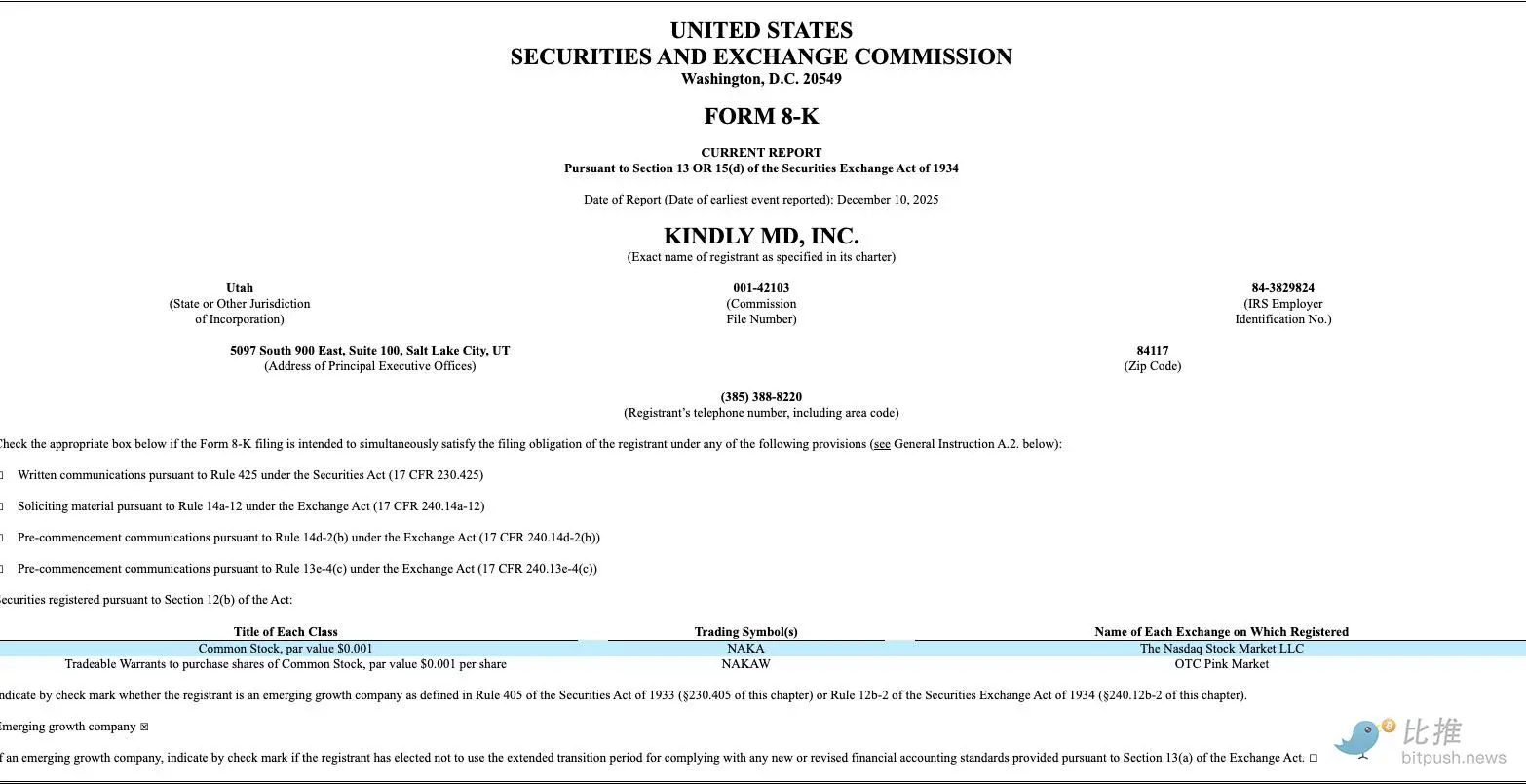
According to Nasdaq rules, the company needs to keep its stock price at $1 or above for at least 10 consecutive trading days by June 8, 2026, in order to restore compliance.
For "treasury companies" whose lifeline is their ability to raise funds in the capital market, such notices often trigger a chain reaction of financing discounts, liquidity contraction, and valuation repricing.
The market's patience seems to be running out.
Imitators are under pressure: the market is "voting with its feet".
If Strategy (MSTR) is the originator of this model, then over the past year, the market has seen a whole host of followers attempting to replicate its path. However, recent stock performance suggests that investors are placing increasingly stringent valuations on these "imitators."
Over the past month, KindlyMD (NAKA) shares have fallen by approximately 39%.
American Bitcoin (ABTC), associated with Eric Trump, fell by nearly 68%.
ProCap Financial (BRR), in which Anthony Pompliano was involved, has fallen by nearly 70%.
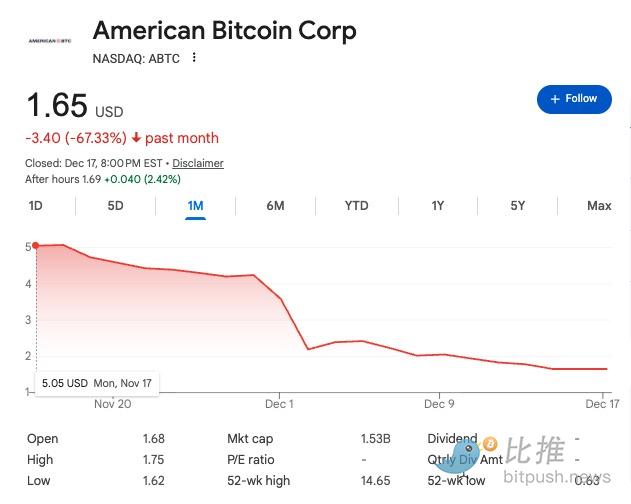
This slowdown is not an isolated case, but a sector-wide phenomenon. Even among Ethereum vault companies, the situation has not improved. Take Bitmine Immersion Technologies (BMNR) as an example. This company, whose core asset is ETH, has seen its stock price fall by more than 30% since the sharp correction in the crypto market last October, while the price of Ethereum has fallen by about 25% during the same period.
This means that during a downturn, these companies not only fail to provide a "buffer," but often exhibit volatility higher than that of the underlying assets.
Who is paying a premium, and who is being discounted?
If we further analyze the situations of different companies, the differences are particularly evident in two metrics: the size of their cryptocurrency holdings and mNAV (market capitalization/net asset value). The former determines the company's size in the crypto asset narrative, while the latter reflects whether the market is still willing to pay a premium for its continued fundraising capabilities.
Public data from Bitcoin Treasuries and other sources show that the differentiation among different companies is already very obvious.
Comparison of core data from major Bitcoin vault companies
| company | Major assets | Cash holdings | Estimated market value of cash holdings | Current market capitalization | mNAV |
|---|---|---|---|---|---|
| Strategy (MSTR) | BTC | 671,268 BTC | ≈57.7 billion US dollars | ≈46 billion US dollars | ≈0.8x |
| KindlyMD (NAKA) | BTC | 5,398 BTC | ≈465 million US dollars | ≈161 million US dollars | ≈0.35x |
| American Bitcoin (ABTC) | BTC | 5,098 BTC | ≈439 million US dollars | ≈2 billion US dollars | ≈3.5x |
| ProCap Financial (BRR) | BTC | 4,951 BTC | ≈435 million US dollars | Below the value of holdings | <1x |
Note: The holdings and valuation data are based on publicly available tracking data such as Bitcoin Treasuries, and the market capitalization is an estimate for a certain period.
The signal conveyed by this set of data is not complex:
The market is no longer pricing in the question of "whether or not to hold Bitcoin," but rather reassessing a company's capital structure, financing flexibility, and ability to continue operating.
KindlyMD's mNAV has fallen below 0.4, meaning its stock is now seen by the market as a "high-risk vehicle below book value"; while American Bitcoin, though still maintaining a high premium, has experienced a sharp price pullback, indicating that this premium itself is extremely volatile.
Of all the companies, Strategy (MSTR)'s changes are the most representative. Its mNAV once exceeded 1.5x during the year, but as Bitcoin entered a period of high volatility in the fourth quarter, the metric quickly converged to asset-based levels and recently fell back to around 0.8x.
This change is not a simple "valuation correction," but rather a shift in market focus:
The focus has shifted from "how much more cryptocurrency can I buy" to "whether I will be forced to sell cryptocurrency during periods of volatility."
Against this backdrop, Strategy announced the establishment of approximately $1.44 billion in cash reserves to cover dividends and debt interest payments over the next 21 months, in order to explicitly reduce the likelihood of selling Bitcoin during extreme market conditions.
The underlying reality: Most companies actually bought at a high price.
If we broaden our perspective, the overall vulnerability of the industry is more directly reflected in the statistics.
According to Bitcoin Treasuries, of the approximately 100 Bitcoin vault companies with measurable cost bases, 65 purchased Bitcoin at current prices, meaning the industry as a whole is experiencing substantial unrealized losses.
More notably, during the recent period of accelerated market decline, at least five companies collectively sold 1,883 Bitcoins. This action itself creates significant tension with the narrative of "holding cryptocurrencies long-term and weathering market cycles."
As Matt Zhang, founder of Hivemind Capital, put it, this phase is more like an "industry shakeout." In an interview with Yahoo Finance, he revealed that his team evaluated more than 100 digital asset vault companies this year, but ultimately only invested in a dozen or so, and frankly stated that a significant portion of them may gradually become "irrelevant."
In his view, even if more and more traditional companies include Bitcoin or Ethereum on their balance sheets in the future, this alone is not enough to constitute a long-term competitive advantage. The real dividing line lies in whether they have stable operating cash flow and whether they can maintain their financial structure without relying on continuous financing.
Analysts at Galaxy Digital point out that this industry upheaval is actually a "Darwinian selection process." As risk appetite weakens and financing costs rise, companies without business support and relying solely on asset appreciation narratives will be forced to consolidate, sell, or exit the market entirely.
This assessment is also highly consistent with the conclusions of some research institutions: the vault strategy has not been negated, but it has evolved from "concept arbitrage" into a comprehensive competition centered around capital structure, cash management, and risk control.
Conclusion
The Nasdaq notification KindlyMD received may just be the beginning. It serves as a reminder to the market and to these companies:
During periods of ample liquidity and unilateral asset price increases, "buying cryptocurrencies" is sufficient to support valuations; however, when the cycle reverses, what the market truly cares about is whether you can survive the volatility.
This round of adjustments will not make all Bitcoin vault companies disappear, but it will certainly redefine who can still stand on the stage.
Looking back at the end of the year, this may be the moment when the first batch of "Bitcoin vault companies" were tested by the market, and also the starting point for the next stage of industry differentiation.