
Original title: How Banks Learned To Stop Worrying And Love Stablecoins
Original author: Christian Catalini, Forbes
Compiled by: Peggy, BlockBeats
Editor's Note: Whether stablecoins would impact the banking system was one of the most central debates in recent years. However, as data, research, and regulatory frameworks have become clearer, the answer is becoming more sobering: stablecoins have not triggered a large-scale outflow of deposits; instead, constrained by the reality of "deposit stickiness," they have become a competitive force forcing banks to improve interest rates and efficiency.
This article offers a fresh perspective on stablecoins from a banking standpoint. They may not be a threat, but rather a catalyst that forces the financial system to reinvent itself.
The following is the original text:

A dollar sign flashing on an IBM computer monitor in 1983.
Back in 2019, when we announced Libra, the global financial system reacted, without exaggeration, quite violently. The near-existential fear stemmed from the question: once stablecoins could be instantly used by billions of people, would banks' control over deposits and payments be completely shattered? If you could hold a "digital dollar" that could be transferred instantly on your phone, why would you keep your money in a zero-interest, fee-ridden, and essentially "shut down" demand deposit account on weekends?
At the time, this was a perfectly reasonable question. For years, the mainstream narrative had maintained that stablecoins were "stealing the jobs of banks." People worried that a "deposit outflow" was imminent.
Once consumers realize that they can directly hold a digital cash backed by Treasury-grade assets, the very foundation that provides low-cost funding to the U.S. banking system will quickly crumble.
However, a recent rigorous research paper by Cornell University Professor Will Cong suggests that the industry may have panicked prematurely. By examining real evidence rather than emotional judgment, Cong proposes a counterintuitive conclusion: with proper regulation, stablecoins are not disruptors that drain bank deposits, but rather complement the traditional banking system.
"Sticky Deposits" Theory
The traditional banking model is essentially a gamble built on "friction".
Because the checking account is the only truly interoperable central hub for funds, almost any transfer of value between external services must go through the bank. The design logic of the entire system is that if you don't use a checking account, operations become more complicated—the bank controls that single bridge, connecting the isolated "islands" of your financial life.
Consumers are willing to accept this "toll" not because current accounts are inherently superior, but because of the power of the "bundling effect." You put money in a current account not because it's the best place for your funds, but because it's a central node: mortgage payments, credit cards, and direct salary payments all connect and coordinate here.
If the assertion that "banks are on the verge of extinction" were true, we should have already seen a massive flow of bank deposits into stablecoins. However, this is not the case. As Cong points out, despite the explosive growth in stablecoin market capitalization, "existing empirical research has found almost no clear correlation between the emergence of stablecoins and the outflow of bank deposits." Friction mechanisms remain effective. So far, the widespread adoption of stablecoins has not resulted in a substantial outflow of traditional bank deposits.
As it turns out, warnings about a "massive flight of deposits" were largely panic-mongering by vested interests, ignoring the most basic economic "physical laws" of the real world. Deposit stickiness is an extremely powerful force. For most users, the convenience of a "package deal" is too valuable to justify transferring their life savings to a digital wallet for a few extra basis points of return.
Competition is a characteristic, not a systemic flaw.
But this is where the real change is happening. Stablecoins may not "kill banks," but they will almost certainly make banks uneasy and force them to improve. This Cornell University study points out that even the very existence of stablecoins constitutes a disciplinary constraint, forcing banks to move beyond simply relying on user inertia and begin offering higher deposit rates and more efficient, sophisticated operating systems.
When banks actually face a credible alternative, the cost of sticking to the old ways rises rapidly. They can no longer take it for granted that your funds are "locked up" and are forced to attract deposits with more competitive prices.
Within this framework, stablecoins will not "scalp the pie," but rather drive "more credit issuance and broader financial intermediation, ultimately improving consumer welfare." As Professor Cong stated, "Stablecoins are not intended to replace traditional intermediaries, but rather to serve as a complementary tool, expanding the business boundaries that banks are already adept at."
As it turns out, the threat of exiting itself is a powerful motivator for existing organizations to improve their services.
"Unlocking" from a regulatory perspective
Of course, regulators have good reason to be concerned about the so-called "bank run risk"—that is, if market confidence falters, the reserve assets behind stablecoins may be forced to be sold off, thereby triggering a systemic crisis.
However, as the paper points out, this is not a new and unprecedented risk, but rather a standard form of risk that has long existed in financial intermediation activities, and is essentially highly similar to the risks faced by other financial institutions. We already have a mature framework for addressing liquidity management and operational risks. The real challenge lies not in "inventing new laws of physics," but in correctly applying existing financial engineering to a new technological form.
This is precisely where the GENIUS Act plays a crucial role. By explicitly requiring stablecoins to be adequately backed by cash, short-term U.S. Treasury securities, or depositary deposits, the Act provides a hard and fast rule for security at the institutional level. As the paper states, these regulatory safeguards "appear to cover the core vulnerabilities identified in academic research, including the risk of bank runs and liquidity risks."
The legislation sets minimum legal standards for the industry—adequate reserves and enforceable redemption rights—but leaves the specific operational details to banking regulators for implementation. Next, the Federal Reserve and the Office of the Comptroller of the Currency (OCC) will be responsible for translating these principles into enforceable regulatory rules, ensuring that stablecoin issuers fully account for operational risks, the possibility of custody failures, and the complexities inherent in large-scale reserve management and integration with blockchain systems.
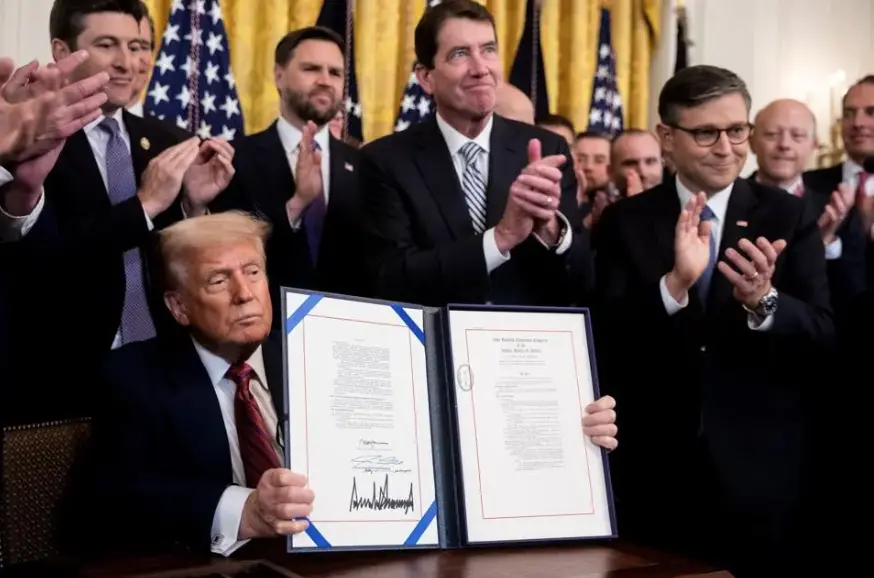
On Friday, July 18, 2025, U.S. President Donald Trump displayed the newly signed GENIUS Act at a signing ceremony in the East Room of the White House in Washington, D.C.
efficiency dividend
Once we move beyond a defensive mindset regarding the "diversion of deposits," the real upside potential will become apparent: the "underlying channels" of the financial system themselves have reached a point where they must be restructured.
The true value of tokenization lies not only in 24/7 availability, but in "atomic settlement"—the instant transfer of cross-border value without counterparty risk, a problem that the current financial system has long been unable to solve.
Current cross-border payment systems are costly and slow, with funds often circulating among multiple intermediaries for several days before final settlement. Stablecoins, on the other hand, compress this process into a single, irreversible on-chain transaction.
This has profound implications for global cash management: funds will no longer need to be tied up for days "in transit," but can be transferred instantly across borders, releasing liquidity currently tied up by the correspondent banking system. In the domestic market, the same efficiency gains also foreshadow lower-cost and faster merchant payment methods. For the banking industry, this presents a rare opportunity to upgrade its traditional clearing infrastructure, which has long relied on tape and COBOL to barely function.
The upgrade of the US dollar
Ultimately, the United States faces an either-or choice: either dominate the development of this technology or watch the future of finance take shape in offshore jurisdictions. The US dollar remains the world's most popular financial product, but the "tracks" that support its operation are clearly aging.
The GENIUS Act provides a truly competitive institutional framework. It "localizes" this field: by bringing stablecoins within the regulatory boundaries, the United States has transformed what was originally a volatile element of the shadow banking system into a transparent and robust "global dollar upgrade plan," shaping a novel offshore phenomenon into a core component of the domestic financial infrastructure.
Banks should stop focusing on the competition itself and start thinking about how to turn this technology into their own advantage. Just as the music industry was forced to move from the CD era to the streaming era—initially resisting but ultimately discovering it was a goldmine—banks are resisting a transformation that will ultimately save them. They will truly learn to embrace this change when they realize they can charge for "speed" instead of relying on "latency" for profit.

A New York University student downloaded music files from the Napster website in New York City. On September 8, 2003, the Recording Industry Association of America (RIAA) filed a lawsuit against 261 file-sharing individuals who downloaded music files via the internet; in addition, the RIAA issued more than 1,500 subpoenas to internet service providers.