

In October 2024, Invest Hong Kong did something very bold and approved the first investment immigration application using Bitcoin as proof of assets. Just a few months later, on February 7, 2025, another applicant from mainland China successfully passed the review with Ethereum worth HK$30 million. These two events were like thunder from the blue, exploding many people who were concerned about investment immigration and crypto assets. Everyone turned their attention to Hong Kong, wanting to see what was behind it.
As a lawyer who has been working in the Web3 field for many years, I can't help but analyze this matter carefully. Let's start with these two cases in Hong Kong to give you a glimpse of the practical application, legal challenges and future trends of crypto assets in investment immigration.
Hong Kong: A pioneer in crypto asset investment immigration
1. The policy card of the “New Capital Investor Entrant Scheme”
Hong Kong has always been an international financial center, and its investment immigration policy is flexible and open. According to the "New Capital Investor Entry Scheme", applicants need to prove that they (or their spouse) own at least 30 million Hong Kong dollars in assets, and after passing the review, invest the funds in Hong Kong's designated financial markets within six months, such as stocks, bonds or other regulated assets. It is worth noting that the Hong Kong government did not explicitly exclude crypto assets in the plan. As long as the real existence and ownership of the assets can be proved by a report issued by a professional accountant, it is compliant.
2. Two major “ice-breaking” cases in Hong Kong
(1) Bitcoin Case
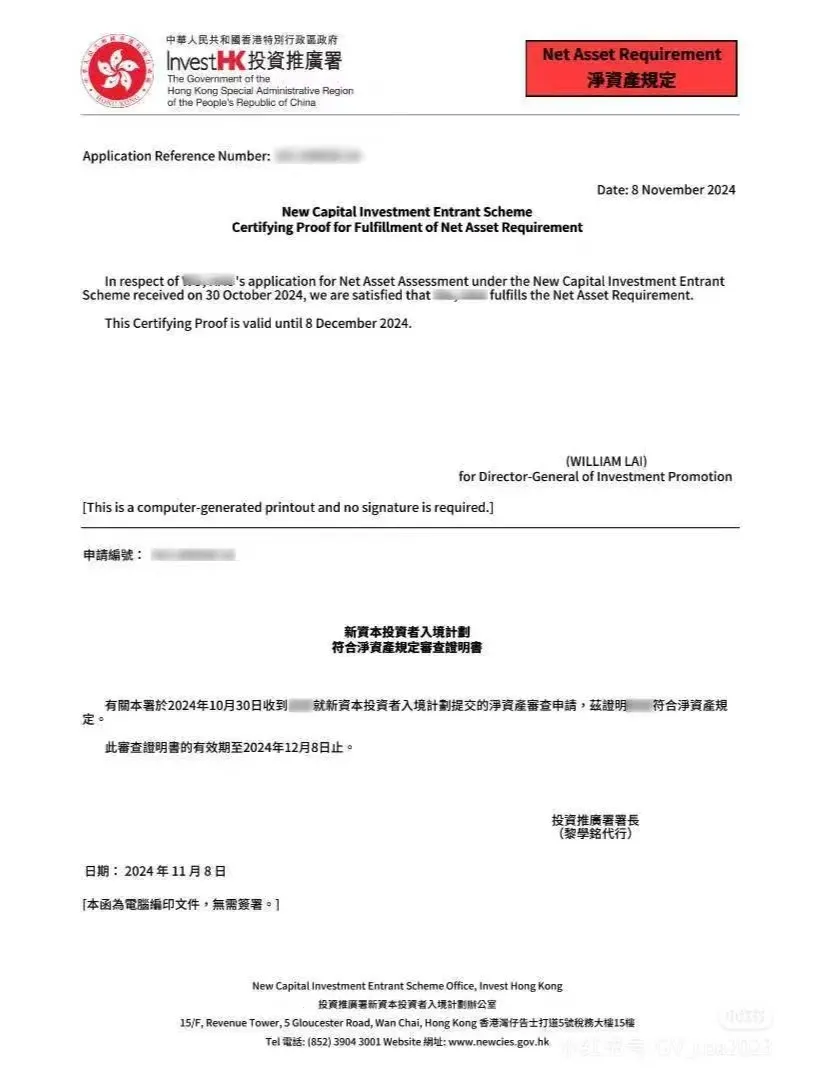
▲Image source: Hong Kong accountant Mr. Xiao Yaohe’s self-media
In October 2024, the first investment immigration application in Hong Kong using Bitcoin as proof of assets was successfully approved. The applicant in this case submitted detailed blockchain transaction records, wallet address information and relevant bank statements to prove that the market value of the Bitcoin he held reached or exceeded HK$30 million. After a month of internal review by the Hong Kong Investment Promotion Agency, the application was successfully approved. This case not only sets a precedent for subsequent similar applications, but also shows Hong Kong's open attitude in the field of crypto assets.
(2) Ethereum Case
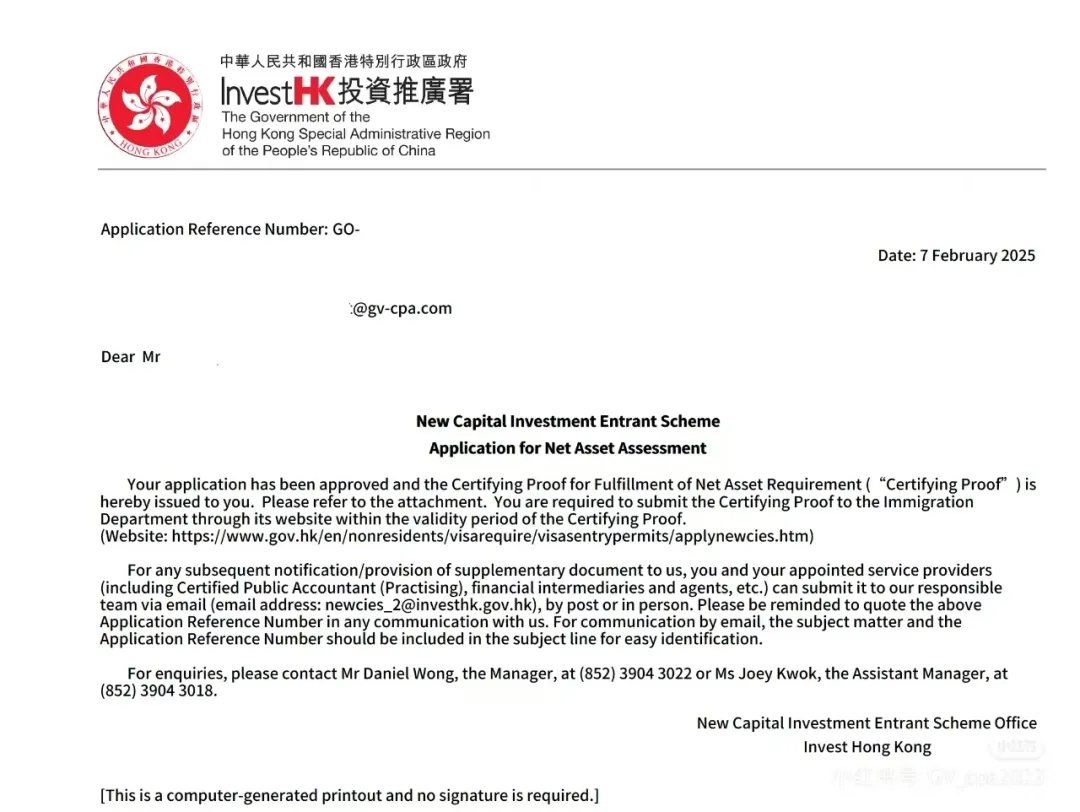
▲Image source: Hong Kong accountant Mr. Xiao Yaohe’s self-media
Following the Bitcoin case, on February 7, 2025, another applicant successfully applied for investment immigration using Ethereum worth HK$30 million as proof of assets. Similar to the Bitcoin case, the applicant provided comprehensive asset proof materials and source of funds records to prove that his Ethereum assets met the requirements. Hong Kong accountant Xiao Yaohe elaborated on this process in an interview, pointing out that this is an important sign that Hong Kong has once again confirmed that crypto assets are acceptable in asset proof after the Bitcoin case.
3. Key challenges in Hong Kong practice
Although Hong Kong has made breakthrough progress in accepting crypto assets as proof of assets for investment immigration, it still faces many challenges in actual operation:
Proof of Source of Funds (SOF): Although crypto assets show asset value on paper, it is often difficult for applicants to provide complete records of fund flows, especially for those who obtain assets through mining, over-the-counter transactions or gifts. The lack of some historical transaction records or incomplete data will make it a huge challenge to prove the legitimacy of the source of funds.
Uncertainty in asset valuation standards: Crypto asset prices fluctuate dramatically, and how to determine the asset value at the time of application becomes a difficult problem. Should it be calculated based on the market price on the day of application, or the average value over the past period of time? Different accountants may use different valuation methods, resulting in different audit standards.
Complexity of proving identity and asset ownership: Due to the anonymity of encrypted assets, accountants need to use a variety of tools and means such as blockchain browsers and exchange bills to prove the direct connection between the wallet address and the applicant. This process is complicated and time-consuming.
Legal issues regarding proof of funds and ownership of assets
In the practice of using crypto assets as proof of investment immigration assets, the legal difficulties mainly focus on the following two aspects:
1. Proof of Asset Existence
Applicants need to provide evidence to prove the existence of crypto assets, including but not limited to:
Blockchain data records: Use a blockchain browser to query the transaction records of a specific wallet address and confirm that the asset balance is consistent with the supporting documents submitted by the applicant.
Exchange bills and bank statements: Applicants are required to provide screenshots of their accounts on mainstream exchanges (such as Hashkey, Bianace), transaction statements, and relevant bank transfer records to form a complete asset proof chain.
2. Proof of legal source of funds
Proof of source of funds is the most challenging part of the entire application process. Faced with the problem of "having the money but not the money", applicants must:
Keep original transaction records: From the first purchase of crypto assets, keep all transfer records, payment receipts, exchange bills and tax certificates. These documents will become an important basis for proving the legitimacy of the source of funds.
Supplementary supporting documentation: For applicants who obtain assets through mining or over-the-counter transactions, it is often difficult to provide complete transaction records. It is recommended to explain the legality and transparency of the funds obtained through third-party audit reports, lawyers’ letters, etc.
In general, applicants must provide sufficient, transparent and detailed supporting documentation for the existence of assets and the legality of funds. This not only affects the success of the immigration application, but also directly affects the applicant's ability to protect themselves against transnational legal and tax risks in the future.
Application prospects of other crypto assets
At present, the practical cases in Hong Kong are mainly focused on Bitcoin and Ethereum, which have become industry benchmarks with their highest market capitalization and liquidity in the world. However, as the crypto asset market continues to mature, other cryptocurrencies may also be included in the asset proof system for investment immigration in the future. The key lies in the following points:
1. Liquidity and market acceptance
High liquidity and wide market recognition are important prerequisites for acceptance. For example:
Stablecoins (such as USDT, USDC): Due to their relatively stable prices, active transactions and easy access to price data, stablecoins theoretically have the potential to become part of asset proof, but the issue of consistency with traditional asset valuations needs to be resolved.
Other mainstream currencies (such as BNB, XRP, etc.): If these currencies can provide complete transaction records and an open and transparent price formation mechanism, they may also be recognized by regulators. However, governments have not yet released a clear list of currencies, and in practice they still mainly rely on Bitcoin and Ethereum as representatives.
2. Difficulties in asset evaluation and proof of funds
Regardless of which currency is chosen, the key issue is how to accurately value crypto assets and how to prove the legitimacy of their source of funds. Only those currencies with complete transaction records, open and transparent price mechanisms, and mature market recognition can stand out more easily in strict audits.
Exploring other parts of the world
In addition to Hong Kong, some other regions around the world are also trying to include crypto assets in the scope of investment immigration or asset proof for high net worth individuals:
Singapore:
While there are some cases in Singapore where crypto assets can be used as proof of assets, the main challenge remains proving the legitimacy of the initial funds.
UAE/Dubai:
As a hotspot for crypto assets, Dubai is actively promoting long-term residence programs such as the "Golden Visa" and continuously improving the regulatory system for crypto assets. In the future, Dubai is expected to include crypto assets in the category of asset proof, providing more options for high-net-worth individuals.
Some European countries (such as Malta and Cyprus):
These countries are exploring related practices due to their friendly blockchain policies. Although there are not many cases at present, as the regulatory system gradually improves, it is possible to accept crypto assets as part of investment immigration applications in the future.
United States and Canada:
Although traditional investment immigration programs have extremely strict requirements on the source of funds, if the applicant can provide complete proof of crypto assets and capital flow, it is theoretically possible to include some crypto assets in the asset proof. Such cases are still relatively rare, but in the future, as the regulatory policies for crypto assets mature, this field is expected to usher in more pilots and explorations.
Mankiw's Practical Advice
As a Web3 lawyer who has been paying close attention to crypto assets and transnational legal affairs, I would like to summarize several practical suggestions for reference by high-net-worth individuals who plan to use crypto assets to apply for investment immigration:
1. Preserve all evidence at the source
Be sure to keep all relevant transfer records, exchange bills, bank statements, and tax certificates from the date of your first purchase of crypto assets. Any omissions may become a fatal flaw in subsequent audits.
2. Establish clear proof of asset ownership
Make sure that the crypto assets you hold are stored in an address that can clearly prove ownership. Whether using a cold wallet or a mainstream exchange account, you should query it through a blockchain browser and cooperate with third-party reports to form a complete asset proof chain.
3. Clarify the source of funds and provide additional proof
For applicants who obtain crypto assets through mining, over-the-counter transactions or donations, it is particularly necessary to organize all records of fund flows in advance and supplement them with lawyers' letters, third-party audit reports, etc. to ensure the legality and transparency of the source of funds.
4. Hire a professional team to assist
Transnational investment immigration involves complex legal, tax and regulatory issues. Applicants are advised to hire a team of professional lawyers, accountants and immigration consultants who are familiar with crypto assets and immigration policies. The professional team can not only help organize the materials, but also provide customized compliance solutions to reduce risks.
5. Keep up with policy changes and market trends
The regulatory policies on crypto assets in countries around the world are constantly changing. Applicants should keep an eye on the latest policies of the target country and adjust their application strategies in a timely manner. In particular, Singapore, the UAE and some European countries may further relax the requirements on crypto assets in the future.
6. Consider a diversified portfolio
Although Bitcoin and Ethereum are currently the two most recognized crypto assets, applicants can consider optimizing their asset proof through a diversified asset portfolio, provided that each asset can provide fully transparent proof materials. This will not only help to diversify risks, but also increase the possibility of application approval.
7. Allow enough time to apply
The application process may be lengthy as it involves a lot of document review and cross-departmental coordination. Applicants should reserve sufficient time to prepare materials to avoid affecting the application process due to time constraints, and maintain close communication with the professional team to promptly resolve any problems that arise.
Attorney Mankiw's Summary
Crypto assets are increasingly playing an increasingly important role in the global economy. Their application in investment immigration has opened up a new path for high-net-worth individuals to allocate assets and obtain residency. As the first to take the plunge, Hong Kong has demonstrated to the world the huge potential and practical application value of crypto assets through two successful cases, Bitcoin and Ethereum. However, in this process, problems such as difficulty in proving the source of funds, inconsistent asset valuation standards, and cross-border regulatory differences are still huge challenges facing applicants and regulators, and they must be overcome.
I firmly believe that with a sound legal and regulatory framework, strict audit procedures, and the collaboration of a professional team, the application prospects of crypto assets in investment immigration will become increasingly clear and diversified in the future. Whether it is Hong Kong, Singapore, the UAE or some European countries, as long as compliance, transparency and legality of funds are in place, crypto assets will definitely become an important tool in the field of global investment immigration. We look forward to the concerted efforts of governments, financial institutions and legal professionals to continuously improve the legality and transparency of crypto assets and promote crypto assets to a more open, flexible and diverse new era. If you have any questions about the overseas compliance configuration of crypto assets, please contact Mankiw.
/ END.
Author: Jayden Shao
Author: Mankiw Blockchain



