
In civil disputes regarding virtual currency investment, a court in Shanghai and the Yancheng Intermediate People's Court in Jiangsu Province have recently had completely different judgments. In addition, given the current judicial practice of virtual currency investment disputes in China, it is necessary to study the acceptance and judgment of civil and commercial cases related to virtual currency. In this article, the author wrote a short article based on his own practical experience and the current domestic regulations on civil and commercial disputes involving virtual currency. Friends are welcome to exchange ideas and make corrections.
1. Current status of domestic virtual currency investment
The market price of Bitcoin has been volatile recently, falling from a peak of more than $100,000 per coin to a low of $78,000 in a short period of time. Some investors who bought virtual currency contract products had their positions liquidated and their positions returned to zero. Even spot holders felt sad, and the declines of some other altcoins were even more astonishing.
Regarding virtual currency investment, some people think that buying virtual currency is illegal or even a crime, and even some legal practitioners cannot hide their contempt for virtual currency. This is actually because many people do not understand the current domestic virtual currency policy. In fact, up to now, mainland my country has not prohibited citizens, legal persons or other organizations from investing in virtual currency, but Chinese law does not provide legal protection for such investment (the third point of this article will focus on analysis), which means that investing in virtual currency in my country is not illegal, let alone a crime.
At present, the common ways for domestic entities (natural persons, legal persons, unincorporated organizations, etc.) to invest in virtual currencies and related industries are: directly purchasing virtual currencies with legal currency, entrusting others to invest in virtual currencies and their derivatives, using virtual currencies (stable currencies, such as USDT) to invest in virtual currency exchange contract products, investing in virtual currency mining activities, etc. It is difficult to count the specific number of people participating in virtual currency investment in China, but there is a relatively reliable data that can reflect the scale of the number of people investing in virtual currencies: there are at least hundreds of thousands of people in China who provide legal currency and virtual currency exchange services (i.e. virtual currency deposit and withdrawal services, also known as "U merchants" in the industry) for virtual currency investors.

II. Huge contrast in currency-related civil judgments in practice
Since the ten national ministries and commissions (including the "two high courts and one ministry", the central bank, the State Administration of Foreign Exchange, etc.) jointly issued the "Notice on Further Preventing and Dealing with the Risks of Virtual Currency Trading Speculation" (hereinafter referred to as the "9.24 Notice") in 2021, the civil and commercial filing courts of domestic courts at all levels have become increasingly strict in accepting and filing cases involving virtual currency. The current practical situation is that the successful filing of civil and commercial cases involving currency is already half successful.
Even under such a severe situation, there are still sporadic civil cases involving cryptocurrency being successfully filed, heard, and judged across the country. Recently, a court in Shanghai and the Intermediate People's Court of Yancheng City, Jiangsu Province, respectively heard a civil dispute case involving virtual currency investment, but the two courts' judgments were very different.
(I) A Shanghai court returned the investment funds after determining that a virtual currency investment contract was invalid
In a virtual currency investment dispute case heard by a Shanghai court, the plaintiff Zhang transferred RMB to the defendant Shen to purchase virtual currency and entrusted Shen to manage virtual currency. Later, the financial management platform was unable to withdraw cash, so Zhang sued Shen to the court and demanded that Shen return the RMB. After the trial, the court, based on the provisions of the "9.24 Notice", determined that virtual currency investment behavior was a violation of public prosecution ethics in China, and the investment behavior was invalid. Therefore, the virtual currency purchase and sale contract between the plaintiff and the defendant was invalid, and the defendant Shen was ordered to return the RMB used by the plaintiff Zhang to purchase virtual currency.
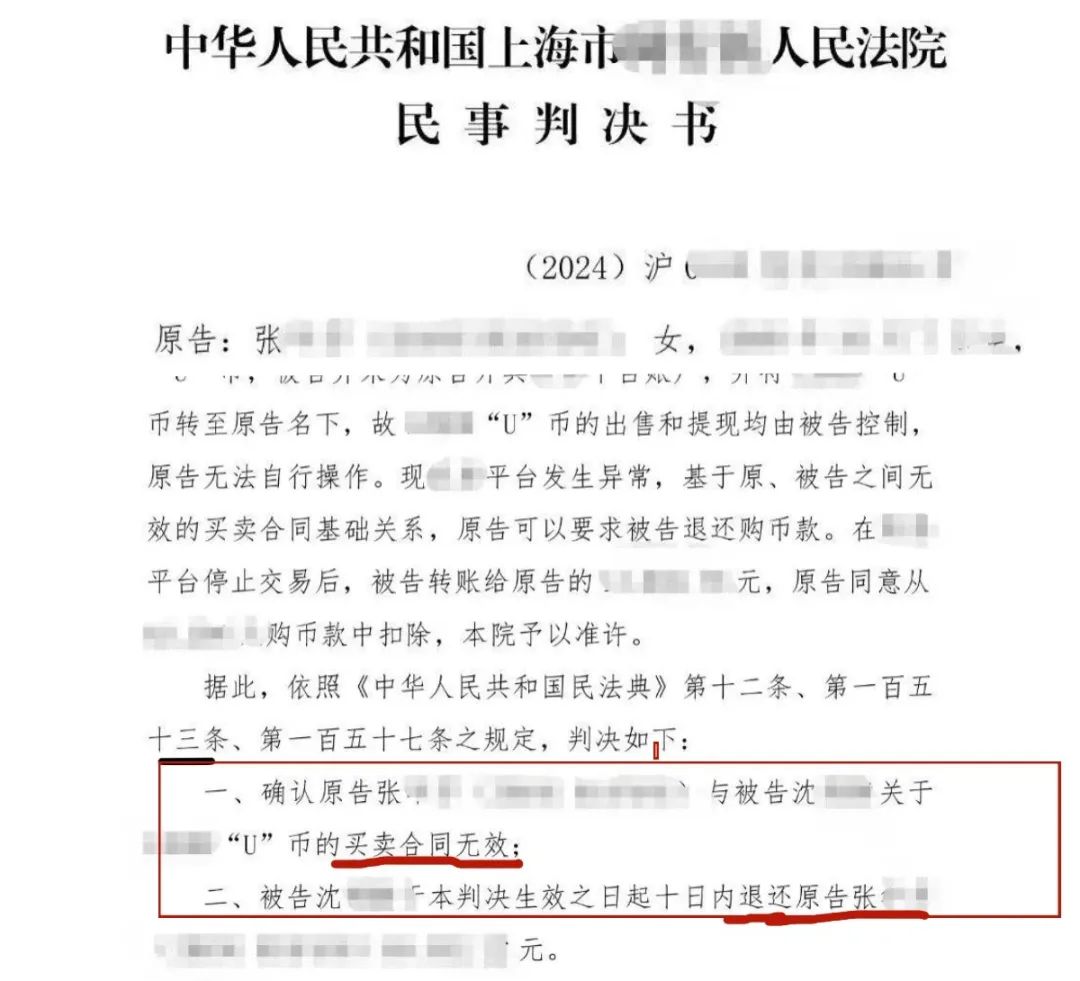
The author has made a detailed analysis of this case in the article " Virtual Currency Sales (Investment) Dispute, Shanghai Court Ruling that the Contract is Invalid! " Interested friends can go there to check it out.
(II) The Yancheng Intermediate Court found the virtual currency investment contract invalid, but ruled that the losses must be borne by the parties themselves and no refund is required
In an article published on the official WeChat account of the Yancheng Intermediate People's Court, " <People's Court Daily> Report: Overseas virtual currency investment is not protected by Chinese law ", a conclusion opposite to the judgment path of the aforementioned Shanghai court was given.
Pan (Singaporean) and Tian jointly invested in a virtual currency project. Tian was responsible for the technical development and operation of the project, while Pan was responsible for the initial development costs and fund operation. Pan transferred 15.74 million yuan to Tian to purchase virtual currency. Later, due to the poor operation of the platform, Pan asked Tian to return the investment. Tian gradually returned 1,060 yuan, but the remaining amount was not returned. Pan then sued Tian in court, demanding the return of the remaining amount.
This case went through the first and second instance trials, and both courts determined that China does not recognize the legal effect of virtual currency investment contracts, and that investing in overseas virtual currencies and related derivatives violates the mandatory provisions of China's laws and regulations and goes against public order and good morals. The cooperation agreement should be deemed invalid, and the losses caused thereby shall be borne by the parties themselves .
Compared with a court in Shanghai, the Yancheng Intermediate Court not only determined that the virtual currency investment contract (in this case, the cooperation agreement) was invalid, but also applied the principle that "the losses caused by this shall be borne by the parties themselves", which is more in line with the spirit of the "9.24 Notice". However, the author does not agree with the statement of the Yancheng Intermediate Court that "investing in overseas virtual currencies and their derivatives violates the mandatory provisions of my country's laws and regulations."
III. Judgment Basis for Currency-Related Cases
So far, my country has not issued any laws and regulations on virtual currencies. In judicial practice, the rules for adjudicating virtual currencies are all based on the regulations of relevant national regulatory authorities and industry associations. After the National Court Financial Trial Work Conference was held in April 2023, the "Minutes of the National Court Financial Trial Work Conference (Draft for Comments)" (hereinafter referred to as the "Minutes") was also issued, which also involved the rules for adjudicating civil and commercial cases involving virtual currencies. Although the "Minutes" has not yet officially come into effect, it still has a certain degree of guiding significance for the trials of courts across the country.
In civil and commercial adjudications involving currency, the current legal basis can be summarized as follows:
1. Relevant provisions of the “9.24 Notice”
Prohibited behaviors: virtual currency and legal currency exchange business, exchange business between different virtual currencies, providing pricing services or information intermediary business for virtual currency transactions, token issuance and financing business, virtual currency exchange-related business, etc.;
Disadvantaged behavior: Participating in virtual currency investment transactions. In my country, if any legal person, non-legal person organization, or natural person invests in virtual currency and related derivatives (such as contract products in common virtual currency exchanges) and violates public order and good morals, the relevant civil legal acts will be invalid, and the losses caused by this will be borne by themselves.
Therefore, China does not prohibit virtual currency investment and trading . However, from a practical point of view, there are almost no fully compliant virtual currency investment channels in China. Taking the most basic deposit and withdrawal channels as an example, major domestic banks, as well as WeChat and Alipay companies have clearly stated that users are not allowed to use their payment and transfer channels for virtual currency transactions. In other words, when you use bank transfers, WeChat and Alipay transfers to conduct virtual currency transactions, it is at least a civil breach of contract.
(II) Relevant provisions of the Minutes
- Handling of disputes involving payment consideration using virtual currency . The Minutes recognizes the property attributes of virtual currency. If the parties agree to use a small amount of virtual currency to offset debts arising from basic relationships such as exchange and labor, the court shall determine that the contract is valid if there are no other reasons for invalidity. If a party requests the other party to fulfill the obligation to deliver virtual currency, the court may support it (author's note: this is extremely difficult to implement in practice). However, if the parties use virtual currency as a payment tool to exchange legal currency or physical goods under the guise of an underlying transaction contract, the court shall determine that the contract is invalid.
- Regarding the handling of disputes over entrusted investment in virtual currency financial management . If the entrusted financial management contract between the two parties is signed after the release of the "Announcement on Preventing the Risks of Token Issuance and Financing" (i.e. the "9.4 Announcement"), the court shall determine that the entrusted contract is invalid because the agency matters are illegal. For the losses suffered by the principal, the cause of the entrusted matters can be used as the main consideration for determining the degree of fault, and the parties shall share the losses . This provision is consistent with the core of the "9.24 Notice", so the author also agrees that the current domestic courts cannot determine that the contract is invalid simply on the grounds that the contract matters violate domestic regulatory provisions when hearing civil and commercial disputes involving currency, but do not consider the respective fault levels of the two parties.
- Disputes related to "mining" . Mining disputes are concentrated in contract disputes involving the sale, lease, and storage of "mining machines" or the provision of related operation management, technology development and other services. The Minutes uses September 3, 2021 as the dividing point. Mining contracts before this date are generally valid, while mining contracts after this date are generally invalid. The court should handle them based on the degree of fault of both parties.

4. Final Thoughts
At present, civil and commercial cases involving currency are characterized by small numbers and single types in judicial practice. The author believes that this phenomenon is difficult to change in the short term, but as mentioned earlier, it cannot be ruled out that local courts will occasionally accept such cases. Because there are few actual precedents, there are currently few precedents that courts can refer to when hearing civil cases involving currency. In addition, many judges do not really understand the virtual currency industry, market rules, etc. These combined factors make the results of civil judgments involving currency vary greatly (in criminal judicial practices involving currency, the current caliber of judicial organs is relatively unified).
The judiciary always serves reality. If China can appropriately open up virtual currency investment and transactions in the future, I believe that the level of civil and commercial trials involving currency by our judicial organs will definitely be qualitatively improved.