
Author: Babywhale, Techub News
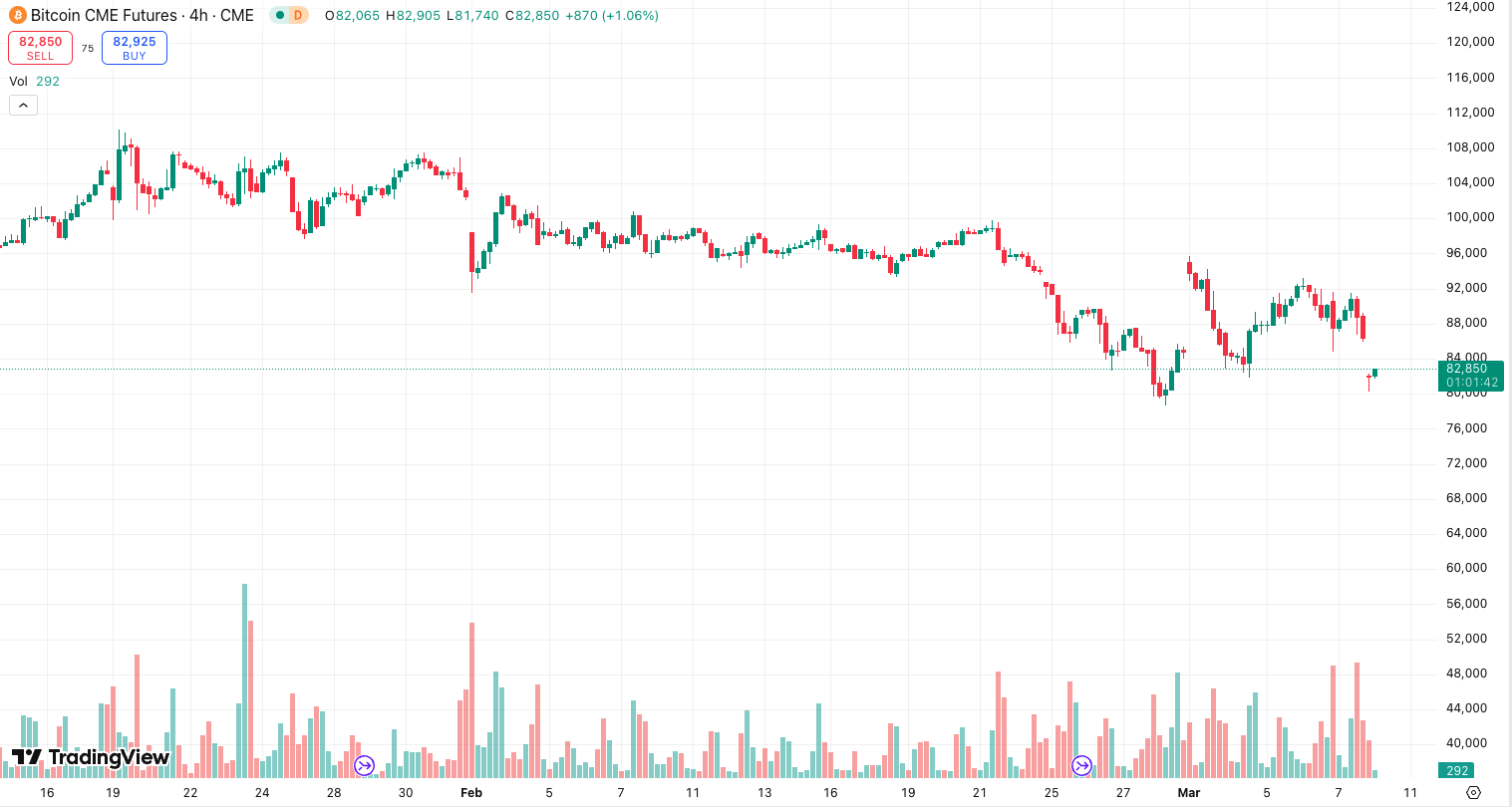
This morning, Bitcoin hit the $80,000 mark again and has rebounded above $82,500 at the time of writing. The weekend's drop also left a huge gap on the CME Bitcoin futures chart, just like last week.
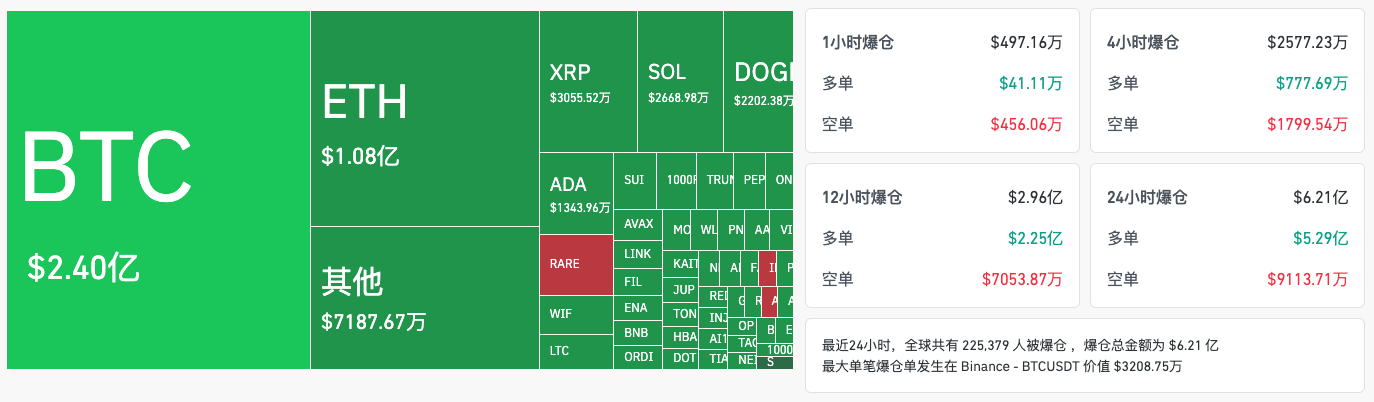
According to Coinglass data, as of the time of writing, the total liquidation of the entire network in the past 24 hours was about $621 million. Among them, the liquidation of Bitcoin contracts was about $240 million, the liquidation of Ethereum contracts was $108 million, the liquidation of XRP contracts was about $30 million, and the liquidation of SOL contracts was over $26 million. The largest single liquidation occurred on Binance, with more than $30 million liquidated.
Reserve policy falls short of expectations, and macro uncertainty rises rapidly
The Bitcoin reserve plan, which was previously given high hopes, has brought almost no good news in the near future.
On the one hand, the Bitcoin Reserve Act signed by Trump clearly states that the bulk of the reserves come from the approximately 200,000 Bitcoins held by the previous US policy, and additional purchases of Bitcoin need to be made in a "budget-neutral" manner, that is, even if additional Bitcoins are purchased, the fiscal burden cannot be increased. The outside world has speculated that the government may choose to sell some assets to purchase additional Bitcoin.
Standard Chartered Bank said that the US government could choose to sell gold to buy Bitcoin, but then "Crypto Tsar" David Sacks denied it. In my opinion, buying additional Bitcoin is a very difficult operation for the United States. For a government that cuts off a lot of useless budgets at the beginning, it is hard to convince people to buy a risky asset that can fluctuate more than 10% within a day. For us in the industry, Bitcoin is well known, but for the general public, not everyone recognizes crypto assets.
In addition to the fact that the national level Bitcoin reserves did not buy as crazily as many optimists predicted and Strategy, the promotion of state government Bitcoin reserve bills has also encountered many setbacks.
So far, several states, including Montana, North Dakota, and Wyoming, have rejected Bitcoin reserve bills. Although Utah passed the HB230 bill called the "Blockchain and Digital Innovation Amendment," it deleted the clause authorizing the state treasurer to invest in Bitcoin.
Of course, relevant bills in many states have reached the final stage, but we can also draw some conclusions from the existing situation: the "nationwide buying of currency" expected by many practitioners is likely not to happen, and the legislators have kept a clear head. It is indeed difficult to convince the public in the short term to use real money to buy high-risk assets.
On the macro level, Morgan Stanley and Goldman Sachs lowered their forecasts for US GDP growth in 2025. The former lowered its growth forecast from 1.9% to 1.5%, while the latter lowered the figure from 2.2% to 1.7%, and raised the probability of a recession from 15% to 20%.
In fact, Trump's efforts, including raising tariffs and cutting unnecessary spending, are essentially conducive to the sustainable development of the United States in the long run, but in the short term, they will inevitably cause rising inflation, rising unemployment, and weakening of the dollar's hegemony. In my opinion, the current financial market is facing an extremely delicate situation: on the one hand, the increase in inflation caused by tariffs will further affect the US economy and force the Federal Reserve to cut interest rates at some point; but on the other hand, if the economy is resilient enough, a rash interest rate cut may further push up inflation.
In this way, Trump's proud "conspiracy" may lead to an unsolvable vicious cycle, which may be the main reason why analysts predict that the United States will enter a recession. The author has an unfounded guess that many of the rich in the world are actually seriously out of touch with the lives of ordinary people. The short-term "pain" they think may ruin the lives of a considerable number of people at the bottom, and this "why not eat meat" mentality is also an important source of many uncertainties.
For risky assets, certain bad news is even better than uncertainty. The rise of gold, US stocks and the US dollar in the past year is the most obvious sign that funds are looking for certainty. The recent decline of US stocks and the US dollar means that the last safe haven in the risk market, the United States, no longer has certainty. The rise of Hong Kong stocks and A shares also follows the same logic. However, given that Bitcoin has become part of the US stock market to some extent after the launch of the spot ETF, the author still needs to remind investors to be on guard against the tsunami caused by the flapping of butterfly wings at any time, at least in the first half of this year.