Author: BUBBLE
The development of cryptocurrency OTC platforms has seen two major breakthroughs. In 2024, the approval of Bitcoin and Ethereum ETFs was followed by the gradual introduction of frameworks (MiCA and VARA) in regions like the EU and Dubai, allowing OTC desks to operate legally and on a large scale, necessitating rapid procurement of underlying assets by institutions. In 2025, the overall trend of traditional finance underwent a 360-degree shift after US President Trump introduced the concept of a "crypto capital." Following the introduction of various new crypto policies, Bitcoin reached new highs in early 2025, while Ethereum saw strong gains. This surge in institutional asset allocation fueled explosive growth in OTC platform trading.
Typically, OTC trading directly matches buyers and sellers. They provide a single quote, eliminating slippage and bidding. Transfers are completed through custodial wallets and institutional accounts. Because orders never hit the public limit book, the market never sees your hand. As dark pools in the cryptocurrency market, OTC institutions don't disclose their users' specific trading details. However, unlike traditional finance, we can obtain clues through on-chain analysis.
In July 2025, one of the largest Bitcoin over-the-counter transactions to date took place, with a total of 80,000 BTC changing hands for approximately US$9 billion, but there was almost no ripple in the public market. The manipulator behind this was Galaxy Digital, the most popular "crypto over-the-counter trading institution" on Wall Street today, which also led to its Q2 financial report with a 268-fold year-on-year increase in revenue.
What role do OTC platforms play in this regulatory compliance movement? And how does Galaxy Digital leverage its resources to navigate the crypto-to-stock market? BlockBeats conducted a series of research on this topic.
The third pillar of crypto liquidity
With this wave of institutional investment, OTC platforms have become the third pillar of liquidity in the crypto market, alongside centralized exchanges (CEXs) and decentralized exchanges (DEXs). For large funds, CEXs and DEXs are unable to directly handle hundreds of millions of dollars in buy orders without triggering significant volatility. Therefore, OTC platforms act as "white gloves" for institutions, completing the construction and liquidation of positions behind the scenes.
Throughout 2024, no single month saw OTC trading volumes fall below year-ago levels, demonstrating a growing preference among market participants for private transactions rather than open market bets. The crypto industry has evolved from a fringe speculative activity to an acceptable asset allocation option, transforming Wall Street from skeptic to participant. This growth is expected to accelerate exponentially in 2025.
Finery Markets points to the surge in OTC trading volume as a key factor driven by the increasing shift of traditional financial leaders from a wait-and-see approach to neutrality or acceptance. When more trading occurs in dark pools, apparent market fluctuations can be significantly smoothed. Finery Markets' Q4 2024 report noted that overall OTC platform trading volume increased by 106% compared to the previous year, with OTC spot volume in the first half of 2025 increasing by 112.6% year-on-year compared to the first half of 2024.
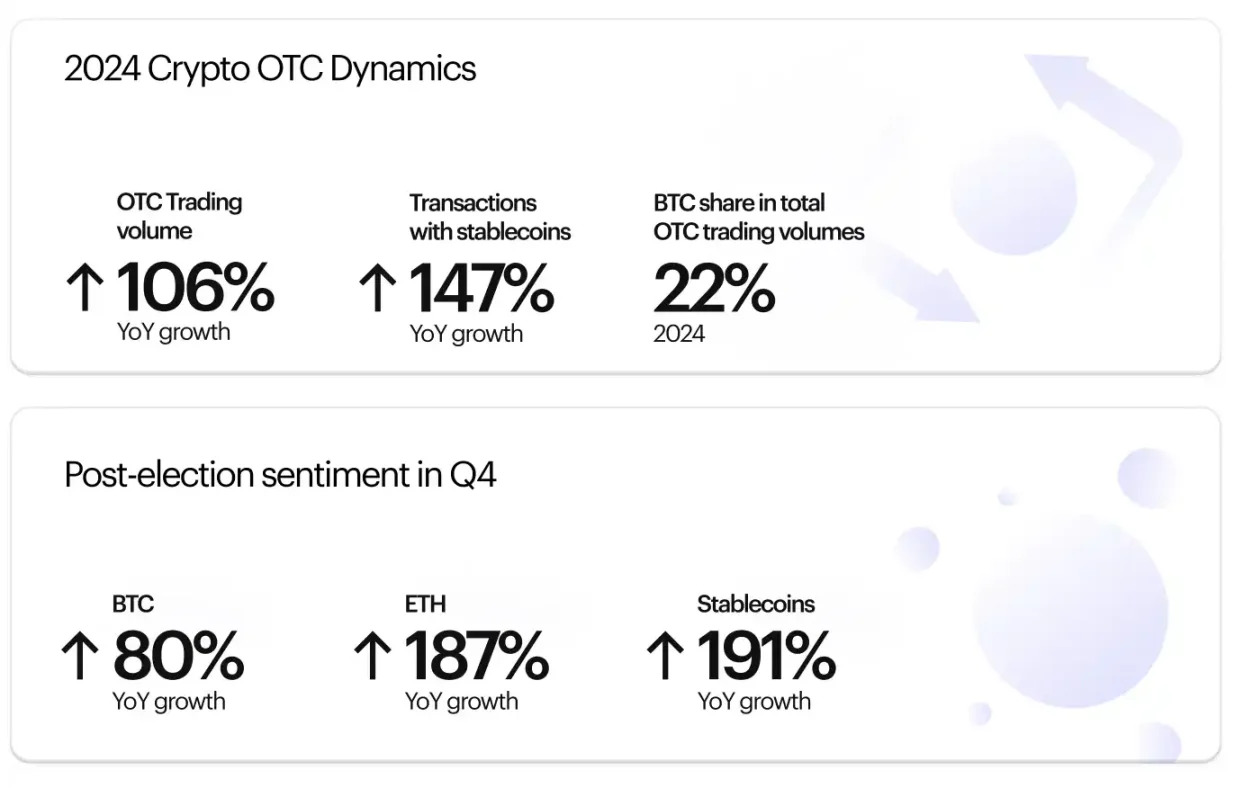
It's worth noting that, alongside improvements in regulatory compliance in Europe and the US, the OTC market in Asia is also booming. Hong Kong-licensed OTC platform OSL, as well as emerging platforms in the UAE and Southeast Asia, are attracting global liquidity for large orders. Meanwhile, traditional block trade market makers, such as Flow Traders, are also active in the market, leveraging high-frequency and quantitative strategies to provide institutional clients with bilateral quotes for large-volume crypto trades, improving execution efficiency and reducing impact costs. These factors have solidified OTC's position as a hidden pool in the crypto market.
Galaxy Digital is gaining popularity
Among the numerous OTC players, Galaxy Digital, founded by Mike Novogratz, is undoubtedly the star of this wave of institutional buying. Galaxy is both a renowned crypto investment bank and a high-touch OTC business, encompassing trading, investment, asset management, consulting, and mining. Its clients include top players such as listed companies and hedge funds. However, its primary source of profit comes from OTC spot trading and investment. Leveraging its founder's 20 years of Wall Street experience and the regulatory compliance procedures required for its IPO, Galaxy has attracted a growing influx of institutional capital, and its platform has witnessed a remarkable repertoire of large-scale transactions, covering mainstream assets like ETH and BTC, as well as popular cryptocurrencies like SOL and BNB.
Epic 80,000 BTC transaction successfully completed
As mentioned above, the OTC transaction of 80,000 bitcoins in 4 days was worth up to 9 billion U.S. dollars, which set a record for one of the largest single transactions in the history of encryption. The middleman of this transaction was Galaxy Digital.
On July 25th, Galaxy Digital announced that it had completed a massive Bitcoin sale on behalf of an early investor from the "Satoshi era." This was reportedly part of the investor's estate planning. Galaxy did not disclose the client's identity, stating only that the transaction was part of a broader wealth management strategy. Surprisingly, the sale of 80,000 Bitcoins had little impact on the market. Starting on July 17th, the on-chain ancient address saw movement, with Bitcoin transferred to Galaxy Digital's OTC address within a few days. However, the Bitcoin price was not reflected in the sale. Although the price briefly dropped nearly 4% after Galaxy's announcement a few days later, briefly falling below $115,000, it quickly rebounded to approximately $117,300 within hours.
Analyst Jason Williams noted that this massive sell-off was "fully absorbed" by the market. Another analyst, Joe Consorti, lamented that "80,000 Bitcoin (over $9 billion) was sold at market price, while the BTC price barely budged." On the one hand, this further tests the depth of the current OTC market, demonstrating the ability of counterparties to handle such a large volume of sell orders within a short period of time after the exchange matched them. On the other hand, it also demonstrates the importance of "dark pool trading" in the current cryptocurrency landscape. In fact, based on a single publicly available OTC address (bc1q0), the Galaxy OTC Deck handles Bitcoin worth hundreds of millions to billions of dollars weekly, depending on market sentiment, and the actual figure is likely even higher.
ETH CoinShares’ Preference
In Q2 2025, multiple unusually large buy orders appeared on the Ethereum chain, drawing close attention from the community. Since July 9th, 14 new wallet addresses have accumulated a staggering 856,554 ETH, valued at approximately $3.16 billion, through over-the-counter (OTC) platforms such as Galaxy Digital and FalconX. These wallets, all previously without any on-chain history, suddenly began receiving large amounts of ETH through OTC channels, suggesting that major players are quietly increasing their ETH holdings.
On-chain analytics firm Arkham Intelligence noted that starting in late July, a newly created wallet address (0xdf0A…2EF3) accumulated approximately $300 million worth of ETH through Galaxy Digital's over-the-counter trading desk in just three days. The address initially held 79,461 ETH, costing approximately $300 million. Based on the then-market value of approximately $282.5 million, this resulted in a paper loss of approximately $26 million (approximately an 8.7% retracement). This suggests that this whale, despite purchasing at a relatively high average price, is still steadily increasing its holdings.
On August 5th alone, three new addresses acquired a total of 63,837 ETH, valued at approximately $236 million, through Galaxy and FalconX. EyeOnChain publicly disclosed some of these buyers' addresses, including 0x55CF…679, 0x8C6b…60, and 0x86F9…446. It is estimated that the cumulative purchases from these addresses reached tens to hundreds of millions of dollars, with a single wallet holding over 110,000 ETH (worth over $400 million) at one point.
Who is behind this buying? Signs point to SharpLink Gaming, which has been publicly claiming since June 2025 that it will emulate MicroStrategy's strategy and continue to increase its holdings of Ethereum as its primary treasury asset. According to its announcements and on-chain data, SharpLink amassed nearly 500,000 ETH between June and the end of July through ATM financing and over-the-counter transactions. As of July 27th, the company held 438,190 ETH, a 21% increase from the previous week. This represents a single-week purchase of over 77,000 ETH at an average weekly price of approximately $3,756.
By the end of July, SharpLink had accumulated approximately 449,000 ETH. Entering August, the company continued to stockpile on dips, spending $43.09 million on July 31st to purchase 11,259 ETH. On August 4th, it purchased another 18,680 ETH from Galaxy. Analysts estimate that SharpLink's total holdings have exceeded 499,000 ETH, with an average cost of approximately $3,064. The current market capitalization is approximately $1.8 billion, with a floating profit of approximately $275 million. This massive Ethereum purchase was almost entirely completed through OTC platforms like Galaxy and FalconX. Even the founder of Wintermute jokingly stated, "It's almost impossible to buy ETH on our OTC platform now, as whales have already cleared out the supply." Besides SharpLink, currently the second-largest holder of ETH, Bitmine, currently the largest holder of ETH, is also a close partner of Galaxy.
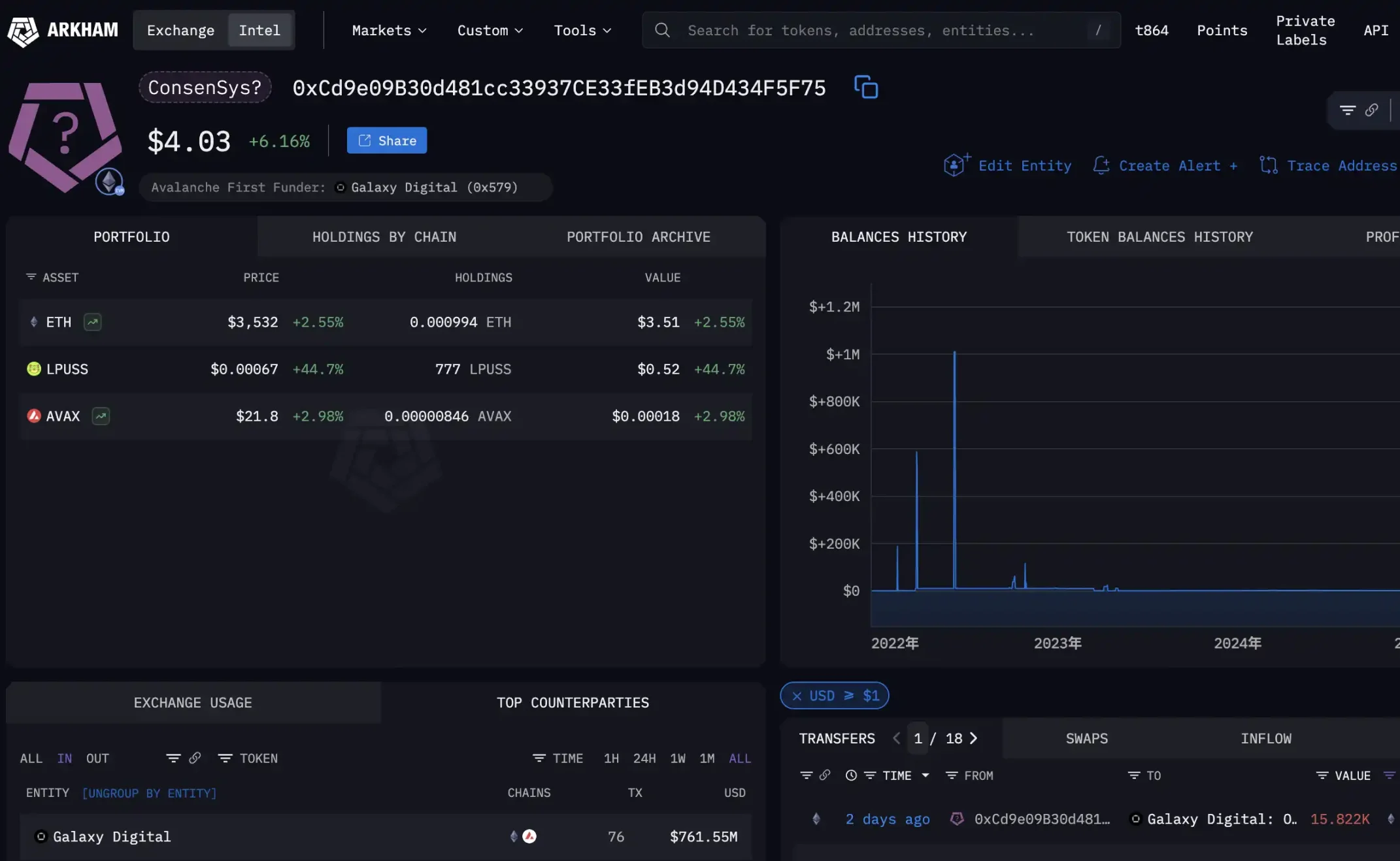
The associated address 0xCd9 has transferred over $800 million in ETH to SharpLink. Multiple addresses are also associated with 0xdf0, which holds $153 million in ETH, and 0x286, which holds approximately $300 million.
While we can't fully understand the source of this massive OTC position buildup, it's clear that this undercurrent is becoming a key force influencing the supply and demand of ETH. BlockBeats' rough calculations based on several OTC addresses on the Galaxy blockchain indicate that OTC trading in ETH has reached $5.444 billion over the past 90 days, with an average monthly volume of approximately $1.8 billion.
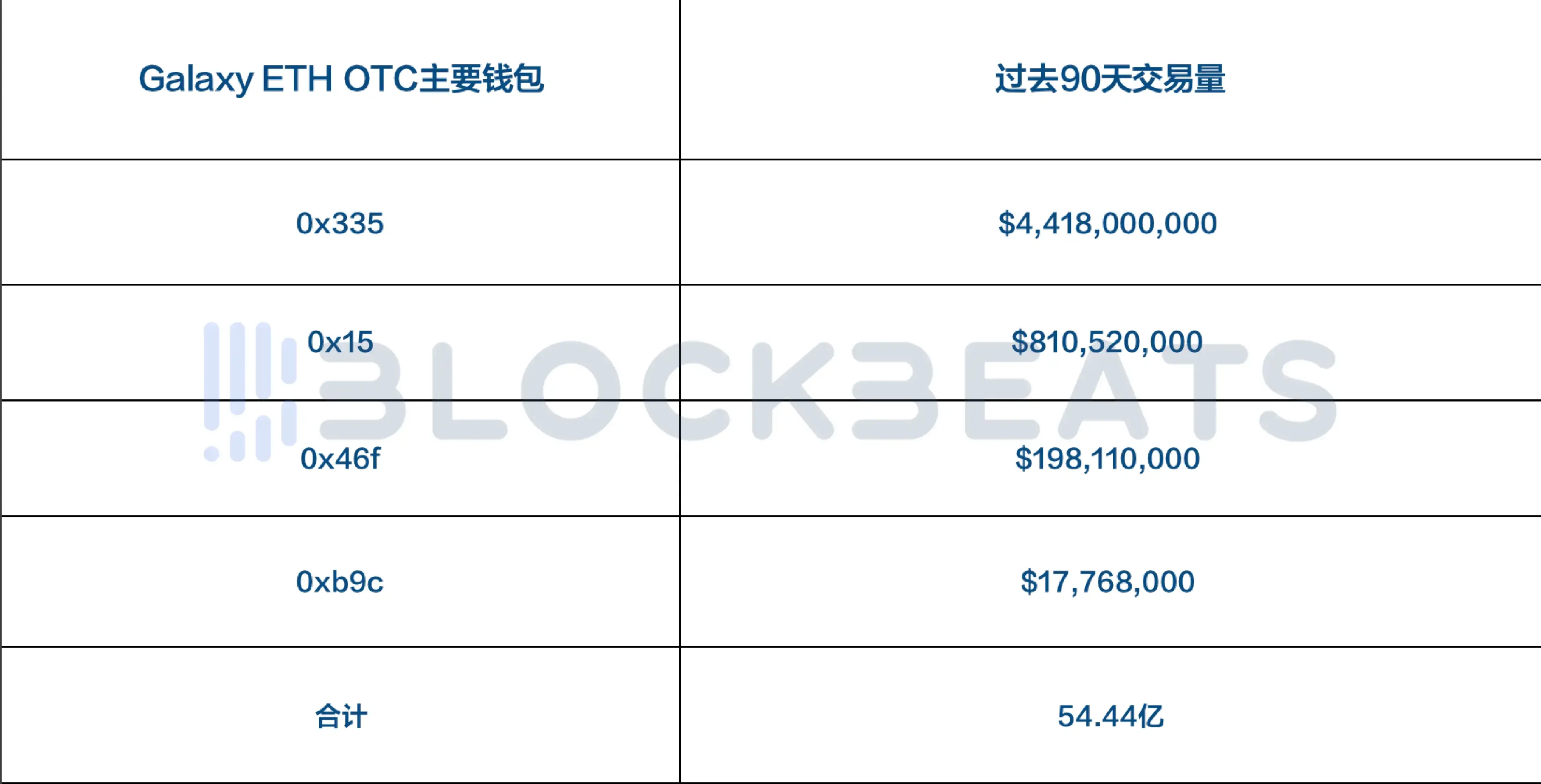
According to the four OTC wallets 0x335, 0x15, 0x46f, and 0xb9c disclosed by Arkham
MicroStrategy plays both referee and player on BNB Chain
If BTC and ETH were the main players in 2024, then starting in the second half of 2025, BNB also entered the arena of institutional investment. In July, an unexpected news broke: Nasdaq-listed CEA Industries (ticker symbol VAPE), a company formerly focused on agricultural temperature control and e-cigarettes, announced its complete transformation into the "BNB Treasury Company," intending to raise up to $1.25 billion through private placements and option exercises to purchase BNB. This plan sent VAPE's stock price soaring 550% in a single day.
Even more striking is that VAPE's crypto pivot is being spearheaded by none other than David Namdar, co-founder of Galaxy Digital. He will serve as VAPE's new CEO, while Russell Read, a partner at 10X Capital and former Chief Investment Officer of the California Public Employees' Retirement System (CalPERS), will serve as CIO. Namdar stated that he will use the $500 million (with the option to raise up to $1.25 billion) to actively build a BNB position over the next 24 months, including through open market purchases, strategic trading, and generating returns through staking and decentralized finance.
This means BNB will welcome its first large-scale open market institutional buyer, and OTC channels will undoubtedly play a key role in this process. Due to the highly concentrated issuance and circulation of BNB, Binance and its founder Changpeng Zhao (CZ) reportedly control 71% of the circulating BNB. To absorb hundreds of millions of dollars of BNB without triggering significant market volatility, they can only resort to over-the-counter block trades or negotiated transfers. Galaxy Digital's extensive OTC network and liquidity resources will provide strong support for Namdar's "BNB version of MicroStrategy Operation." As the world's third-largest crypto asset by market capitalization, this move marks BNB's official entry into institutional asset allocation.
Whether it's Coinbase's integrated custody, trading, and on-chain ecosystem, or Galaxy Digital's consulting and OTC trading platform that matches cryptocurrencies and stocks, or the rapid convergence of traditional brokerages and trading platforms, every industry in the cryptocurrency sector is moving towards compliance and a shift in resources towards leading players. The recent launch of the Crypto Project may be a clear sign of this trend. The hegemony of regulatory compliance institutions is approaching, and cryptocurrency OTC platforms, known as "transparent dark pools," may occupy a more important niche in the future.
