
Author: A1 Research
Compiled by: Tim, PANews
Ethereum's price fluctuations seem simple: retail investors are enthusiastic, prices are soaring, and market optimism continues to ferment. But beneath the surface, there is actually a structurally complex market mechanism. The interweaving of the funding interest rate market, the hedging operations of neutral strategy institutions, and the recursive leverage demand expose the deep systemic fragility in the current crypto market.
We are witnessing a rare phenomenon: leverage has essentially become liquidity itself. The massive long positions invested by retail investors are fundamentally reshaping the way neutral capital allocates risk, thereby giving rise to new market vulnerabilities that most market participants have not yet fully understood.
1. Retail investors follow the trend and buy more: When market behavior is highly convergent
Retail demand is concentrated in Ethereum perpetual contracts because such leveraged products are easily accessible. Traders are rushing into leveraged long positions at a rate far exceeding the actual demand for spot. The number of people who want to bet on ETH's rise far exceeds the number of people who actually buy Ethereum spot.
These positions need to be taken over by the counterparty. However, as the buying demand becomes extremely aggressive, short positions are increasingly being absorbed by institutional players that implement Delta neutral strategies. These are not directional bears, but funding rate harvesters. They intervene not to be bearish on ETH, but to take advantage of structural imbalances for arbitrage.
In fact, this practice is not shorting in the traditional sense. These traders short perpetual contracts while holding an equal amount of long spot or futures positions. As a result, although they do not bear ETH price risk, they earn income through the funding rate premium paid by retail longs to maintain leveraged positions.
As the Ethereum ETF architecture evolves, this arbitrage trade may soon be enhanced by adding a passive yield layer (staking income is embedded in the ETF wrapper structure), further strengthening the appeal of the delta neutral strategy.
It's really a fantastic deal, if you can stomach the complexity.
Delta Neutral Hedging Strategy: A Response Mechanism to Legal “Money Printing”
Traders take on retail investors’ long demand by shorting ETH perpetual contracts and hedge with spot long positions, thereby turning the structural imbalance caused by the continuous funding rate demand into profits.
In a bull market, the funding rate turns positive, and longs need to pay shorts. Institutions that adopt a neutral strategy can hedge risks while earning profits by providing liquidity, thus forming profitable arbitrage operations. This model attracts a continuous influx of institutional funds.
However, this creates a dangerous illusion: the market appears to be deep and stable, but this "liquidity" depends on a favorable funding environment.
The moment the incentive mechanism disappears, the supporting structure will also collapse. The apparent market depth will instantly become a void, and as the market framework collapses, prices may fluctuate violently.
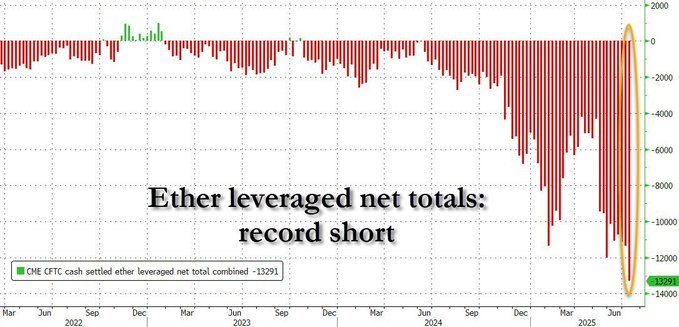
This dynamic is not limited to crypto-native platforms. Even on the institutional-dominated Chicago Mercantile Exchange, most short flows are not directional bets. Professional traders short CME futures because their investment strategies are prohibited from opening spot exposure.
Options market makers use futures to delta hedge for margin efficiency. Institutions hedge institutional client order flow. These are structurally necessary trades, not a reflection of bearish expectations. Open interest may rise, but this rarely conveys market consensus.
Asymmetric risk structure: Why it’s not actually fair
Retail longs face the risk of being liquidated when prices move in an unfavorable direction. In contrast, delta-neutral shorts are usually better funded and managed by a professional team.
They pledge their ETH as collateral and are able to short perpetual contracts in a fully hedged, capital-efficient mechanism that can safely withstand moderate leverage without triggering liquidations.
There are structural differences between the two. Institutional shorts have long-lasting stress resistance and a sound risk management system to withstand volatility, while leveraged retail longs have weak tolerance and lack of risk control tools, and their operational tolerance is almost zero.
When market dynamics shift, longs can quickly collapse while shorts remain entrenched. This imbalance can trigger a cascade of liquidations that appears sudden but is structurally inevitable.
Recursive Feedback Loops: When Market Behavior Becomes Self-Interfering
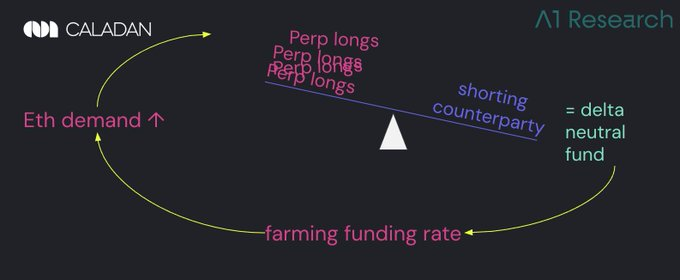
The long demand for Ethereum perpetual contracts continues to exist, and Delta neutral strategy traders need to act as counterparties to hedge short positions. This mechanism keeps the funding rate premium. Various protocols and yield products compete for these premiums, driving more capital back into this circulation system.
A money-making machine that never stops running does not exist in reality.
This will continue to create upward pressure, but it depends entirely on one prerequisite: longs must be willing to bear the cost of leverage.
There is an upper limit to the funding rate mechanism. On most exchanges (such as Binance), the funding rate for perpetual contracts is capped at 0.01% every 8 hours, which is equivalent to an annualized rate of return of about 10.5%. When this upper limit is reached, even if long demand continues to grow, shorts seeking returns will no longer be incentivized to open orders.
Risk accumulation reaches a critical point: arbitrage returns are fixed, but structural risks continue to grow. When this critical point comes, the market is likely to close positions quickly.
Why did ETH fall more than BTC? The battle between the two ecosystems
Bitcoin is benefiting from non-leveraged buying from corporate fiscal strategies, and the BTC derivatives market has stronger liquidity. Ethereum perpetual contracts are deeply integrated into the income strategy and DeFi protocol ecosystem, and ETH collateral continues to flow into structured products such as Ethena and Pendle, providing income returns for users participating in funding rate arbitrage.
Bitcoin is often considered to be driven by natural spot demand from ETFs and companies. However, a large part of ETF fund flows is actually the result of mechanical hedging: traditional financial basis traders buy ETF shares while shorting CME futures contracts to lock in a fixed price difference between spot and futures for arbitrage.
This is essentially the same as ETH's delta-neutral basis trade, except that it is executed through a regulated wrapper structure and financed at a 4-5% USD cost. In this way, ETH's leverage becomes a yield infrastructure, while BTC's leverage forms a structured arbitrage. Both are non-directional operations, and both aim to obtain returns.
Circular dependency problem: when the music stops
Here’s something that might keep you up at night: this dynamic is inherently cyclical. Delta neutral strategies rely on consistently positive funding rates to be profitable, which requires a long-term continuation of retail demand and a bull market environment.
The funding premium is not permanent, it is very fragile. When the premium shrinks, the liquidation wave will begin. If retail enthusiasm fades, the funding rate will turn negative, which means that short sellers will pay fees to long sellers instead of receiving a premium.
This dynamic mechanism creates multiple vulnerabilities when large amounts of capital flow in. First, as more capital flows into delta-neutral strategies, the basis will continue to compress. Funding rates will fall, and the returns on carry trades will also decrease.
If demand reverses or liquidity dries up, perpetual contracts may enter a discount state, that is, the contract price is lower than the spot price. This phenomenon will hinder the entry of new Delta-neutral positions and may force existing institutions to close their positions. At the same time, leveraged longs lack margin buffer space, and even a mild market correction may trigger a chain liquidation.
When neutral traders withdraw liquidity and long forced liquidations emerge like a waterfall, a liquidity vacuum is formed, and there are no real directional buyers below the price, only structural sellers. The originally stable arbitrage ecosystem quickly turned over and evolved into a disordered liquidation wave.
Misreading Market Signals: The Illusion of Balance
Market participants often mistake hedge fund flows for bearish bias. In fact, high short positions in ETH often reflect profitable basis trades rather than directional expectations.
In many cases, seemingly strong derivatives market depth is actually supported by liquidity provided by neutral trading desks that temporarily rent liquidity, and these traders earn profits by harvesting funding premiums.
Although the inflow of funds into spot ETFs can generate a certain degree of natural demand, the vast majority of transactions in the perpetual contract market are essentially structural artificial operations.
Ethereum’s liquidity is not rooted in a belief in its future; it exists as long as the funding environment is profitable. Once profitability disappears, liquidity will also disappear.
Conclusion
The market can be active for a long time with the support of structural liquidity, creating a false sense of security. But when the conditions reverse and the longs cannot maintain their financing obligations, the collapse is just a matter of seconds. One side is completely crushed, while the other side withdraws calmly.
For market participants, identifying these patterns presents both opportunities and risks. Institutions can profit from gaining insight into funding conditions, while retail investors should distinguish between artificial depth and real depth.
The driving factor of the Ethereum derivatives market is not the consensus on decentralized computers, but the structural harvesting of funding rate premiums. As long as the funding rate maintains a positive return, the entire system can operate smoothly. However, when the situation reverses, people will eventually find that the seemingly balanced appearance is nothing more than a carefully disguised leverage game.