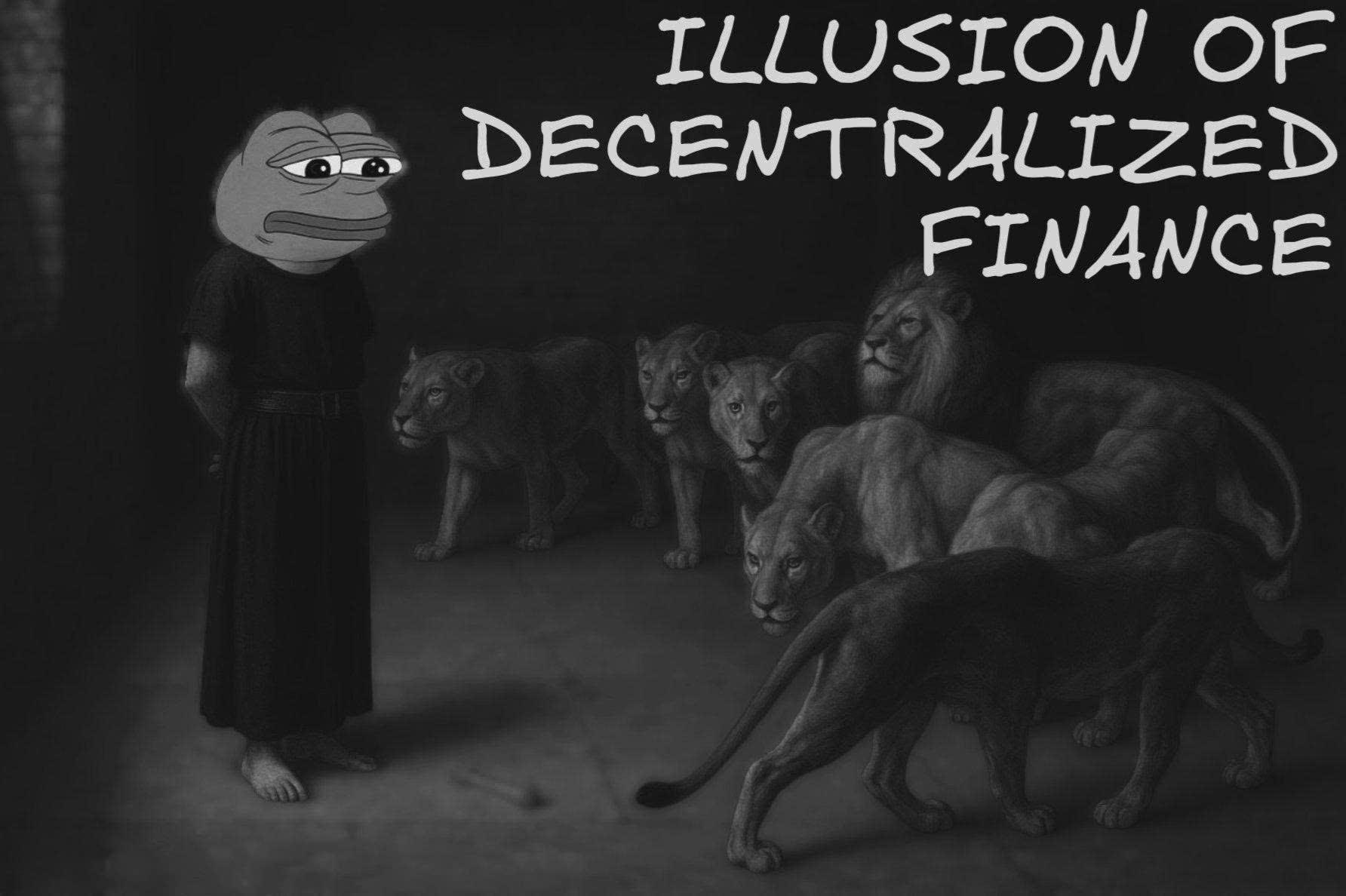
1️⃣ The starting point of decentralization: counterattack after the collapse of trust
In 2009, the Bitcoin Genesis Block wrote:
“The Times 03/Jan/2009 Chancellor on brink of second bailout for banks.”
This is not a sentence, but a declaration.
We no longer trust the old system and want a new world where trust is not needed.
📌 Therefore, "decentralized currency, data, and identity" have become the three temples of faith.
2️⃣ The theory is beautiful, but the reality is cruel
Three core criteria of the decentralized ideal:
✅ Everyone can participate (Permissionless)
✅ Code is the rule (Trustless)
✅ Censorship Resistant
But the reality is:
🚧 Bitcoin Mining ≠ Freedom
The global computing power is highly concentrated, and a few mining pools have the final say.
🚧 Ethereum staking ≠ decentralization
Lido, Coinbase, and Binance control the majority of ETH stakes.
🚧 Dapp disconnection ≠ decentralization
Once the front-end server crashes, DeFi becomes “ByeFi”.
3️⃣ DeFi, is it freedom? Or an illusion?
Seemingly free, but actually many protocols:
🔒 Smart contracts can be upgraded and paused, controlled by the team or multi-signature
🔒 Oracles only rely on centralized services such as Chainlink
🔒 The front-end can block the address and shut down the service at any time
If a protocol can be “operated in the background” at any time - then can it still be called “decentralized”?
4️⃣ Why is it so difficult to be truly decentralized?
🧠 Technical bottleneck + 🧍♂️ User nature, working together:
⚖️ Distributed systems are inefficient and costly, which is not conducive to rapid iteration
🪙 Power concentration: VC + team holds the most tokens and has the most say
😴 Users are lazy: too lazy to self-host, too lazy to run nodes, too lazy to learn contracts
As a result, "Web3" is becoming more and more like "Web2.5".
5️⃣ Does decentralization still make sense?
Of course!
It's not perfect, but it's worth sticking with.
Just like democracy - it has compromises and flaws, but it's still better than dictatorship.
✅ The really important questions are:
💥 “Are we still using ‘decentralization’ as the criterion for every technology decision?”
If the answer is “yes,” then the revolution has not failed.
🔭 We are still moving forward
You may not have noticed:
Rollup is promoting the decentralization of verification nodes. EigenLayer proposes a "re-staking" mechanism. Projects such as Farcaster are building open social protocols. More and more front-ends are deployed on IPFS + ENS, moving towards serverless.
This is the evolution of technology and the persistence of faith.
✅ Conclusion: Decentralization is not a myth, but a compass
We are still far from our ideal.
But every persistence brings the future closer to freedom.
📌 Not “Are we decentralized yet?”
But: 🧭 "Are we still taking 'decentralization' as the direction for every step in the future?"
