Have you noticed that it has become increasingly difficult to find suitable financial products in the past two years?
Bank interest rates continue to fall, the returns of government bonds and money market funds cannot even keep up with inflation, and insurance and financial management are also quietly "downgrading". For users who hope to increase their assets, they look around in financial management apps and only see returns of around 1%, which really makes them lose interest.
We seem to be living in an era with an unprecedented variety of financial products, but it is becoming increasingly difficult to find a way to "make money steadily". Against this background, financial management methods that were originally only available in the crypto circle, especially on-chain financial management based on stablecoins, have quietly entered the field of vision of more and more people.
Why is stablecoin investment worth paying attention to?
As a digital asset issued and pegged to legal tender, stablecoins do not have the same price volatility as Bitcoin, but they are more like "digital cash". Stablecoin financial management allows users to borrow, pledge or invest their idle stablecoins on the chain or on a centralized platform in exchange for corresponding annualized returns .
This may sound strange, but the logic is not complicated - just like a bank lending your deposit to earn interest rate spread. However, in the on-chain world, this "interest rate spread" is more transparent and the returns are more reasonable. Currently, common stablecoin financial products can be roughly divided into the following categories:
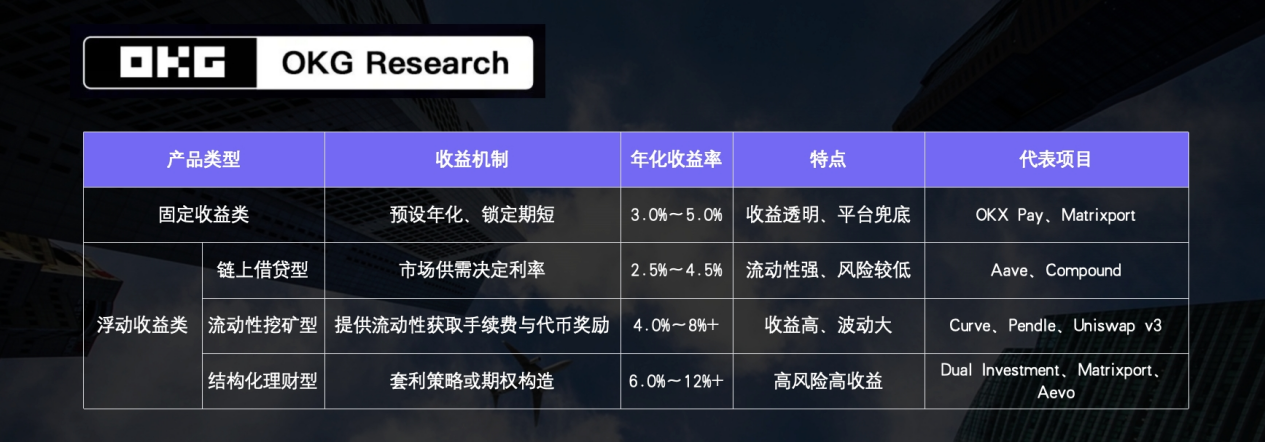
According to data from the first half of this year, the annualized interest rates of USDT/USDC in mainstream DeFi lending protocols mostly fluctuate between 2.5% and 4%. Some DeFi platforms may provide a total annualized return of more than 8% through liquidity mining or reward mechanisms, but this is accompanied by higher volatility and lock-up requirements. In contrast, although the annualized rate of return of fixed-income products is not the highest, it has been steadily increasing overall, reaching up to about 5%. Coupled with the advantages of stable returns and low thresholds, it has become the first choice for on-chain financial management for many users.
More importantly, the flexibility and user experience of such products are being rapidly optimized. Users only need to hold stablecoins, then select the platform and product type, and they can subscribe with one click. Some platforms also support deposits and withdrawals at any time, and interest is calculated on a daily basis. This operation method is as convenient as Yu'ebao, but you can get interest similar to that of US Treasury bonds; it is as stable as a fixed deposit, but there is no penalty interest for early redemption. Isn't this "stable and flexible" experience exactly what users are looking for?
The following is a comparison between stablecoin investment and fixed income products in the traditional financial market:
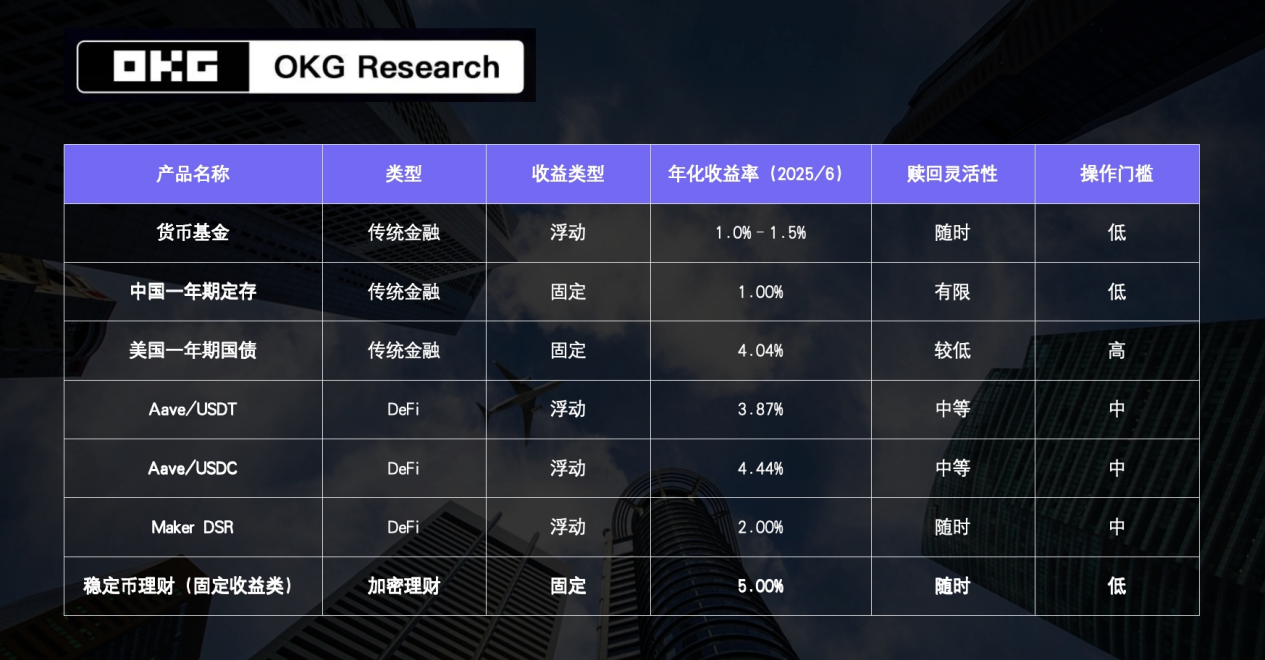
It is not difficult to see that the appeal of stablecoin financial management is not only the rate of return. In addition to the rate of return, the redemption flexibility of stablecoin financial products is also very high. Most of them support deposits and withdrawals at any time, and interest is calculated on a daily basis. There is no need to lock positions or set a period of return, which truly realizes "no idle assets". Secondly, in terms of transparency, most platforms will disclose the source of income, risk descriptions and capital flows, and some even verify the security of funds in real time through on-chain data. More importantly, it makes the user's income more reasonable: the platform no longer "eats the interest rate difference", but distributes the real lending or matching income to investors in proportion, which is a direct reflection of the "value return to users" of the on-chain financial system.
Where does the income from stablecoin financial management come from?
The income structure of stablecoin financial management mainly comes from three sources : first, on-chain lending interest, where the platform lends the locked stablecoins to other users to obtain income; second, pledge rewards or node income, especially in staking products; third, profit distribution from participating in options or income stratification strategies. For users, as long as the platform product structure is open and transparent and asset custody is safe, it can be regarded as a "quasi-fixed income product" on the chain.
Currently, the number of active addresses on the stablecoin chain continues to grow. Although there is no clear statistics on the number of users participating in stablecoin financial management, its scale is expanding rapidly from the perspective of on-chain activity and capital inflow. Especially in Southeast Asia, Latin America, the Middle East and other regions where the local currency is unstable and the financial system is insufficient, stablecoins have become an important means for residents to avoid the depreciation of their local currencies and obtain returns on US dollar assets.
It is worth noting that institutional funds are also continuously entering the market. Insurance companies, family offices, funds, etc. have incorporated stablecoin financial management into liquidity management tools as part of the US dollar asset pool. This trend has driven the platform to continuously upgrade in terms of risk control, transparency and compliance, providing C-end users with a more mature product environment and service experience.
From the perspective of ordinary users, stablecoin financial management is not a "get-rich-quick" business, but it may be the quietest but stable source of income in your asset allocation. It is more like a "digital cash asset" in the financial jigsaw puzzle, with higher returns than current deposits and lower volatility than stocks, suitable for finding certain returns in an uncertain environment . As the regulatory framework for stablecoins in Hong Kong, Europe, Southeast Asia and other regions becomes clearer, users will have more safe, compliant, and transparent products to choose from.
However, stablecoin financial management is still an emerging field, and risk identification cannot be ignored. Some stablecoins may face the risk of de-anchoring due to problems such as liquidation mechanism and anchor asset management. For example, TUSD and USDD have experienced fluctuations; smart contract audits and security measures will also affect fund security. Therefore, for ordinary users, they should choose leading platforms or institutional products that have been included in supervision, give priority to stablecoin financial management methods with clear income structure and flexible redemption support, and maintain prudent judgment on high-yield products such as "annualized more than 10%", and avoid blindly chasing high. Stability, transparency, and compliance are the prerequisites for long-term participation.
With interest rates low today, stablecoin financial management provides users with more stable investment options. You don’t necessarily need to embrace the entire crypto world, but at least you can have a transparent, secure, and annualized “crypto savings account” of about 5% through stablecoins—finding certain returns amid uncertainty.