
Author: Zuo Ye Web3
Give money freedom, give information a price tag.
The economy has devoured society, technology has distorted the economy, finance has become the target of technology, and the meme has nihilized finance to the extreme.
Every era's great waves leave behind either gold or silt. From the .ETH suffix to the rampant Yap account creation tutorials, without exception, they are all washed away by time and forgotten. This is especially true in the cryptocurrency industry, where there are always extremely short ways to monetize content.
But what I observed was only fragmentation, the separation of information flow and capital flow, the fragmentation of public chains due to the different groups of people, the isolation of interconnected memes, and only the perpetual increase of entropy.
The era of transformation is unprecedented in the history of human financial evolution, leading to the following situations becoming commonplace:
- In a typical encrypted context, the fate of information is to become a commodity that can be bought and sold;
- As nation-states regain their authority, no investment should attempt to overstep the boundaries of that authority.
- Preserving value hinges on lossless transmission; information flow can severely damage fundamental business value.
Binance Square's aggressive traffic acquisition reveals underlying concerns about the energy-intensive mining of memes, while Twitter's attempt to seize financial traffic entrances is also short-sighted and perpetuates the entanglement of funds and information.
Separation Anxiety: The Collapse of Information and Capital Flows
Binance cannot enter the global order; it can only continuously update and maintain its commercial value.
If we have any understanding of the early history of cryptocurrencies, we will have no doubt that ICOs and Chinese memes were indeed precise, destiny-driven wealth-creation movements, as long as one ran faster than the latecomers.
It's just that 17 years is a test of hand speed, and 26 years is a test of internet speed.
This is not irony. Speculation and speculation have never prevented "Bitcoin evangelists" from gaining both fame and fortune. In fact, the evangelists themselves are the source of hype. Going all in on EOS and selling off ETH at the wrong time have become old stories in the dead of night, generating a traffic effect on Twitter.
The recollection of the past implicitly acknowledges the value of information preservation. Celebrity stories and contemporary ticks often trigger wonderful connections. From Wang Xin of Kuaibo to the Happy Sci Meme by researchers at YZi Labs, I firmly believe they don't need to resort to such money-making methods, but they often have no choice.
Binance's proactive adoption of Meme is nothing more than a timely change in its marketing tactics. Binance's angel investors are far more aggressive than these. What's truly puzzling is why Binance, sitting at the top of the CEX ecosystem, still needs to constantly connect with the masses and create the illusion of traffic and instant wealth.
Taking Binance as an example, and extending to the entire exchange and industry, there is a growing anxiety about the separation of information flow and capital flow.
Starting with Kaito, the amount of information received per person skyrocketed, but the quality of information declined rapidly. By the time Vibe Coding ended, the content stock of the crypto industry that had migrated overseas since 2021 had completely disappeared, and the transformation to AI or general traffic was just a self-rescue measure.
Four years after newcomers to the crypto industry stopped entering the scene, the battle for traffic and the internal friction of trading could no longer be sustained. KOLs, media, and exchange employees could easily travel overseas and access foreign websites, but for retail investors who actually had to bear the losses, this was an insurmountable obstacle.
 Image caption: The end of growth

 Data source: @_businessofapps
The long-term growth of exchanges has ended and will not return. The problem for the entire industry is the anxiety about traffic after insufficient new user acquisition. Everyone, inside and outside the crypto circle, knows about the crypto circle, but people's enthusiasm for trading is declining day by day.
The more difficult it is, the more challenging it becomes to grow data. This is the main reason why Binance is desperately pushing up BSC. On-chain users are the last incremental customers in the crypto community. Next, they will have to face the influx of mainstream users.
 Image caption: The theory of encrypted information quantity

 Image source: @zuoyeweb3
Drawing inspiration from Irving Fisher's quantity theory of money, we can propose a quantity theory of encrypted information: the supply of information x velocity of opinion = exposure per item x total number of items at a given time. Based on this, we can explain how encrypted information networks actually operate.
In Irving Fisher's era, the problem of dollar inflation remained unresolved, ultimately leading the world to embrace the gold standard, the Great Depression, and World War II. If you think Meme and Yap have dashed the hopes for cryptocurrency, the good news is that it's still much better than World War II.
Within a certain period of time, such as when an XX Foundation launches an account and announces a massive fundraising, everyone, including retail investors, will recognize it as a prelude to a token listing. At this time, interactive articles about the Yap project, such as investment research and discussions, will increase explosively, which will also affect the flow of information. You can think that the speed of information circulation is increasing rapidly, but the "effective" information will be inversely proportional to V/Y/Q in the above chart.
Closed information links, free flow of funds
Under financial inflation, spending money and information dissemination are virtually indistinguishable.
If I don't like Binance, can I still use Binance? Can I still trade coins listed on Binance?
In fact, Binance doesn't like the crypto community, Musk doesn't consider Binance's feelings, and He Yi doesn't like Chinese, but none of this prevents them from cooperating. Qualified investors require themselves to be responsible for their returns, not for their preferences.
The current crypto industry no longer discusses the ultimate dream of all problems—decentralization and privacy protection—but instead studies which meme Shandong Studies and a16z favor more. They don't laugh at the West from the East, and they don't covet applications in infrastructure.
Furthermore, with the cooperation of deposits and withdrawals, CEXs, and crypto banks, free capital has become the norm. However, CT's traffic is declining daily, and information collapse seems to be everywhere. The crypto community discusses AI, US stocks, robots, and commercial spaceflight, but no one seems to care about the future of crypto.
The exchange of information and funds is not uncommon, and is even more common:
- Information competition: The ultimate Bot account is not a script, but an endless stream of human GMs and account creation guides;
- Exchanges: Aster's human-machine competition and Nof1's LLM trading competition are both vying for crypto traffic.
The real challenge lies in the process of information-driven funding. From any trading product in the industry to repurchase mechanisms, there is an emphasis on funding that aligns with the user's information preferences. The ultimate solution in this regard is Hyperliquid's Builder Code's transparent rebates.
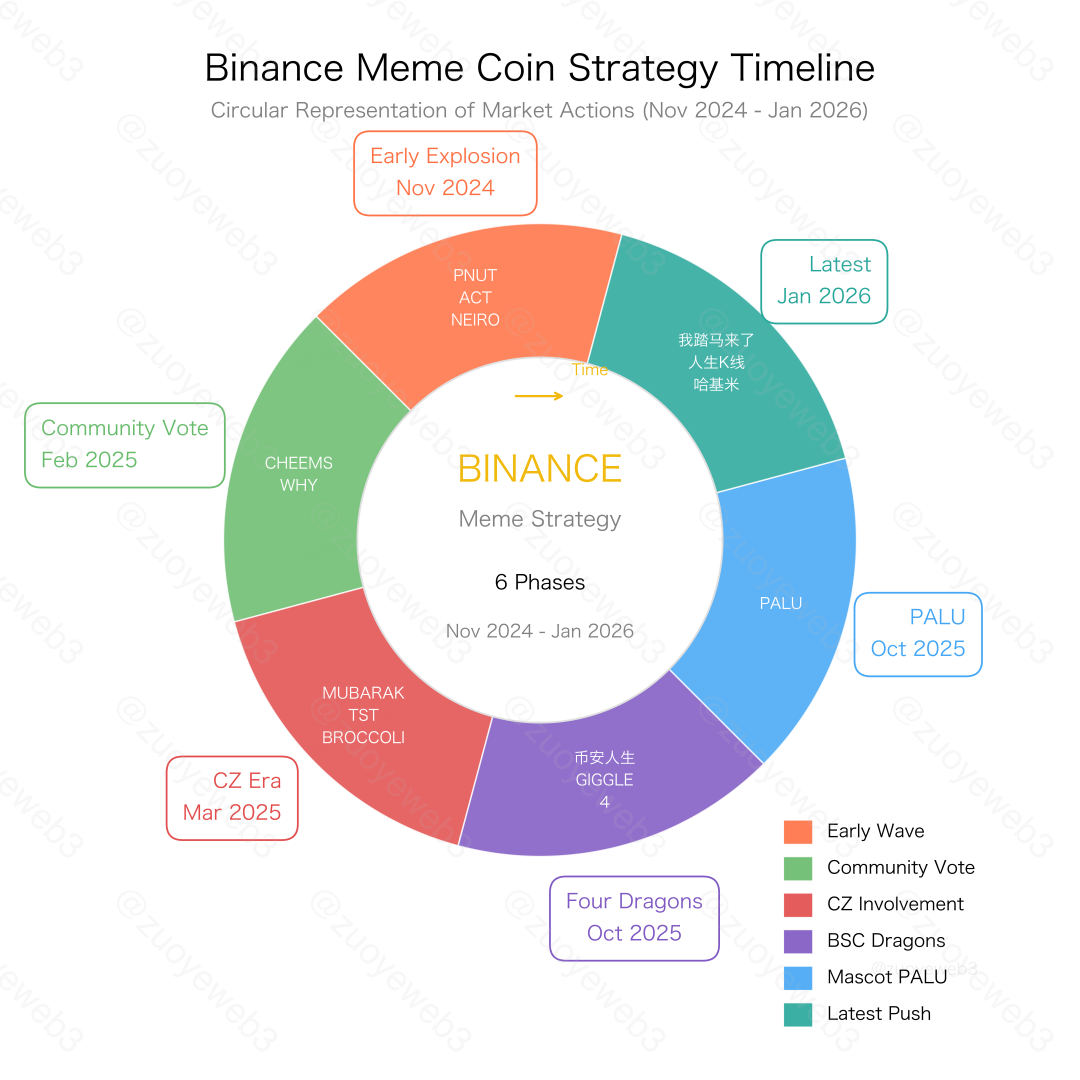
 Image caption: Binance Meme Timeline

 Image source: @zuoyeweb3
Most rebate mechanisms and information dissemination are difficult to directly correlate. This is not to say that exchanges cannot distinguish the source and destination of rebates. OKX's ability to ban user rebate accounts is a case in point. Rather, it is to say that the transactions are really related to the content of KOLs.
The medium is the information, and the rebate is the content.
Combined with the IV=YQ formula, it can even "roughly" correspond to the information dissemination chain, and it can also correspond to whether a certain KOL has a very strong ability to drive orders, but it is impossible to determine whether the KOL's content preferences will trigger transaction growth.
If we understand this, we can see the intermediate stages of the flow of funds, but we cannot track every link of the information flow. Official hot searches, recommendation algorithms, and regional language preferences can all lead to "going viral". Memes actually become an unpredictable "feeling".
Therefore, Binance or exchanges personally engage in marketing, while simultaneously investing in traditional crypto media and KOLs. This traffic boost is not for attracting new users, but for maintaining a comprehensive and systematic distribution channel. The ultimate example of this model is when Binance's two founders personally lead the trading of Meme and continue to do so.
Similar to the Irving Fisher equation, under the traditional monetary issuance framework, the velocity of paper money cannot be accurately calculated. With the interference of information from CT (crypto Twitter community), we also cannot measure effective information or the velocity of information flow. With the help of statistical methods, we may be able to obtain some data from KOL agencies, but it will eventually turn into trading data on CEX or DEX.
This may be the source of Binance's anxiety. It is not surprising that information occurs outside the Binance system, but the loss of control over the flow of information makes it impossible for Binance to accurately measure the effectiveness of transactions. This framework can also explain the disappearance of the listing effect.
It's important to understand that traffic is not just a simple entry point; it's also the place where public opinion is generated and amplified, as well as where crisis public relations are conducted. Information and funds are intertwined, constituting the entire essence of the CEX era, and now all of this will be taken by more people.
First, there is the "renationalization" following the failure of globalization, with power centers in various regions expanding again. Chen Zhi cannot retain his nationality and title in Cambodia, and the crypto king hiding in the Middle East will face more sovereign attacks in the future.
Secondly, the combination of public blockchains and exchanges was once the strongest information and capital network model. Whether it's RWA, stablecoins, or Meme, it doesn't matter. The core is the closed loop from the information end to the capital end, so that transaction fees can continuously feed back into the ecosystem.
However, in terms of product evolution, we may be facing a major change that is not seen in the last decade. On the one hand, we really need to embrace the transformation of products with hundreds of millions of users. On the other hand, the entire crypto industry is facing the crisis of being backend-oriented and losing its own brand.
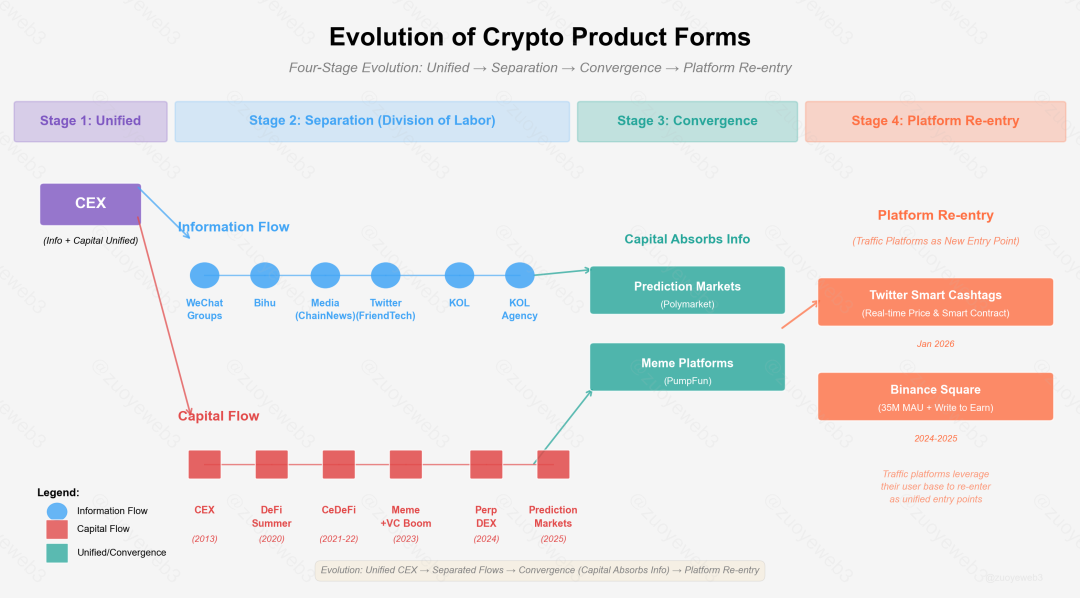
 Image caption: The evolution of crypto products

 Image source: @zuoyeweb3
Starting with CEX as the starting point for traffic/funds, we seem to be experiencing a classic four-stage cycle:
1. Unified: CEX
2. Separation (Socialized Division of Labor)
- Information Flow
- cash flow
3. Uniformity (funds precede information)
- Prediction Market
- PumpFun
4. Restructuring: X aims to become a traffic portal for financial products.
Musk was optimistic about WeChat's Super App model when he acquired Twitter. This was also his unfulfilled ambition after losing X.COM to Peter Thiel's PayPal. In fact, WeChat's logic for doing finance is not as smooth as that of commons products such as TikTok. Relationships between people are more of a point-to-point interaction. If you look at Western financial products, no financial and social integration giant has emerged to date.
I'm willing to consider Twitter's integration with cryptocurrencies and CEXs as an attempt that's expected to fail; as long as the expectations are low enough, the potential gains will be significant enough.
A more interesting perspective is that Twitter is reverting to a "backtrack" of traffic-driven crypto rather than crypto-driven traffic. We once thought that DeFi, represented by DEX, would devour the world, just like the internet, but the reality is that stablecoins still need more merchant support, and BTC has completely become a golden substitute for the likes of the rich.
Conclusion
Words are power, and traffic is leverage.
One beginning usually only reveals the existence of another.
From the very beginning when CEXs consolidated information dissemination and capital interaction, we are experiencing a typical period of separation. Signals and trading guidance constitute everything, and it seems that there is no need for high-quality content to drive traffic, or rather, high-quality content is no longer the starting point for everything.
Finally, and even more difficult, is the process of funding-driven information. Most projects cannot start from here. Perhaps only the Seven Sisters of the US stock market can have this effect. If the crypto industry loses its ability to set the agenda and is left with only internal games of funds, crypto will become an isolated island in a dying world about to disappear.
Even within the confines of a nutshell, Binance remains the king of an infinite universe, until Musk's Dark X arrives, ushering in a truly world-class mainstream product.