Podcast source: Bitcoin Magazine
Compiled & translated by: Deep Tide TechFlow
Guest: Mark Yusko, CEO of Morgan Creek Asset Management
Host: Brandon Green: CEO of BTC Inc
Broadcast date: March 4, 2026
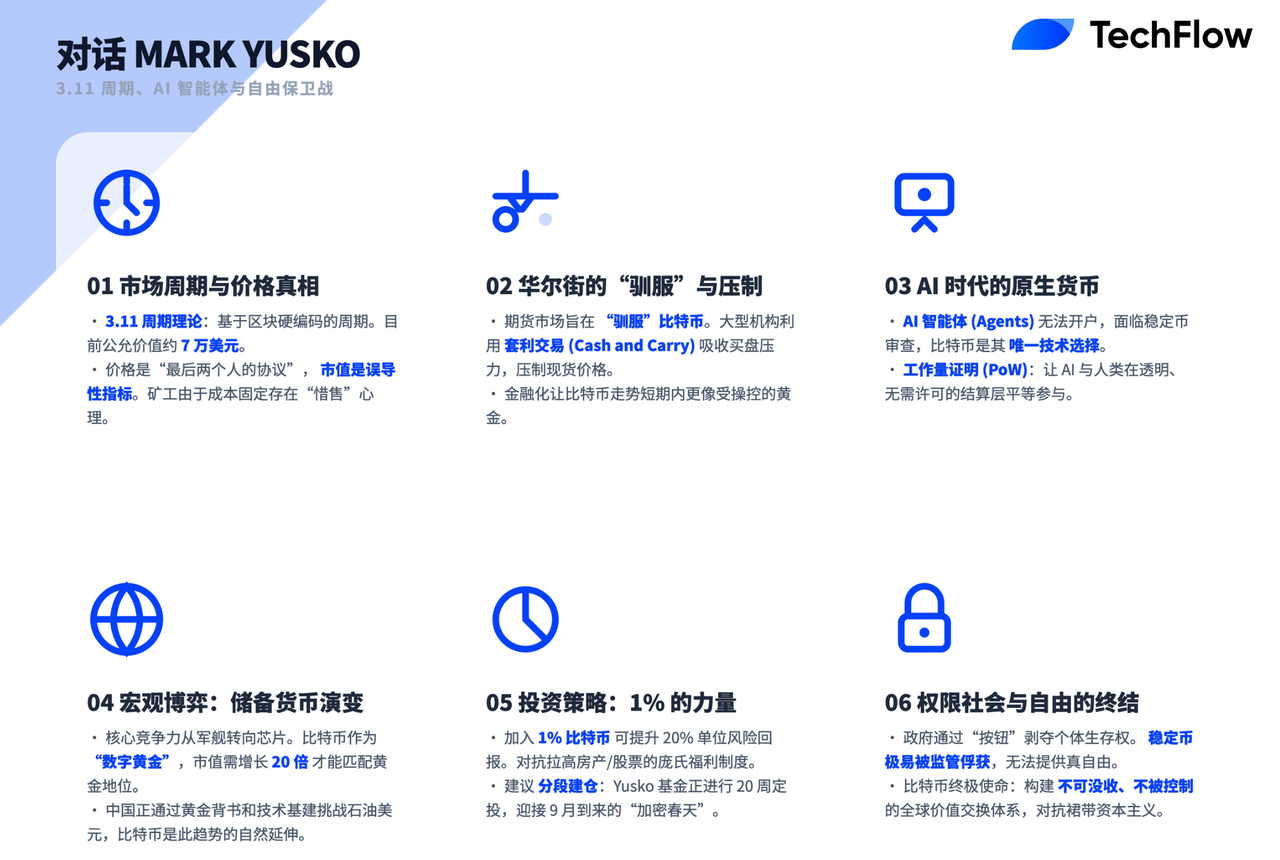
Key points summary
Mark Yusko and Brandon Green of Morgan Creek Capital delve into the distinction between Bitcoin's price and value, explaining why this is particularly important today. They analyze how the futures market influences Bitcoin's spot price, revealing the regularity of Bitcoin's four-year cycles, and why AI agents consider Bitcoin their preferred native currency.
Summary of key viewpoints
The essential difference between "price and value"
- Price is a lie; the price of any asset is irrelevant and has no relation to its value. Price is merely the result of two people agreeing to trade a small amount of an asset.
- Market capitalization is one of my least favorite metrics.
- The total supply of Bitcoin is 21 million, but some of these Bitcoins have been permanently lost. Therefore, when we multiply the current price by 21 million to calculate the market capitalization, this number is inaccurate; it is merely a hypothetical figure.
Hard-coded logic regarding the "four-year cycle"
- I call it the “3.11 cycle”, which is based on the number of blocks, not a four-year calendar cycle.
- The four-year cycle is actually hard-coded into Bitcoin; every four years, Bitcoin's code reduces the block reward. If you halve the reward, theoretically, without difficulty adjustments or other measures, half of the miners might leave the market due to fixed costs.
- Miners will not sell Bitcoin. Just like oil producers, if the price you get drops, you don't sell oil; you wait for the price to rise again.
Regarding the "suppression of prices by the futures market"
- They bought Bitcoin ETFs and simultaneously shorted Bitcoin futures, but they weren't required to report these short positions. Therefore, they were effectively dollar-neutral, simply profiting from the price difference in the futures market.
- Buying BTC between now and September would be a wise move.
Regarding "Why AI agents choose Bitcoin"
- An AI system with agent-like capabilities needs to pay fees, but it cannot open a bank account or use fiat currency. While stablecoins are an option, intelligent agents do not belong to the fiat currency system and cannot be fully integrated into the system behind stablecoins, making Bitcoin the best choice for them.
- Bitcoin's proof-of-work mechanism makes it the only system that allows AI agents to participate on an equal footing with humans.
Risks related to "Cash and Investment Portfolio"
- Cash is actually the most dangerous asset. Despite its apparent safety, holding cash every day means your wealth will diminish due to inflation. Since 1913, the devaluation of fiat currencies has caused our wealth to gradually slip away, with purchasing power being halved every 30 years.
- If you add 1% of Bitcoin to your portfolio, Bitcoin can increase your risk-reward ratio by about 20%, and your annual compound return can increase by about 200 basis points.
Warnings about "authority-based societies"
- We are gradually entering a "permission society" in which all actions require permission.
- If your account is incorrectly flagged as a "dangerous account," the government may work with the stablecoin issuer to freeze your funds.
- This definition is extremely difficult to accept. If we call economic sanctions "starving women and children," then there will likely be even fewer people who support them.
Regarding "K-type economy and welfare system"
- The baby boomers controlled the economy, wielded power, and created what is known as a “welfare system.” This system is essentially an unfunded promise that the next generation has to pay for. It operates much like a Ponzi scheme: it sustains itself by continuously increasing the value of two assets owned by the baby boomers—stocks and real estate.
Bitcoin's Four-Year Cycle and the Reasons for Its Perfect Performance
Brandon Green: Welcome to the Bitcoin Magazine podcast. Today we're honored to have Mark Yusko with us. Mark, if you were to review the evolution of Bitcoin over the past 24 months, how would you describe it? What phenomena surprised you, and what were entirely within your expectations?
Mark Yusko :
I really liked that you mentioned the word "cycle". Although many people now claim that "cycles are dead", I still firmly believe in their existence.
There's a lot of debate within the industry right now, but everyone's talking past each other without really listening to each other's perspectives. Undoubtedly, Bitcoin, as a store of value, is subject to business cycles and liquidity cycles. This is undisputed. Essentially, an ounce of gold is an ounce of gold, and a Bitcoin is a Bitcoin. Its shape may not be a round coin, but its total supply is absolutely fixed.
What has truly changed is fiat currency. Regardless of which fiat currency you use to price Bitcoin, changes in the fiat currency environment (such as interest rate fluctuations) will cause fluctuations, which is normal. As for the core of the controversy—"has the four-year cycle ended?"—I believe the price action over the past 24 months precisely confirms the existence of the cycle.
Some argue that the massive influx of institutional funds will disrupt the existing patterns, but my theory is that the four-year cycle is hard-coded into Bitcoin's underlying code. Every four years, Bitcoin's block reward halves.
Why is this so important? Block rewards are payments to miners for maintaining network security. If the rewards were halved, miners with relatively fixed production costs could face bankruptcy, even without considering difficulty adjustments. However, miners behave similarly to oil producers: if the price of their output plummets, they don't choose to sell at a loss; instead, they hoard coins and wait for the price to recover.
Looking back at the market trends over the past 24 months, there weren't many unexpected events. The only thing that truly surprised me, and even impressed me, was someone's accurate prediction that Bitcoin's price would turn around on October 6th. But if you delve into the underlying logic, this "accuracy" is actually traceable: everyone is used to applying the concept of a "four-year cycle," but in reality, Bitcoin operates above block height, not on a calendar. The actual span of this cycle is approximately three years and 11 months, so I call it the "3.11 cycle."
If you observe historical patterns, you'll find that the peak in 2017 was in December, in 2021 it was earlier in November, and 2025 naturally points to October. All of this is entirely in line with expectations, but what I find most different is the volatility within this cycle. Market participants can be divided into four categories: investors, traders, speculators, and hedgers. Investors tend to buy assets at below-fair value, such as buying a $1 asset for 70 cents. As investors start buying, prices begin to rise—this is the so-called "crypto spring" and "crypto summer." People know the asset is trading below fair value, but eventually the price recovers.
When prices start to rise, traders enter the market—they need volatility to profit. There are no inherently good or bad traders, just different trading styles and behavioral patterns. Then there are speculators, who aren't exactly "villains," but simply occupy opposite ends of the trading spectrum with hedgers. Hedgers are those who actually produce assets and need to sell them for cash to cover costs, such as producers of commodities like oil, gold, and copper, as well as Bitcoin miners. They sell their produced assets through the futures market; speculators, on the other hand, are the counterparties in these hedging transactions.
When prices rise above fair value, buying pressure tends to continue, pushing prices even higher than fair value. Conversely, if you are a hedger and the market price is already below your production cost, you typically won't choose to sell. This is why Bitcoin has almost never traded for an extended period below the cost of electricity in the past 17 years: the logic is simple—since I still have to pay for electricity, why would I sell Bitcoin when the price is below cost?
When prices are higher than fair value, hedgers start selling, and speculators enter the market. The reason there are more speculators today is that people no longer go to Las Vegas or Macau as frequently as they used to, but instead turn to online entertainment, betting, and even sports betting; now they can also "bet" in financial markets, and even leverage it.
Returning to the core question: In 2017-2018, the price of Bitcoin surged to twice its fair value. So what exactly is fair value? It can be estimated using the Metcalfe's Law model—Metcalfe's Law measures the value of a network, and Bitcoin is essentially a network, one of the most powerful and valuable networks today. According to this model, Bitcoin's fair value at that time was approximately $10, while the market price rose to $20.
By 2021, the fair value was around $30, while the price surged to $69. In this cycle, the fair value was around $80, and the highest price reached $120. This means that the premium of this peak relative to fair value was about 50%, not the previous 100%. Therefore, theoretically, this correction should be smaller: if the price is twice the fair value, it should retrace at least 50% to return to fair value; however, in reality, prices often don't stop at fair value, and panic selling pushes prices further down, which is why we've seen historical deep retracements of 84%, 83%, and 74%. If this time the price was only 50% higher than fair value, the theoretical retracement could be around 33%; but ultimately, the market fell below this "theoretical value," with the retracement reaching as high as 51%.
I'm not saying the bottom has definitely been reached. In my experience, a crypto winter usually lasts about 11.5 months, so this one might not end until around September this year.
Futures market, arbitrage trading and Bitcoin price suppression
Brandon Green: But actually, the most painful part isn't the price drop, but the sideways price movement. Those long periods of sideways trading are the most agonizing, like slowly moving through a tunnel.
Mark Yusko :
The market is changing faster than ever before, and this isn't just a characteristic of the Bitcoin market, but a trend across all markets. Capital is being weaponized; for example, the Robinhood app allows users to trade with 10x leverage instantly. This weaponization of capital makes the market faster and more volatile.
However, this also raises a problem. In 2017, Leo Melamed, chairman of the Chicago Mercantile Exchange, stated, "We will tame Bitcoin." This statement is quite intriguing. At the time, he was addressing a group of financial executives, including Jamie Dimon, who believed that Bitcoin was a fraud and even posed a threat to the banking industry. Bitcoin technology offers "truth" rather than "trust" in the traditional financial system, potentially redistributing the $7 trillion annual trust cost of the global financial system to users.
Gold is a similar example. Gold once cost $200 per ounce, but now it has risen to $5,000. This reflects currency devaluation, not a change in the price of gold itself . Furthermore, the price of gold remained almost unchanged between 2021 and 2023, largely due to manipulation in the futures market.
Futures contracts allow for price manipulation using virtual commodities. In traditional commodity trading, sellers must actually possess the goods to sell, while the futures market allows for the sale of non-existent commodities through virtual contracts. This mechanism is similar to creating fiat currency by printing money, ultimately leading to a decrease in the value of goods. The logic of money is the same. If I have one million dollars and then print another million dollars, the value of that money will decrease.
Gold prices have long been "controlled." If you look at its price action, you'll see it lingered around $200 for a long time—due to resistance from the futures market, it just couldn't break through; but once it did break through, it triggered a short squeeze, quickly pushing the price up to $400. Then it got stuck around $400 again, until it broke through again and climbed all the way to $1000. Similarly, gold hovered around $2000 for two years before experiencing another parabolic rise. Silver's rise was even more dramatic: it experienced an even steeper parabolic surge, followed by a sharp drop.
So what does this have to do with Bitcoin? Recent 13F reports show that institutions like Millennium and Jane Street hold significant "Bitcoin exposure." However, strictly speaking, they don't necessarily hold actual Bitcoin in the spot market: they buy Bitcoin ETFs while simultaneously shorting Bitcoin futures; and these short futures positions don't need to be disclosed in the 13F filing. As a result, they are generally close to "dollar neutral," their core objective being simply to profit from price differences in the futures market.
Typically, futures prices are higher than spot prices because the market is naturally more optimistic about the future. This leads to classic arbitrage : selling futures contracts and buying them back at expiration to profit from the price difference. This also explains why prices and the supply-demand structure often experience more dramatic fluctuations and rebalancing around option expiration.
This phenomenon is called arbitrage trading. The logic is that you might get the results you want, but you might also have unexpected consequences. For example, when Bitcoin was first classified as a non-security, many people were happy, but in reality, being classified as a commodity meant the creation of a futures market, which could lead to increased price volatility.
When Bitcoin futures were first launched on December 18, 2017, the price peaked. Similarly, when a new futures market innovation was launched for the second time in 2021, the price of Bitcoin also peaked two days later. Now, with the Chicago Mercantile Exchange (CME) planning to launch more futures contracts on May 29, 2023, I worry that this could lead to a “volatile summer.”
Currently, the fair value of Bitcoin has declined, from around $80,000 to around $70,000. Yesterday, the price of Bitcoin fell to $60,000, but rebounded to $67,000 within 24 hours. This volatility is a reality that market participants need to accept in stages.
As venture capitalists, we typically invest 80% of our raised funds in companies related to digital infrastructure, such as AI, blockchain, chip, and data companies. We also invest 20% in the protocols themselves, but we don't trade them; instead, we hold them long-term.
In our first fund, we bought Bitcoin at $5,000 and sold it 10 years later for $100,000, generating substantial returns for our investors. In our current fund, we plan to buy 5 Bitcoins per week for the next 20 weeks. While we cannot accurately predict the bottom, we believe that buying between now and September will be a wise move .
Price is a Lie: Why Market Cap is a Misleading Indicator
Brandon Green: Bitcoin's cyclical changes are very interesting. While the 2024 halving is a key event, what truly drives this cycle is likely the approval of ETFs in late 2023 and early 2024, which attracted a large number of institutional investors to the Bitcoin market. These institutional investors previously could only participate in the Bitcoin market through the futures market or other products, but now they can gain near-spot access through ETFs. At the same time, we are also seeing some companies, as well as some countries and sovereign wealth funds, begin to get involved in Bitcoin.
However, despite these positive signs, Bitcoin's price hasn't surged as much as expected. I think this is a question worth exploring: what exactly is hindering this boom? What's keeping the market stagnant? Are they long-term investors, short-term traders, or hedgers? Are they buying Bitcoin because they believe in its long-term value and world-changing potential, or because they've discovered arbitrage opportunities? Or are they simply viewing Bitcoin as a highly volatile tech asset for portfolio construction?
Based on the current situation, we find that the latter is more prevalent. For many investors, Bitcoin is merely one part of their portfolio. They are more likely to exploit Bitcoin's volatility for potential gains than to invest based on a belief in its long-term value.
While Bitcoin's potential value is high, its current market performance has been somewhat conservative. This suggests that many new entrants are not yet "true Bitcoin supporters." They haven't fully grasped the true meaning of Bitcoin. Their measure of success isn't the amount of Bitcoin they accumulate, but rather the return on some dollar-based derivative investment.
Mark Yusko :
This is a very profound insight. Price is a lie; the price of any asset is irrelevant and has no relation to its value. One might argue that price reflects an asset's future cash flows, but this is not the case. Price is merely the result of two people agreeing to trade a small amount of an asset. For example, Microsoft stock might be worth $400 per share, but if Bill Gates were trying to sell a million or a billion shares, he absolutely could not sell them for $400 per share. Price has nothing to do with value; it is simply a representation of a transaction.
Market capitalization is one of my least favorite metrics. Take, for example, a company called Oklo, a fake nuclear energy company run by a husband and wife who fooled everyone. This company had no product and never will, yet its market capitalization reached billions of dollars. If people realized it was a scam, its market capitalization would instantly drop to zero.
Bitcoin's market capitalization faces a similar issue. The total supply of Bitcoin is 21 million, but some of these have been permanently lost. Therefore, when we calculate market capitalization by multiplying the current price by 21 million Bitcoins, the figure is inaccurate; it's a hypothetical number. Satoshi has addressed this point, stating in an email, "Yes, some Bitcoins are lost or stolen; consider it a contribution to the community." This is because as fiat currency evolves into this better form of money, its value is distributed across fewer complete Bitcoins.
Of course, owning a full Bitcoin is great, but you can actually own a portion of Bitcoin. My Twitter account name is "2.1 Quadrillion," which is the number of all Satoshis (the smallest unit of Bitcoin) in the total Bitcoin supply—a very large number.
Brandon Green: Going back to the point I made earlier, the key is your percentage ownership within the network. This reflects how you represent yourself within a larger network—a network where value is constantly traded, stored, and recorded. That's where the true value of Bitcoin lies.
Mark Yusko :
The most important thing is having partial ownership of the network. As long as you participate, you share in its value. So the question is, why hasn't the increased demand significantly driven up spot prices? In fact, there is some new demand in the market.
For example, investment firms like Bitwise are working to promote the concept of Bitcoin to the traditional financial world. However, the term "alternative investment" is not a good marketing term; people generally prefer "traditional" things, such as traditional medicine, traditional education, and traditional music, and are prejudiced against "alternative." Therefore, promoting Bitcoin as a new type of asset is not an easy process.
Looking back, the shift in investment philosophy has faced similar challenges. Before 1982, investing in assets other than bonds was considered aggressive, even contrary to the duties of a fiduciary. In 1979, Time magazine published a cover story titled "The Death of Stocks," advising fiduciaries to stop investing in stocks. However, as research showed that stocks could provide higher long-term returns, investors gradually changed their minds.
Furthermore, cash is actually the most dangerous asset . Despite its apparent safety, holding cash daily leads to a decline in wealth due to inflation. Since 1913, the devaluation of fiat currencies has caused our wealth to gradually erode, with purchasing power being halved every 30 years. In contrast, Bitcoin, as a decentralized currency, offers a solution to this problem.
This promotional strategy is similar to repackaging gambling as a "prediction market." The marketing tactic is ingenious, but it's still gambling at its core . Regardless, we need to recognize the problem with cash and find better alternatives.
Portfolio Allocation: Why 1% of Bitcoin Can Change Everything
Mark Yusko :
Faced with a shrinking cash base, we diversify our risk by investing in bonds, thus reducing the risk of our portfolio. This is because although bonds are more volatile than cash, they are not correlated. Their movements differ because they are based on different factors.
Then, with cash and bonds, adding stocks actually lowers the portfolio's risk, rather than raising it. Next, if you add alternative investments such as private equity, venture capital, or hedge funds, your portfolio efficiency, Sharpe ratio, and return per unit of risk will all improve.
Then, Bitcoin appeared. If you add 1% of Bitcoin to your portfolio, Bitcoin can increase your risk-reward ratio by about 20%, and your annual compound return can increase by about 200 basis points.
I even excluded data from the first four years of Bitcoin's history (2009-2013) because Bitcoin was priced at less than a cent then, and the market was too small to support large investments. But starting from the end of 2013, you could make real investments, and even using that data, the investment results for Bitcoin were still very impressive.
Now, more and more people are beginning to embrace this idea. They're using Bitcoin as a diversification asset in their portfolios, perhaps buying only 0.5%, 1%, or 2% of it, but that's already a great start. We all hope that large institutions with far more capital than individuals, such as Harvard University, will take similar action; this would be very good news for Bitcoin.
So why doesn't the spot price of Bitcoin reflect this step-by-step increase in demand? If you look at historical data, you'll find that Bitcoin's price does indeed gradually form higher highs and higher lows, which is a long-term accumulation pattern.
As for sovereign wealth funds and national-level Bitcoin reserves, we haven't seen any large-scale action. Instead, we've seen the so-called Genius Act and Clarity Act. The impact of these two acts isn't as positive as people imagine. The Clarity Act, in particular, is in a very poor current form, even resembling a central bank digital currency (CBDC), and we need to oppose this.
Furthermore, we face resistance from powerful interest groups who do not want Bitcoin to become widespread. This situation can be summarized by the classic saying: "First they ignore you, then they laugh at you, then they fight you, and finally you win." From 2009 to 2015, Bitcoin was in the "ignorance" phase; almost no one cared about it, and ordinary people didn't even know what Bitcoin was, only considering it "cyber magic currency." From 2016 to 2021, Bitcoin entered the "laughing" phase. Although some geeks and tech enthusiasts made money with Bitcoin, people still thought it was just geeks playing with cyber currency. However, from 2022 to 2027 or 2028, Bitcoin entered the "fighting" phase. We are at the heart of this struggle.
This struggle includes regulatory intervention, such as the various regulatory measures currently in place, which we should be vigilant about and actively address. In addition, there are market manipulation, financialization, and a recurring campaign of negative press surrounding Bitcoin, all aimed at weakening its influence.
I'm not a tech expert, nor did I dream of working in this field from a young age, but as someone working in the financial services industry, after delving into Bitcoin, I've discovered it's a better form of currency. Once you understand that, you can't ignore its potential, and you'll be excited about it.
Regulatory capture and the war on FUD
Brandon Green: You are the first company to discuss with pension funds about including Bitcoin in their portfolios, which raises the question: how do you transform these new entrants from simply viewing Bitcoin as a trading instrument into people who truly understand its value?
I'm curious whether, in the future, hedge funds, financial institutions, sovereign wealth funds, or even governments will directly hold Bitcoin for the long term and gradually break the short-selling pressure on Bitcoin from the Chicago Mercantile Exchange (CME).
Mark Yusko :
This is a fantastic question; it touches on all the key points of the Bitcoin story. Bitcoin is fundamentally the currency of the future. Currency is a very interesting concept; it's an asset that has no liabilities. It's typically gold, silver, or to a lesser extent platinum and other rare assets. Essentially, currency must be a scarce asset that cannot be created out of thin air and is not backed by debt.
As JP Morgan famously said, "Gold is money; everything else is credit." What we consider currencies, such as the US dollar, Japanese yen, and euro, are actually derivatives of money, a type of debt-based currency backed by government debt. This isn't to say they are bad or evil; in fact, I believe the fractional-reserve banking system is one of humanity's greatest inventions. Without it, we might still be living in mud huts.
Fractional reserve banking has fostered economic growth. Because if money simply sits idle in a room, it's useless. However, many people haven't yet grasped the concept of Bitcoin as a monetary layer. Central banks and governments still primarily rely on gold as a reserve asset against disasters; gold has been a perfect store of value for the past 5,000 years, but Bitcoin is better . For example, if I have a gold bar, I can't divide it and send it to you via computer, but Bitcoin can. With a few clicks, I can send Bitcoin instantly anywhere in the world, almost for free.
In the past, government currency was based on gold, which was theoretically stored in the Fort Knox. Between 1776 and 1913, due to a stable money supply, there was no concept of inflation. However, the establishment of the Federal Reserve in 1913 changed everything, and since then, the value of fiat currency has gradually been eroded.
Michael's choice reflects this changing trend. He decided to convert his fiat currency into Bitcoin because Bitcoin is not only a superior store of value but also possesses technological advantages . He built a complete capital system through Bitcoin, an act that foreshadows a future vision: Bitcoin will become the foundational layer of currency.
Murray Stall goes a step further, arguing that Bitcoin will not only be a substitute for gold but will also overturn Gresham's Law. According to Gresham's Law, bad money drives out good , as seen in Zimbabwe and Argentina. However, he proposes the opposite theory: good money will drive out bad money, and ultimately Bitcoin could become a trillion-dollar asset.
Gold and Bitcoin: Same Store of Value, Different Timelines
Brandon Green : Regarding the recent phenomenon of rising gold prices while falling Bitcoin prices, some believe this might negate Bitcoin's theoretical value. However, this is simply a continuation of central bank practices from the past 5000 years. For example, China is currently reducing its investment in US Treasury bonds and increasing its gold reserves, actions consistent with the country's traditional monetary policy. This does not mean Bitcoin's value theory has failed, but rather that Bitcoin's status as a substitute for gold is still in its early stages.
Mark Yusko :
If we look at the data from the past three years, we'll find that the returns of Bitcoin and gold are exactly the same . Looking back five years, Bitcoin outperformed. Looking back seven or nine years, their returns are again identical. Why is this? Because they are essentially the same thing. What matters is the exchange rate fluctuation when you buy them with fiat currency. Some might say that gold rose while Bitcoin fell. But from 2021 to 2023, Bitcoin rose while gold remained unchanged. What happened was market manipulation. They manipulated the gold market for two years but eventually lost control. They manipulated silver for five years, keeping the price between $20 and $30 before it suddenly surged out of control. It's rumored that JPMorgan Chase went bankrupt after shorting the global silver market by a factor of two; they also shorted gold, which is why GLD (Gold ETF) was launched .
Their attacks on gold are not without reason; they don't want gold prices to rise because it would make the public realize that their wealth is being diluted. We need to look at these issues from a longer time perspective. Secondly, the correlation between any store of value will fluctuate in the short term due to the existence of the futures market . But in the long run, their correlation will be very high, which is indeed reflected in the data.
The real problem lies in people's beliefs, and the way humans form beliefs is often flawed . We acquire beliefs from parents, mentors, the media, religions, and people we admire, then gather all information that supports our beliefs while rejecting anything that contradicts them. If you believe Bitcoin is evil because of FUD (Fear, Uncertainty, and Demand), you might think gold outperforms Bitcoin, but if you look back at data from the past three or five years, you'll find that this isn't the case.
I was skeptical at first too. When I first encountered Bitcoin in 2013, I was also skeptical. However, after delving deeper into its research, I became a staunch supporter. I've found that almost everyone I respect becomes a supporter after studying Bitcoin. We tend to believe what we believe and reject all information that contradicts our beliefs, rather than scrutinizing it. Bitcoin is a technologically superior store of value; it not only better protects value but also facilitates more efficient global value exchange. Based on data and facts , Bitcoin's technology and network represent the future.
Bitcoin is not only the world's most powerful computing network, but its computing power is also more than 1,500 times that of the CERN supercomputer. Owning a part of this network is very meaningful, but investing in Bitcoin does not require a sudden rush; gradual accumulation is a better strategy.
Bitcoin's volatility is its characteristic, not its flaw . In fact, volatility is key to wealth creation. If we invested all our assets in low-volatility assets, we wouldn't achieve substantial returns; volatility is essentially the market's differing expectations of future outcomes . For example, US Treasury bonds have almost no volatility because the market consensus is that the probability of default is extremely low; while assets like Amazon and Bitcoin have higher volatility. Amazon has experienced double-digit drawdowns every year for the past 30 years, but long-term investors have reaped huge returns.
Investment funds can be divided into three parts: The first part is daily operating expenses funds , used to pay bills. This part needs to be kept liquid and is currently mainly in fiat currency; the second part is high-risk investment funds , used to try high-yield projects. Although the risk is high, the returns can be substantial if successful; the third part is long-term value preservation funds , used to build a diversified investment portfolio, which includes assets with high volatility but not correlated with other assets, such as Bitcoin.
Bitcoin is well-suited as a "store of value" because of its extremely low correlation with bonds and stocks, effectively diversifying risk in the long run. While the correlation of all assets may increase in the short term during market crises, Bitcoin remains a unique investment tool in the long run.
In investing, focusing on long-term signals rather than the noise of short-term fluctuations is the key to truly achieving wealth growth.
World Reserve Currency
Brandon Green : If I could summarize all of this into one interesting point in time, it would be where we are right now. Gold is now worth $36 trillion, and we can analyze exactly who all the participants are, but the main factor is central banks diversifying their investments from government bonds into gold.
Mark Yusko :
This time, they didn't choose Bitcoin, but if they had chosen Bitcoin just once, they could have permanently solidified its position as an alternative to gold.
The history of world reserve currencies has changed over the centuries. In the 1500s and early 1600s, Portugal was the most powerful country in the world, and its currency was the world reserve currency. Spain then conquered Portugal and became the holder of the world reserve currency, followed by the Netherlands.
How could a country the size of Ohio defeat the Spanish fleet in the 1600s? The answer is the stock market . They invented the stock market, created the first central bank, printed vast amounts of currency, invested in joint stock companies, and also built a mercenary army to defeat the Spanish fleet.
Then Napoleon appeared, a more capable general who defeated the Netherlands. Subsequently, the Rothschild family went to England and founded the central bank —the Bank of England. Leveraging their technological advantage in steamships, they became the holder of the world's reserve currency. Later, the United States also established connections with central banks through the Rothschild family and, with its nuclear weapons and submarines, became a global superpower.
I believe that 15 years ago, China realized that the next battle for global reserve currency wouldn't rely on ships, but on semiconductors —a significant shift. The Chinese government has made it clear that they aspire to global dominance, including in technologies like AI and 5G, while simultaneously becoming the world's reserve currency. They have already been included in the Special Drawing Rights (SDR) and plan to re-peg the renminbi to gold through massive gold purchases, making it fully convertible. China has already secured a significant position in global trade and poses a substantial challenge to the petrodollar system.
However, some argue that China's plans will fail. For example, a recent article in *The Washington Post* claimed that future global dominance cannot be achieved through infrastructure development but only through military force. This view, however, ignores the value of peaceful strategic cooperation. By providing resources to other countries to improve their lives, China's strategy is actually more far-reaching. This criticism, in fact, justifies China's plans, as the quality of an idea is often measured by the quality of its opponents.
Future competition will increasingly focus on the technology sector , and a natural extension of this technological competition is the transition from the AI-dominated open-source world to Bitcoin . Research shows that AI agents currently hold more Bitcoin than any other cryptocurrency. Why do AI agents choose Bitcoin? An AI system with agent-like characteristics needs to pay fees, but it cannot open a bank account or use fiat currency. While stablecoins are an option, the agent does not belong to the fiat currency system and cannot fully integrate into the system behind stablecoins; therefore, Bitcoin becomes the best choice for them.
The Future of AI Agents, Proof-of-Work, and Digital Currency
Mark Yusko :
A futurist once described a scenario where you sit in the back seat of a car that drives itself and stops at a fast-charging station. This automated and technology-driven future is closely related to the application scenarios of Bitcoin, which, as a decentralized currency, can support this technological ecosystem.
The automated payment scenario of the future might look like this: you sit in your car, and the car automatically pays for charging instead of requiring you to insert a bank card. When you enter the fast lane, the car pays the toll directly instead of taking your license plate and sending you a bill. Even in navigation, you can choose a priority route, pay extra, and other vehicles might be directed to a slower route. This scenario seems like a dystopian nightmare, but it could actually happen. In this case, the asset used for payment would likely be Bitcoin.
Brandon Green : I think it must be Bitcoin because it's digital and doesn't rely on the existing fiat currency system; it also doesn't use stablecoins because the supply and value of stablecoins are determined by a centralized system. Bitcoin's proof-of-work mechanism makes it the only system that allows AI agents to participate on an equal footing with humans.
When Satoshi Nakamoto designed Bitcoin 15 years ago, he foresaw that it would become part of the future monetary system, especially to serve AI agents .
Mark Yusko :
In the past, people traded goods in kind, such as exchanging chickens and cattle for other goods, but this method was both inconvenient and chaotic. So people began using coins instead of barter, for example, engraving chicken or cattle images on coins to represent value. However, the use of coins also brought new problems: people could be robbed after a transaction, so coins were deposited in banks, and paper money became the new medium of exchange.
As society enters the electronic age, currency has become increasingly digital. Stocks and assets have transitioned from paper-based forms to electronic identifiers, and funds in bank accounts are stored digitally. However, this centralized electronic system is not without its flaws. Banks hold your funds; they can refuse transactions or prevent you from withdrawing cash. If your account balance shows zero and you don't have a paper statement, proving the existence of funds becomes extremely difficult.
While the banking system is reliable most of the time, there have been exceptions in history. For example, during the 2012 Cyprus financial crisis, many people had their account funds suddenly frozen or deducted, with two-thirds of their deposits disappearing. Such events highlight the vulnerability of centralized financial systems.
Brandon Green : We are currently in a transitional phase where many transactions have become digital, but still need to be processed through centralized intermediaries. This centralized system makes the intermediaries accountable for the transactions, but it also brings risks. When society becomes intolerant, minority groups may become targets, such as having their bank accounts frozen, which is more destructive than street robbery.
Mark Yusko :
A worrying problem exists in the current financial system: it would be extremely dangerous if regulators could arbitrarily freeze personal assets and exclude people from the system. The head of the Bank for International Settlements has publicly stated that regulators should have complete control over how people use their funds, a view that paints a dystopian picture of the future.
Imagine this scenario: You collect your paycheck on Friday, go out to celebrate with friends that night, and after getting drunk, send an inappropriate text message about the president. The next day, you wake up to find that the money in your account is inaccessible.
Brandon Green : Although it sounds like something out of science fiction, similar situations have occurred in reality, such as during the COVID-19 pandemic and the censorship regime from 2020 to 2022, which directly froze people's accounts, preventing them from using the banking system.
Mark Yusko :
This brings us back to a key point: why AI agents don't choose to use stablecoins. The recent Tether stablecoin incident demonstrates that even cryptocurrencies considered stable can be affected by centralized regulation. The US government recently seized accounts linked to Iran and confiscated Tether stablecoins from those accounts. If an AI agent were to transact through these addresses, even a simple identity error could lead to the confiscation of funds, without regulators needing to provide any explanation.
Brandon Green: This further exposes a core problem with the existing financial system: AI agents lack identities in the physical world, and the existing system may impose an identity on them, which may then be deemed non-compliant with the rules. This situation underscores the importance of decentralized currencies.
Mark Yusko :
Coinbase CEO Brian Armstrong, dubbed "public enemy number one" by the Wall Street Journal for his opposition to excessive government regulation of cryptocurrencies, is working to protect users' digital currencies from government interference. However, the past experience of many tech companies having to compromise with governments makes the freedom of digital currencies all the more precious.
Governments can now monitor almost everything we do. They can read the emails you send via Gmail, monitor the content of other email providers, and even track your phone communications. Therefore, we have lost our right to privacy, and it all seems to be a voluntary consequence of our actions, as we clicked the "agree" button in pursuit of convenience, thus sacrificing our privacy.
Even more worrying is that we are gradually entering a "permissioned society," where all actions require permission. Similar risks exist with stablecoin accounts; if your account is wrongly flagged as a "dangerous account," the government may cooperate with the stablecoin issuer to freeze your funds. This permissioned society not only restricts our actions but can also stop us through censorship and intervention.
Ultimately, this kind of authoritarian society means we've created a tool, a "button," that, when pressed, makes all the "bad guys" disappear. Initially, people might find the existence of this button terrifying, as it can erase so-called "bad guys." But over time, witnessing the behavior of these "bad guys" daily might make pressing this button seem justifiable. However, the very existence of this button is problematic, because it can be abused, and who decides what constitutes a "bad guy"? This raises a philosophical discussion, such as why Western values are necessarily superior to Eastern values? Why are American values necessarily superior to Chinese values? Who defines "better"?
Take the protests in Canada as an example. Why is supporting the protesters considered a "bad thing"? This definition is very difficult to accept. As a friend of mine once said, if we call economic sanctions "starving women and children," then fewer people would support them. The essence of economic sanctions is to exert pressure on people to submit to our will.
Therefore, should we continue to allow individual countries to weaponize their financial systems? Or should we build a global system of value exchange, a system that cannot be confiscated, controlled, or weaponized? I lean towards the latter.
Brandon Green :
During the Biden administration, and particularly during the 2022 conflict between Russia and Ukraine, the United States took the action of freezing assets worldwide linked to Russian oligarchs. These assets, which originally belonged to the so-called "Western financial system," were completely wiped out overnight, an event that many may recall as the final straw that broke the camel's back for the United States' status as the world's reserve currency.
This raises a question: in a permission-based society, a "button" might only be able to be pressed once, and then have no effect when pressed a second time.
Mark Yusko :
Yes, so when you press the button for the first time, you must ensure your target is clear enough. If you only eliminate most of the "bad guys" but leave some of their allies behind, those allies might retaliate against you. Furthermore, the definition of "bad guy" is highly subjective. What is a "bad guy" to one person might be a "freedom fighter" to another. This relativity of perspective makes us even more compelled to reflect on who has the right to decide "good" and "bad."
Hyper-Bitcoinization, Bear Market Outlook and Final Thoughts
Brandon Green : Regarding the current market situation, we are experiencing a familiar cycle—the tail end of a bear market. While bear markets are not as exciting as bull markets, they are often the starting point for new opportunities.
During this cycle, we have seen initial signs of Bitcoin hypercoinization. Those who once claimed they would never participate in the Bitcoin ecosystem are now starting to try to enter this space and explore its potential. Like entering a sandbox, they initially just tentatively explore, but once inside, they begin to "build sandcastles," creating new use cases and value.
While Bitcoin adoption isn't fully realized yet, there's no need to rush. Time is on our side; more and more people will recognize Bitcoin's value and eventually become its supporters. Just like gold, which currently has a market capitalization of approximately $36 trillion. While we can't be certain whether the People's Bank of China will continue buying gold, what will those who have already bought gold and achieved a tenfold increase in wealth do when Bitcoin starts to rise? If China and other central banks stop buying gold in large quantities, and the price of gold begins to stagnate, how many people will choose to sell their gold and buy Bitcoin instead? After all, Bitcoin is the "fastest horse."
The impact of Bitcoin replacing gold will vary depending on the market value of gold. If the total market capitalization of gold is $10 trillion, the substitution effect of Bitcoin will differ from when gold's market capitalization reaches $36 trillion. Bitcoin's potential and market ceiling have been pushed even higher, a trend that makes me optimistic about future cycles. As you mentioned regarding the Metcalfe's Law, this market hasn't experienced an extreme "bubble peak," which may mean there won't be an extreme "trough" either.
Mark Yusko :
Of course, human behavior is always reflexive, and market peaks and troughs are often triggered by excessive leverage and speculation. However, the level of leverage in this market is much lower; most of it has been eliminated, and while some residue remains, it is very little. Therefore, I am comfortable with the current market situation. Regardless of where the final market bottom is, I believe the excessive leverage in the market has been eliminated . The "crypto winter" is halfway over, and spring is on its way.
Bitcoin is frequently compared to gold, especially as a store of value. It's important to note that only a portion of gold's total value is monetary, such as gold bars and bricks held in central bank reserves. The remainder is used for jewelry and industrial purposes. Historically, the monetary value of gold has typically accounted for about half of its total value, and while this may have increased recently, it has rarely exceeded 60%.
Using gold's monetary value as a benchmark, assuming its market value is $10 trillion, while Bitcoin's current market capitalization is approximately $1 trillion, this means Bitcoin would need to grow 20 times to match gold's monetary value. While such growth seems enormous, it's not impossible. Bitcoin's value increase doesn't necessarily mean it becomes harder to carry; rather, it reflects how much fiat currency would be needed to purchase one Bitcoin.
Bitcoin's decentralized nature makes it a unique store of value, especially in countries with volatile economies. For example, in Venezuela and Turkey, dictators have enriched a few while impoverishing the majority through currency devaluation. In such situations, Bitcoin's value becomes particularly evident, serving as a tool for many to weather economic crises.
If you live in a dysfunctional country like Venezuela, you may have already experienced hyperbitcoinization. This has led to a growing awareness that people need "escape funds" or "independent funds" to protect themselves from extreme economic manipulation and crony capitalism. This isn't a critique of capitalism itself, but rather of crony capitalism and authoritarian regimes . The operating manual of crony capitalism and dictators may play out in other countries, but globally, some powerful families have controlled wealth for generations. They own the vast majority of the wealth but are unwilling to share it, resulting in a "K-shaped economy"—the upper class lives very well, while the lower class suffers decline .
The plight of the lower classes includes record car recycling rates, rising apartment rents, and unaffordable food prices. However, these problems are rarely reported because the upper classes dominate media coverage, portraying them as well-off and enjoying a strong stock market. Yet, 49% of Americans have no stock investments, no retirement plans, no Robinhood accounts, and are completely unconcerned about the stock market's performance.
The baby boomers have taken control of the economy, wielded power, and created what is known as a “welfare system.” This system is essentially an unfunded promise that the next generation has to pay for . It operates much like a Ponzi scheme: the system is sustained by continuously increasing the value of two assets owned by the baby boomers—stocks and real estate— which is exactly what we are seeing now.
Shockingly, the best-performing stock market over the past five years has been Venezuela. Would you want to own Venezuelan stock? Absolutely not unless you live in Venezuela, use the bolivar as your currency, and are at the top of the power structure. The same thing happens in Zimbabwe; I have a 100 trillion Zimbabwean dollar note on my desk, but that note can't even buy a loaf of bread. These countries are trying to solve their problems by printing money like crazy, but it turns out that printing money doesn't create wealth.
Wealth creation doesn't stem from printing money, but rather from human creativity. This creativity is the most powerful force driving societal development. However, with technological advancements, many are concerned about the emergence of AI, even believing it will lead to mass unemployment. In reality, AI is merely a tool, and tools are meant to make humans better. Every tool in history—whether it's a car, an airplane, biotechnology, or Bitcoin—has improved human lives to some extent. While these tools may eliminate some old jobs, they also create many more new ones. Today, there are more jobs on Earth than at any other time in human history. The purpose of tools is to empower humans, not replace them.
AI can be likened to a hammer, exceptionally adept at hammering nails; however, hammering nails quickly doesn't automatically build a house. Many AI proponents believe that given sufficient computing power and energy, AI can spontaneously achieve consciousness and creativity, but this is not how AI works. The human brain requires only 20 watts of energy to engage in conversation, not nuclear power or high-powered electricity around the clock, demonstrating that human thought is not achieved through brute force. We don't even fully understand how the brain works, let alone how to replicate it.