In March 2026, something happened simultaneously in the product departments of three leading trading platforms: Binance, OKX, and Bitget: How should we integrate with OpenClaw?
OpenClaw is an AI agent created by Peter Steinberger. It can control your computer, write code, read files, and perform tasks all hands-free. After its release, it quickly spread among developers.
As soon as this thing came out, people in the crypto community immediately thought of the same thing: Can it help me trade? The kind that actually places orders, runs strategies 24/7, and lets people go to sleep.
Every exchange is being forced to make a decision: whether or not to become the trading gateway for the AI Agent?
The window of opportunity is very short.
I. Troop Strength of All Parties
The high barrier to entry for quantitative trading has been a major obstacle in the crypto community for many years. API documentation, signature authentication, and server deployment—these three hurdles eliminate most people with trading aspirations. To succeed in quantitative trading, one either needs to write the code themselves or hire someone to do so.
After the AI Agent, this door began to loosen. Tell OpenClaw: "If BTC falls below 90,000, go long, 10% position, stop loss at 87,000." It finds the interface and completes the operation itself. What used to require hundreds of lines of code, now takes only a single line. People without technical skills will rejoin; ordinary users who never imagined algorithmic trading would try it for the first time. How large is this group? Possibly ten times the current number of commercial users.
However, the cost of entering this market is not low. The MCP protocol is still evolving, the security system requires independent auditing, even slight delays will result in slippage for users, and documentation and developer support are long-term, costly endeavors. Small and medium-sized exchanges cannot sustain this.
The landscape was already set in advance: Binance, OKX, and Bitget, the three leading companies, announced their entry almost simultaneously, taking completely different paths and making completely different bets.
Let's start with Binance. Skills Hub's logic is to create an open skills marketplace where third-party developers can list trading strategies and tools, and users can access them on demand. Binance handles the rules and infrastructure, letting the ecosystem grow naturally.
For a platform to succeed, it needs people to come first.
Opening its Skills Hub reveals seven officially launched skills: Token Ranking, meme-rush (meme coin tracking), on-chain wallet query, token security audit, token information, and trading-signal smart wallet signals. These are all data query and content publishing categories.
There is only one thing that can truly trigger a CEX order: spot trading, which requires connecting to the Binance spot trading API.
There are no contracts, no copy trading, no wealth management, and no leverage.
Binance is the largest centralized exchange in the crypto market, with daily spot trading volume of billions of dollars, but the trading capabilities available to its AI Agents currently only include spot order placement. The headquarters are set up, but the soldiers haven't arrived yet.
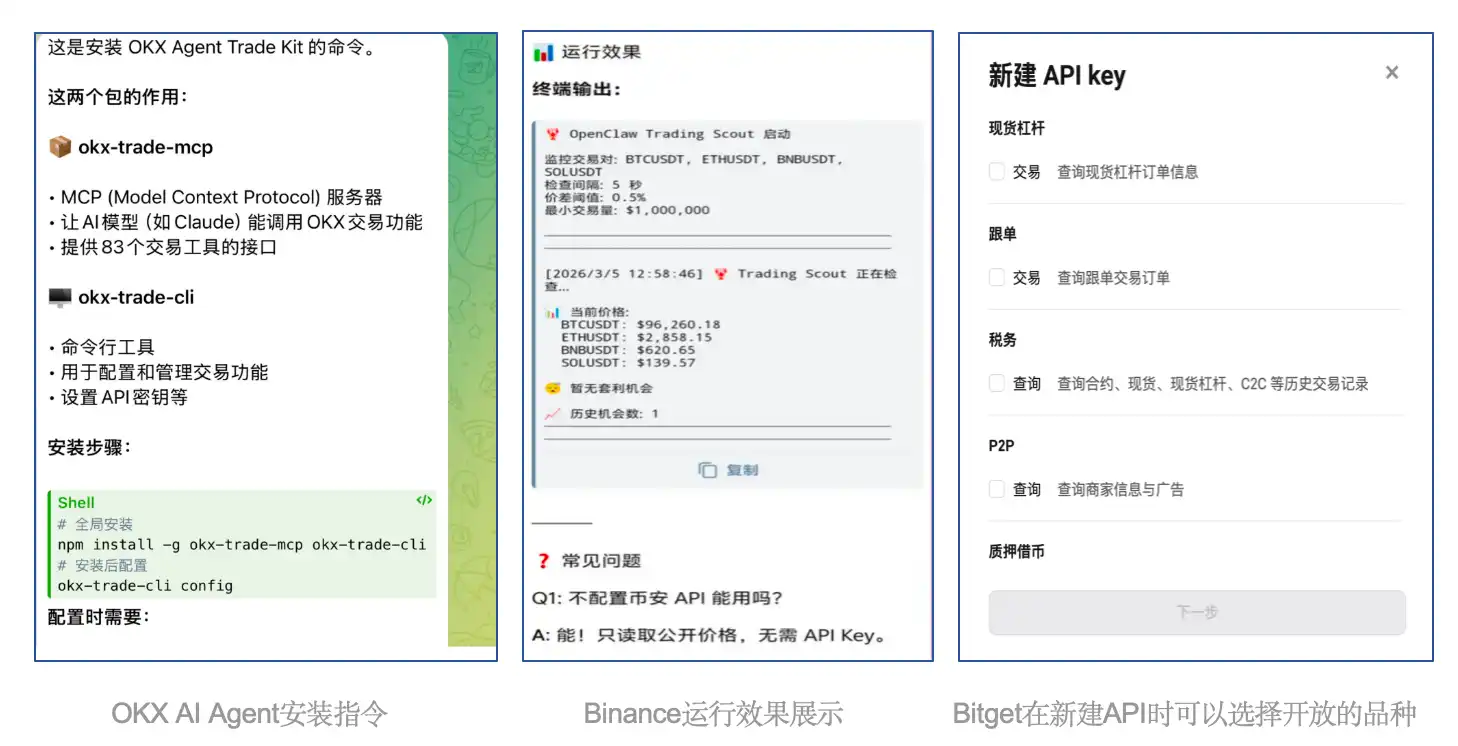
Then there's OKX. Agent Trade Kit is OKX's answer this time, positioned as "trading everything you can do on OKX using natural language." It's open source, with keys stored locally, and AI can't see your credentials throughout the process.
There are two access methods: MCP Server for AI clients such as Claude Desktop, Claude Code, Cursor, and OpenClaw, which can drive transactions by speaking human language; CLI for developers to call via command line, which can receive scripts, run scheduled tasks, and pipe JSON output.
Functional modules are broken down into independent skills and installed on demand: the market data module can be called without an API key, the trading module manages spot/contract/option/algorithmic orders, and the account module manages balance and open positions.
The trading capabilities are a true full-chain CEX solution. Spot market price, limit price, take profit and stop loss, contract opening and closing, OCO, trailing stop loss, grid strategy, batch order cancellation, it's all there. You say "BTC drops to 85000, open a long position, stop loss at 84000", it handles everything from checking the price to placing the order, returning the order ID and transaction status.
However, two modules are currently unavailable: copy trading and wealth management. No corresponding interfaces can be found in the Skills list for these two modules, and they are not currently covered by the Agent.
The overall strength is strong, the battlefield is CEX live trading, and the direction is clear.
Let's take a look at Bitget.
Its approach differs from the previous two. Instead of waiting for third-party developers or distinguishing between on-chain and off-chain operations, it directly integrates the entire CEX transaction chain into a native AI interface, making it usable immediately. Clearly, Bitget began its AI strategy quite early on.
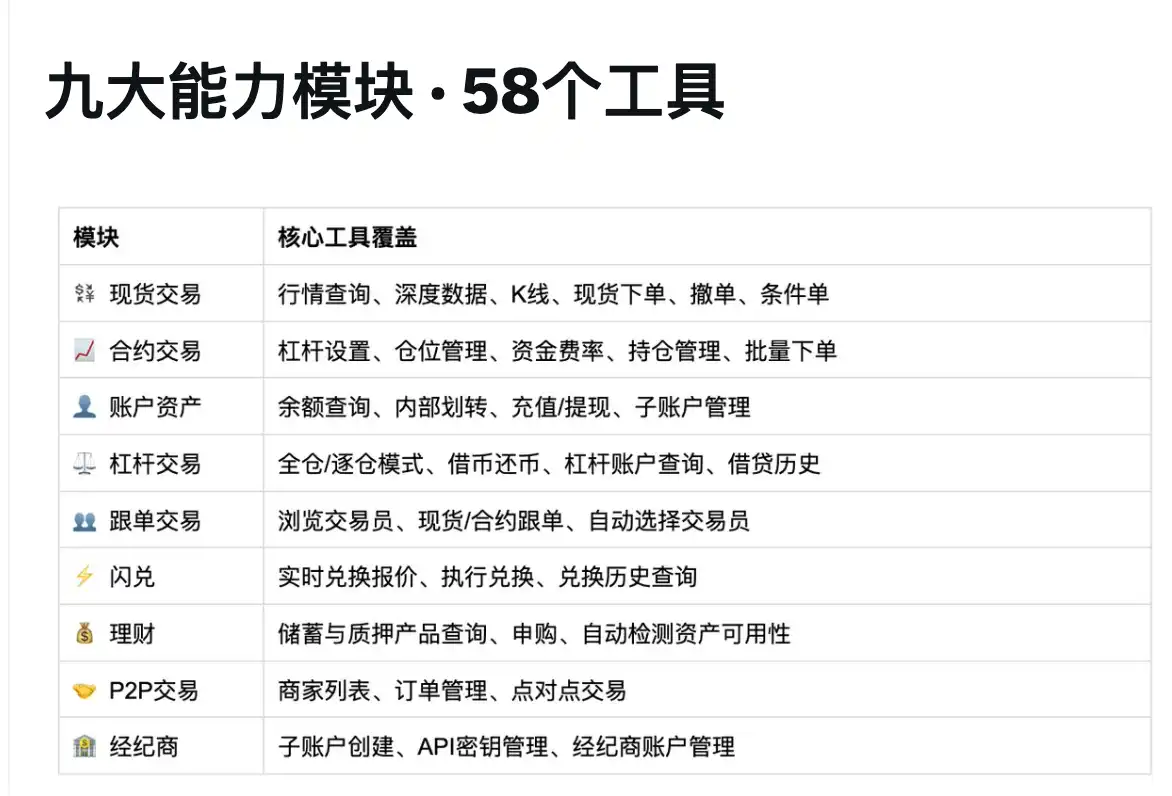
The newly launched Agent Hub, with its 9 modules and 58 tools, opens up almost all the operational needs that exchanges would generate to AI:
It has everything you need for spot trading—market data, candlestick charts, order placement, conditional orders, and order cancellation.
Contracts are also readily available—leverage settings, position management, batch order placement, and funding rate monitoring. At the account level, it allows for transfers, deposits and withdrawals, and sub-account management.
Copy trading allows users to directly browse trader rankings, start trading with one click, and automatically filter trades. The wealth management section allows users to search for products, subscribe, and automatically match available assets. Instant exchange, P2P lending, leveraged lending, and brokerage management are all integrated.
The system supports four access methods simultaneously, catering to different user groups: MCP provides direct connection for Claude, GPT, and OpenClaw, requiring no additional integration code; Skills enables agents to perform intent recognition, knowing which interface corresponds to "place an order," "check position," or "view funding rates"; the CLI tool bgc allows engineers to call via command line, enabling them to run all APIs with a single command and output standard JSON; and the complete API combining REST and WebSocket provides quantitative teams with refined integration capabilities.
With such broad coverage, there's only one underlying logic: to prevent "not being able to code" from becoming a reason for anyone to enter the market. Ordinary users who want to use OpenClaw for their trading, Vibe Coders, quantitative engineers—all three types of people have a path to follow, using their familiar methods without having to compromise with the platform.
With this system in place, Bitget has secured a foothold in the AI Agent era. Once a developer ecosystem is running on a platform, the migration costs are extremely high. The one that gets it up and running first is very difficult for newcomers to challenge.
II. The same question, different answers
Examine the gaps using specific scenarios.
Scenario 1: Buy 500 USDT of ETH. If the price falls below 3200, the stop loss will be automatically triggered. If the price rises to 3800, the take profit will be automatically triggered.
OKX: The Agent Trade Kit spot trading module supports stop-loss and take-profit orders and can execute them.
Binance: Spot Skill supports OCO (Operation-Control-Operation) orders and can execute them.
Bitget: The spot conditional order is complete and can be executed.
All three companies can do it. This is currently the most competitive crossover area, involving basic spot trading plus conditional orders. The barriers to entry are low, and user demand is high, so all three companies are directly competing head-on here. The difference isn't whether they can do it, but how smoothly the integration is handled and how accurately they recognize user intent.
Scenario 2: Help me open a long position in BTC futures when it drops to 85,000, with a position size of 10%.
OKX: The Agent Trade Kit has a complete contract module, supporting spot, contract, options, and algorithmic orders, and can execute them.
Binance: There are no contract skills in Skills Hub.
Bitget: The contract module is complete, and the MCP is pre-configured and can be executed directly.
Scenario 3: Select short-term traders from the copy trading leaderboard with a win rate of over 60% and a maximum drawdown of no more than 15% over the past three months, and automatically start copy trading.
OKX: Agent Trade Kit currently does not have a copy trading module.
Binance: Skills Hub currently does not offer copy trading capabilities.
Bitget: Copy trading is one of the nine major modules, including trader screening, automatic activation, and position management, with all interfaces fully open.
Scenario 4: If you have idle USDT in your account, allocate it to the highest-yielding investment product and reinvest it automatically upon maturity.
OKX: Agent Trade Kit currently does not have a financial management module.
Binance: I currently lack financial management skills.
Bitget: The wealth management module is complete, offering a one-stop service for product inquiry, automatic matching of available assets, and subscription.
Overall, OKX has caught up in contract trading and is now on par with Bitget; however, copy trading and wealth management are not yet available, so there is still a gap.
Binance is currently the most conservative, not even offering contracts. Bitget, on the other hand, offers the most complete version available to CEX users today.
III. Real-world testing: What's it like to integrate Bitget with OpenClaw?
I conducted a full test of Bitget Agent Hub.
The official documentation explains the specific operations very clearly. You only need to copy the code provided by Bitget into your own OpenClaw application to operate it.
OpenClaw says to "install the Bitget CLI tool bgc", which runs as follows:
npm install -g bitget-client
After installation, you can directly call all Bitget APIs from the command line:
bgc spot spot_get_ticker --symbol BTCUSDT
Returns real-time BTC quotes in standard, clean JSON.
Continue telling OpenClaw:
npx skills add bitget/bitget-skill
After installation, OpenClaw has the ability to recognize Bitget's transaction intent, eliminating the need to explain what "placing an order" means; the agent understands it on its own.
Finally, add an MCP Server in the OpenClaw settings, name it bitget-agenthub-mcp, paste the official configuration, and save.
After configuring, test and place a real order.
I issued the order: Buy 100 USDT of BTC, market order.
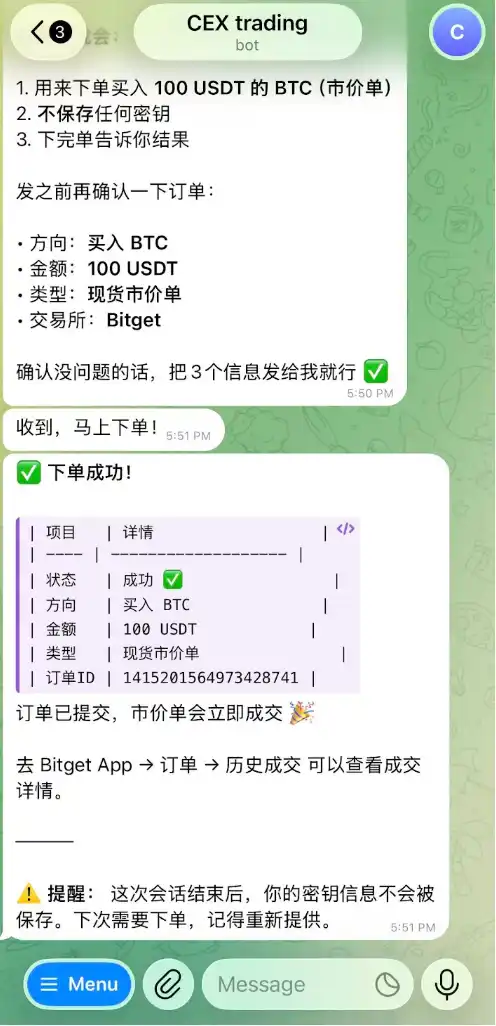
The agent did not execute the order directly but first confirmed the following: direction: buy BTC, amount: 100 USDT, type: spot market order, exchange: Bitget. The agent asked you to confirm the information before providing the API details.
After confirmation, the order is successfully placed, the order status is returned, and the market order is executed immediately.
One noteworthy design element is that the agent explicitly states it will not store any key information; the key is not retained after the conversation ends and must be provided again for the next order. This is a reasonable approach from a security perspective.
Overall, it runs smoothly. The biggest hurdle is binding the API Key for the first time; let me explain how to do it.
In the Bitget backend, click "Create API Key," fill in a name, and set an 8-32 character passphrase. Then select permissions. A detail regarding permissions: if you only need to check market data, balance, and positions, read-only permissions are sufficient; to allow the agent to actually place orders, you must select read-write permissions. You can select the business type as needed: contracts, copy trading, P2P, and spot leverage can be controlled separately. Unnecessary types can be disabled to reduce risk exposure.
After generating the API Key, Secret Key, and Passphrase fields, paste them into OpenClaw to complete the binding. After this step, there will be no obstacles to placing orders via chatbot.
One detail worth noting: After Skills was installed, OpenClaw's identification of transaction intent was more accurate than expected. For vague commands like "Check if there are any suitable financial products in the current market," it could automatically find the query interface for the financial module, without requiring you to say "Call the financial product query API." Using natural language to drive the process is much more convenient than directly calling the API.
IV. The Three Kingdoms Wars Have Just Begun
Developers choose platforms based on simple criteria: the fastest access speed, the most comprehensive capabilities, and access to help with any problems.
To determine whether a platform is worth betting on, consider one thing: can ordinary users get started immediately, and can engineers easily tinker with it? Bitget now offers both. People without coding knowledge can place orders simply by speaking into OpenClaw; quantitative engineers have a complete API and CLI for precise control. With 9 major modules and 58 tools, it covers everyone.
The competition for AI-powered trading infrastructure follows the same logic as the mobile internet app ecosystem in its early days. After iOS and Android solidified their positions, almost no third operating system succeeded. Users flocked to whichever platform developers chose. Once this cycle started, it was extremely difficult for latecomers to catch up.
OKX's Agent Trade Kit is a true CEX competitor in contracts and options, but it hasn't yet filled the gaps in copy trading and wealth management. Binance's Skills Hub is likely to be the largest platform in the long run.
In the arena of AI Agent-based live trading on CEXs, Bitget is currently the fastest moving forward.
Those who get started first build up and thicken their barriers.