Author: Deep Tide TechFlow
introduction
On March 16, 2026, NVIDIA's GTC 2026 conference officially opened, and Jensen Huang's keynote speech once again ignited market enthusiasm.
After listening to the speech, you believed that Nvidia would be a key beneficiary of this global AI wave, so you invested in Nvidia stock.
Without going through a complicated account opening process or waiting for the US stock market to open, you simply clicked a few times, and your on-chain tokenized Nvidia shares were already in your on-chain wallet, with transaction fees that were almost negligible.
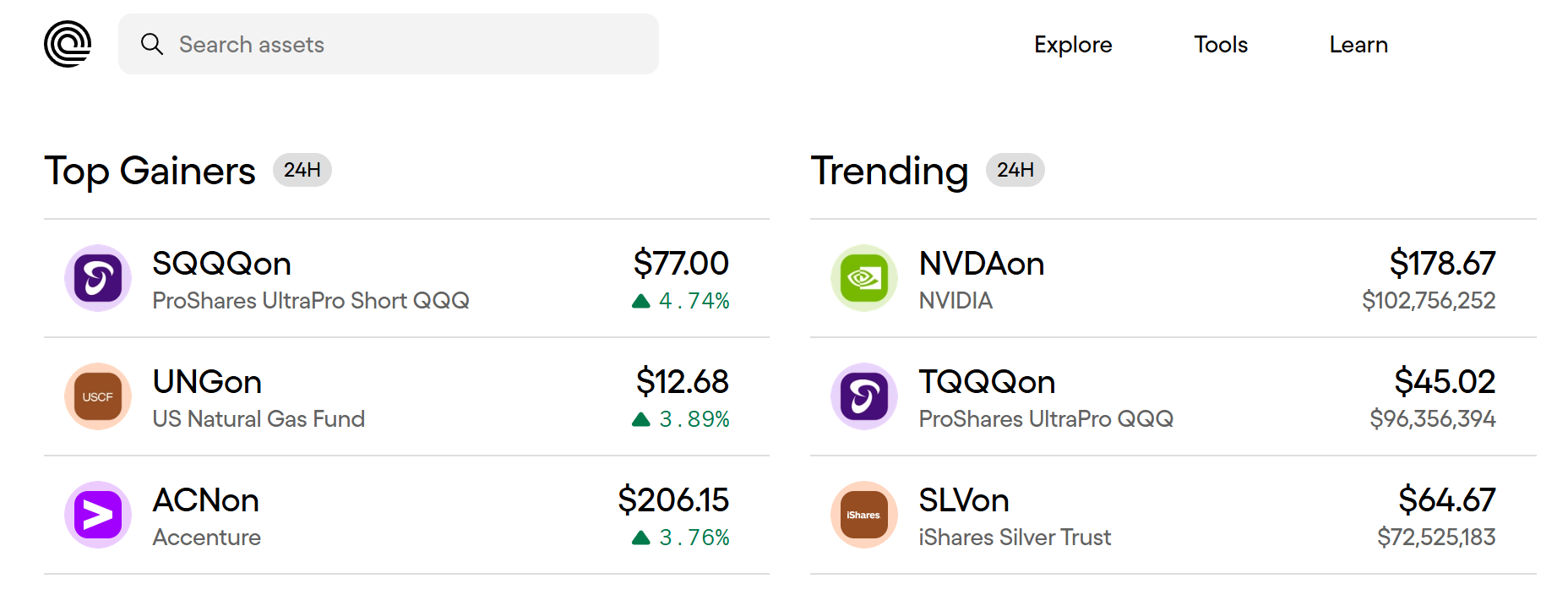
A few years ago, this would have been almost unimaginable. Today, the tokenized stock market has surpassed $1.07 billion in size.
When it comes to the main force that breaks down the walls between ordinary investors and high-quality global assets, Ondo is undoubtedly the name that cannot be ignored.
In September 2025, Ondo Finance, a leading RWA project, announced the launch of Ondo Global Markets, offering trading in over 100 stocks and ETFs simultaneously. This marked the transition of tokenized stocks from scattered experiments to large-scale expansion. Now, just over six months later, Ondo alone holds over 60% of the tokenized stock market share, making it the undisputed leader in this field.
Perhaps this is what truly deserves our attention:
In the first stage of a market with unlimited potential and no shortage of competitors, an almost unavoidable center has already emerged.
When "freely traded stocks on the blockchain" is no longer just a catchy story, a stronger sense of curiosity is piqued by this "cliff-like lead" advantage:
In a place where everyone can see the opportunity, what makes Ondo so capable of being the first to turn that opportunity into its own territory?

Ondo's in-depth data mining: From surface to core, leading the way.
Before answering "Why Ondo?", let's first look at Ondo's lead and how far ahead it is from its competitors.
Data is the most direct way to judge the competitive landscape of a market.
Especially in a sector like tokenized stocks, which is still in its early stages of explosive growth, data often speaks louder than any story in terms of who is leading and who is catching up.
When discussing the competitive landscape of tokenized stocks, most people often use the term "duopoly" to describe the situation where Ondo and xStocks coexist, but the sheer size of the capital base offers a different answer.
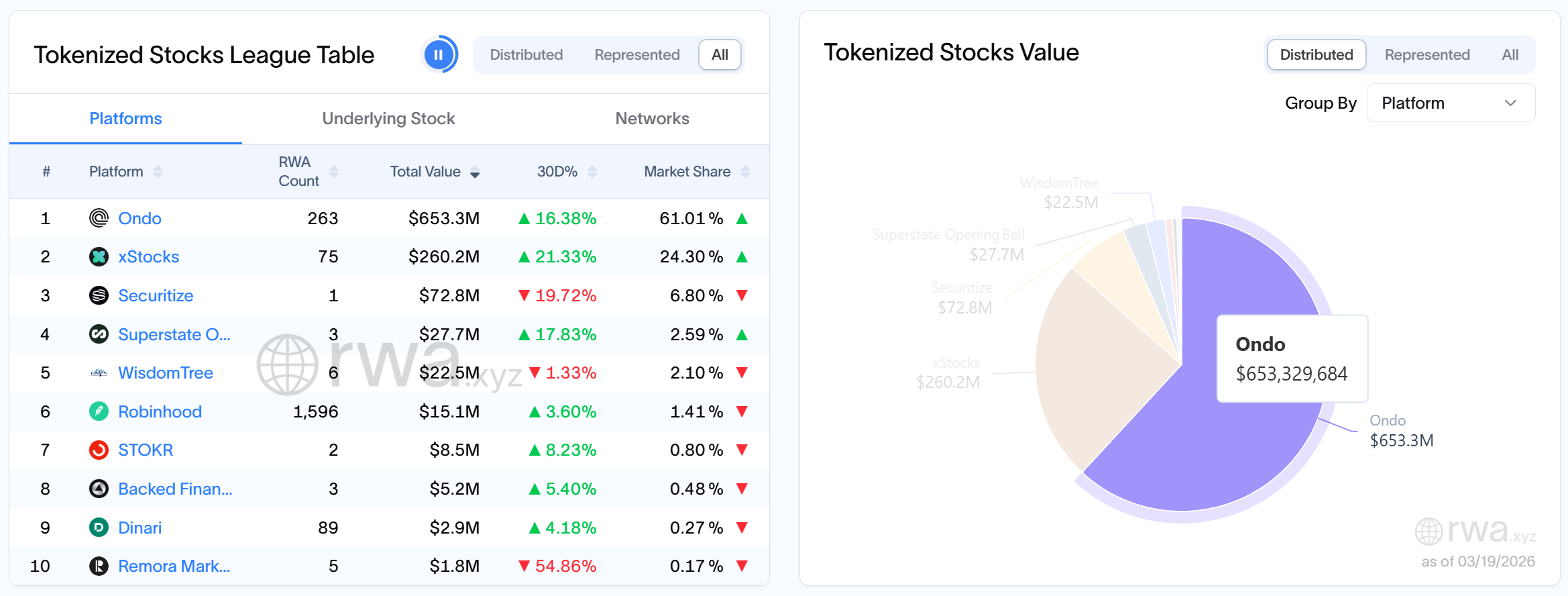
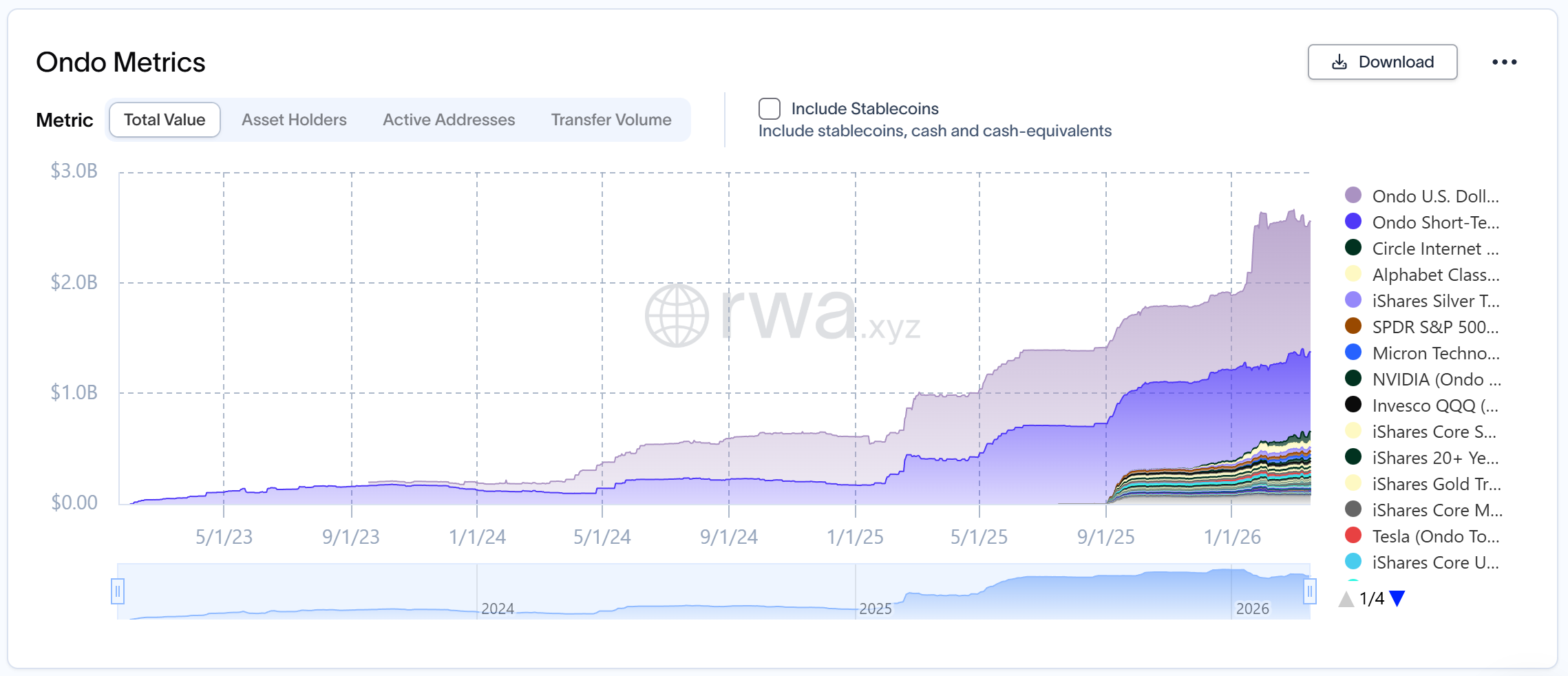
According to data from RWA.xyz, the total on-chain value of tokenized stocks has now exceeded $1.07 billion, with Ondo alone accounting for approximately $653 million. Looking back further, we find that as early as January 2026, Ondo's on-chain value of tokenized stocks already surpassed the combined value of all other platforms, and this advantage has not only not diminished but has continued to widen.
In terms of market share, Ondo holds over 61% of the tokenized stock market, while xStocks, ranked second, holds 24.65%.
Compared to the "duopoly" structure, Ondo, with a market share 2.47 times that of the second-place company, has already taken a significant lead.
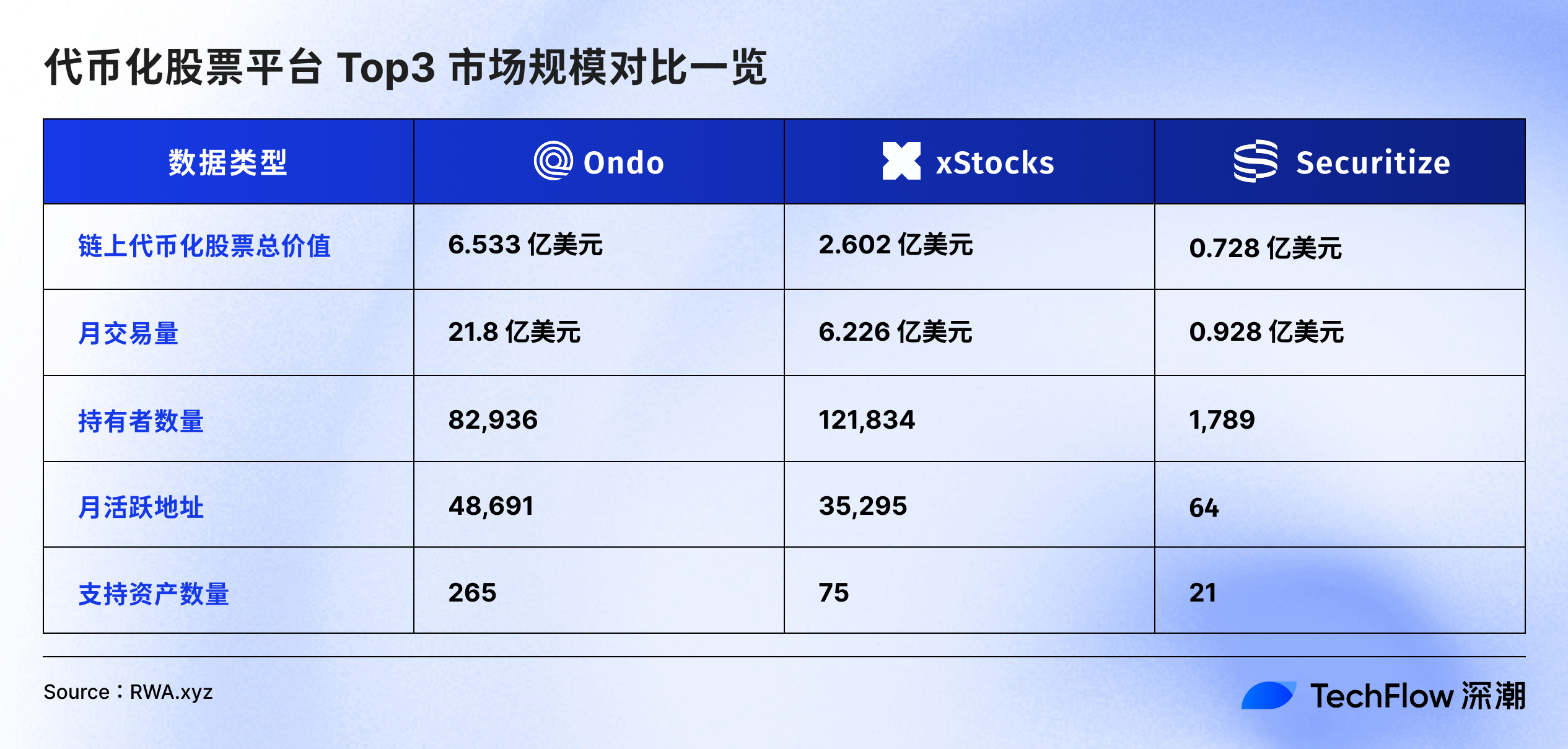
Looking at transaction volume and users provides an even more direct comparison.
According to official data, Ondo's cumulative trading volume has exceeded $12.7 billion, with a peak daily trading volume of $170 million and a monthly trading volume of $2.18 billion.
Meanwhile, according to RWA.xyz data, with the total number of holders in the tokenized stock sector currently around 199,000, the Ondo platform has 82,900 holders, accounting for approximately 41.7%. Although this is slightly lower than the 121,800 holders on the xStocks platform, Ondo's monthly active addresses of 48,600 are higher than xStocks' 35,200.
The higher frequency of transactions and more active users represented by these two sets of data clearly demonstrate that Ondo's leadership is not just about "money gathering here," but about "truly making the stock market happen on-chain."
What's even more noteworthy is that this market's growth continues:
According to data from RWA.xyz, Ondo's user base grew by 11.03% in the past 30 days. With an existing market share of 61%, maintaining double-digit monthly user growth indicates that Ondo's current lead is not a completed, existing result, but rather a dynamic process that is still accelerating.
No matter which dimension you look at it from, the data all point in the same direction: Ondo is a leader in the tokenized stock market.
But data can only tell you "how much ahead", but it can't answer "why you're ahead".
The only certainty is that this multi-dimensional, groundbreaking lead is not the accidental result of a single product decision, but rather the embodiment of a complete strategy.
This playing style is what truly deserves to be analyzed and dissected.
Behind its absolute prominence: a "triple play" of asset coverage, transaction experience, and ecosystem entry point.
To successfully implement tokenized stocks, there's much more to it than simply putting stocks on the blockchain.
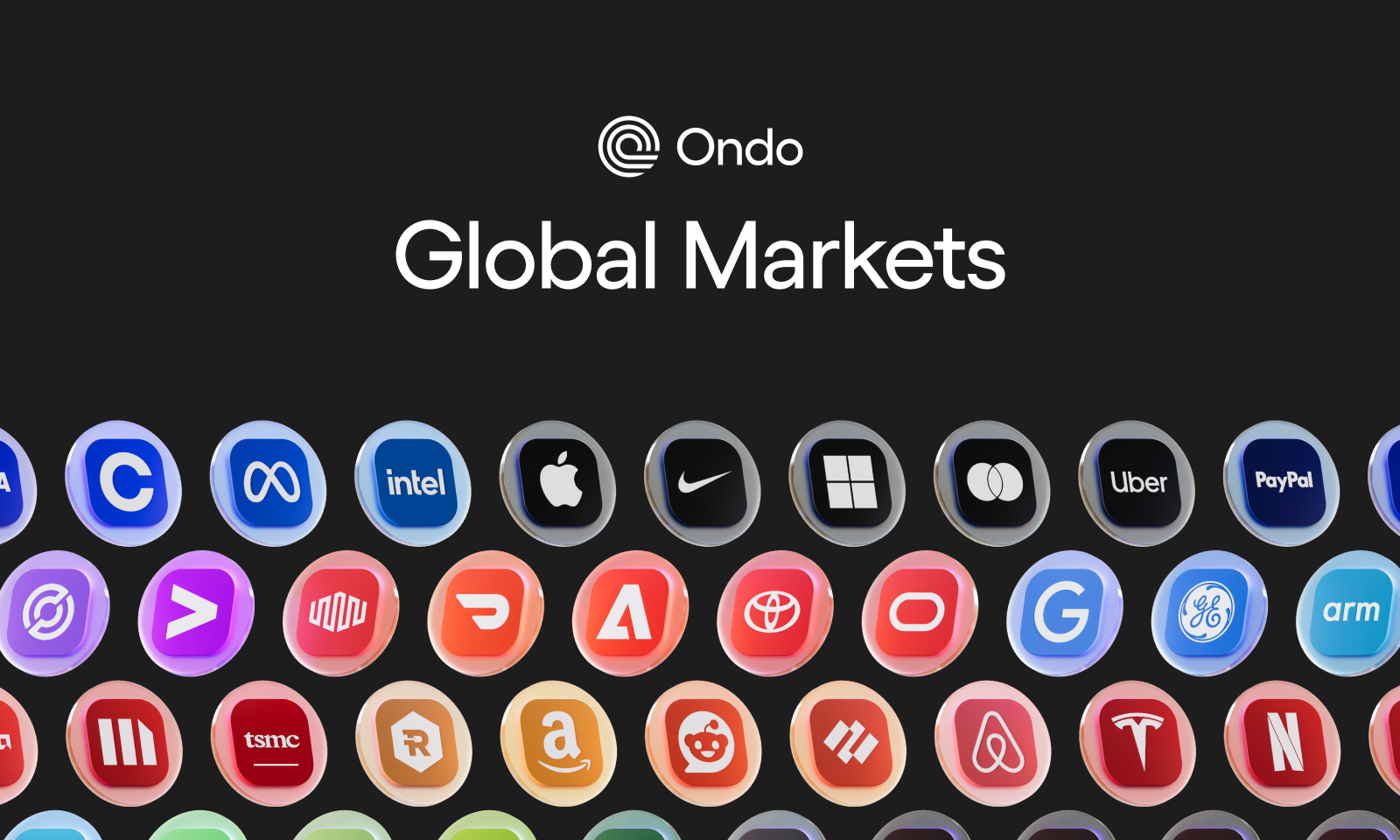
Supports 265 tokenized stocks, filling the "shelves" of the on-chain stock market.
265 is the number of tokenized shares supported by Ondo; no other platform supports more.
The 265 tokenized assets cover multiple asset classes, including US-listed companies, Chinese concept stocks, energy and commodity-related assets, bonds, index ETFs, and leveraged and inverse ETFs.
The fuller the shelves and the more choices there are, the more users can be satisfied, and the more reasons there are to retain users.
Faster, better, and cheaper – the on-chain stock trading experience is top-notch.
Of course, once more stocks are put on the blockchain, the focus of the competition becomes "why should users trade stocks on the blockchain and here?"
This is a competition of trading experience.
Compared to other platforms, Ondo supports 24/7 trading, meaning users don't have to stay up all night waiting for the US stock market to open. Ondo also offers better liquidity, smaller spreads, and lower fees. Slippage on large transactions is often below 0.03%, prices are almost in real-time with Nasdaq, and there are no minting, redemption, or administration fees.
Whether it's faster, better, or cheaper, every small improvement in the user experience addresses the user's most sensitive concerns.
All of this is inseparable from the fundamentals of Ondo's underlying design. The most crucial aspect is Ondo's design of "encapsulated tokenization + instant atomic minting and destruction".
The reasons for choosing the encapsulated tokenization design are quite compelling: in the native tokenization model, tokens are legal shares and need to be directly recorded in the issuer's equity structure table, which is too slow and involves too complex legal procedures.
In contrast, tokenization is more pragmatic and scalable: Tokens are pegged to real-world assets and, with the help of regulated custodians and mature market infrastructure, publicly traded assets are put on-chain without the need for issuers. Tokens represent claims on underlying shares and are held by custodians.
Regarding the custody risks associated with the encapsulation model, Ondo President Ian De Bode offered a vivid analogy: stablecoins are essentially encapsulated tokens.
This leads to a very interesting discussion: given that stablecoins are such a successful "pilot version," if we can accept bringing the US dollar onto the blockchain in this way, why can't we accept bringing stocks onto the blockchain in this way?
Ondo President Ian De Bode's view is also clear: the encapsulation model built with a robust legal, custodial, and verification framework is currently the most effective and scalable method for putting real-world assets on-chain.
The market feedback has, to some extent, confirmed this: Ondo's encapsulation model holds 60% of the market share, while platforms that attempt to adopt stricter or more native token structures have only single-digit market shares.
If tokenization solves the problem of "how to bring assets onto the blockchain", then instant atomic minting and destruction solves another key problem: how to make these assets traded more efficiently on the blockchain.
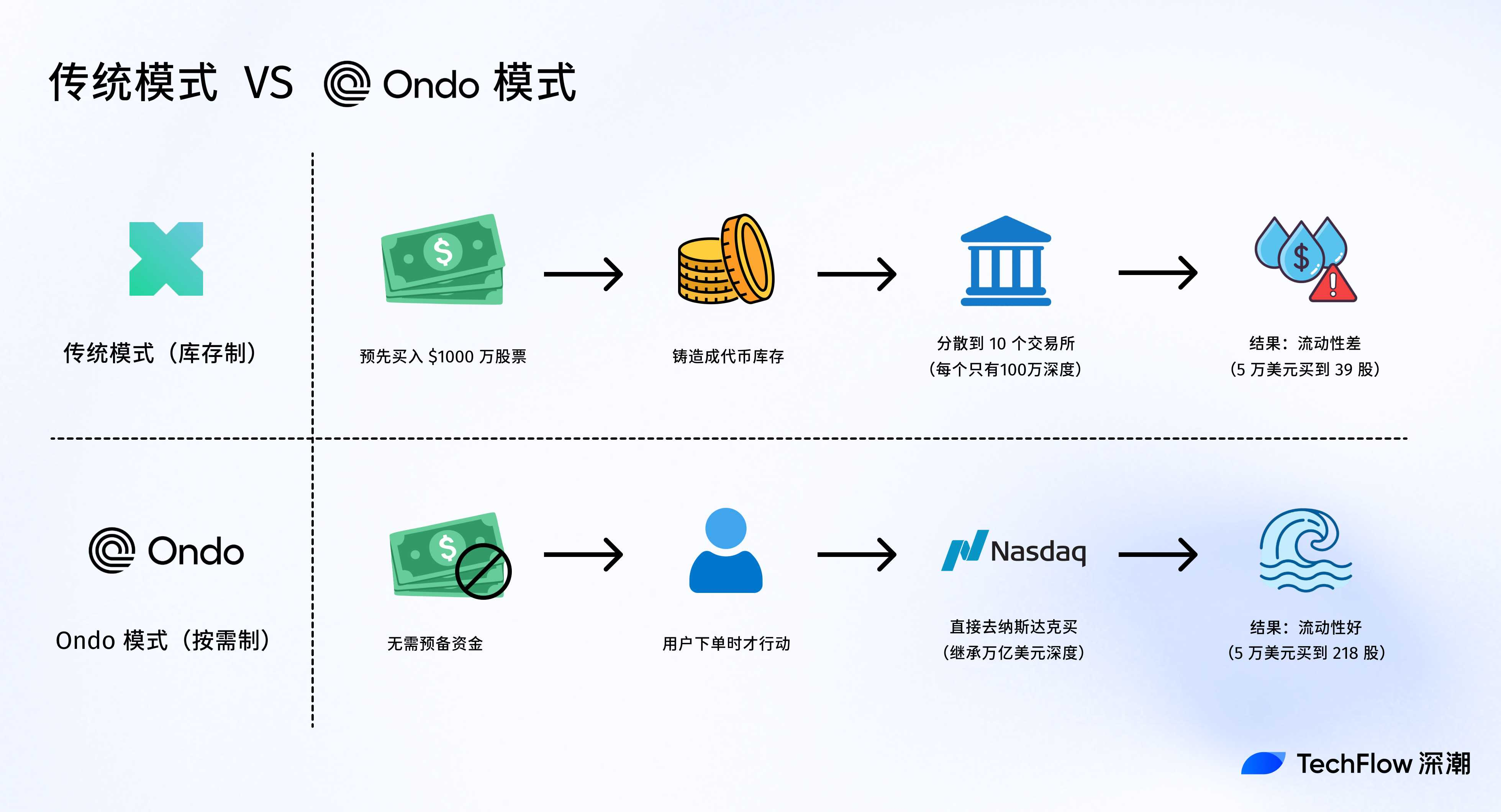
Unlike traditional models that hoard inventory and build liquidity in advance, Ondo only buys real shares and mints tokens on-chain when a user places an order.
Once the token is minted, it becomes a standard ERC-20 token that can circulate on-chain 24/7 and participate in on-chain finance.
When a user wants to sell, Ondo will burn the tokens and sell the shares on Nasdaq.
This mechanism effectively avoids the cumbersome path of "stocking up first and then selling" in the traditional model, bringing Ondo two irreplaceable advantages: first, stronger liquidity in an open market, directly accessing the trillions of dollars of liquidity in the traditional market; second, scalability, since there is no need to prepare a fund pool for each stock in advance, the platform can easily expand to hundreds or even thousands of stocks.
Beyond technology, the more crucial thing is: seizing the entry point.
While it's true that "good wine needs no bush," technology determines a product's potential, but distribution often determines its growth rate.
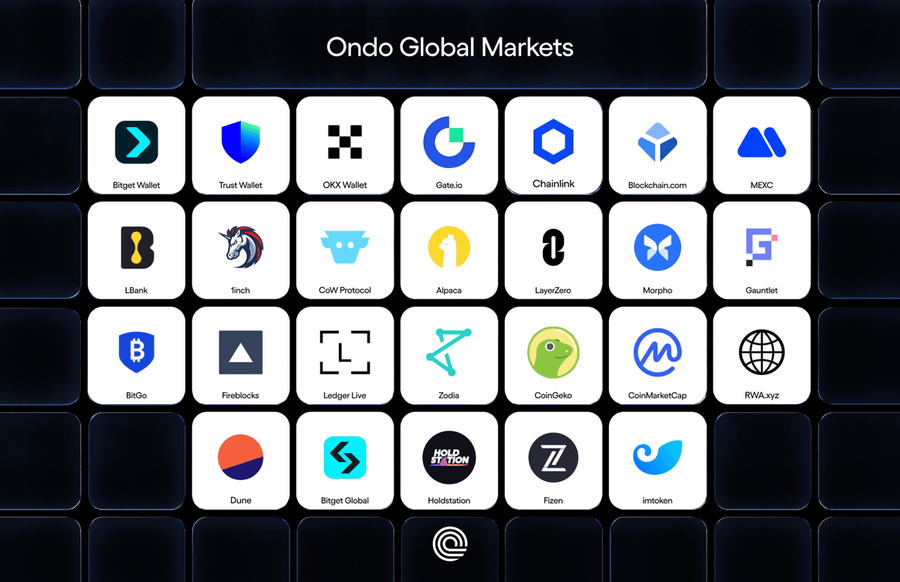
Therefore, in addition to honing its technology and product capabilities, another key move by Ondo is to widely embed Ondo tokenized stocks and ETFs into the most frequently accessed entry points for users through extensive cooperation.
On the wallet side, Ondo has partnered with well-known wallet projects such as MetaMask, Trust Wallet, and Ledger; on the exchange side, Ondo connects to leading trading platforms such as Binance, Bitget, and Gate; on the DeFi side, it integrates with active protocols such as Morpho, PancakeSwap, and 1inch; in terms of multi-chain expansion, Ondo has also connected to several mainstream chains with large user bases, such as Ethereum, Solana, and BNB Chain, and will expand to Ondo Chain in the future.
The significance of this event goes far beyond just having an attractive list of partners; it truly changes the user reach path.
When wallets, exchanges, and DeFi protocols all begin to become distribution channels for Ondo, it means that users will not have to specifically look for Ondo, but will encounter it continuously in their already familiar usage paths.
Once the entry point is secured, customer acquisition costs, usage barriers, and migration difficulties will all be rewritten simultaneously.
The data shows that this strategy has yielded immediate results: both integration with Solana and partnerships with Binance Alpha have brought Ondo significant increases in trading volume and active users. According to official data, since partnering with Ondo in September 2025, the trading volume of tokenized stocks and exchange-traded funds aggregated through the 1inch aggregator has exceeded $2.5 billion.
With its combined strengths in asset breadth, transaction experience, and ecosystem access, Ondo essentially answers the three questions users care about most: Is what I want to buy here? Is the buying experience good? Can I use it anywhere?
Because these questions have been answered in advance, in addition to analyzing the present, we also want to clarify the future regarding Ondo's leading position.
On the eve of putting $150 trillion in stocks on-chain, Ondo's narrative of "new on-chain asset infrastructure"
When discussing growth in a market like tokenized stocks, one cannot focus solely on the blockchain.
Looking at the present, tokenized stocks are already quite exciting: the market size has exceeded $1 billion, discussions are rapidly heating up, leading platforms are emerging, and more and more users are buying familiar US stocks and ETFs on-chain for the first time.
However, it's important to know that the total market capitalization of the global stock market is approximately 150 trillion, making the $1 billion scale of tokenized stocks seem like a drop in the ocean.
The tokenized stock market is less about fierce competition and more about a supermarket that has just been opened to the public.
And this is precisely the starting point for Ondo's future growth to be discussed separately.
In a market where the development rate is less than 0.001%, due to the frictions of traditional stock market brokerage commissions, custody fees, exchange losses, T+2 settlement time costs, and account opening thresholds, as long as on-chain stocks continue to outperform traditional paths in terms of trading time, cross-regional availability, settlement efficiency, liquidity allocation, and usage costs, more and more users will be willing to migrate, and more and more assets will be willing to be brought on-chain.
Building on this, Ondo's progress in compliance will further fuel its growth: Previously, due to compliance requirements, Ondo's tokenized shares were subject to strict geographic restrictions, prohibiting participation by U.S. citizens or residents. In November 2025, the SEC announced the conclusion of its two-year investigation and did not recommend charges against Ondo. Shortly before this, Ondo announced the acquisition of SEC-registered brokerage firm Oasis Pro Markets; both moves will accelerate Ondo's development in the U.S. market.
Meanwhile, another driving force comes from Ondo's undeniable leadership in the tokenized stock market.
Of course, from the perspective of the long-term healthy development of the industry, the community may not want to see one platform dominate for an extended period. Competition is always a good thing, and a diverse ecosystem is more conducive to innovation.
However, if we return to the realities of business and the laws of the market, we must also admit that once a center has been established, it is usually not easily replaced, and Ondo has clearly become that center.
The financial market is never a world where flow and capital are evenly distributed, especially in on-chain finance. The more a sector relies on liquidity, depth, brand, trust, and collaboration, the more likely it is to exhibit a pronounced Matthew effect: users will flock to the places with the deepest liquidity, funds will gravitate towards the platforms with the strongest consensus, and partners will prioritize connecting to the player with the best chance of becoming infrastructure. Once a positive feedback loop is formed, it becomes increasingly difficult for new players to catch up.
Beyond market space and centrality, the third growth logic that deserves more attention is DeFi composability.
In traditional markets, the rights to hold a stock often only mean: price increases, price decreases, and dividends.
When a stock is tokenized on the blockchain, it is no longer just a "tradable asset" but begins to become a "composable asset".
The difference between these two is not a function, but an entire imaginative space.
You can hold it, trade it, stake it, and connect it to an aggregated trading network, allowing it to freely seek better liquidity and lower execution costs across different platforms. It's like a building block that can be embedded into the entire financial system; once the underlying interface is opened, that's when tokenized stocks can truly leverage super leverage.
Judging from Ondo's series of collaborations and integrations with DeFi projects, it is clear that Ondo is well aware of this.
For example, through its partnership with 1inch, Ondo's tokenized shares will achieve better liquidity based on its aggregated trading functionality. Furthermore, Morpho has confirmed that it will accept Ondo's share tokens as collateral, allowing users to use on-chain shares for DeFi lending in the future. This will further enhance the usability of tokenized shares, transforming them from isolated assets into nodes that can connect with more DeFi components. As more DeFi modules are gradually improved, this potential will only continue to expand.
Any one of these three forces, if it comes into play, would be enough to support Ondo's continued growth.
If these goals materialize simultaneously in the coming years, then Ondo Global Markets' narrative may not be limited to a simple "tokenized stock platform," but rather represent a more imaginative growth space for new on-chain asset infrastructure.
And this may be the most noteworthy aspect of Ondo's future growth.