
Written by Eric, Foresight News
On the evening of March 26, Beijing time, the Wall Street Journal reported that Fannie Mae, the U.S. mortgage finance giant, will accept cryptocurrency mortgages for the first time, in a collaboration between Coinbase and Better Home & Finance Holding Co., a Fannie Mae-approved mortgage lending company.
This move, which was seen as yet another instance of recognition from traditional financial institutions in the Web3 field, was almost completely drowned out by widespread skepticism from netizens…
According to reports and Better's announcement, this loan is only for "down payments" and aims to address the tax-related hassles that homebuyers face when selling assets to make a down payment. Currently, only Bitcoin and USDC are supported crypto assets, requiring borrowers to transfer their coins to a Coinbase escrow address, with collateral ratios of only 40% and 80% respectively. Furthermore, the interest rate for cryptocurrency-backed loans is 0.5% to 1.5% higher than traditional mortgage rates.
The good news is that borrowers don't need to replenish collateral due to a drop in Bitcoin prices; the collateral will only be liquidated if it's overdue for 60 days. However, the fact that USDC is only 80% collateral makes it a bit risky.
This loan product is not designed for mortgages, but for down payments. In other words, it gives you the "opportunity" to mortgage Bitcoin to borrow money for a down payment, and then mortgage the house you bought to borrow money for the rest of the purchase, thus taking on two loans.
Let's do a simple calculation. Suppose you want to buy a property priced at $400,000, with a 20% down payment, which is $80,000. If you use Bitcoin as collateral to pay this $80,000, you would need to pledge $200,000 worth of Bitcoin. Currently, the most common 30-year fixed mortgage rate in the United States has an average weekly rate of approximately 6.38% as of March 26th. The interest rate for borrowing money with Bitcoin as collateral could potentially approach 8%.
On Reddit, many Americans are puzzled by this: If I have $200,000 in Bitcoin in my portfolio, how come I can't afford an $80,000 down payment? If I can't afford a down payment, how can I possibly afford to buy Bitcoin?

Of course, there are also many voices of support. Some netizens pointed out that the high capital gains tax means that if you sell $1 million worth of Bitcoin, you may only receive $650,000 in return. However, this method allows you to leverage your Bitcoin holdings to buy a house, providing many people with another option.
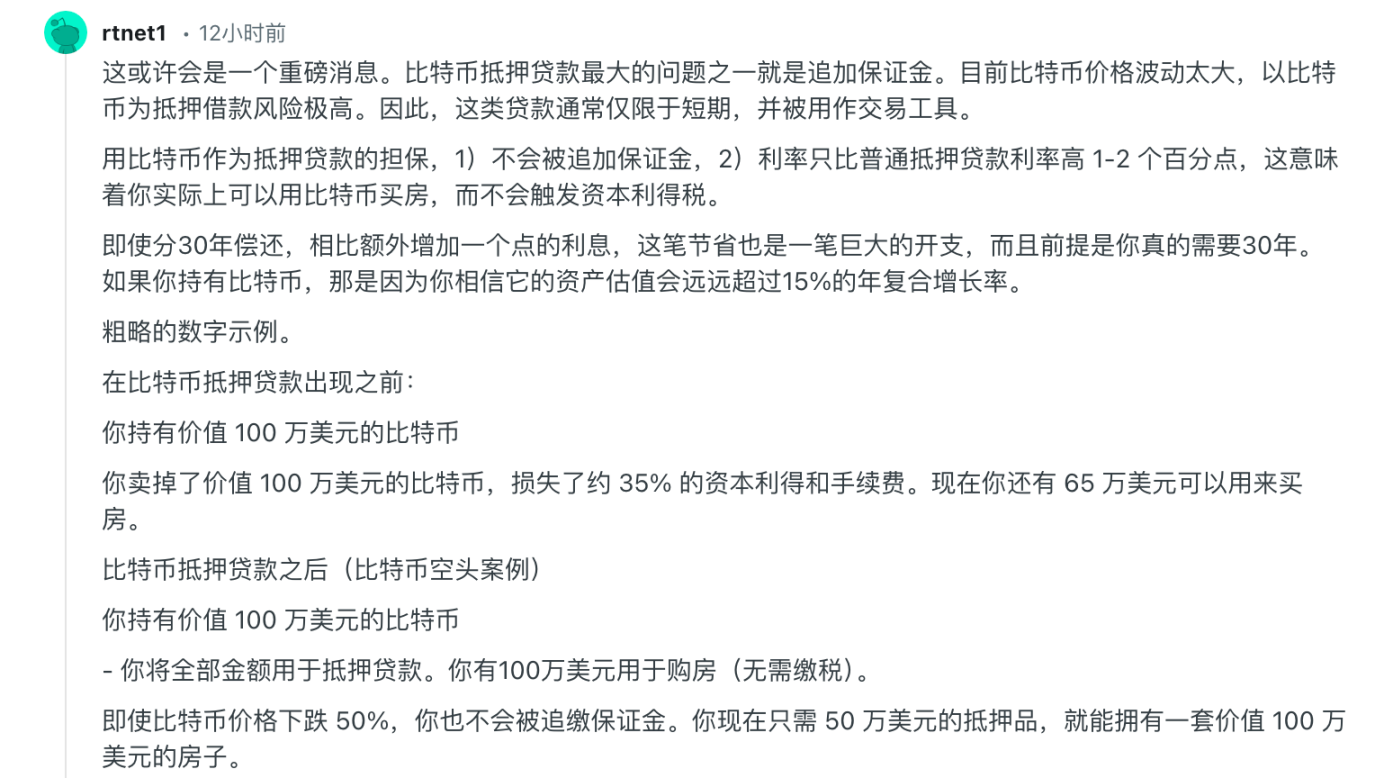
Although there are many supporters, judging from their descriptions, they are at least middle-class and have a relatively deep understanding of finance and taxation. This has sparked a discussion about "helping the rich but not the poor."
Axios also mentioned in its report that this product is "not a broad-based first-time homebuyer product," implying that while it may offer additional assistance to those with a certain level of financial means, it doesn't address a more pressing and practical problem:
Mortgage default rates among low-income groups have risen sharply since the end of last year.
Many ordinary people on Reddit have also expressed their dissatisfaction with this. According to the latest report released by Cotality in February 2026, the national mortgage default rate (more than 30 days overdue) in the United States in December 2025 will remain unchanged from December 2024, at 3.2%. Federal Reserve data shows that the single-family residential mortgage default rate in the fourth quarter of 2025 was 1.78%.
However, the data for FHA loans (government-guaranteed home purchase loans) targeting low-income groups presents a stark contrast. In the third quarter of 2025, the FHA loan default rate reached 10.78%, an increase of 21 basis points from the previous quarter, with the serious default rate increasing by nearly 50 basis points year-on-year. Furthermore, the FHA loan delinquency rate exceeded 11%, accounting for 52% of all seriously delinquent loans.
The criticism focuses on whether Fannie Mae is using a larger risk to try to cover up a risk that is already spreading.
As early as mid-2025, the Federal Housing Finance Agency instructed Fannie Mae and Freddie Mac to study whether cryptocurrency assets should be included in loan approval considerations. At that time, many academics in the financial industry expressed their opposition, with the core concern being that relaxing the standards seemed to be exactly the same as the situation before the 2008 subprime mortgage crisis.
In the US, early repayment of a loan incurs a hefty penalty, meaning that securing a loan often requires locking up your Bitcoin for an extended period. If you only have 5 Bitcoins, mortgaging them all to buy a house and then holding them for 30 years is unlikely to be appealing. However, if you have 200 Bitcoins, mortgaging 50 or even 100 to improve your living conditions seems much more reasonable, as it's a long-term holding that you're unlikely to sell.
For wealthier individuals with more abundant cash flow, using Bitcoin as collateral to purchase a home offers leverage without disrupting their investment portfolio, allowing them to continue investing in other assets, or simply provides asset swapping capabilities. But what the poor don't understand is: why would you assume I can't afford a house because I bought Bitcoin?

Embedding Bitcoin into the complex traditional financial system is an area worth exploring, but the risks are unknown. To borrow a joke from a Reddit user, when Bitcoin truly becomes "too big to fail," could it be the trigger for the next disaster?