Author: CoinGecko
Compiled by: Deep Tide TechFlow
Summary: CoinGecko released its 2026 Spot CEX Report, covering 12 major centralized exchanges globally. The report reveals several key facts: USDT and USDC account for nearly 98% of stablecoin trading pairs; only 32% of newly listed tokens outperformed their initial offering price in the short term, and almost all fell below their initial offering price after 12 months; total exchange reserves increased from $152.1 billion to $225.4 billion; and funds are flowing from institutional platforms like Coinbase to retail-driven exchanges like Bitget and MEXC.
Since the inception of the crypto market, centralized exchanges (CEXs) have been the core gateway for retail and institutional investors to access liquidity. In 2025 alone, the top 12 CEXs processed nearly $21 trillion in spot trading volume. As the industry matures, the focus is shifting to the sustainability of spot trading activity and the health of the underlying reserves supporting these massive volumes of trading.
The competitive landscape of centralized exchanges (CEXs) is changing. USDT and USDC dominate trading pairs, and the performance of newly listed coins remains a major challenge. By 2026, the total reserves of the top 12 CEXs will reach $225.4 billion, with funds migrating from institutional giants to platforms with high turnover rates and driven by retail investors.
The following are the report's four core findings. The full report is 21 pages long and is recommended for download.

1. USDT and USDC account for 66.6% of trading pairs, with stablecoins almost monopolizing spot trading.
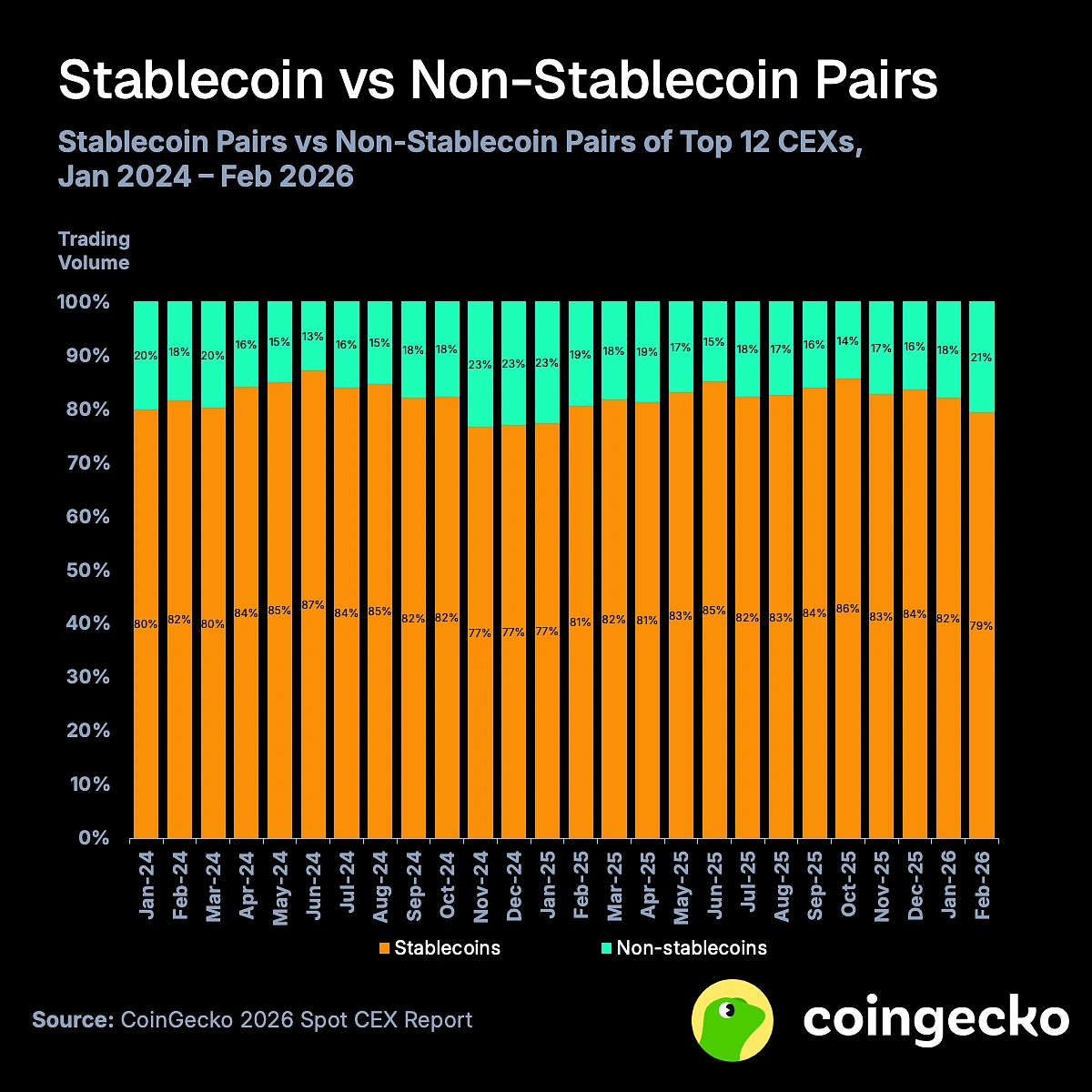
Chart: Stablecoin to Non-Stablecoin Trading Pairs on 12 Major CEXs
The vast majority of spot trading volume on the 12 major CEXs is completed through stablecoin trading pairs such as USDT and USDC.
Specifically, of the 9,870 stablecoin trading pairs, 9,646 are USDT or USDC, accounting for 97.7%. There are 4,615 non-stablecoin trading pairs, accounting for 31.9% of all 14,485 trading pairs.
However, the number of trading pairs and trading volume are not directly proportional. The trading volume of non-stablecoin trading pairs peaked in November 2024, at only 23%.
2. New coin listings are the peak: only 32% recorded positive returns in the short term, and almost all were wiped out after 12 months.
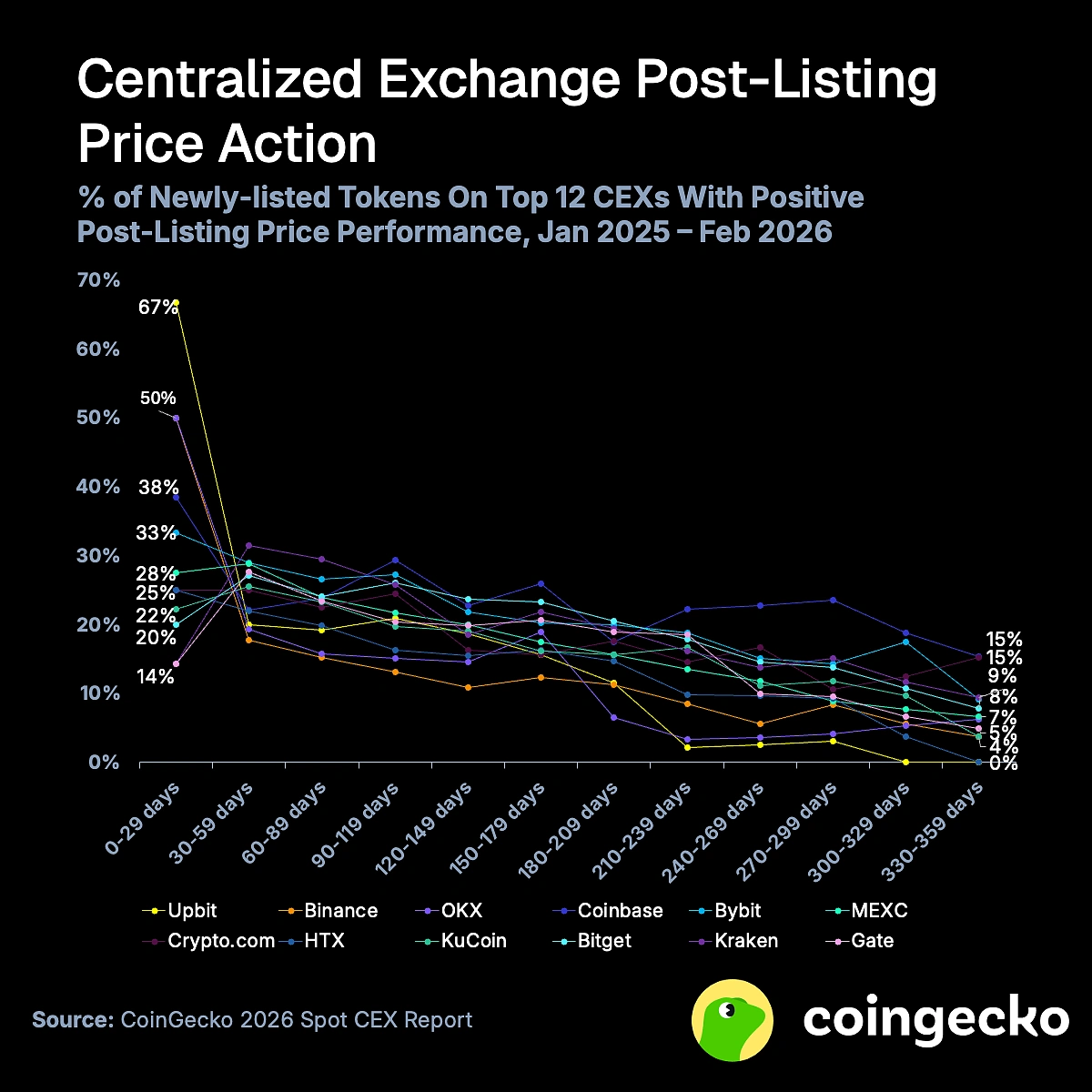
Chart: Price performance of newly listed tokens on 12 major CEXs
Among the 12 leading exchanges, Upbit showed the best short-term performance for new coins after listing, with 67% of them still profitable 30 days after launch. However, Upbit also listed the fewest coins. Following closely were Binance and OKX, both with a 30-day positive return of 50%.
The performance of tokens varied greatly across exchanges during the first 0-29 days after listing, but the gap narrowed rapidly after 30 days. On average, only 25% of tokens remained profitable after 30-59 days.
Over a longer period, the performance of various exchanges tends to decline linearly. The only exception is Coinbase, whose listed tokens experienced a "recovery" after six months.
By the 12-month mark, less than 10% of the tokens listed on most leading exchanges were still above their issue price. Upbit's data was particularly dramatic: it had the best start but also the fastest decline, with all newly listed tokens falling below their issue price by days 300-329.
On March 12th, total reserves on major CEXs increased from $152.1 billion to $225.4 billion, with Binance more than doubling and leading the pack.
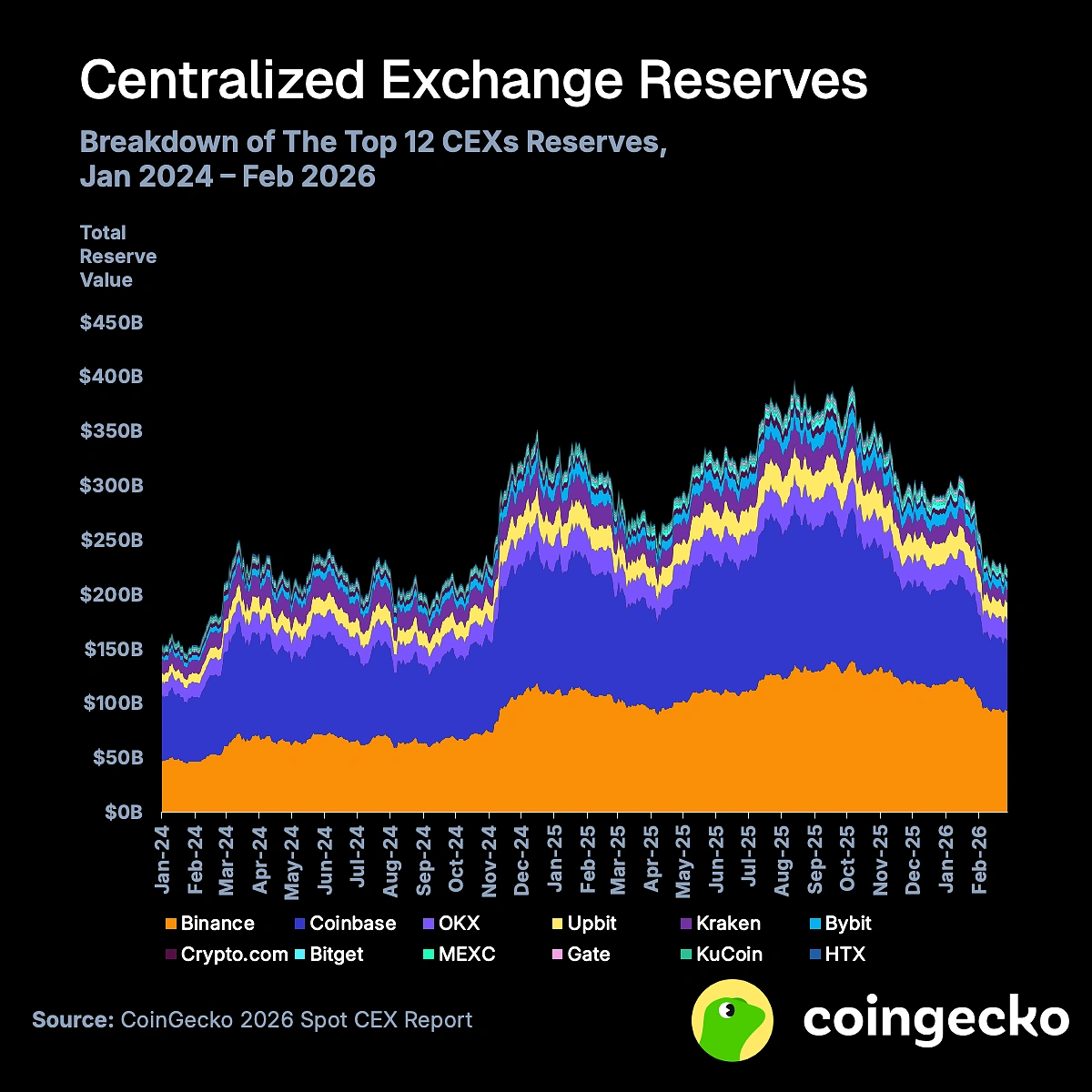
Figure: Changes in the value of reserve assets of 12 major CEXs (2024-2026)
While the price increases of BTC and ETH have boosted the reserve value of most exchanges, price volatility and stricter regulations are driving users to move funds from major exchanges to other platforms.
From the beginning of 2024 to the end of February 2026, the total value of underlying assets of the 12 leading CEXs increased by an average of 69.6%, from $152.1 billion to $225.4 billion.
Eight exchanges recorded net reserve growth, with Binance leading the pack. Its reserves more than doubled from $46.7 billion to $93.4 billion in two years.
In terms of BTC reserves, Coinbase ranks first with over 800,000 BTC, followed closely by Binance with 669,000 BTC. However, Coinbase experienced net outflows of 20% and 41% in its BTC and ETH reserves, respectively.
A significant portion of these outflowing funds flowed into smaller exchanges like Bitget and MEXC, where their reserve values surged by 262.0% and 274.6%, respectively.
4. Retail-based exchanges have a much higher capital turnover rate than institutional exchanges; MEXC's turnover rate is 20 times that of Coinbase.
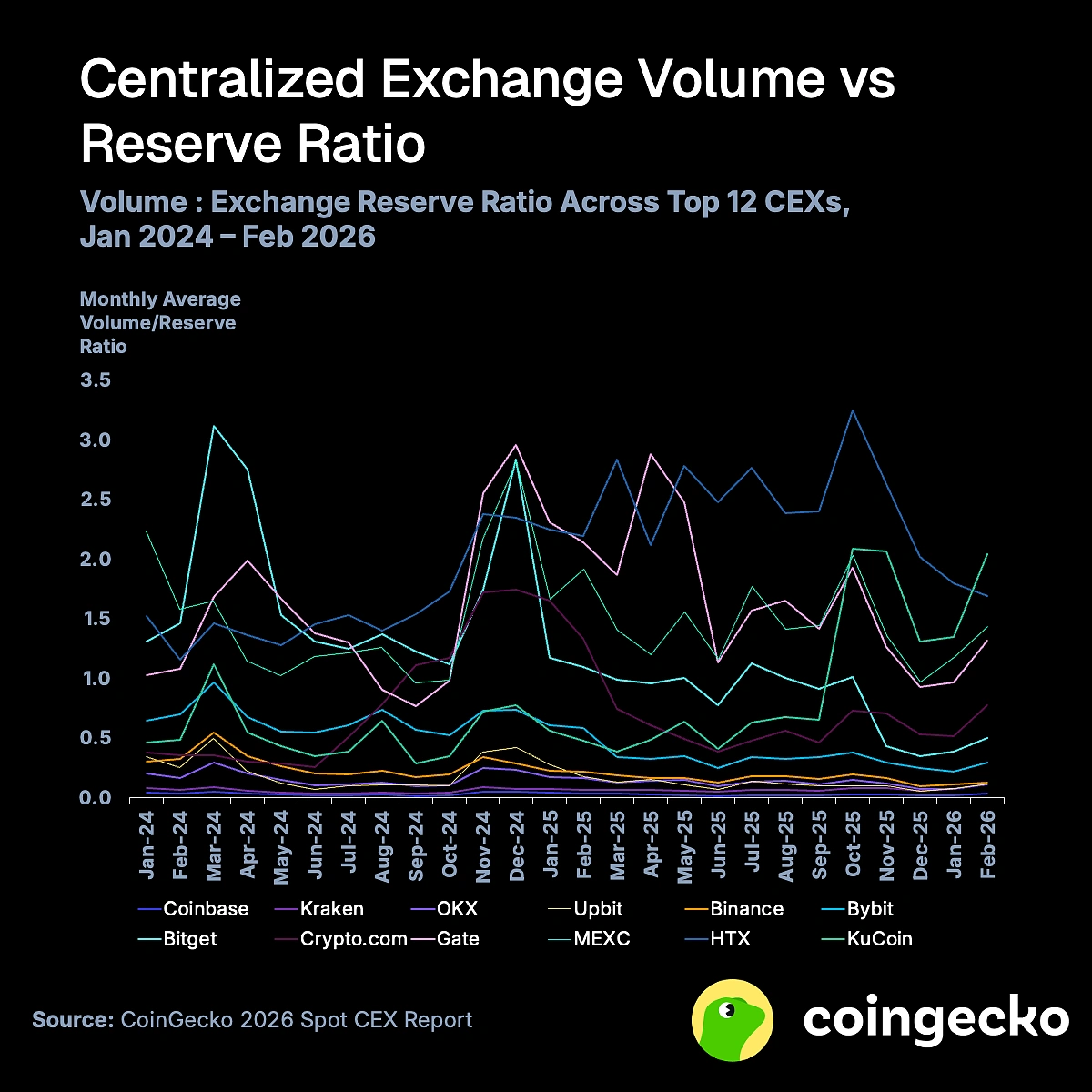
Chart: Comparison of Trading Volume and Reserve Ratio of 12 Major CEXs
Although CEXs all hold large reserves of crypto assets, the efficiency of fund utilization varies greatly among platforms.
Exchanges with higher compliance levels, such as Coinbase, Binance, and Kraken, have a volume-to-reserve ratio of approximately 0.1. This is likely because their clients are primarily institutional, who use the platform more for custody than for frequent trading.
Bybit and Bitget, on the other hand, have both high trading volumes and substantial deposits, with average ratios of 0.3 and 0.5 respectively from January 2024 to February 2026.
Exchanges with smaller reserves, such as MEXC, HTX, and KuCoin, have asset turnover rates between 1.44 and 2.04. This means that users' trading volume far exceeds the reserves held by the exchange, resulting in a rapid flow of funds on the platform.