
Written by: Ignas | DeFi Research
Compiled by: Saoirse, Foresight News
Currently, more than ten MegaMafia ecosystem applications have been officially launched on the MegaETH mainnet, and MEGA TGE is scheduled to officially launch on April 30th. The pre-market price of MEGA is $0.179, and based on a total supply of 10 billion tokens, its fully diluted valuation (FDV) is approximately $17.9 billion.
However, it's important to note that pre-market pricing references a fully diluted valuation, not the actual circulating market capitalization. Initially, only about 10% of the tokens will be in circulation, and some industry sources suggest the actual circulating percentage will be even lower. Therefore, MEGA's true circulating market capitalization on its first day is approximately $180 million, and possibly even lower.
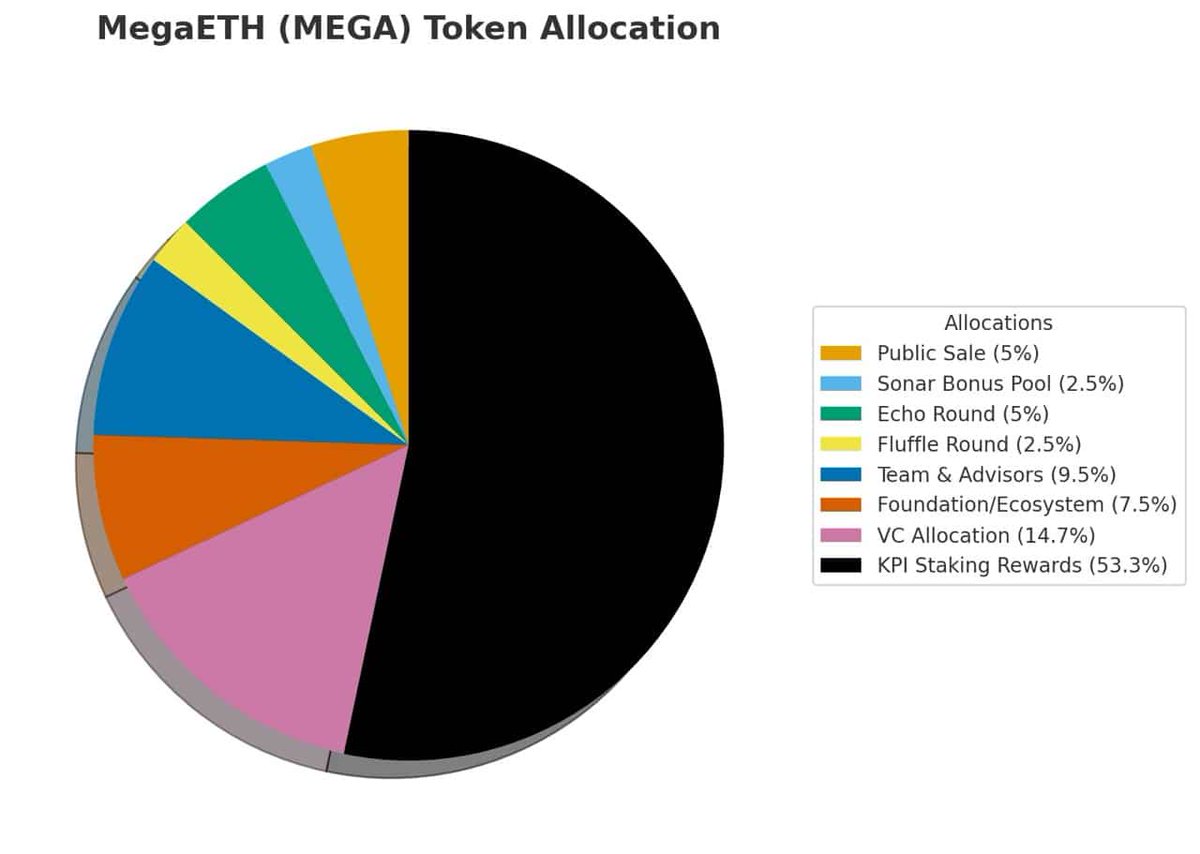
Pie chart of MegaETH (MEGA) token distribution
MEGA's launch follows a typical low-circulation, high-dilution valuation issuance model, replicating the characteristics of early on-chain projects. However, the project has set two token unlocking thresholds at 6 and 12 months. At that time, large-scale unlocking and selling pressure will continuously test the token price, significantly increasing short-term market volatility.
Two core forces driving the development of MegaETH
Core driving force 1: The launch of the MEGA token brings fresh capital into the ecosystem.
Early MegaETH ecosystem participants will see token unlocks: Echo holders will unlock 20% of their tokens, and Fluff holders will unlock 50%; non-US Sonar A token holders with no lock-up period will receive a large token airdrop, including the author of this article.
The market anticipates a concentrated sell-off, especially among Sonar's early investors. These participants originally expected to quickly cash out their tokens upon launch but were forced to hold them for an extended period, making them extremely eager to sell after TGE's launch.
Even if there is a concentrated cash-out, most of the funds from the sell-off will not completely withdraw from the public chain. Instead, they will circulate within the ecosystem: allocating Meme coins, providing liquidity for the protocol, trading cultural tokens on Kumbaya, purchasing Fluff series NFTs, or chasing currently popular narrative assets.
The higher the price of MEGA on its first day of listing, the stronger the wealth effect and the more obvious the empowerment and driving effect on the overall ecosystem; conversely, if it plummets after listing, it will directly damage the confidence of speculative players and be detrimental to the long-term development of the ecosystem.
I plan to sell a small portion of my holdings and divert funds to existing ecosystem applications, popular narrative tracks, and Meme coins; most Fluff and Echo holders will also adopt the same asset rotation strategy. The simultaneous portfolio adjustments by thousands of on-chain speculators will bring massive on-chain activity and capital flow to the entire MegaETH public chain.
Core Driver Two: 2.5% Mainnet Airdrop Event, Amplifying Ecosystem Growth Potential
The official confirmation is that a mainnet incentive airdrop program will be launched, accounting for 2.5% of the total token supply. The project team stated that they will carefully plan the incentive activities, choose the best time to launch them, and reject inefficient subsidies; the incentive mechanism will be designed with multi-level linkage gameplay, supporting user combination strategies and compound interest growth, avoiding a simple mining dumping model.
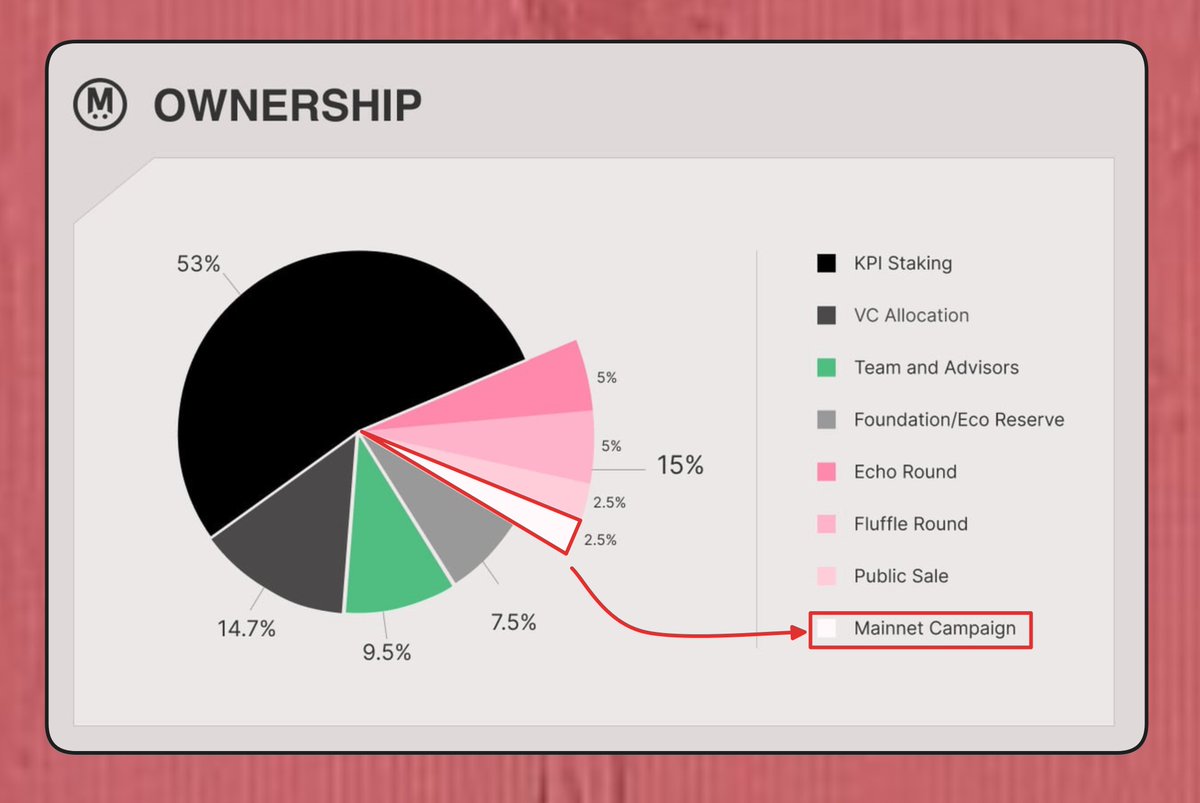
MegaETH is one of the few crypto projects in the industry that operates based on mature business logic, accurately calculating lifetime value (LTV) and customer acquisition cost (CAC), thus avoiding the drawbacks of the extensive operation of most on-chain projects.
Incentive resources will be precisely allocated to new liquidity, rather than distributed universally; the existing $50 million in liquidity already generates natural mining revenue and does not require repeated subsidies, thereby improving the efficiency of capital utilization.
Thanks to the addition of key team members, the long-term value expectation of MegaETH has been further enhanced. The previously planned Lego-like on-chain combination gameplay has now been fully implemented in core applications such as Aave (with Ethena's USDe) and Brix. With the ecosystem infrastructure improving, the details of the airdrop event will most likely be announced shortly after the TGE launch (mid-to-late May), which will attract a large number of mining users.
Positive Flywheel Logic of Ecosystem:
Mining users drive up the on-chain value locked (TVL) → Expanding the USDM scale with the Aave+Ethena combination → US Treasury yields generated by USDM support the foundation's continuous buyback of MEGA → Regular buybacks form a floor buying position, stabilizing the token price.
Whether the entire growth loop can be successfully implemented depends entirely on the performance of MEGA upon its launch; if the fully diluted valuation falls below $10 billion and continues to weaken, the ecosystem's popularity and player enthusiasm will cool down rapidly.
Market valuations and expectations diverge.
Industry institutions and bloggers have given different predictions regarding the valuation of MEGA upon its launch:
- Eli5defi, using five valuation models, arrives at a weighted, fully diluted valuation of $12 billion.
- The pre-market market is optimistically pricing in a price of approximately $16.4 billion.
- The market forecasting polymarket generally estimates its value at only $10 billion.
From a comprehensive fundamental perspective, a reasonable valuation should be in the middle of the range, leaning more towards the lower end. Referring to past patterns in the L2 blockchain sector: all mainstream Layer 2 network tokens saw their valuations fall below their initial offering price within 12-18 months of listing, with ZKsync dropping by 75% and Starknet plummeting by 90%.
There are obvious contradictions in the expectations of various parties: either the current pre-market market is overhyped due to the KPI narrative and the valuation will subsequently revert to its previous level; or the market is predicted to underestimate the real market demand for MegaETH.
Other data shows that MEGA's actual initial circulating supply was only 3.86%, corresponding to a market capitalization of approximately $66.92 million, indicating a highly scarce supply of circulating tokens.
- Venture capital, team, and advisory shares (24.2%): All locked, with a 1-year cliff-breaking period followed by a 3-year linear release;
- KPI pledged share (53%): Permanent lock-up if the performance target is not met;
- Ecological reserve funds (7.5%): Nominally unlocked, managed by the team, and will not be maliciously dumped;
- Mainnet airdrop share (2.5%): Locked for 6–8 months and gradually released.
If the data is accurate, MEGA's initial market capitalization is less than $70 million, far below the general expectation of $180 million. The extremely scarce circulating supply will amplify market volatility, making both rises and falls more dramatic, similar to the market logic of HYPE coins with high consensus and low circulation.
Unlike traditional Layer 2 networks, MegaETH has a unique profit model: it doesn't rely on sorter fees to exploit users, but instead monetizes through USDM stablecoin yields. Backed by BlackRock's compliant US Treasury reserves, the stable yields generated by USDM will be used entirely for repurchasing MEGA in the secondary market.
Market price expectations
- Optimistic outlook: Combining stablecoin yields, ecosystem incentives, and the implementation of new applications, the price of MEGA is expected to reach $0.5–$1 in the short term, with a potential increase of 3–6 times;
- From an institutional perspective: A partner at 6th Man Ventures believes that MegaETH will evolve into a super application ecosystem, distinct from neutral public chains such as Ethereum and Solana, with application revenue as its core driving force and a vertically integrated development path.
MegaETH's core differentiating advantages
Most Layer 2 network tokens have a single value, used only for transaction fees and on-chain governance, lacking real essential demand; while MEGA is supported by three core values, forming a solid foundation for demand:
- Extreme transaction speed: Block confirmation latency as low as 10 milliseconds, far superior to Arbitrum (250 milliseconds), Base/Optimism (2 seconds), and Ethereum (12 seconds), perfectly adapted to order book exchanges and high-frequency trading scenarios, and the only EVM ecosystem chain with low latency advantage.
- The proximity sorter auction mechanism introduces a priority access auction for sorters priced in MEGA, granting millisecond-level trading queue-jumping rights. High-frequency trading teams and market makers need to continuously bid for MEGA to obtain priority packaging rights, forming a long-term rigid demand.
- Stablecoin yield buyback loop: Relying on USDM's revolving lending model to rapidly expand scale and strive for the $500 million stock KPI target; with the addition of three major revenue sources, namely transaction fees, ultra-fast service premium, and US Treasury bond yields, multiple narratives jointly empower the token value.
Existing ecological risks and hidden dangers
- Macroeconomic conditions are under pressure: the overall crypto market is in a bear market atmosphere, and a weak market will drag down the development of a high-quality ecosystem;
- Unlocking potential selling pressure: 50% of the Fluff shares will be unlocked upon launch, with phased release over 6 months, and the team and venture capitalists will unlock shares in a concentrated manner over 1 year;
- Centralization risks: The single sorter architecture poses a risk of centralized operation.
- The assessment threshold is extremely high: the third-stage KPI requires three applications to have an average daily transaction fee of $50,000 for 30 consecutive days, and the assessment will be reset if interrupted.
- Track fatigue: The popularity of L2 second-layer network narratives is waning, and user and funding attention is declining;
- Imbalanced ecosystem structure: Kumbaya, the leading DEX, accounts for 57% of the total locked value on the entire network, meaning that fluctuations in a single project can impact the entire public chain;
- Ecosystem project exodus: Innovative application Avon has officially announced its withdrawal from MegaETH, and leading lending protocol Aave is facing a crisis of trust.
Based on historical experience, many popular narrative projects have ultimately failed. Even with a well-developed ecosystem, it is impossible to completely avoid the risks of market downturns and narrative collapse.
However, with the current low cost of on-chain mining, simple stablecoin swaps and revolving lending operations, coupled with the expectation of airdrops from ecosystem applications, players generally still expect MEGA to launch smoothly and maintain the ecosystem's popularity.
Practical Guide to Ten Mainstream Ecosystem Applications
Key points:
- Stake stcUSD to earn yield;
- Kumbaya offers USDe/USDm liquidity plus a small allocation of cultural tokens;
- Engage in ETH funding rate arbitrage and high-risk leveraged trading on World Markets; or use hit.one and wait for synchronized rewards.
- Configure a small amount of iTRY in Brix for uncorrelated hedging;
- Use Euphoria for trading/gambling.
Cap (@CapApp)
- An adaptive yield stablecoin. It can be minted at a 1:1 ratio with USDC/USDT (cUSD), and then staked as stcUSD to earn yields from authorized strategy providers.
- The largest source of on-chain transaction fees, averaging approximately $21,000 per day, is the team's publicly disclosed KPI-3 core project.
- The three rounds of financing totaled $12.9 million, with the seed round led by Franklin Templeton, and participation from Nomura’s Laser Digital and Kraken Ventures.
- It is highly likely to be the first Mafia application to issue its own token within the ecosystem after MEGA (traditional financial investors are accelerating the process).
- Operation suggestion: Stake stcUSD to earn yield, and use cUSD as the settlement stablecoin on MegaETH.
Kumbaya (@kumbaya_xyz)
- MegaETH's number one DEX has a total TVL of approximately $59 million.
- The cultural token issuance platform is embedded within the DEX, unlike the "graduation-and-separation" phenomenon that occurred with pump.fun to Raydium on Solana.
- The USDe/USDm liquidity pool (approximately $6 million) is a key routing node in the Aavethena cycle.
- The average daily transaction fee is approximately $2,000, and no financing information has been disclosed; although most DEX airdrops are currently not very effective.
- Trading suggestions: Earn transaction fees by providing liquidity to the USDe/USDm pool and follow Aavethena's expansion; for those seeking higher risk, try meme coins.
World Markets (@worldmarketsinc)
- The unified margin order book system covers spot trading, perpetual contracts, and lending, allowing a single collateral to be used for all three types of business.
- Total locked value is $11.6 million, with daily transaction fees of approximately $4,000 (second highest on-chain), and no public fundraising.
- The team claims that compared to fragmented DeFi, the capital efficiency can be up to 100 times greater.
- Cross-margin transactions require margin updates and settlements to be completed within the same block, which only MegaETH can support at its speed.
- Trading suggestions: ETH funding rate arbitrage (long spot with the same collateral + short perpetual); or hold ETH to earn lending income while opening a perpetual hedge.
To be honest, I don't think its interface is very user-friendly.
Brix (@brix_money)
- Tokenized emerging market yield products. iTRY is a tokenized Turkish Lira money market product (approximately 20% annualized local return), custodied by a licensed institution.
- In April 2026, the company raised $5.5 million, led by FRWRD and Is Asset Management, with participation from Circle Ventures, ConsenSys, and Borderless Capital.
- The only non-crypto native yield product in the Mafia ecosystem, it can be used as an uncorrelated hedge when the macroeconomy weakens.
- More emerging market currencies will be launched in the future (with Brazilian Real (BRL) and Indian Rupee (INR) as priorities).
- Trading recommendations: Allocate a small position in iTRY for uncorrelated hedging; I believe delta-neutral strategies for the US dollar will be very popular.
Euphoria (@Euphoria_fi)
- Click-based trading: Click on grid blocks to predict short-term price trends.
- The company raised $7.5 million (including $2.5 million in the previous seed round and $5 million in the previous seed round), led by Karatage, with participation from over 100 investors.
- The most anticipated consumer application in the 2.0 tier.
- Currently, the mainnet is only open to whitelisted participants (AMA participants + early testers), and will be fully open in mid-May.
- Notcoin on TON once brought more than 30 million wallets to an unnamed public chain, and Euphoria is the closest product to it in the Mafia ecosystem.
- Operation suggestion: Add to the waiting list and pay close attention to the launch in mid-May.
Showdown (@Showdown_TCG)
- One-on-one Texas Hold'em game.
- Operational suggestions: Poker players can participate in cash games; the ranking airdrop weight is tilted towards active players.
Stomp (@stompdotgg)
- A fully blockchain-based PvP monster battle game (Pokémon + Super Smash Bros. style), developed by Owen Shen of 0xmons.
- The first public blockchain to truly run a game loop: every attack is an on-chain transaction.
- Gameplay suggestions: Collect monsters and participate in battles; airdrops offer even more rewards to active players.
Hit.One (@hitdotone)
- They packaged perpetual contracts with leverage of 666 times or more into a mobile click game.
- It has been fully launched on MegaETH and has not received any public funding.
- This was used to test whether gamified, high-leverage trading could attract a large number of new ordinary retail investors.
- Operational advice: Only participate with small amounts; this is a casino, not an investment.
Pump Party (@pumpparty)
- A encrypted gaming show will be broadcast live from Manhattan every Monday, Wednesday, and Friday at 9 p.m. Eastern Time.
- Each episode is 15 minutes long, and viewers play skill-based mini-games (hamburger making, Zyn throwing) to share a prize pool.
- Payouts are credited instantly on the MegaETH blockchain.
- The core issue is not the application itself, but testing whether a native encrypted streaming media product can bring ordinary users onto the blockchain.
- Operational suggestions: Watch and participate in the game on time; pay attention to the number of online viewers, a continuous 10,000+ viewers indicates that the product is working properly.
Ubitel (@getubitel)
- Decentralized eSIM, covering prepaid data in over 200 countries, supports ETH or UBI payments. It has its own token and is not in the same category as the tokenless Mafia application.
- Recommendation: If you travel frequently, consider purchasing a data plan.
On a side note: I actually really like these kinds of applications. Gnosis is also working on VPNs and other non-financial application stacks.
Nectar AI (@TryNectarAI)
- AI companion and role-playing platform, where characters are cast into NFTs (adult-oriented). A major Web2 category (similar to Character.ai and Replika), but there are no successful on-chain versions yet.
- Suggested action: Don't tell your mom or girlfriend.
The entire ecosystem extends far beyond these 11 applications. Bread states that approximately 120 applications are already online or under deployment through rabbithole.megaeth.com. Chefgoose's beginner's guide compiles 50 key projects: Prism (a super app), SectorOne (DLMM DEX), Tulpea (RWA lending), Huntertales (idle GameFi, CROWN token), TopStrike (football card game), Aqua (liquidity staking), Blackhaven, Blitzo, and non-native projects like Aave, GMX, and gTrade, which are worth bookmarking.
Summarize
MEGA token TGE is scheduled for April 30th, with the mainnet airdrop incentive event to follow. The core short-term logic relies on the wealth effect to retain ecosystem funds and prevent cross-chain outflow.
MegaETH has carved out a commercialization path distinct from traditional L2 public chains with its three core advantages: extreme speed, exclusive auction mechanism, and stablecoin yield buyback. Its long-term narrative is clear.
However, we must also face multiple risks such as selling pressure from unlocking, structural imbalances, a macro bear market, and KPI assessments. On-chain speculation must be conducted with rational position control and caution. This article is only for ecosystem analysis and does not constitute any investment advice.