
Written by: Vaidik Mandloi
Compiled by: Saoirse, Foresight News
There's a well-known influencer in the crypto world named ThreadGuy. In 2021, he rose to fame by teaching people how to trade NFTs. Now he lives in a New York apartment, with a barrel of U.S. crude oil on his desk, and trades pharmaceutical stocks and commodities on the Hyperliquid platform. A few weeks ago, he invited Cobie to be a guest on his live stream.
Cobie is a veteran in the crypto industry, having worked there since 2012. He sold his project Echo to Coinbase for $375 million and now works full-time at Coinbase. When ThreadGuy asked about the current state of the crypto industry, he described it as a K-shaped divergence.
He said, "A strange K-shaped divergence is emerging in the crypto world. The industry has seen an unprecedented number of outstanding success stories, far exceeding previous years, but these achievements are not reflected in the prices of crypto assets available to ordinary investors."
This sentence has been lingering in my mind because he was absolutely right.
Polymarket and Kalshi, the two major prediction markets, have formed a duopoly in the industry with a scale of up to $440 billion; stablecoins are widely used for paying gig workers' wages, and DoorDash now pays drivers through the Tempo platform; Hyperliquid has built its own underlying public chain, and its on-chain transaction volume has exceeded that of most centralized exchanges; Trade XYZ can even control the prediction error of the opening price of US stocks on Monday to within 50 basis points.
The initial vision of cryptocurrencies was to enable fund transfers without banks, market making without brokers, and allow anyone to trade any asset anytime, anywhere. By the standards of all the skeptics of that time, the crypto industry today has completely achieved all of this.
However, ordinary investors who were early adopters of crypto and held various tokens received almost no benefits.
Ordinary investors cannot buy equity in Polymarket and Tempo; although Circle is listed, half of the net interest margin generated by USDC is first distributed to Coinbase as channel distribution revenue, and shareholders can only receive the remaining profits at the end.
The platform made a fortune, but token holders were always the losers.
This is the K-shaped divergence in the crypto industry. And after further research, I discovered that this is no longer a problem unique to the crypto world.
Where exactly did the value go?
Let's start with stablecoins, which are the true track for the crypto industry to achieve successful product-market fit.
It is estimated that Tether will generate $10 billion in profits by 2025, with only about 100 employees, giving it a profit per employee that surpasses the vast majority of companies worldwide. Circle has successfully gone public, and as of April 28, its market capitalization reached $230 billion.
In the past few years, the total supply of stablecoins has surged a hundredfold, from $6.8 billion in 2020 to more than $315 billion today. The U.S. Treasury Department even predicts that the size of stablecoins will exceed $2 trillion by 2028.
A true global financial system is being built on top of crypto infrastructure. However, ordinary token holders have no economic connection to this trillion-dollar windfall.
Tether's profits go to its corporate shareholders, Circle's revenue flows to its own shareholders and Coinbase; DoorDash pays salaries through Tempo, and the transaction value is shared by the platform, companies, and practitioners, completely unrelated to ordinary people's token holdings.
The same script applies to prediction markets.
Polymarket has evolved from a niche crypto experiment into a regular data source for CNN, and the Wall Street Journal has incorporated its data into its news reports. Substack directly integrates with Polymarket's features, allowing creators to embed real-time odds in their articles, turning every piece of information into a real-time data terminal.
Intercontinental Exchange, the parent company of the NYSE, invested $2 billion in it at an $80 billion valuation; Kalshi won a lawsuit against the U.S. Commodity Futures Trading Commission and expanded its business into fields such as economics, sports, and scientific research. By 2025, the total trading volume of the two platforms will reach $440 billion, with the highest monthly trading volume exceeding $100 billion.
Not a single penny of this enormous increase in value went to the token holders.
Polymarket's early venture capital firms, founding funds, and investors hold a huge amount of unrealized book profits. As a benchmark success project in the crypto world, built on crypto infrastructure and by insiders, it ultimately adopted a traditional equity structure, with all the added value going into the pockets of venture capitalists.
Some might say: Polymarket hasn't issued a token yet.
Indeed, it may issue tokens in the future. But even if it does, private capital has already valued it at $80 billion. The window of opportunity for ordinary early adopters to share in the industry's profits has closed without anyone realizing it.
If it never issues tokens, then all the value in this prediction market revolution, which crypto enthusiasts have been touting for years and claiming will reshape the global information landscape, will be completely absorbed by the traditional equity system: venture capital will fund its incubation, and it will eventually be sold to institutions, leaving ordinary users with no on-chain ownership.
Even in the decentralized finance (DeFi) field, this pattern still applies.
The crypto industry has spent nearly a decade building the underlying infrastructure for DeFi: lending protocols, automated market makers, perpetual contract exchanges, and stablecoin payment chains have all been perfected. The entire process was largely open-source, relied on tokens, and faced regulatory pressure and restrictions throughout.
The project builders took on extremely high entrepreneurial risks; early users, in an era where smart contract vulnerabilities could wipe out their assets at any time, also took huge risks by actively providing liquidity and testing protocols.
Now that the technology is mature, stablecoins, on-chain transactions, and asset tokenization have all been successfully implemented. Those who come to reap the benefits are no longer the pioneers and users who ventured into the field.
Instead, established companies using traditional equity structures are taking their place: Stripe is developing stablecoin payments, PayPal is issuing its own stablecoin, and major banks are promoting asset tokenization on private blockchains.
These companies initially observed the exploration of the crypto industry from the sidelines. Once they verified the viability of the business model, they built their own closed ecosystem to replicate the technology, and distributed all economic benefits only to their own shareholders.
The industry's profits are being privatized. Tokens were meant to be a tool to counterbalance this situation, allowing early participants to share in the value they create.
The reality is that truly successful projects either don't issue tokens at all, or their token issuance is severely delayed and their valuations are inflated. When ordinary retail investors buy in, the tokens end up being used as cash-out funds by early investors.
The common problems of K-type capitalism
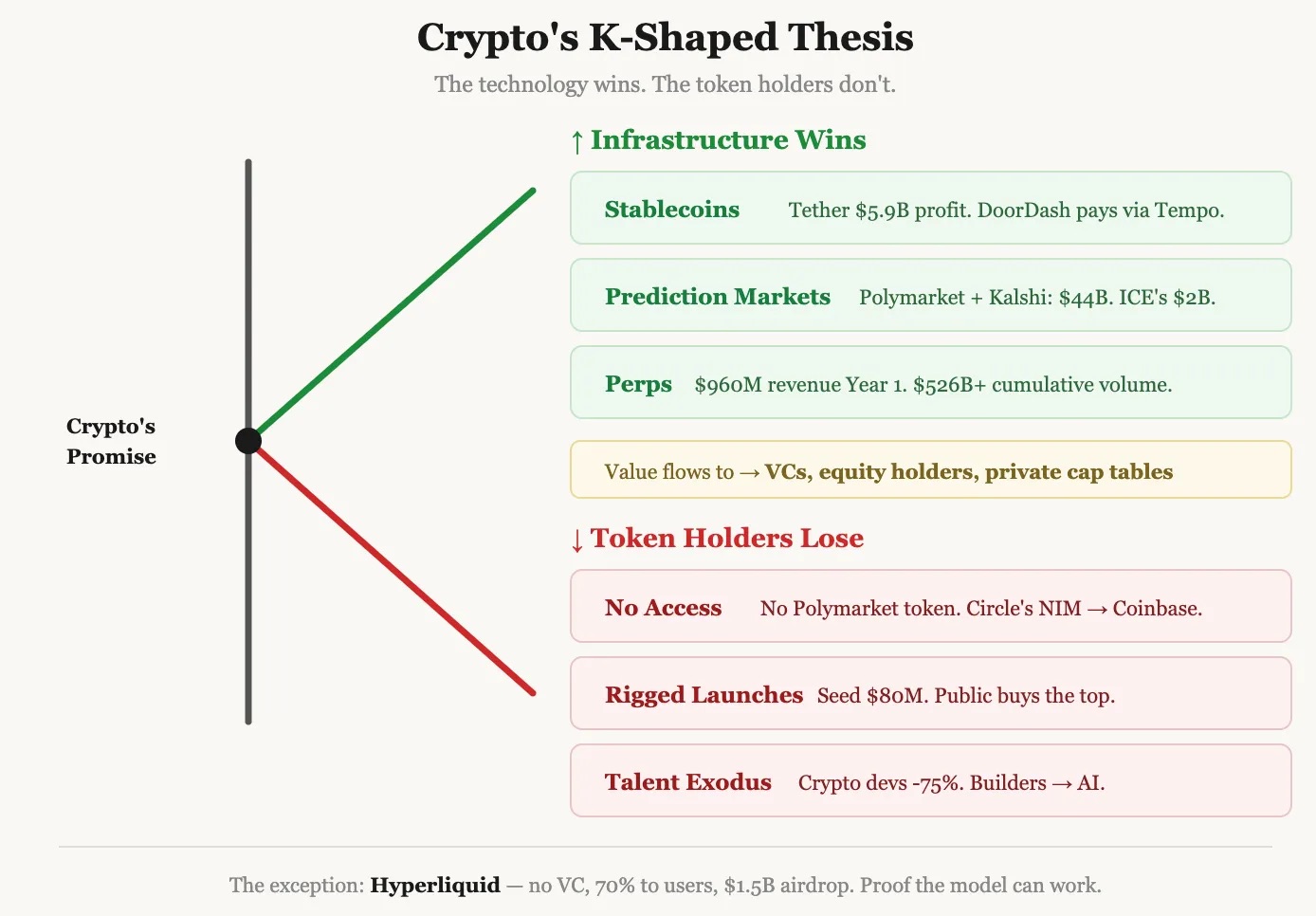
K-shaped differentiation theory in the crypto industry
This is no longer a problem unique to the crypto industry, but a common pattern in global wealth creation today. Crypto has simply replicated the social ills it originally intended to cure.
SpaceX started from scratch and its private valuation soared to $1.75 trillion; OpenAI's valuation reached $852 billion, and Anthropic also reached the $800 billion level. These three companies alone have created trillions of dollars in added value.
In the 1970s or early 2000s, ordinary people could simply buy shares in companies like Apple, Amazon, and Google, and share in the wealth dividends of their growth.
The expectation of a bright future and the prospect of rewards, which is the most basic social contract of capitalism, has now completely failed.
These groundbreaking giants remained private throughout the period of fastest value growth, with entry limited to the top tier: Silicon Valley networks, fund of funds, and institutional investors with single investments of up to 50 million.
By the time SpaceX and OpenAI finally went public, their stock prices had already factored in ten years of private compound interest returns, leaving ordinary retail investors with no chance of early dividends.
The number of publicly listed companies in the United States has plummeted by 46% since 1997, from approximately 7,500 to 4,000. Today, there are over 1,400 venture-backed unicorn companies with a combined valuation of $5 trillion, all of which have chosen to remain private for the long term.
In the past, companies went public to raise funds. Now, giants can complete billions of dollars in private financing through closed capital circles, extending their lifespan indefinitely. By the time of the final IPO, the valuation has already been determined in private circles inaccessible to ordinary people.
The data also confirms that this is not unfounded speculation: from 1970 to 1990, the average annual return on IPOs was only 5%, far lower than that of mature listed companies of the same size.
For IPOs with low float, such as SpaceX and OpenAI, the historical failure rate is as high as 90%. Since 1980, eleven companies that went public with low float have underperformed the market by more than 50% within three years.
For ordinary people, there is only one outcome: when a company is valued at tens of millions, you are not allowed to invest; when it goes public with a high valuation of 1.5 trillion, you can only buy at the top, allowing internal investors to cash out and leave.
This is the K-shaped economy: the upside benefits are monopolized by closed circles through privatization, while the downside losses are borne by the whole society – sky-high IPO prices, index funds passively taking over at high prices, high inflation, stagnant wages, and all the costs are distributed among every ordinary person.
This is also the core reason for the continued outflow of crypto talent.
Since the beginning of 2025, the number of encrypted code commits has plummeted by 75%, from 850,000 per week to 210,000; the number of active developers has declined by 56%, leaving only about 4,600. A large influx of talent is flowing into the artificial intelligence field: GitHub now has 4.3 million AI-related code repositories, and the import volume of code related to large models has increased by 178% in one year.
This trend can be fully understood from the perspective of K-shaped differentiation: every wave of wealth creation in the crypto industry—altcoins in 2013, ICOs in 2017, DeFi and NFTs in 2021, and later Meme coins—has in common the fact that ordinary people can make money quickly.
Now, this wealth-creating atmosphere has shifted to the AI field. Independent developer Peter Steinberger single-handedly created OpenClaw, which was eventually acquired by OpenAI for billions of dollars. This is precisely the wealth-creating allure that the crypto industry once possessed.
If you're a 22-year-old like me, planning your career for the next five years, the answer is obvious:
The crypto industry offers governance tokens that started with a valuation of $16 billion but subsequently experienced a continuous decline; while the AI sector offers the opportunity for teams of three to five people to develop intelligent agents and incubate projects with a valuation of billions of dollars in just one year.
The root cause of the talent exodus is that the crypto industry is gradually ceasing to distribute the dividends it creates. The K-shaped divergence causes profits to concentrate upwards, flowing to venture capitalists and equity holders, ultimately becoming part of the traditional elite circles that the industry itself wanted to disrupt.
Where is the ideal of decentralization now?
Faced with this predicament, where is the way out?
The predicament of the crypto industry is already clear: its technical strength is impeccable, but early believers cannot share in the industry's benefits; the privatization of value in traditional markets has already infiltrated the crypto industry, which was originally created to break down injustice.
Is there any way to break this deadlock?
Cobie believes there is a solution, and I wholeheartedly agree. The only solution, and a weapon unique to the crypto industry, is airdrops.
Airdrops bypass all intermediaries, directly distributing project ownership globally to real users and precisely targeting the most valuable early stages. This is the original purpose and mission of airdrops.
Unfortunately, in reality, the vast majority of airdrops are merely formalities and ineffective. However, there is one benchmark case that has proven this model to be entirely feasible and worth learning from—Hyperliquid.
Founder Jeff Yan led his team to build the underlying public blockchain from scratch and developed a perpetual contract exchange, which has been operating stably for a long time and has accumulated a trading volume of over 4 trillion US dollars to date.
When allocating project ownership, the team distributed 70% of the total token supply to the community, with no venture capital, no advisory shares, and no exchange backing or allocation.
All benefits went to genuine traders: loyal users who consistently used the platform, transferred funds across chains, and underwent long-term stress testing of the protocol. Ultimately, 94,000 on-chain addresses shared the $1.5 billion airdrop, turning many ordinary people into millionaires overnight.
What's most remarkable is that the users who received the tokens didn't mindlessly dump them to cash out.
These HYPE holders are not just speculators looking to profit from airdrops; they are the platform's core, loyal users—the most active traders, those with the largest capital, and those who have remained long-term due to their positive experience with the product. They receive ownership rights based on their contributions and choose to hold their shares long-term, upholding the consensus.
The project team also set an example by reducing their holdings by only 20% of the vested tokens in the first two months (most likely for tax purposes), and then reducing the monthly reduction ratio to 1%. Currently, 97% of the protocol's revenue is used for HYPE token buybacks and burns.
Industry analyst Saurabh has broken down its valuation logic in detail: Hyperliquid's trading volume is expected to reach nearly $3 trillion in 2025, with revenue of $960 million, and its valuation is only 10-13 times its revenue.
In comparison, the CME Group has a price-to-earnings ratio of 25, the Intercontinental Exchange 23, and the Chicago Board Options Exchange 22. It approached one billion in revenue in its first year, with zero debt, no redundant personnel costs, and almost all transaction fees were returned to token holders through buybacks and burns.
Hyperliquid has proven with its performance that this path is viable.
Share the benefits with users, not capital; let real usage behavior determine value growth; align the interests of builders and users to achieve a win-win situation.
However, it must be admitted that Hyperliquid is ultimately a minority, and the vast majority of airdrops fall far short of this level.
Most airdrops on the market are just a carefully orchestrated performance: users pretend to use projects they have no interest in, only to sell the tokens immediately after unlocking them; the project teams are fully aware of this, and the users are also tacitly aware of it.
Everyone tacitly cooperated in this game because once they admitted that airdrops were merely "using high-priced tokens to cover customer acquisition costs," they would no longer be able to tell a story and raise funds during VC roadshows. In essence, 90% of the tokens in the industry are just tools for VCs to cash out and leave, rather than being used to bind user consensus and distribute value.
Cobie's analysis data hits the nail on the head: when Ethereum had its ICO, ordinary people could enter with a valuation of $26 million and reap a 7,500-fold return; while for new projects like Berachain, the seed round valuation reached $40 million, and the valuation peaked as soon as it was launched.
Retail investors were trapped as soon as they entered the market, while early seed investors reaped a 138-fold return.
Now the industry is left with only one core question, which is far more important than insiders realize: Is Hyperliquid a replicable industry model, or a unique and accidental exception?
If this is a replicable model: more teams can focus on developing real products, break free from the venture capital harvesting trap, and distribute ownership to genuine users. This will become a unique core value in the crypto industry—SpaceX can't airdrop equity to onlookers, and OpenAI can't distribute original rights to every user, but crypto can, and there are already successful precedents.
If this is merely a rare exception, then Cobie's K-shaped polarization theory will be definitively confirmed. Token holders will continue to be marginalized, top developers will continue to flock to the AI field, and for ordinary people who want to share in the crypto industry's profits, the only option left is to buy traditional stocks like Coinbase and Circle.
And this is precisely the outcome that encryption, at its inception, aimed to completely eliminate.