Written by: Gino Matos
Compiled by: Chopper, Foresight News
According to DeFiLlama data, the current scale of on-chain tokenized real-world assets (RWA) is approaching $30 billion, but only $2.47 billion of this is shown as DeFi Active Value Locked (TVL), which is the amount of funds actually deposited into the liquidity pools of third-party DeFi platforms and participating in the operation of the ecosystem.
The vast majority of other RWA assets remain outside of scenarios where crypto assets can be freely combined and linked, such as lending markets and collateralized vaults. Bonds and money market funds are the largest RWA category, with a total on-chain size exceeding $16.6 billion, but only $920 million of that has been effectively locked in the DeFi ecosystem. Gold and commodities have an on-chain size of $5.7 billion, but only $183.6 million is in effective circulation within DeFi; equity assets have an on-chain size of $2.7 billion, but only $78.27 million has entered the DeFi market.
Only the private lending sector performed exceptionally well: on-chain assets reached $3.226 billion, effective total value locked in DeFi reached $1.257 billion, and ecosystem penetration reached 39%. The reason behind this is that projects such as Maple Finance and Centrifuge positioned themselves as lending and financial instruments from the very beginning of their product design, making them naturally suited to DeFi application scenarios.
Tokenized products such as US Treasury bonds, gold assets, and equity assets are designed with the needs of institutional investors in mind, and their overall structure is in line with the operating model of traditional compliant funds.
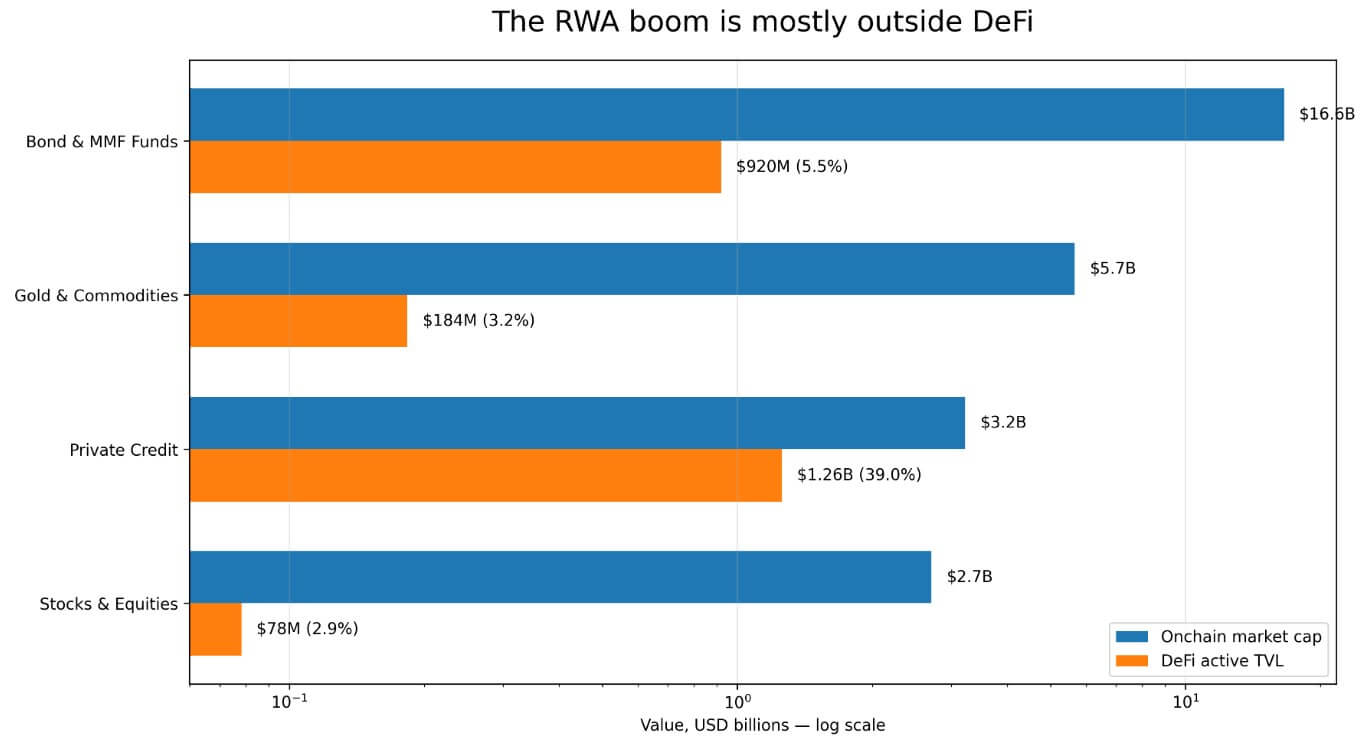
Distribution of On-Chain Market Cap and DeFi Active TVL in Four RWA Categories
Permissioned architecture becomes the biggest barrier to composability in DeFi.
DeFiLlama classifies BlackRock's money market fund BUIDL as a permissioned fund, with an effective total value locked (TVL) of only $18.9 million within the DeFi ecosystem.
In its final report on the tokenization of financial assets, published in November 2025, the International Organization of Securities Commissions (IOSCO) stated that BUIDL has created a permissioned system on a public blockchain for issuance, custody, secondary trading between accredited investors, dividend distribution, and redemption.
Potential investors must pass the Securitize platform's whitelist review, and on-chain asset transfers must be verified and confirmed by an offline transfer registration agency before they have full legal effect.
This also means that BUIDL is essentially a compliant asset holding infrastructure built on the underlying blockchain channel, primarily serving the asset custody and offline accounting reconciliation needs of institutions. Its smart contracts only support interaction with addresses on a whitelist, and without the aid of a compliant encapsulation layer, it cannot be directly deposited into open DeFi protocols with no entry barriers, such as Aave and Uniswap.
In February 2026, BlackRock completed the ecosystem integration of BUIDL and Uniswap, enabling some assets to be listed in the trading pool. However, asset access is still controlled by Securitize, and participation is limited to qualified investment institutions with a net asset value of at least $5 million. Ordinary market participants are still unable to participate.
IOSCO found that the vast majority of tokenized money market funds currently on the market adopt a similar operating model, and these assets have so far failed to deliver the high liquidity value in the secondary market that the industry had previously expected.
In its March 2026 report on the tokenization industry, RedStone stated frankly that the most difficult aspect of implementing asset tokenization is coordinating a series of complex rules across different jurisdictions and public blockchain ecosystems, including compliance audits, identity verification, transaction permission restrictions, risk control and arbitration screening, and corporate rights distribution. Looking at the current market, Morpho and Aave Horizon are among the few truly successful examples of successfully implementing RWA assets in DeFi.
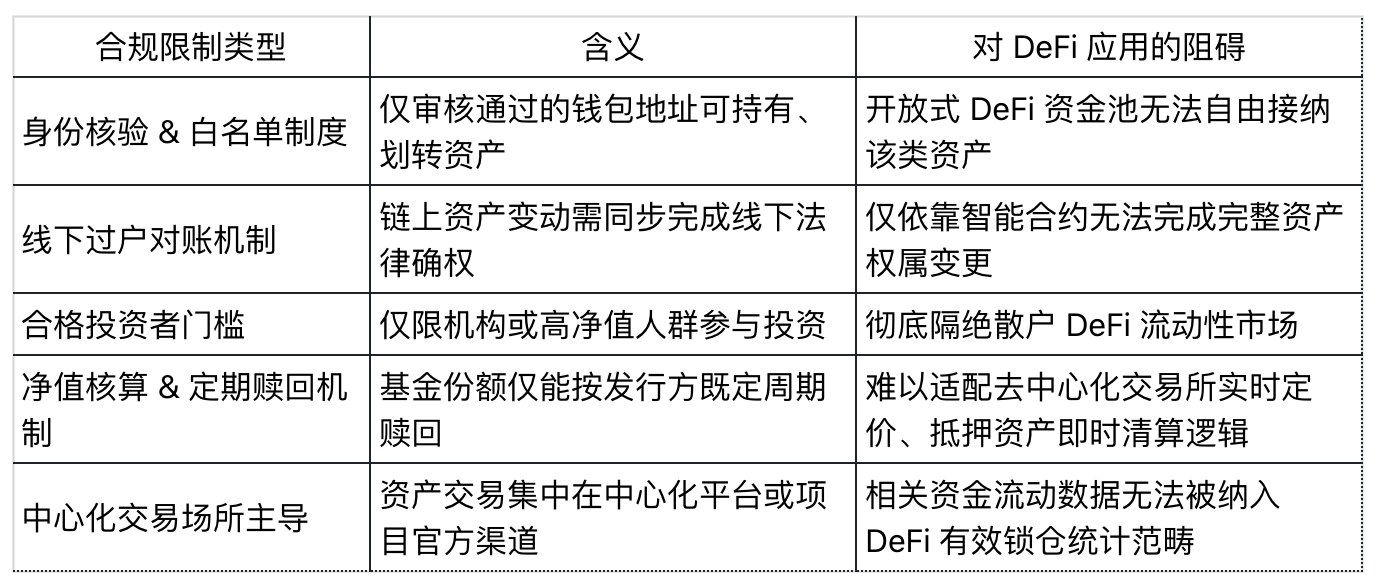
In short, every compliance restriction set by the project team further raises the barrier to entry for assets into the DeFi ecosystem. Furthermore, products such as US Treasury bond tokens and money market funds are designed to proactively incorporate various permission constraints to meet the regulatory requirements of licensed institutional investors.
Gold and other commodities face another real-world problem. CoinGecko data shows that tokenized gold spot trading volume reached a staggering $90.7 billion in the first quarter of 2026, surpassing the total for the entire year of 2025. However, the vast majority of these transactions occur on centralized exchanges. The aforementioned $183.6 million in effective locked value in DeFi represents only a tiny fraction of the total volume circulating within the ecosystem; the massive trading volume in centralized markets is completely outside the scope of DeFiLlama's data statistics.
Positive expectations: Highly adaptable products have already been successfully developed.
In early 2026, Ondo's USDY total value locked exceeded $1 billion, and it now covers all nine major public blockchain ecosystems. Ondo's Global Markets platform, launched in September 2025, focuses on tokenized US stocks and ETFs for overseas investors. From its inception, it has supported free asset transfers and can be directly used as DeFi collateral. Currently, the corresponding assets locked amount to $650 million, with a cumulative trading volume exceeding $12 billion.
According to RedStone, Morpho's RWA assets and deposits exceed $620 million, while Aave Horizon's related assets total $423.5 million. Both lending protocols have successfully implemented RWA's mature mortgage lending application model.
These successful cases fully demonstrate that as long as the design concept of free circulation without restrictions is upheld during the asset issuance stage, RWA assets can fully realize the composability of the DeFi ecosystem.
At an industry roundtable conference held in April 2026, DWF Labs, together with projects such as Centrifuge, Falcon Finance, and xStocks, jointly proposed the following view: The RWA track has now diverged into two major development tracks. The first prioritizes compliance with asset ownership and follows a strict licensing and control route. The second takes into account compliance issuance standards while opening up secondary market circulation attributes, with ecosystem composability as the core design guideline.
Graham Nelson, the project leader of Centrifuge, said that the strict whitelist access mechanism means that each participant in the fund pool needs to complete the qualification review separately, which directly blocks the path for assets to enter open DeFi.
Centrifuge's DeRWA solution breaks down barriers by compliantly encapsulating underlying primary-level assets while relaxing restrictions on secondary market asset transfers. Artem Tolkachev of Falcon Finance also mentioned that ecosystem composability and flexible exit mechanisms are key bridges connecting real-world assets with crypto market liquidity.
Industry optimists believe that as the overall on-chain RWA asset size approaches $50 billion, if most projects in the sector shift to a DeFi-compatible design approach, the penetration rate of RWA assets in the DeFi ecosystem is expected to break through the current low level of 9%.
Negative Reality: Industry Growth May Be Hindered by the Traditional Financial System
Standard Chartered predicts that the global tokenized asset market will reach $2 trillion by 2028, but also warns that this industry boom will likely be confined to the traditional banking and financial system, and the growth dividends that the open crypto market can share will be very limited.
IOSCO's research in November 2025 also confirmed this. Due to the inherent barriers to entry and liquidity limitations of distributed ledger technology, the distribution, circulation, and secondary market trading of tokenized assets still heavily rely on traditional financial infrastructure at this stage.
In its April 2026 report on the tokenization industry, the European Central Bank further pointed out that the lack of a unified global standard for asset tokenization could easily lead to the creation of isolated asset silos. Different asset systems have their own compliance rules, clearing mechanisms, and access mechanisms, ultimately resulting in liquidity being highly concentrated within closed systems, making interoperability difficult.
The DeFi penetration rate for bonds and money market funds is only 5.5%, gold and commodities 3.2%, and equities 2.9%, which vividly illustrates this fragmented ecosystem.
Most US Treasury bond tokens and money market funds on the market typically have minimum investment thresholds, mandatory identity verification, offline asset reconciliation cycles, and fixed redemption windows tied to net asset value. These underlying rules inherently conflict with the operating logic of decentralized exchanges' real-time pricing and barrier-free collateralized vaults. These constraints are all mandatory requirements from regulators and are a necessary choice for asset issuers to proactively adapt to the compliance environment.
Two major markets, the same industry label
The total on-chain RWA market size of $30 billion and the effective circulation of DeFi $2.47 billion, while seemingly belonging to the same RWA sector, actually represent two completely separate markets:
- Compliant on-chain financial market: mainly money market funds, US Treasury bond funds, and institutional custody assets. Asset transfer relies on offline transfer institutions for reconciliation and confirmation of rights, and follows traditional financial regulatory rules throughout the process.
- DeFi's composable ecosystem market: assets can be freely deposited into lending protocols, used as collateral without barriers, and freely circulated by various automated wealth management strategies.
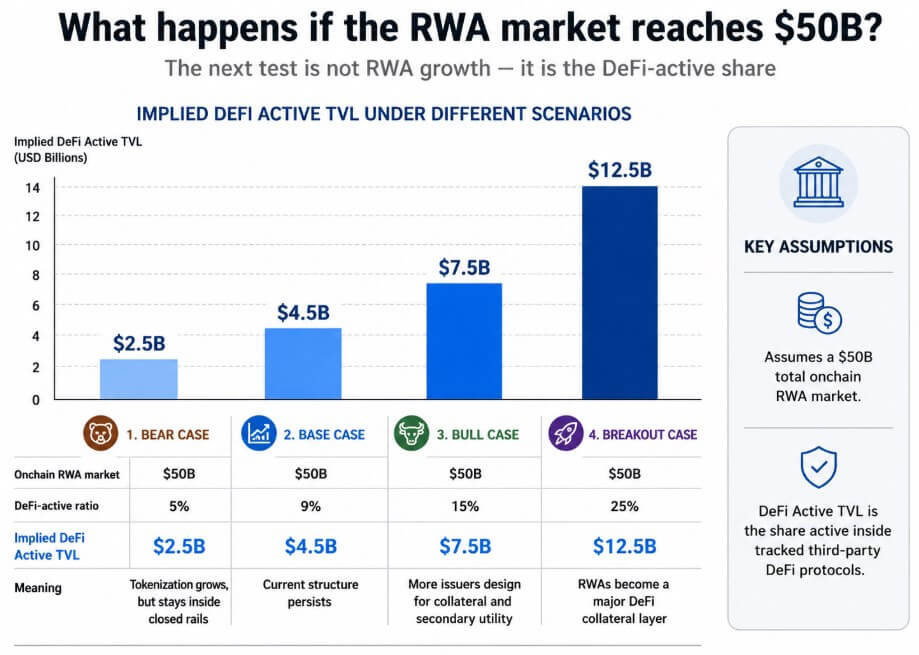
The chart above predicts the implied TVL of DeFi activity in a $50 billion RWA market under four scenarios, ranging from 5% to 25%.
Morpho's over $620 million in RWA deposits and the achievement of USDY circulating across 9 blockchains are sufficient proof that the second type of market has real development potential.
To push RWA asset DeFi penetration to over 9%, asset issuers must abandon design approaches like BlackRock's BUIDL, which are "compliance-centric," and instead adopt an underlying architecture that natively supports free circulation without barriers.
Currently, all $28.56 billion of RWA assets on-chain belong to the permissioned regulatory track. This means that the current tokenized real-world assets are more like compliant on-chain traditional financial products than general collateral assets adapted to the open DeFi ecosystem.