
Written by: Allard Peng
Compiled by: Saoirse, Foresight News
Strategy recently announced it might sell some of its Bitcoin holdings to achieve business goals, causing a stir in the market. The company had previously maintained a firm stance against selling any cryptocurrency; Saylor even jokingly stated that they would rather sell assets than sell Bitcoin.
In fact, for companies holding Bitcoin reserves, selling the coins is an alternative business strategy. The "never sell" approach simply reflects a long-term investment philosophy, aligning with the prevailing long-term investment thinking in the crypto space. Even though the market generally advocates for holding Bitcoin, selling it remains a reasonable choice in many scenarios.
At the individual level, cryptocurrency sales are primarily used to improve one's life, such as purchasing property, traveling, children's education, and dealing with large, unexpected medical expenses. However, the core purpose of all corporate business decisions is to enhance shareholder equity.
In the first quarter of 2026, Bitcoin miners sold a total of 25,376 Bitcoins, using the proceeds to transform their businesses into artificial intelligence. Company management determined that the risk-reward ratio of AI projects was higher than their Bitcoin holdings. This leads to the basic logic that selling Bitcoin to acquire other assets is justifiable when a higher-return investment opportunity exists. For companies like Strategy that hold Bitcoin, selling it can also create real value, for five main reasons.
Reason 1: To increase the amount of Bitcoin held per share
The amount of Bitcoin held per share is a core objective in a company's reserve asset management, and the periodic increase in this metric represents the Bitcoin yield. Common methods include purchasing Bitcoin to increase the total holdings, or reducing the outstanding shares through stock buybacks; both methods can boost the holding value per share.
If a company's stock price is lower than the value of its corresponding Bitcoin asset, selling Bitcoin to repurchase shares will ultimately increase the amount of Bitcoin held per share, and the decrease in Bitcoin holdings will be less than the reduction in share capital. When a company's operating cash flow cannot cover fixed expenses such as preferred stock dividends and bond interest, and the stock price is undervalued, selling Bitcoin to repay debts and interest can minimize the reduction in the amount of Bitcoin held per share.
Reason 2: Optimize capital structure and reduce financing costs
Rating agencies have a profound impact on the flow of funds in the capital market, and adhering to their rating rules can help companies secure financing smoothly. Previous reports have analyzed feasible ways to improve credit ratings, and a good rating can effectively reduce corporate financing costs.
S&P recognized the value of cash reserves, and Strategy promptly adopted the plan. As of January 2026, the company's cash reserves reached $2.2 billion, significantly alleviating investors' concerns about the company's inability to pay preferred stock dividends.
Companies can sell Bitcoin to replenish cash reserves, meet capital market demands, and then issue bonds at a lower cost. At the same time, selling Bitcoin to repay debt can reduce senior liabilities and increase the attractiveness of preferred stock financing.
In the long run, the difference in financing interest rates will widen the gap in returns through the compounding effect, and low-cost debt can reduce the burden on business operations and increase revenue.
Reason 3: Legitimate tax planning
Currently, there are no restrictions on Bitcoin wash trading in the United States. Businesses can sell Bitcoin to incur a book loss, then immediately buy it back, lowering the tax basis of their assets and thus offsetting their taxes. Strategy used this tactic as early as the market downturn in 2022.
This tax incentive remains in effect, allowing companies to combine it with loss deduction policies to simultaneously conduct stock buybacks, debt repayments, and other operations, achieving multiple benefits.
Reason 4: Overcoming negative public opinion in the market
The Bitcoin industry is relatively new, and various negative rumors have emerged one after another. Some false claims assert that if Strategy were to sell off its Bitcoin holdings, it would directly impact the entire crypto market and overturn the company's Bitcoin hoarding business model.
If a company sells 50,000 Bitcoins and neither the market price nor its own stock price fluctuates drastically, it can dispel rumors and allow the capital market to accept the company's business model of allocating Bitcoin assets.
The market itself has a self-regulating ability. Those who deliberately create hype are mostly media and self-media practitioners. Professional investment institutions make decisions based on actual research and will not be influenced by one-sided opinions. This is also the most subjective of the five reasons.
Reason 5: Discounted repurchase of preferred shares
This business strategy is rarely mentioned in the market. When the price of floating-rate financial products deviates significantly from their face value, companies can repurchase the products at a price far below face value to settle their high debts.
This operation is equivalent to closing out one's own short position in preferred stock without interest or borrowing costs. Taking the STRC product as an example, with a face value of $100, if the price falls to $82, the company can sell Bitcoin to repurchase the shares at a lower price, earning a difference of $18 per share, and this profit is tax-free.
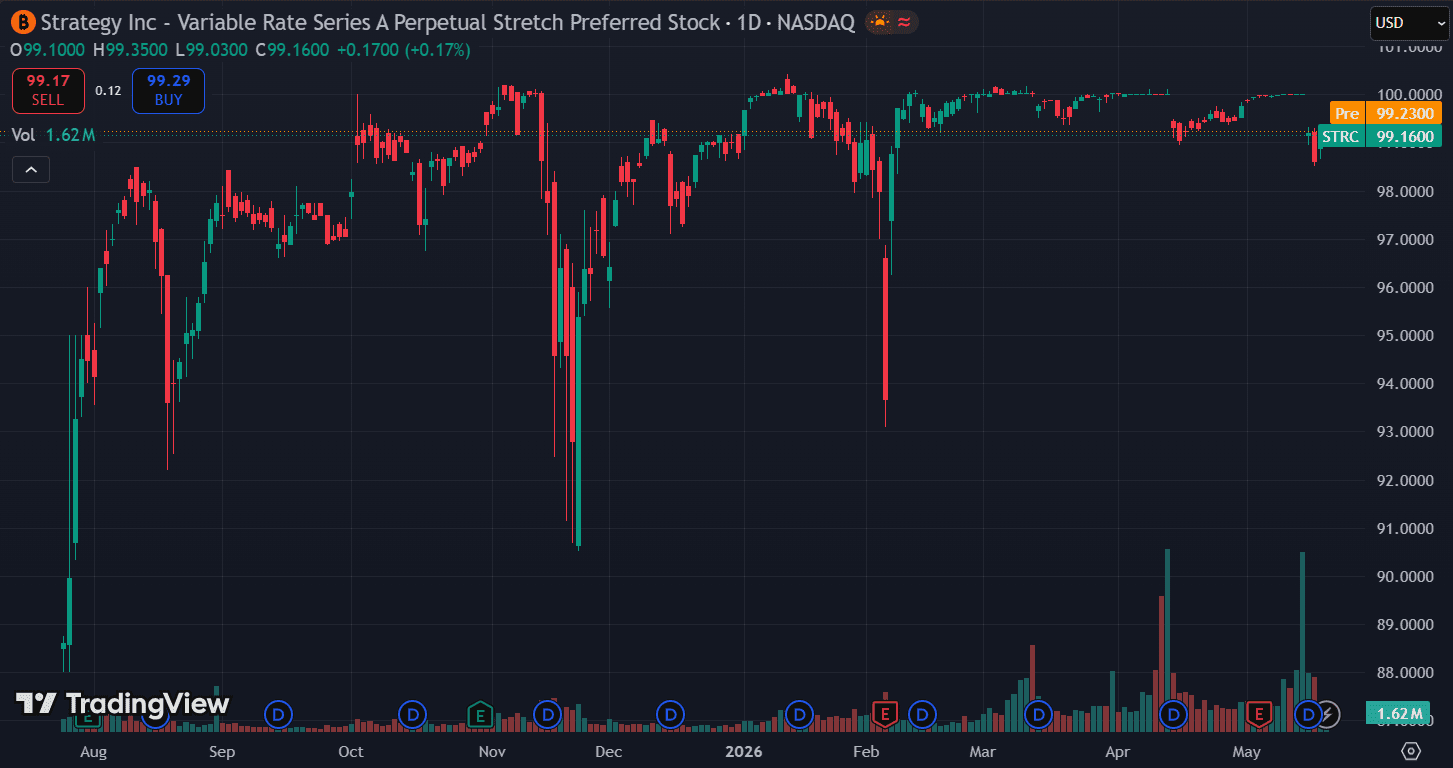
STRC's price trend since its initial public offering
A decline in preferred stock prices does not necessarily lead to a plunge in Bitcoin prices, and leveraged trading can easily trigger a chain reaction of selling. Companies can take advantage of low prices to repurchase shares, avoiding the financial losses that would result from subsequent dividend increases.
Summarize
Selling Bitcoin should not be viewed as a negative move by businesses. In many scenarios, selling Bitcoin can safeguard the interests of the company and its shareholders. Bitcoin possesses monetary attributes, providing businesses with flexible cash allocation capabilities; only by using assets wisely can their value be maximized.