Written by: Tao Zhu, Jinse Finance
Recently, a US stock trader named Serenity has inexplicably become a sensation. Some call him the godfather of AI supply chain, the king of optical communications, the Roaring Kitty of the AI era, and a new generation WSB legend. Others believe he is merely a bull market survivor who has failed to validate his returns. Regardless of the controversy, Serenity has risen from an unknown anonymous user to one of the most influential individual researchers in the AI investment field. This article explores: Who is Serenity? What is his stock selection logic? Which targets does he favor?
I. Who is Serenity?
Many people first came to know Serenity because of his X account .
His X bio reads: "The famous @Reddit WSB trader is now on the X platform. AI/semiconductor supply chain analyst (former RISC-V Foundation member), formerly an AI research scientist; currently focusing on trading little-known supply chain bottlenecks."
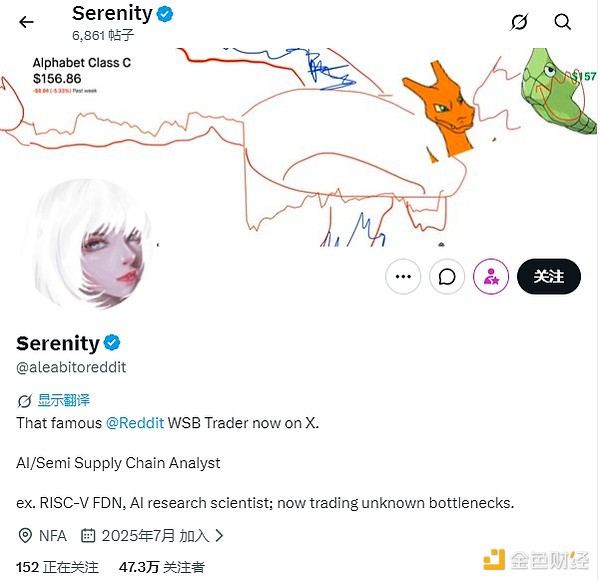
Serenity is also featured on the Serenity tracker : he is a trader from the Reddit Wall Street Bets (WSB, a retail trading community) and an AI and optical communications engineer. He has attracted 473,000 followers on X by identifying key bottlenecks in the AI supply chain, the so-called "choke points"—critical suppliers that are not well-known to AI infrastructure giants but are highly vertically integrated.
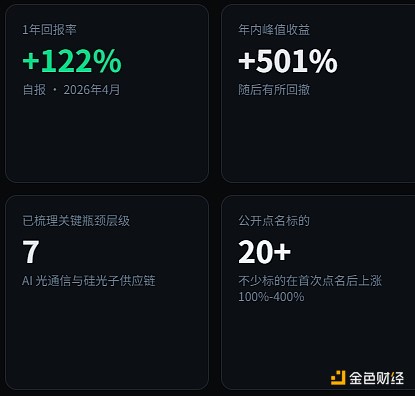
He stated his year-to-date return as +122%, with a peak of +501% year-to-date (followed by a pullback). He identified seven key bottleneck levels and publicly named over 20 (38) investment targets. He disclosed no funds or 13F filings—only his investment views publicly released on X, some of which were later corroborated by financial reports and industry data.
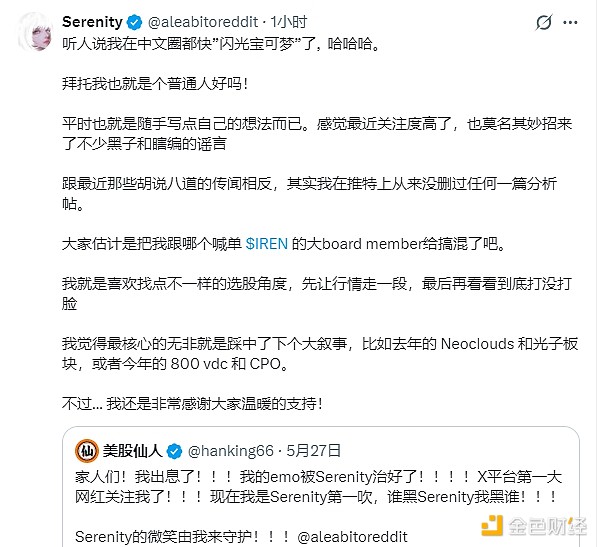
Serenity also posted information on X today: it is very popular in the Chinese community; the core reason is simply that it has hit the next big narrative, such as Neoclouds and the photonics sector last year, or 800 vdc and CPO this year.
Based on publicly available posts and profiles, Serenity is best known for:
Migrating from Reddit/WSB to X.
Publish theory-driven stock research reports, with a particular focus on areas such as artificial intelligence, semiconductors, and supply chain bottlenecks.
Although Serenity claims strong past returns, these figures are self-published and lack independent verification; the specific position size is unknown.
II. Serenity's Stock Selection Logic
Serenity's stock selection logic can be summarized as the "bottleneck theory." That is, he doesn't buy Nvidia, but rather companies that Nvidia cannot function without.
The Serenity tracker details his stock selection logic through examples:
AXTI Supply Chain: Just as 20% of the world's oil flows through the Strait of Hormuz, the construction of AI optical communication infrastructure relies on several key bottlenecks controlled by a single supplier or a duopoly. Identify these bottlenecks, buy shares in the corresponding companies, and hold them long-term. (Note: AXTI refers to AXT, Inc. (NASDAQ: AXTI), a well-known US semiconductor materials company. This company primarily produces indium phosphide (InP) substrate materials, essential for optical communication and AI optical modules.)
"Only invest in technologies I have truly researched and understand": Former AI research scientist + RISC-V Foundation member + silicon photonics engineer. Capable of understanding substrate-level technical literature, materials that individual investors and most analysts often don't delve into.
"Positioning ahead of institutional funding": Pointing out the InP substrate bottleneck that AXTI faces a year in advance. In Q1 2026, IntelliEPI's CEO publicly acknowledged that "the shortage of indium phosphide supply is a bottleneck for the entire AI infrastructure."
Of the investments that Serenity has publicly named, more than half are in the optical communication sector.
SerenityAI's optical communication and silicon photonics supply chain can be divided into seven key tiers. From this tiered division, we may be able to further understand its stock selection logic.
1. Raw materials—gallium, indium, arsenic
Every indium phosphide (InP) substrate wafer begins with the sourcing and refining of these rare metals. The main production site is in China; AXT has its own processing lines. AXTI is recommended.
2. pBN crucible and crystal growth equipment
The pyrolytic boron nitride crucible is used for growing InP ingots. This is a bottleneck in the equipment segment due to the reliance on a single supplier. Shin-Etsu Chemical is recommended.
3. InP Substrate Processing – The "Crown Jewel"
This is the most constrained link in the optical communication supply chain. IntelliEPI's CEO publicly confirmed a "InP supply shortage" in Q1 2026—a year later than Serenity's assessment. AXTI is recommended.
4. Continuous Wave Laser (CW Laser) – Light Source for Co-packaged Optics (CPO)
A turning point may arrive in 2027-2028. CPOs are expected to gradually replace pluggable optical modules; Sivers controls the key bottleneck of laser light sources, yet its market capitalization is only about $290 million. We recommend SIVE.
5. Optical Module – Assembly
This is the most readily visible link in the supply chain. Nvidia's $2 billion investment in optics has secured production capacity here. We recommend AAOI, COHR, LITE, and Accelink.
6. Testing and Verification
Optical communication device testing equipment – similar to AAOI in the early stages before mass production. We recently secured a verification order from a leading optical module manufacturer. AEHR is recommended.
7. Optical cables and optical fibers (hollow-core optical fiber + traditional optical fiber)
The foundational transmission layer of the entire system. Traditional optical fiber plus novel hollow-core optical fiber, used for low-latency interconnection between AI clusters. Recommended suppliers include GLW, Prysmian, and Furukawa Electric.
In short, Serenity's core logic is: not to buy AI leaders, but to find the links in the AI industry chain that are the most difficult to replace and the most likely to experience supply bottlenecks, and to make early investments before the market discovers them.
III. Serenity's 38 publicly named investment targets
Looking only at Serenity's publicly recommended stock list, these companies seem unrelated. However, rearranging them according to his "bottleneck theory" reveals that they actually form a complete map of AI infrastructure, encompassing optical communication, storage, AI cloud computing power, energy, and many other areas. Interestingly, Serenity is even interested in ETH and Coinbase.
1. Optical communication
(1) AXTI (AXT Inc)
AXT is one of the few companies globally capable of mass-producing InP (indium phosphide) and GaAs (gallium arsenide) substrates, positioned at the very upstream of the AI optical communication industry chain. Its customers primarily include optical communication manufacturers, silicon photonics manufacturers, and laser manufacturers, giving it a very strong industry position. However, its financial performance is mediocre: its TTM revenue in 2026 was approximately $96 million, and it remains unprofitable. Its current stock price is $115.70. Serenity believes that InP may become the oil of the future AI photonics era.
(2) SIVE (Sivers Semiconductors)
Sivers primarily manufactures lasers, photonic chips, and RF chips, mainly targeting AI optical communication, CPO (co-packaged optics), and silicon photonics customers. Serenity believes that the future CPO era will require a large number of continuous wave lasers.
(3) AAOI (Applied Optoelectronics)
Applied Optoelectronics is a vertically integrated manufacturer of fiber optic communication products, producing 400G, 800G, and 1.6T optical modules. Its customers include Microsoft and hyperscale cloud providers. Revenue for the past 12 months was approximately $507 million, a year-over-year increase of 64%. The current stock price is $169.02.
(4)AEHR (Aehr Test Systems)
Aehr primarily manufactures semiconductor testing equipment, with customers including AI chip and data center chip manufacturers. Its latest quarterly revenue was $10.3 million, with a net loss of $3.2 million. However, its order book reached $37.2 million.
(5) MRVL (Marvell)
Marvell is a leading AI network chip manufacturer. Its core products include DSPs, optical interconnects, and custom AI ASICs. Customers include major cloud providers such as Amazon, Microsoft, and Alphabet, and its revenue is projected to exceed $16 billion in fiscal year 2026. Serenity considers Marvell to be a mainstay in optical communications.
(6) COHR (Coherent)
Coherent is a global leader in optics, producing lasers, optical devices, and optical modules, covering 2-5 layers of the supply chain.
(7) LITE (Lumentum)
Lumentum is one of the world's leading optical module manufacturers. Its customers include Meta and Amazon.
(8) TSEM (Tower Semiconductor)
Tower Semiconductor specializes in specialty wafer foundry services and is one of the world's leading silicon photonics foundries. Its clients include giants such as Nvidia and Broadcom.
(9) SOI (Soitec)
Soitec is the undisputed leader in the global manufacturing of innovative semiconductor engineering substrates (wafers) and a pioneer and definer of "silicon-on-insulator" (SOI) technology. Its customers include TSMC, Samsung, and Sony.
(10) GLW (Corning)
Corning is a global leader in fiber optics, offering products including fiber optic cables, optical fiber, and data center connectivity. Its clients include NVIDIA, Microsoft, AWS, Meta, Apple, and Samsung.
(11) VNP
VNP is 5N Plus Inc., a Canadian manufacturer of specialty semiconductors and high-performance materials. Its customers are primarily concentrated in high-barrier-to-entry industries such as renewable energy, aerospace, medical imaging, and advanced pharmaceuticals, and it collaborates with companies such as First Solar and Sierra Space.
(12) ARM (Arm Holdings)
Arm is a UK-based global semiconductor intellectual property (IP) provider. It doesn't manufacture or sell any actual chips; instead, it focuses on designing Reduced Instruction Set Computing (RISC) processor architectures and licensing those designs to top technology companies worldwide. Serenity believes Arm is a long-term beneficiary of AI infrastructure.
(13) LPK
LPK is a German laser equipment company. They provide PCB and semiconductor packaging, specializing in advanced packaging.
(14) XFAB
XFAB is a specialty process wafer fab. It does not design its own chips, but primarily provides chip manufacturing services to customers in the automotive, industrial, medical, consumer electronics, and communications sectors.
(15) NVTS (Navitas)
Navitas' core business is to replace traditional silicon-based chips with GaN (gallium nitride) and SiC (silicon carbide) technologies, providing efficient, high-power-density, and low-heat-generating solutions for AI data centers, electric vehicles (EVs), fast charging for mobile phones, and industrial power supplies.
(16) WOLF (Wolfspeed)
Wolfspeed is a semiconductor company and a global leader in silicon carbide (SiC) materials and devices.
(17)OSS (One Stop Systems)
One Stop Systems focuses on designing and manufacturing innovative edge computing modules, rugged servers, and AI transmission systems for military, aerospace, automotive, and industrial applications that require extreme computing power.
2. Storage, high-bandwidth memory
(1) SNDK SanDisk
SanDisk is renowned for designing, manufacturing, and selling memory cards, USB flash drives, and solid-state drives (SSDs), and is a core player in the global AI infrastructure and digital storage market. In 2016, SanDisk was acquired by Western Digital and delisted. Subsequently, in 2025, SanDisk relisted as an independent flash memory giant, focusing on its core storage business and rapidly becoming a key player in the AI storage field.
(2) MU Micron
Micron is a provider of semiconductor storage and imaging solutions. It focuses on the design, manufacture, and sale of core storage technologies such as DRAM (Dynamic Random Access Memory) and NAND flash memory.
(3) WIN Win Semi (Win Semiconductors, Taiwan)
Win Semiconductors is the world's first professional wafer foundry service company to manufacture gallium arsenide microwave integrated circuits (GaAs MMIC) using six-inch wafers.
(4) EWY iShares MSCI Korea ETF
EWY primarily invests in large-cap South Korean stocks, covering sectors such as technology, finance, and automobiles. Besides Samsung Electronics and SK Hynix, it also includes Hyundai, POSCO, and financial stocks. This diversified industry portfolio may reduce volatility associated with any single sector, but it still carries the risk of exposure to single-country and exchange rate fluctuations.
3. AI Cloud Computing Power Providers
(1) NBIS (Nebius)
Nebius focuses on providing global AI cloud infrastructure. NVIDIA and institutions like Accel have made significant strategic investments in it, ensuring Nebius has priority and rapid access to the latest generation of NVIDIA GPUs to meet the AI computing power needs of startups worldwide.
(2) CRWV (CoreWeave)
CoreWeave is a high-performance GPU cloud computing service provider focused on providing computing power for AI and deep learning. As a deep strategic partner of NVIDIA, it has become one of the world's largest independent cloud platforms thanks to its ability to deploy cutting-edge GPU clusters on a large scale, primarily providing computing power services to AI large-scale model companies, visual effects, and biomedical industries.
(3) IREN (IREN Limited)
IREN Limited is a next-generation data center company. Originally named "Iris Energy," the company changed its name to IREN at the end of 2024 and has now transformed from a single green energy Bitcoin miner into an infrastructure platform focused on AI cloud computing and high-performance computing (HPC).
(4) RDDT (Reddit)
Reddit's core role in the AI wave is that of a "data provider." The company generates substantial revenue by licensing its 20-year-old corpus of real-world human conversations to giants like OpenAI and Google. Its CEO has publicly stated that the company does not invest heavily in data centers (it doesn't build its own cloud computing power and sell it to others), but rather uses it as data "fuel" for AI development.
4. Macroeconomics, Energy
(1) LNG (Cheniere Energy)
Cheniere Energy is the largest liquefied natural gas (LNG) producer in the United States and the second largest LNG operator globally. Its main business includes the liquefaction, processing, and export of natural gas, and it is a key driver of the US shale gas revolution's expansion into the global market.
(2) CVX (Chevron)
Chevron is one of the world's largest multinational energy companies and the second-largest integrated energy company in the United States. Its business covers the entire value chain, including oil and gas exploration, production, refining, petrochemicals, sales, and renewable energy, and it operates in more than 180 countries and regions worldwide.
(3) NEXT (NextDecade)
NextDecade is a liquefied natural gas (LNG) development and energy company. Its core businesses include natural gas liquefaction, LNG export facility construction, and carbon capture and storage (CCS) technology development.
(4) MP (MP Materials)
MP Materials is the largest rare earth materials producer in the Western Hemisphere and the only rare earth company in the United States with large-scale mining and processing capabilities. The company is dedicated to rebuilding the domestic rare earth supply chain in the United States, and its core products are widely used in electric vehicles, wind turbines, and defense systems.
(5) FAZ (3x short selling of financials)
FAZ is a leveraged inverse ETF issued by Direxion, designed to provide investment returns that are three times (-300%) the daily performance of the Russell 1000 Financial Services Index.
(6) GUSH (3x leveraged long position in oil)
GUSH is a daily leveraged ETF issued by Direxion. It aims to provide investment returns that track the daily multiple of the S&P Oil & Gas Upstream Sector Index.
(7) SQQQ (3x short Nasdaq)
SQQQ is a leveraged ETF that shorts the Nasdaq 100 index by 3x. Its core objective is to provide a daily inverse 3x return on the Nasdaq 100 and it is only suitable for intraday/very short-term trading.
(8) UVIX (2x long VIX)
UVIX is a leveraged ETF that goes long on VIX short-term futures by 2x, aiming to provide 2x the daily return of the VIX short-term futures index (LONGVOL), and is a purely short-term instrument.
(9) AIRO (AIRO Group Unmanned Aerial Vehicles/Defense)
AIRO is a technology company focused on the aerospace and defense sectors, with its main businesses concentrated in military drones, advanced avionics, pilot training, and electric vertical takeoff and landing (eVTOL).
5. Cryptocurrency
In the cryptocurrency space, Serenity focuses on ETH and Coinbase.
6. Other
(1) BOT (Direxion Robotics & AI ETF)
BOT is a leveraged ETF issued by Direxion. It aims to achieve twice (200%) the daily investment performance of the index it tracks.
(2) VCX (Fundrise Innovation Fund)
VCX is a closed-end venture capital fund listed on the New York Stock Exchange (NYSE). It pioneered the concept of "Public Venture Capital Fund (PVC)," aiming to break down the barriers that previously only allowed high-net-worth individuals to participate, enabling ordinary retail investors to directly invest in top private technology companies such as OpenAI, Anthropic, SpaceX, and Databricks, just like buying and selling stocks.