Written by: Jason Rosenthal , Operating Partner, a16z crypto
Compiled by: Chopper, Foresight News
Throughout business history, many enduring companies have shared a common logic for success: they all operate within an ecosystem, undertaking value creation and transfer activities and extracting profits from them. The larger the value flowing through the ecosystem, the larger the company tends to be.
Encryption technology is the first modern technology natively adapted to this business logic. If a startup doesn't base its product design and business model development on this logic, it will miss out on huge opportunities. The widespread adoption of stablecoins has enabled internet-level speeds of capital and value transfer, allowing for 24/7 global settlement and end-to-end programmability. Now, with the underlying channels for capital flows fully open and the unit economic model transparent, every dollar circulating globally becomes a potential source of traffic in this sector.
Underlying business logic
Blockchain is essentially a network-based business model. All transactions are recorded on a shared ledger, and each new participant reinforces the underlying system used by subsequent developers. The more people use the ecosystem and build applications, the higher the value of the entire network to all users.
Most traditional businesses need to spend years building network effects on outdated infrastructure; while entrepreneurs in the crypto space start with natural network effects.
Network tokens further amplify this advantage. A well-designed token system can bind users, developers, service providers, node validators, and the protocol ecosystem to a common goal—driving network development while distributing rewards according to each party's contribution. The rewards generated by the protocol ultimately belong to all ecosystem participants. There are no private rebates or special transactions; only a positive cycle is formed: value circulates within the system, and rewards flow back to everyone who builds the ecosystem.
This business logic is not new; it's just that for the first time in the crypto industry, it has made it easier for startups to launch and scale their operations.
The core profit of railroad companies has never been selling locomotives, but rather charging tolls for each freight train carrying grain, coal, and steel. Standard Oil, U.S. Steel, and AT&T are all giants rooted in the value transfer process. Google and its Metaverse platform replaced traditional print and television media not simply because of superior advertising formats, but because they occupied the key nodes in converting attention into commercial transactions, taking a share of trillions of dollars in commercial traffic. Amazon Web Services, on the other hand, occupies a central position in computing resources.
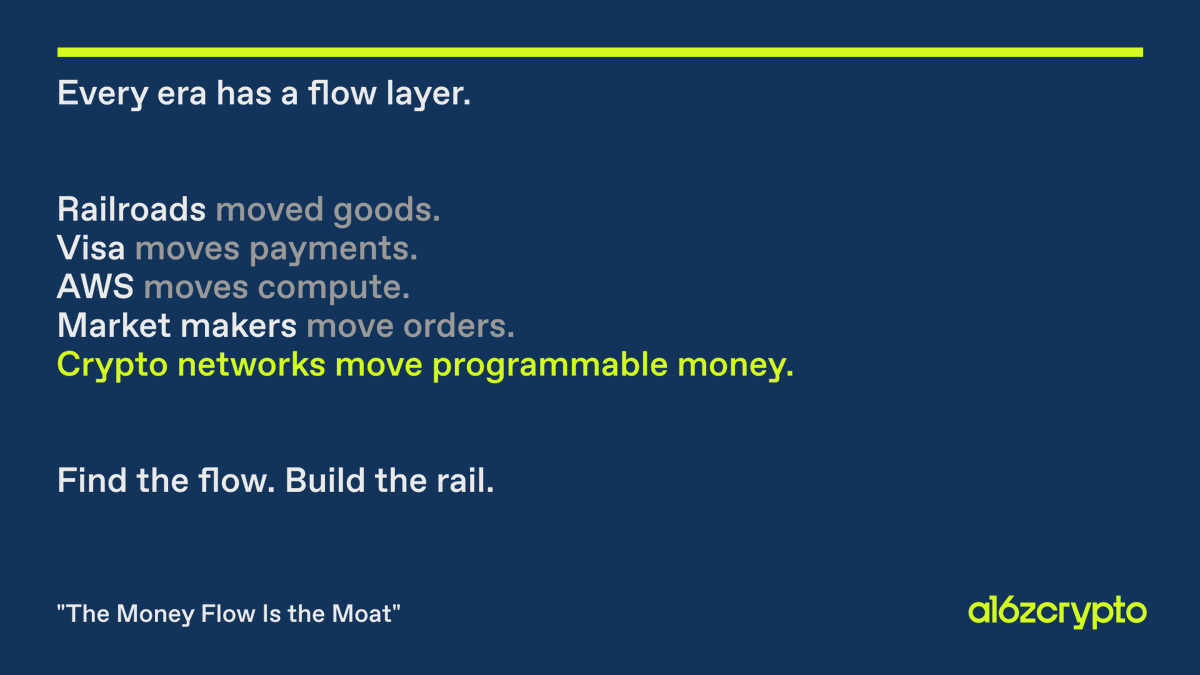
The principle remains constant: find the core path of value flow and occupy a key position within it.
This logic is vividly demonstrated in the financial markets. In fiscal year 2024, Visa processed a total of $15.7 trillion in payments, generating net revenue of $35.9 billion. Jane Street, a well-known market maker, earned a staggering $20.5 billion in net trading revenue last year, surpassing Citibank and Bank of America. The top five market makers in the US handle 87% of order flow payments: they don't predict market fluctuations; they simply monitor the flow of each order, and the higher the trading volume, the greater their profits.
These types of businesses also share a common characteristic: a strong network effect. The more merchants accept Visa cards, the greater the value of the card to the cardholder; conversely, the more cardholders there are, the more merchants will be attracted to open the service. The same principle applies to the order flow market: the more brokers that join, the narrower the bid-ask spread becomes, which in turn attracts more brokers to join, bringing in a larger volume of orders.
The combination of cash flow and network effects is one of the most stable business models in the business world.
Your profits are my opportunities.
Bezos famously said, "Your profits are my opportunities." While originally a statement about the retail industry, this is even more apt in the traditional financial services sector—the financial industry is the largest contributor to global profit retention. This applies to various sub-sectors including payments, asset custody, lending, foreign exchange, asset securitization, transaction settlement, and market making.
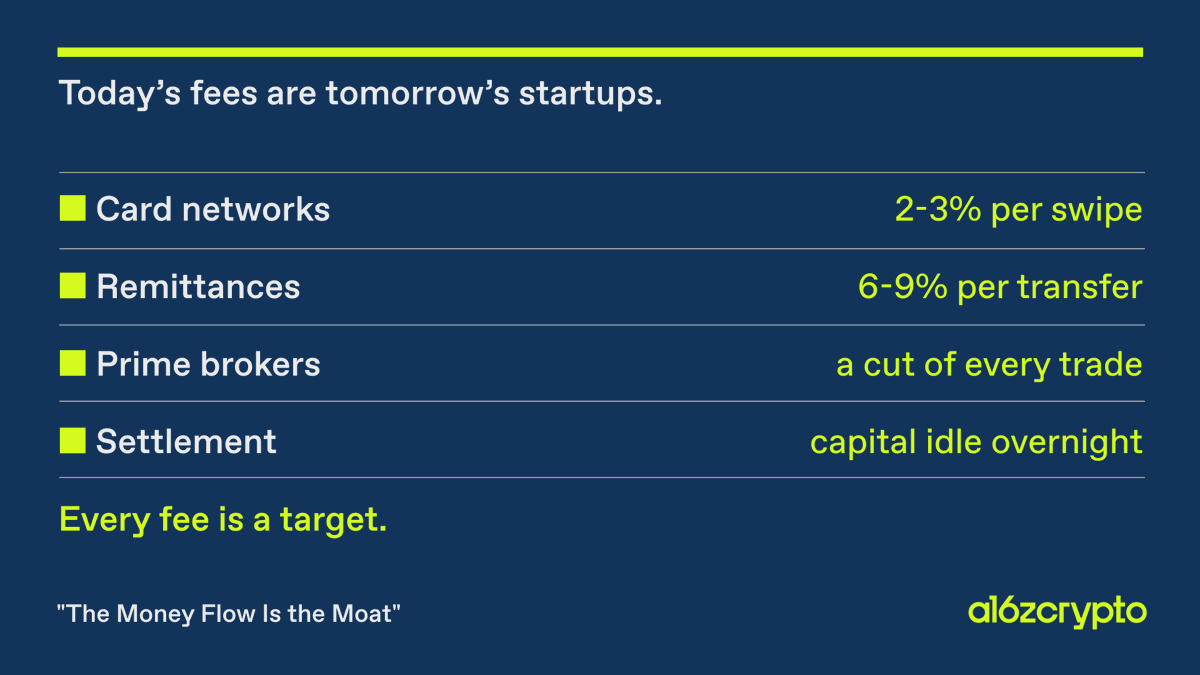
Visa and Mastercard, based on networks built in the 1960s, charge transaction fees of 2% to 3%; cross-border remittance fees are as high as 6% to 9%; prime brokers and asset custodians take a cut from every securities transaction. Even if the US shortens the securities settlement cycle to T+1 in 2024, funds will still be idle overnight, which means all market participants will bear a structural cost.
The existing profit margins in these industries represent potential entry points for change. This could reduce transaction costs, improve the efficiency of capital flow, and potentially further expand the overall market size. Stripe and Square have already proven that this model works effectively in the payments sector.
Entrepreneurs in the crypto industry have the opportunity to build the next generation of infrastructure: programmable, with instant transaction processing, global service coverage, and rooted in the flow of funds from its inception.
Opportunities have long since transcended the boundaries of financial services. The computing power and GPU trading market, memory chips, AI training data, energy, robotics, aerospace, and rare earth metals are all poised to witness large-scale global value flows, and existing traditional channels are simply unable to handle such a volume of business.
The above-mentioned sectors are all new blue ocean markets that rely on programmable infrastructure and focus on capital flow models. There are no deeply rooted established platforms, no entangled intermediary service providers, and no old patterns that need to be adhered to.
As an entrepreneur, you might want to ask yourself a few questions: Is your business currently at the core of the value chain? When the transaction volume and value of your product ecosystem increase tenfold, will your revenue grow in tandem? If you are developing a new product, in the target market, which stage offers the highest profit retention relative to the value it creates?
The answer lies where the opportunity lies. Reduce costs in existing processes, enter entirely new value transfer channels, and leverage network effects to achieve sustained growth.