
Author: angelilu, Foresight News
Dear players, please open your eyes. ZKJ and KOGE were poisoned last night!
At the end of the dull weekend market, the crypto market once again staged a thrilling scene. At around 20:30 on the evening of June 15, 2025, ZKJ and KOGE, the two tokens with the largest trading volume on the BSC chain on the Binance Alpha platform, suffered a cliff-like drop.
Polyhedra Network's token ZKJ plummeted from $1.946 to a low of $0.3767 in just two hours, with a maximum drop of an astonishing 80.64%, and its market value plummeted to only $230 million. At the same time, KOGE also fell from $61 to a low of $8.46 in half an hour, with an equally shocking drop.

Market impact and chain reaction
Coinglass data showed that between 20:00 and 22:00 that night alone, the total amount of liquidation in the entire network reached 102 million US dollars, of which the currency ZKJ alone contributed 94.336 million US dollars in liquidation, and the long position liquidation reached 93.6878 million US dollars, forming a typical long trap.
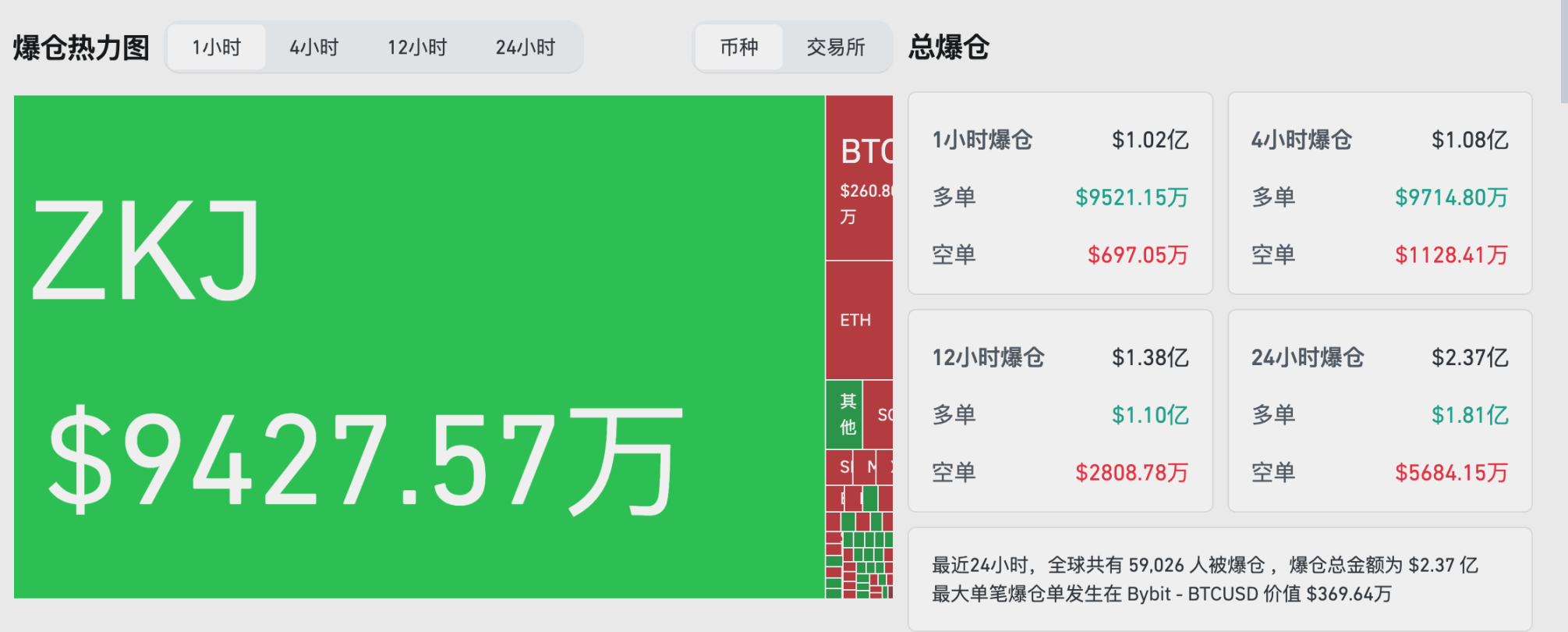
For ordinary participants, the losses were particularly severe. Users who traded only to earn Binance Alpha points suffered a devastating blow. Taking an investment of $1,000 as an example, with an 80% drop in ZKJ, users who panic-sold lost an average of about $800, which is close to the income of 10 Binance Alpha airdrops. Some users reported that the $5,000 investment that was originally planned to accumulate points through small transactions was less than $500 after the flash crash, with a net loss of up to $4,500. Once again, "small gains lead to big losses."
It is worth noting that ZKJ has been trading at a fully diluted valuation (FDV) of about $2 billion in the past few months, showing an unusually stable trend - liquidity exceeds $20 million, almost a "stable currency", and has long been ranked first in the Binance Alpha points ranking. This unreasonable price performance now seems to be the calm before the storm.
Warning signs before a crash
In fact, there were signs of a collapse the day before. The prices of ZKJ and KOGE experienced slight fluctuations yesterday. Some analysts pointed out that the initial decline of ZKJ and KOGE was due to a specific address (starting with 0x364) withdrawing 1.29 million ZKJ and 8,667 KOGE bilateral liquidity from OKX, followed by a sell-off.
A market observer said, "Yesterday's KOGE and ZKJ fluctuated 3%, which is the countdown to the plunge. Price fluctuations → fewer people are swiping → APY plummets → LPs withdraw from the pool → spot prices crash → more people withdraw from the pool. When the negative spiral begins, it is like an avalanche, which has nothing to do with the quality of the project itself."
What is even more surprising is that the 48 Club team behind KOGE issued a statement when the price of the currency first fluctuated: "KOGE has been fully released from day one and is not locked. 48Club has never promised not to sell treasury holdings. Investors are requested to conduct their own research at their own risk." This statement was later interpreted by many investors as a disguised "crash warning."
Deep Cause Analysis
According to the research of on-chain analyst AI Yi, the flash crashes of ZKJ and KOGE showed the characteristics of a carefully planned harvesting operation. The three main addresses targeted the huge transaction volume and liquidity formed by the two tokens in the context of Binance Alpha, and through the double blow of "large withdrawal of liquidity + continuous selling", the two tokens collapsed one after another:
- The address starting with 0x1A2 withdrew approximately $3.76 million of KOGE and $532,000 of ZKJ bilateral liquidity twice between 20:28 and 20:33, and then exchanged 45,470 KOGE for ZKJ, worth $3.796 million, and sold 1.573 million ZKJ in batches.
- The second key address withdrew approximately $2.07 million of KOGE and $1.38 million of ZKJ in bilateral liquidity, while selling 1 million ZKJ.
- The third address liquidated its position after receiving 772,000 ZKJ transferred from the second address, further exacerbating the downward trend of ZKJ.
It is worth noting that the crypto community once popularized the "ZKJ-KOGE pair brushing low wear" operation strategy when participating in the Binance Alpha airdrop event. This phenomenon precisely laid the groundwork for this harvesting operation.
Aunt AI’s in-depth analysis on the X platform revealed several key issues of this flash crash:
Strategic considerations for the order of market crashes
The operator's choice to dump KOGE first and then ZKJ was not a random choice. The primary reason is that ZKJ has contract trading, and the operator can dump the market on the chain at the same time as opening a short position on the exchange, thus achieving double benefits. Secondly, from the perspective of liquidity, ZKJ has relatively more liquidity, and dumping the market requires more funds, so it is more economical to start with KOGE, which has weaker liquidity.
Mechanisms of delayed price crashes
ZKJ and KOGE are well-known tokens in the Binance Alpha ecosystem for their "good liquidity + stable price", which leads to their LPs (liquidity providers) generally setting extremely narrow price ranges. Once a large-scale sell-off breaks through this narrow range, there will not be enough funds in the market to take over the sell orders, which will inevitably cause a flash crash. What's more fatal is that when LPs see the price of the currency falling, they often panic and flee, further exacerbating the vicious cycle of the price plunge. For those LPs who fail to react in time, the end result is that they passively hold a large number of depreciated ZKJ and KOGE tokens.
Accuracy of timing
Auntie AI speculates that the obvious decline in Binance Alpha's trading volume for several consecutive days may be the key reason why the operator chose to dump the market at this time. For large LPs, "running fast" is often the rule of survival. Especially considering that there are few real long-term believers among ZKJ and KOGE holders, most participants are just for high interest, which makes the entire ecosystem extremely fragile, like a building, which can cause the entire collapse if only one load-bearing column is broken.
Analysts pointed out that 16 days before the incident, the two projects had jointly established the ZKJ/KOGE trading pair and liquidity pool on the Pancake platform, accumulating tokens worth $30 million. However, as altcoins in the Alpha ecosystem, once the price of one of the coins collapses, it is very easy to trigger a chain sell-off of the other coin, forming a "domino effect".
In addition, Polyhedra Network (ZKJ) plans to unlock about 15.53 million tokens at 8:00 am on June 19, accounting for 5.04% of the current circulation and worth about 30.3 million US dollars. This upcoming unlocking pressure may also be one of the catalysts for the crash. Overall, this flash crash is the result of both careful layout at the technical operation level and objective pressure from market fundamentals, and is the result of multiple factors.
Reflections on Binance Alpha Mechanism
This incident also triggered a deep reflection on Binance Alpha Points Mechanism. Since Binance launched this mechanism, it has attracted a large number of users to participate in the "money-making" activities, but it has also provided opportunities for some projects with ulterior motives.
The flash crash also coincided with the introduction of two reform measures by Binance Alpha: the first was the launch of the Alpha Financial Center, which enabled LP providers to earn points; the second was the adjustment of the airdrop distribution mechanism, which will be distributed in two phases starting from June 19, so that users who meet the airdrop threshold can receive points first, and those who have not received all can receive them at a lower score. However, in this incident, position holders, liquidity providers, and users who tried to brush points during the crash all suffered huge losses.
Market warnings and lessons
Traders in the community have pointed out in advance that the so-called trading competition is often actually for the project party to ship. A user analyzed that before ZKJ was listed on Binance, it was observed that there were as many as 100 million positions on BYBIT, equivalent to more than 200 million US dollars, which is equivalent to the holdings of the mainstream currency SUI on Binance. In this plunge, the contract alone smashed more than 600,000 US dollars of positions.
One trader gave this advice: "I advise everyone not to buy these altcoins just because of the Binance Trading Competition. If there is a spike, you may suffer heavy losses. The profit is often not worth the potential loss."
The ZKJ and KOGE crashes have sounded the alarm for Binance Alpha and crypto market participants. In the high-risk crypto market, especially when facing altcoin projects with opaque governance structures and artificially maintained liquidity, investors need to remain highly vigilant and guard against becoming targets of harvesting.
As large and small investors rush to leave, the future direction of Binance Alpha activities and the platform’s response to such problems will become the focus of market attention.