
Introduction: Stablecoins have proven crypto's "payment value," while prediction markets are attempting to prove its "information value." Within the cryptocurrency market, platforms like Polymarket and Kalshi have seen soaring trading volumes, making them one of the sectors closest to real-world applications. However, outside the market, prediction markets are still viewed as gambling, struggling to gain mainstream acceptance. This article will analyze the current state of prediction markets, their path to breakthroughs, and future trends, exploring whether they can become the next cornerstone connecting crypto and reality, following stablecoins.
Author: Shigeru
CGV Research

Over the past two years, prediction markets have become the most controversial, yet most promising, "real-world application" in the crypto industry. Within the industry, it has already spread beyond leading platforms like Polymarket and Kalshi, with trading volume climbing rapidly. However, outside of the industry, it is still viewed as gambling, making it difficult for mainstream investors to incorporate it into their asset allocation.
However, the question arises: Can prediction markets, like stablecoins, truly break through the boundaries of their niche and become the next cornerstone connecting the crypto industry with the real world? Can they become the next internet-level fintech product?
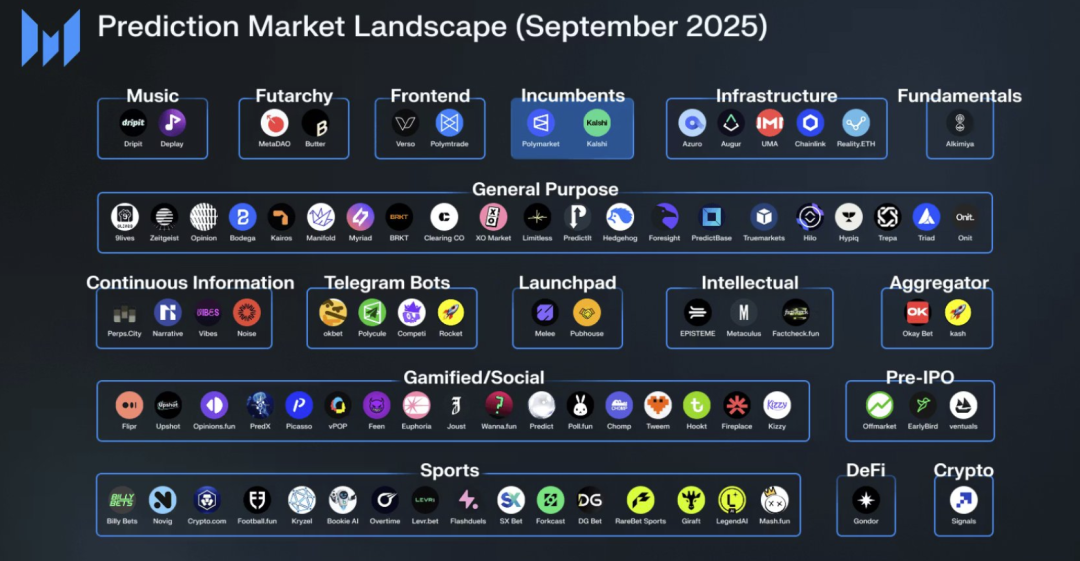
Crypto Prediction Market Ecosystem (Messari)
Analysis of the current situation: prosperity within the circle and the cognitive gap outside the circle
Why is it that the same market is so hot within the crypto community, yet so rarely seen outside? The prediction market is a prime example of this phenomenon.
On the one hand, the popularity in the circle continues to rise.
Platforms represented by Polymarket, Kalshi, and Manifold have established relatively stable traffic and narratives in the crypto community.
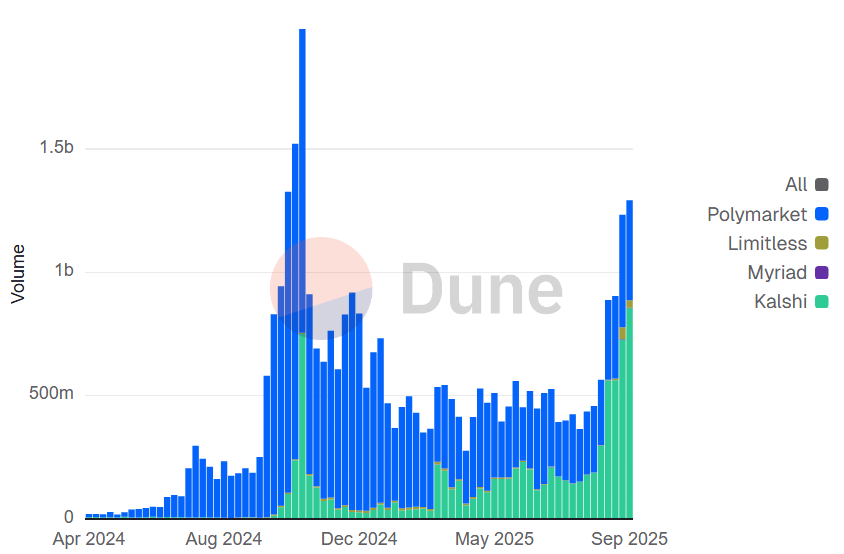
Crypto Prediction Market Share Statistics (Dune, 20251006)
With its simple interface and USD stablecoin settlement, Polymarket has become a key venue for discussing events such as the US election, macroeconomic data, and crypto airdrops. By 2025, Polymarket's cumulative trading volume had exceeded $7.5 billion, with August's volume exceeding $618 million, primarily driven by political events and macroeconomic forecasts. During the 2024 US election, Polymarket gave Trump a 99% chance of victory at 1:30 AM Eastern Time, while Fox News didn't announce the results until 1:47 AM, and other media outlets delayed even longer. Continuous arbitrage and the rising marginal cost of shifting prices away from fair value make prediction market errors short-lived and easily correctable.
Manifold, with its light entertainment model of "social + prediction," has attracted over 200,000 users, becoming a "new voting pool" for community users to obtain information and express their opinions. However, in 2025, Manifold's daily active users fell to a historic low of 886, highlighting the challenges of user retention.
In addition, Kalshi has emerged as a compliant platform, with a trading volume of US$1.3 billion in September 2025, accounting for 62.2% of global prediction market activities and dominating the market in sports event predictions.
On the other hand, awareness outside the circle is still insufficient.
The general public often equates prediction markets with gambling, lacking an appreciation for their value in information aggregation and probabilistic pricing. Even when mainstream US media began occasionally citing Polymarket data, prediction markets remained largely unknown.
For example, a 2025 report in The Economist noted that low liquidity hindered participation by large investors, limiting market credibility. The lack of regulatory compliance and authoritative endorsements hindered mainstream adoption. Despite Kalshi recording $208 million in trading volume during the March Madness event in March 2025, the public still viewed it as gambling rather than an informational tool.
Cross-circle expansion strategy: multi-dimensional integration and innovation path
If the prediction market truly wants to break out, it needs more than just technological upgrades; it needs to find new narratives and entry points. Politics, macroeconomics, entertainment and sports, and even the native Web3 ecosystem are all potential breakout points.
1. Anchored in real-world events: Traffic portals for politics, economics, and entertainment
The prediction market naturally has a strong correlation with real events, and sectors such as politics, economy, entertainment and sports are the best entry points for it to break through the circle.
Political events such as the US presidential election, the UK's Brexit referendum, and the probability of a bill passing are all difficult for traditional polls to accurately predict. Prediction markets, due to their price-based mechanism, often provide more real-time indicators that are closer to true probabilities. For example, the 2025 Federal Reserve interest rate decision market on Polymarket saw trading volume exceeding $50 million. Users hedged their risk by betting on the probability of a 25 basis point rate hike.
Macroeconomics: Sensitive financial market events such as CPI releases, non-farm payroll data, and Federal Reserve interest rate decisions are key focus for institutions and investors. Prediction markets can provide a real-time representation of market expectations. During the 2025 carry trade unwind in the yen, oracle-based prediction markets predicted a 15% depreciation of the yen several weeks in advance, while the stock market was slower to react.
Entertainment and Sports: Events like the Oscars, the World Cup, and the Olympics command widespread public attention, naturally attracting a significant number of users outside of entertainment circles to prediction market platforms. For example, in the 2025 prediction market on Kalshi regarding Taylor Swift and Travis Kelce's engagement, a trader bought a contract at $0.37 and ultimately made a profit of $50,000. This garnered widespread media coverage and drove an influx of users from the entertainment industry.
2. Media and Public Opinion Collaboration: Transforming from Data Sources to Authoritative Indicators
If the prediction market is to break through its circle, it must become a referenced data source.
Polling Alternatives: In the United States, some media outlets have begun using Polymarket prices as a supplement or even a substitute for polling. Unlike traditional polling, which relies on questionnaires, prediction market prices reflect "real money bets," thus providing greater signal value. In 2025, Yale Insights reported an increase in citations of political prediction markets, but warned of caution regarding their accuracy.
Real-time Probability Indicators: News reports that cite real-time prediction market data, such as "The market indicates a 72% probability of a September Fed rate hike," will greatly enhance the authority and reach of prediction markets. For example, in 2025, Barron's magazine directly cited Kalshi data as an indicator of event predictions when reporting on March Madness.
3. Deep Integration of the Web3 Ecosystem: Derivative Tools and Social Closed Loops
DeFi Integration: Prediction markets can become part of on-chain derivatives, providing users with risk hedging tools. For example, they can hedge against uncertain events like interest rates, policies, and even token listings. In 2025, Polymarket's integration with DeFi platforms enabled users to hedge on-chain in the Bitcoin price prediction market, generating $430 million in trading volume.
SocialFi integration: KOLs can initiate prediction contracts, allowing fans to directly participate and creating a revenue-and-traffic cycle. The emerging platform Melee raised $3.5 million in 2025 and launched a "viral prediction market," allowing users to create social prediction events without any barriers to entry.
RWA Integration: Prediction markets are inherently similar to derivatives, and in the future, they could potentially be integrated with RWA (real-world asset) derivatives to become alternative on-chain trading tools. Kalshi's attempt to integrate RWA in 2025 helped push its trading volume above Polymarket for three consecutive weeks.
Private company tokenization: Tokenizing private companies presents significant challenges, including founder resistance, legal risks, spurious "governance" rights, and insufficient liquidity. Prediction markets can more easily address similar needs. By creating markets on company events (such as the probability of a successful financing), users can indirectly speculate on private assets without the complexities of tokenization.
4. Technical experience upgrade: user-friendliness and lower barriers to entry
AMM + NFT: Utilizing automated market making mechanisms and NFT share-based design, it makes "buying into an idea" more intuitive and lowers the barrier to entry. Manifold's NFT-based prediction share attracted new users in 2025, but overall activity still needs to be improved.
Lightweight entry: Through Telegram bots and WeChat mini-programs, participation in the prediction market is as simple as "initiating a vote," helping outsiders quickly gain access. Polymarket's mobile optimization is expected to drive 20% user growth by 2025.
Analysis of Development Bottlenecks: Regulation, Mobility, and Narrative
Every boom is bound to encounter bottlenecks. The challenge for prediction markets isn't whether they have value, but whether they can sustain themselves. Regulation, liquidity, and narrative are three crucial hurdles.
1. Regulatory Gray Area: The Boundary Game Between Gambling and Derivatives
Prediction markets exist in a nebulous area between gambling and financial derivatives. In the US, the CFTC's approval of Kalshi set a precedent, but most platforms still operate in a gray area. In September 2025, the CFTC approved Polymarket to re-enter the US market, but Commissioner Kristin Johnson warned of insufficient regulatory safeguards and a lack of market visibility.
While Hong Kong, Singapore, and other places offer potential regulatory windows, they currently lack clear policies. Regulatory uncertainty limits the ability of prediction markets to attract institutional users. For example, PrizePicks obtained NFA FCM registration in 2025, launching a compliant prediction market. However, the industry as a whole still faces legal challenges, potentially reaching the Supreme Court.
2. Liquidity Shortcomings: Lack of Fund Pool Size and Network Effect
Most prediction markets have a concentrated pool of funding for a few popular events, leaving long-tail markets with a lack of liquidity, leading to price inefficiencies. Without attracting larger capital inflows, prediction markets will struggle to achieve the "network effect" of information aggregation.
The 2025 report shows that low liquidity prevents large hedging demands from being met, impacting accuracy. For example, Manifold's long-tail market has fewer than 1,000 active users, making it difficult to support complex forecasts.
3. Narrative Cognitive Bias: The Difficulty of Transforming from “Gambling” to “Information Market”
The public's stereotype of prediction markets remains that they are "gambling" rather than "probabilistic information markets." Without the endorsement of authoritative institutions, this narrative will be difficult to quickly reverse. Media reports in 2025 emphasized that despite a surge in trading volume in prediction markets, a lack of regulation has led to a lack of public trust.
Future Trend Outlook: Mainstream Integration and Long-term Value Positioning
Stablecoins have solved the payment problem, and the next thing that can prove the true value of cryptocurrencies may be prediction markets. It may not be now, but the direction is clear.
To achieve true cross-circle dissemination, prediction markets must go beyond the self-circulation of crypto users and be embedded in a broader narrative.
Media datafication: Becoming a real-time forecast indicator in reporting
Prediction markets need to become a commonplace probabilistic indicator in news coverage, fostering public acceptance of market prices as a proxy for "collective expectations." A 2025 KPMG report shows that prediction markets continue to grow in popularity, with media citations increasing by 30% year-over-year. In the future, data from Polymarket and Kalshi will continue to appear in mainstream news and financial programming. Journalists must reference prediction market probabilities if they want to maintain credibility when covering elections, macroeconomics, or sporting events.
Regulatory evolution: Compliance opens the door to institutional funding
The CFTC's technical upgrades and feedback mechanisms are expected to be completed by October 2025. Polymarket's return to the US market and Kalshi's victory in the regulatory battle mean that the prediction market will have a clearer path forward in terms of event contract listing, clearing methods, and institutional capital participation. This not only symbolizes "legitimization" but will also become a prerequisite for institutional capital to enter the market.
Institutionalization of liquidity: the influx of professional funds and trading teams
As regulations become clearer, professional funds will be the first to enter the market. This trend has already begun to emerge, from the launch of a pure prediction market fund with tens of millions of dollars under management to quantitative institutions establishing dedicated prediction market trading departments (not only for market making but also for directional trading). SIG's provision of market making services for Kalshi is a clear precedent.
Product Financialization: Derivativeization and Terminalization of Prediction Market
The ultimate form of prediction markets is likely to evolve into a new type of derivatives exchange. Experts predict that by 2030, the global prediction market could reach $1 trillion. Simultaneously, prediction market data will gradually integrate with professional terminals like Bloomberg and Refinitiv, offering real-time quotes, historical records, alerts, charts, and native API support for Excel, Python, and news editing systems. At that point, editors and traders will be able to directly process prediction market probability data, just as they do with stock prices, interest rates, and exchange rates.
In summary, the true value of prediction markets lies not only in enabling people to place bets but also in giving information a price. Stablecoins have already proven their real-world value as a payment method, and the next area to be verified may be the pricing of information.
The current situation of the prediction market is similar to that of the early stablecoin market. Whoever can understand its potential may stand on the next cornerstone of the industry in advance.
Note: This article is a CGV research report and does not constitute any investment advice. It is for reference only.