
Author: nader dabit
Compiled by: Tim, PANews
Autonomous AI agents are exciting and promising, but there is an obvious problem: who will control them?
Smart contracts grant us financial autonomy with verifiable code and unseizureable assets, but this is achieved through strict limitations: they must run entirely on the blockchain, resulting in high execution costs and limited functionality, only able to execute pre-defined, simple logic.
AI agents need to process massive amounts of data, make complex decisions, and interact with off-chain systems, which seems to contradict the nature of protecting the autonomy of smart contracts.
Sovereign proxy
Once the AI agent moves off-chain to obtain the necessary computing power and data, these sovereignty guarantees disappear. At this point, your agent will be subject to the server controller, the API key holder, and the controller of the model weights.
In short: How do we extend sovereignty guarantees to AI agents that need to operate in complex off-chain environments?
We need to build a technology stack that can achieve maximum flexibility and programmability (like Web2 infrastructure and services) while providing smart contract-level security.
In this article, we will explore how this technology stack should evolve.
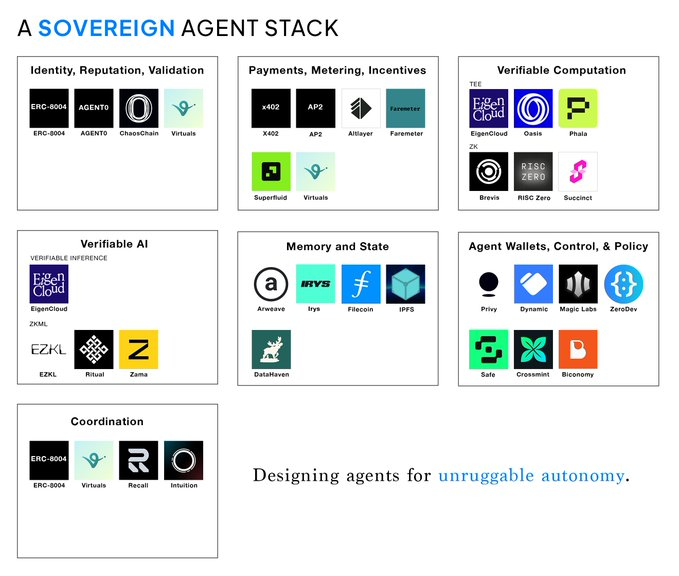
The Seven Pillars of the Sovereign Proxy Technology Stack
1. Identity, Reputation, and Verification
Standards such as ERC-8004 provide on-chain identity registration mechanisms that enable agents to be traced and identified, establish verifiable reputations through feedback of cryptographic authorization, and prove their effectiveness with pluggable verification systems (including staked re-execution, zero-knowledge machine learning, or trusted execution environment certification).
This enables agents to operate across scenarios where trust relationships are lacking, from low-risk tasks such as ordering pizzas to high-risk decisions such as financial transactions or medical diagnoses.
Virtuals' ACP framework extends this through ERC-6551 proxy identity and a complete business framework, enabling comprehensive management of inter-agent coordination, negotiation, and payments.
SDKs such as Agent0 and Chaos Chain make it easier for developers to access these capabilities.
2. Payment, Settlement and Incentives
Protocols such as x402 and AP2 enable frictionless micropayments and proof-of-payment functionality. AltLayer's infrastructure and Faremeter's development tools enable seamless chain abstraction operations for x402 integration, allowing agents to autonomously complete transactions under appropriate economic incentives.
Streaming payment protocols such as Superfluid enable continuous and real-time value transfer between agents without human intervention.
Virtuals' ACP framework provides a complete payment solution for inter-agent business activities through managed settlement, automated negotiation processes, and x402 integration.
3. Verifiable calculation
By employing trusted execution environment technologies, such as Eigencloud, Oasis Protocol, and Phala Network, proxies can obtain cryptographic protection for their execution environment, preventing even infrastructure providers from tampering with their code or accessing their memory space.
Trusted Execution Environment (TEE) technology supports in-enclave key management, storing keys in a hardware-isolated environment that is inaccessible to any party (including developers, node operators, or any external party).
Through deterministic key derivation technology, the agent can maintain a consistent cryptographic identity during restarts, upgrades, and infrastructure migrations, thereby ensuring continued sovereignty is not affected by changes in a single service provider.
Transparent on-chain control records every configuration change and deployment in an auditable smart contract, ensuring that the agent's infrastructure is governed by immutable logic rather than server administrators. This creates truly autonomous agents: they can hold assets, sign transactions, and build reputations without relying on any operator's custody.
Zero-knowledge virtual machines from Brevis, Risc Zero, and Succinct prove the correctness of computations without disclosing sensitive data through complementary verification mechanisms. This enables agents to verify their operations to third parties while protecting the privacy of proprietary logic, sensitive inputs, or confidential states.
4. Verifiable AI
EigenAI provides deterministic AI inference, ensuring that the same input always produces the same output, with guarantees of model integrity and verifiable execution. Through controlled GPU operations and deterministic processing, it verifies that the AI output has not been tampered with and supports independent recomputation verification.
EZKL, Ritual, and Zama's zkML solutions provide supplementary verification for the correct execution of the reasoning process through zero-knowledge proof technology.
This ensures the verifiability and tamper-proof nature of AI model outputs, which is crucial for enabling agents to make high-impact financial, healthcare, or operational decisions.
5. Records and Status
Through persistent decentralized storage solutions such as Arweave, Irys, Filecoin, DataHaven, and IPFS, proxies can obtain persistent state storage that cannot be tampered with or erased.
This ensures that the agent maintains a verifiable history throughout its lifecycle, with every decision, transaction, and interaction becoming part of an immutable record, thereby building reputation and achieving auditability without relying on any single service provider.
6. Proxy Wallets, Control, and Strategies
Smart account and account abstraction technologies offered by providers such as Privy, Dynamic, Magic, Zerodev, Safe, Crossmint, and Biconomy enable granular access control and spending policy functionality.
AI agents can operate autonomously within a preset range. By limiting transaction amounts, restricting interactive contracts, and requiring human approval for high-risk decisions, they maintain autonomy while ensuring security.
7. Coordination, discovery, and skills markets
Frameworks such as ERC-8004, Virtuals, Recallnet, and Intuition enable agents to discover each other, coordinate tasks, and trade in open markets.
Unlike single agents who try to do everything, professional agents can showcase their skills, negotiate terms, and coordinate complex workflows. This transforms the agent ecosystem into a marketplace where professional skills can be traded, and reputational value accumulates over time.
Why are sovereign proxies important?
A sovereign proxy is an autonomous proxy that is encrypted and bound to its owner. It cannot be seized, censored, or manipulated by infrastructure providers, platforms, or even their creators.
With this technology stack, we can build agents that are truly autonomous in operation and have complete control over them. These agents can perform tasks on your behalf, rather than being arbitrarily controlled by the server controller.
The future of AI lies not only in making agents smarter or more trustworthy, but also in giving them sovereignty.