Author: Yue Xiaoyu
Recently, Bitcoin Treasury's micro-strategy is reportedly being removed from global index funds. This could mean an outflow of $8.8 billion, a significant blow to Bitcoin's price. So, what does the future hold for Bitcoin Treasury? What is the future of the DAT model?
The DAT model is not just about traditional companies borrowing money to buy tokens. More importantly, it binds the interests of traditional companies to the ecosystem of this token.
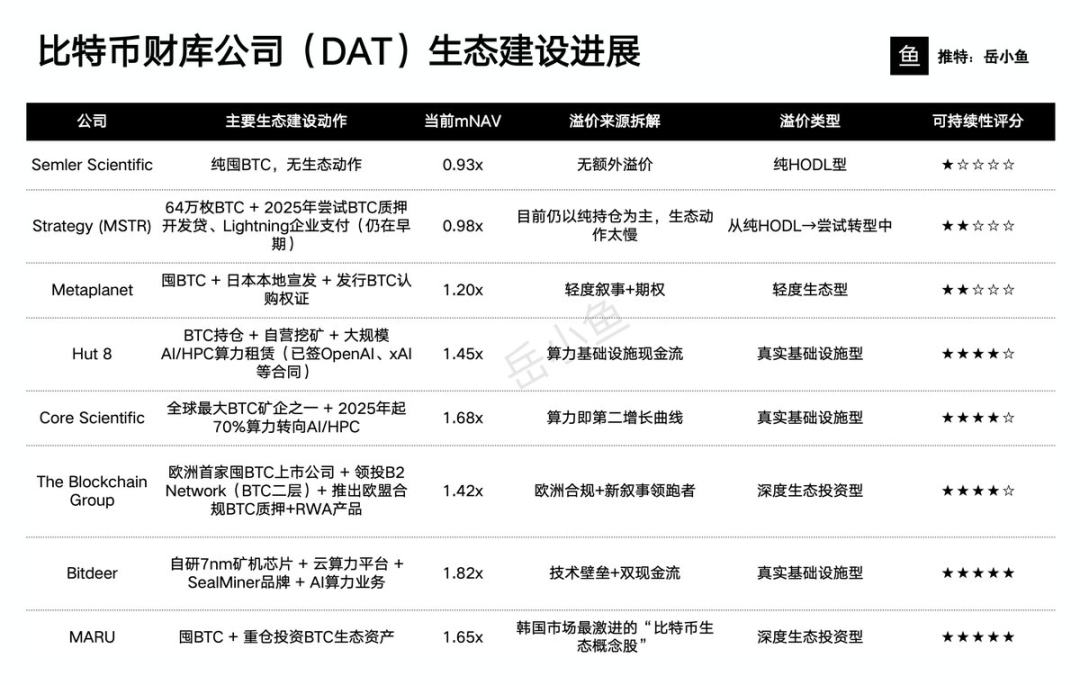
Contrary to popular belief, many Bitcoin treasury companies are already actively building the Bitcoin ecosystem. Proactively constructing a Bitcoin ecosystem is currently one of the few reliable paths to reignite the market capitalization premium of Bitcoin (BTC) companies. In times of market downturn, this approach can create a more sustainable premium than foolishly hoarding more BTC. The market has already proven this with real money. A table here lists the ecosystem development progress of some mainstream Bitcoin treasury companies.
Break the vicious cycle of pure holding
For companies that hoard cryptocurrency, as long as BTC doesn't rise or their financing channels are blocked, CPS (Cost Per Sale) will stop rising and the price will inevitably drop to zero. Building an ecosystem is essentially giving yourself a second or even third engine, allowing you to supplement your portfolio, create technological barriers, and generate new growth narratives.
Turn dead assets into active income
For example, Hut 8, Core Scientific, and Bitdeer convert their BTC holdings and computing power into HPC resources that can be rented to large model companies such as OpenAI and xAI, generating an annualized return of 8-15% and directly generating USD revenue. The market's valuation logic has become: BTC holdings (1.0x) + appreciation gains (an additional 0.5-1.0x premium).
Seize the new narrative cycle
In fact, the Bitcoin ecosystem still supports new narratives, from the initial ordinal protocol to later Bitcoin Layer 2, BTCFi, and so on. As long as companies are willing to invest money, teams, and branding to become the leading listed companies in this new round, retail and institutional investors are willing to give them a 2-3 times premium. MARU and the Blockchain Group are typical examples.
From a capital game to an open platform
The original logic: Premium → Increased issuance → Buying BTC → Pushing up stock price (closed-loop, reflexive, extremely fragile) The current logic: BTC holdings + ecosystem project portfolio + external developer/capital inflows → Platform value → Sustainable premium
To summarize
The market is increasingly skeptical that simply hoarding coins can maintain a premium.
The only companies that can truly reignite mNAV are those that transform Bitcoin from dead gold into a living ecosystem. Whoever first turns their BTC holdings into a yield-generating asset will be able to once again capture a sustainable premium.