Author: Jasper De Maere
Compiled by: Deep Tide TechFlow
Preface
Liquidity drives the cryptocurrency cycle, while inflows through stablecoins, ETFs, and DAT (Digital Asset Trust) have slowed significantly.
Global liquidity remains strong, but higher SOFR (Secure Overnight Funding Rate) is driving funds toward government bonds and away from the cryptocurrency market.
Cryptocurrencies are currently in a self-financing phase, with capital circulating internally and awaiting new inflows of funds.
Liquidity dictates every cryptocurrency cycle. While technological adoption may be the core driver of the cryptocurrency story in the long run, it is the flow of funds that truly drives price changes. Over the past few months, the momentum of fund inflows has weakened. The flow of funds is slowing through the three main channels through which capital enters the crypto ecosystem—stablecoins, ETFs, and digital asset vaults (DATs)—leaving cryptocurrencies currently in a self-financing phase rather than an expansion phase.
While technological adoption is a significant driving force, liquidity is the key driver that defines every cryptocurrency cycle. This is not just about market depth, but also about the availability of funds themselves. When the global money supply expands or real interest rates fall, excess liquidity inevitably seeks out riskier assets, and cryptocurrencies have historically, particularly during the 2021 cycle, been among the biggest beneficiaries.
In previous cycles, liquidity primarily entered the digital asset space through stablecoins, which served as the core channel for fiat currency inflows. As the industry matures, three major liquidity channels are increasingly becoming key determinants of new capital inflows into cryptocurrencies:
- Digital Asset Vaults (DATs): Tokenized funds and yield structures that connect traditional assets with on-chain liquidity.
- Stablecoins: As an on-chain representation of fiat currency liquidity, they provide underlying collateral for leveraged and trading activities.
- ETFs: In traditional finance, they are access points that provide passive investors and institutional capital with exposure to BTC and ETH.
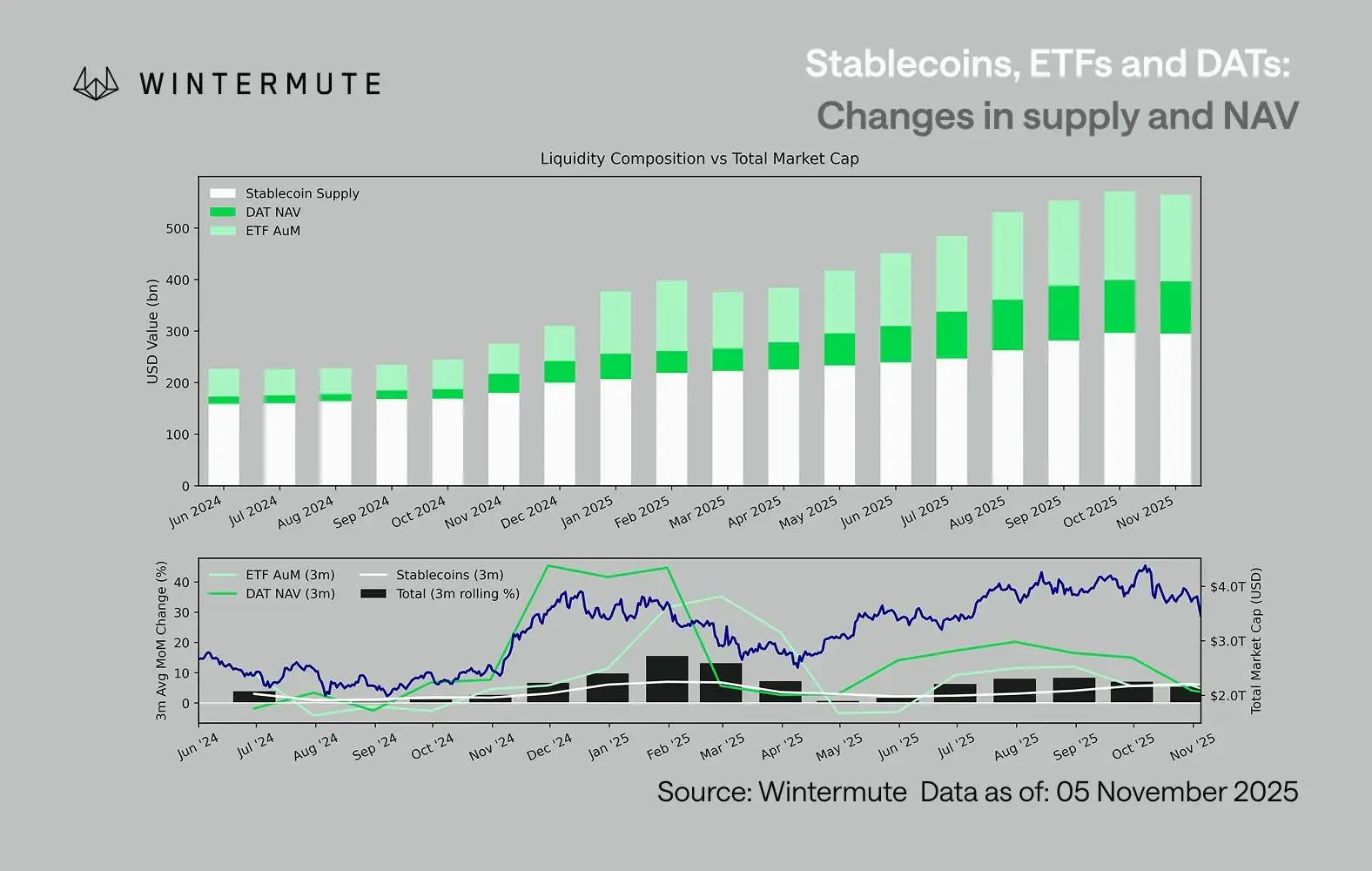
By combining ETF assets under management (AUM), net asset value (NAV) in digital assets (DAT), and the number of stablecoins issued, a reasonable estimate of the total capital inflow into digital assets can be obtained. The chart below shows the trends of these components over the past 18 months. The bottom of the chart clearly shows that changes in total volume are closely related to the total market capitalization of digital assets; as capital inflows accelerate, prices rise accordingly.
A key observation is the significant slowdown in inflows into DAT and ETFs. Both performed strongly in Q4 2024 and Q1 2025, with a brief rebound in early summer, but this momentum subsequently weakened. Liquidity (M2 money supply) is no longer flowing into the crypto ecosystem as naturally as it did at the beginning of the year. While the total size of DAT and ETFs grew from approximately $40 billion to $270 billion since the beginning of 2024, and the size of stablecoins more than doubled from approximately $140 billion to approximately $290 billion, demonstrating strong structural growth, it also shows a clear stagnation in growth.
This slowdown is crucial because each channel reflects a different source of liquidity. Stablecoins reflect risk appetite within the crypto industry, DAT captures institutional demand for yield, and ETFs reflect broader traditional finance (TradFi) allocation trends. The simultaneous flattening of all three indicates an overall slowdown in the deployment of new capital, rather than just a rotation of funds between products. Liquidity hasn't disappeared; it's simply circulating within the system, rather than expanding.
Looking beyond cryptocurrencies and into the broader economy, liquidity (M2 money supply) is not stagnant. While higher SOFR rates have somewhat constrained liquidity in the short term, making cash yields attractive and locking funds in government bonds, the world remains in an easing cycle, and the US quantitative easing (QT) has officially ended. The overall structural backdrop remains supportive; it's just that liquidity is currently expressing risk in other ways, such as the stock market.
With reduced external capital inflows, market dynamics have become increasingly closed. Capital is rotating more between mainstream and altcoin sectors rather than generating new net inflows, creating a "player versus player" (PVP) situation. This explains why market rallies are short-lived and why market breadth has narrowed, even though total assets under management (AUM) have remained stable. The current volatility peaks are primarily driven by liquidation cascades rather than the formation of sustained trends.
Looking ahead, any significant recovery in liquidity channels—such as the reminting of stablecoins, the creation of new ETFs, or an increase in DAT issuance—will indicate a return of macro liquidity to the digital asset sector. Until then, cryptocurrencies remain in a self-financing phase, with capital circulating internally without achieving value-added expansion.