Author: Xiaozhu Web3
Preface
Before the U.S. stock market opened on August 12, 2025, Circle, the “first stablecoin stock” in the United States, released its first financial report since its listing: as of June 30, the circulation of USDC reached US$61.3 billion, an increase of 90% over the same period last year.
Thanks to a significant increase in USDC circulation, revenue and reserve income reached $658 million, a 53% year-over-year increase. The financial report also revealed a net loss of $482 million, primarily due to two non-cash expenses related to the IPO: the cost of employee stock awards vesting upon the company's IPO and the increased valuation of convertible bonds due to the stock price increase. Following the release of the financial report, Circle's US stock price surged nearly 14% in pre-market trading.
Just before that, on July 31, Coinbase, the "first listed cryptocurrency exchange" in the United States, released its second-quarter financial report, which showed that profits soared to US$1.4 billion, far exceeding the US$36 million profit in the same period last year, but this was mainly due to the huge returns from its investment in Circle. However, the core business performed weakly and revenue fell short of Wall Street expectations, causing the stock price to fall by more than 16% the next day, and dragging Circle's stock price down by more than 8%.
The partnership between Circle and Coinbase is one of the most notable strategic alliances in the cryptocurrency space. If USDC is a circle, Circle and Coinbase can be likened to the two legs of a compass. Through a carefully designed business structure, the two companies have formed a unique symbiotic relationship in the USDC stablecoin ecosystem.
Circle Then and Now
Coinbase was founded in Delaware in 2012 by former Airbnb engineer Brian Armstrong and former Goldman Sachs trader Fred Ehrsam. Its earliest product was a Bitcoin wallet. The following year, Circle was founded in Boston by Jeremy Allaire and launched Circle Pay, a Bitcoin payment product designed to help investors "more easily convert, store, send, and receive Bitcoin and other digital currencies."

In 2013, Coinbase entered the cryptocurrency exchange market, becoming one of the earliest. In 2015, Coinbase became the first US-based cryptocurrency exchange to hold a formal license. In 2017, Circle acquired the regulated US exchange Poloniex for approximately $400 million, entering the exchange business and establishing three main business lines: exchange, OTC, and its original payment business.
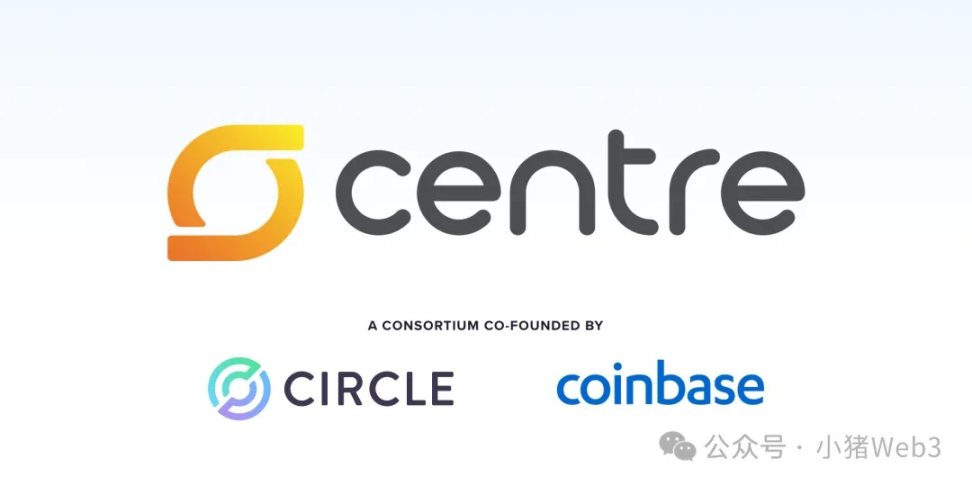
In 2018, Coinbase and Circle jointly established the Centre Consortium and launched the USDC stablecoin. USDC is jointly owned by Coinbase and Circle. Regarding the distribution of USDC revenue, Coinbase receives 100% of the reserve interest income for USDC held on the Coinbase platform, while Coinbase and Circle each receive 50% of the reserve interest income for USDC held outside the Coinbase platform.
In 2019, Circle shut down all three of its business lines to focus entirely on the operations of Centre Consortium. On April 14, 2021, Coinbase went public on the Nasdaq Stock Exchange. Its market capitalization peaked at $100 billion, making it the first publicly traded cryptocurrency company in the United States.
In March 2023, Silicon Valley Bank, where Circle held some of its reserves, collapsed, causing USDC to temporarily decouple and drop to $0.87. In August, Circle and Coinbase restructured their partnership: the Centre Consortium was dissolved, and Circle acquired Coinbase's remaining shares, becoming the wholly-owned issuer of USDC. Coinbase, as a strategic investor, held a stake in Circle and retained the profit-sharing agreement.
In May 2025, Coinbase was approved for inclusion in the S&P 500 index. On June 5, 2025, Circle successfully listed on the New York Stock Exchange at $31 per share. The stock price surged on its first day, reaching a peak of $298 on June 23rd, a nearly tenfold increase. Circle's market capitalization exceeded the value of its reserve assets. Circle's IPO was the largest by a cryptocurrency company since Coinbase's 2021 IPO and the first major IPO by a stablecoin issuer.
Coinbase and Circle have formed a symbiotic relationship in the USDC ecosystem, with Coinbase providing vital distribution channels and liquidity support for USDC, while Circle is responsible for issuance and compliance.
From 2013 to 2016, Circle completed four rounds of funding, raising a total of $136 million. Following its 2016 Series D round, Circle was valued at $480 million. In 2018, it secured $110 million in Series E funding, led by Bitmain, at a valuation of $3 billion. In 2022, Circle brought in BlackRock, a key partner, as the manager of its USDC reserve fund, and completed a $400 million Series F round, also led by BlackRock, at a valuation of $7.7 billion.
In terms of revenue, Circle will rely on investment income from its reserve funds and interest on bank deposits for 99% of its revenue in 2024, totaling $1.661 billion. 90% of the reserves are managed by a fund established by BlackRock and invested in US Treasury bonds (maturing within 93 days), while the remaining 10% is held as a deposit at Bank of New York Mellon. Due to a profit-sharing agreement with Coinbase, Circle will pay Coinbase $908 million in 2024, representing 54.2% of its revenue.
In terms of compliance, Circle holds MTL licenses in 46 states, including the New York DFS BitLicense. In the EU market, Circle is the first stablecoin issuer to receive a MiCA compliance license, allowing USDC and EURC (Circle's euro-denominated stablecoin) to legally circulate in the EU. Circle has also received approval from Singapore's MAS. Some countries and regions, such as Thailand, Argentina, Japan, Brazil, and Mexico, recognize the legality of USDC, despite not yet issuing a license.
The Future of Circle — CPN
The "2025 State of the USDC Economy" released by Circle in January has clarified the future development of Circle and USDC, which is to replace the old global payment channels - SWIFT and ACH, etc. through the Circle Payments Network (CPN).
SWIFT and ACH were established in 1977 and 1972 respectively. Today, global communications have undergone a complete transformation, allowing people to connect with each other instantly around the world. However, global payments are still stuck in the past half a century, which is reflected in extremely high transaction costs (0.1% remittance fee and fixed remittance communication fee), extremely long transaction delays (1 to 6 business days) and great transaction friction (exchange rate friction), as well as financial inclusion issues for a large number of people who cannot access the global banking system.
The emergence of stablecoins can leverage the innovations of blockchain networks to improve the global banking and financial system. Circle is building a stablecoin-based internet of value, providing a network upgrade for global finance. This is the CPN mentioned above. The CPN connects leading global banks, payment providers, and other institutions. Centered around USDC, the world's largest regulated stablecoin, the CPN connects all participants in a real-time global settlement system with minimal transaction costs and global accessibility.
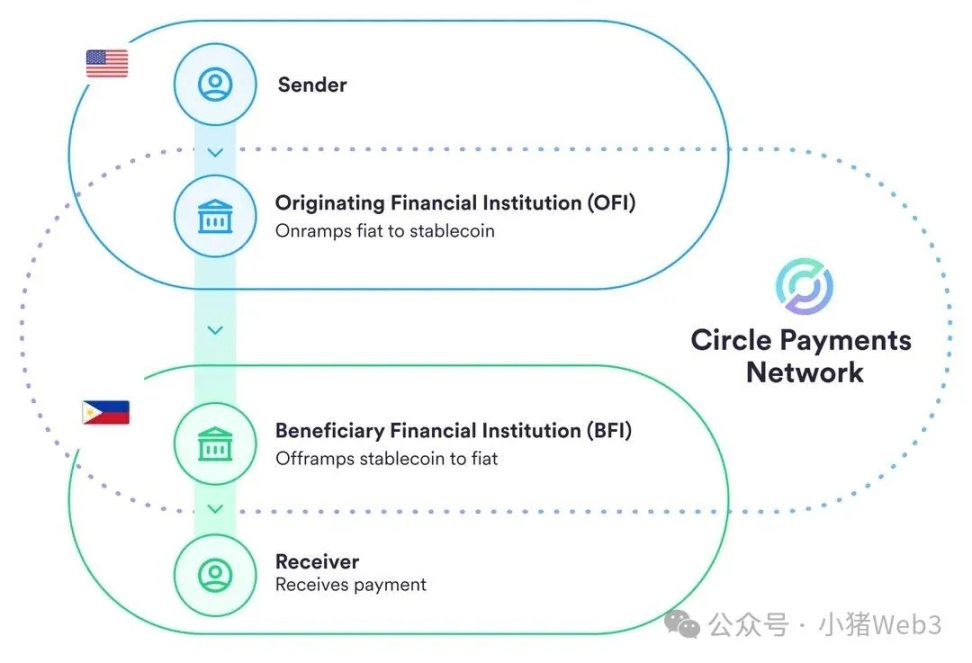
Circle serves as the primary governance and standards-setting body for the CPN, as well as the network operator. Through the CPN, Circle is building a new platform and network ecosystem that will create value for every stakeholder in the global economy and help accelerate the benefits of this new internet-based financial system to society. These stakeholders include:
- Businesses: Importers, exporters, merchants, and large corporations can leverage CPN-enabled financial institutions to eliminate significant costs and friction, strengthen global supply chains, optimize treasury operations, and reduce reliance on expensive short-term working capital financing.
- Individuals: Remittance senders and receivers, content creators, and others who frequently send or receive small payments will gain greater value, as financial institutions using the CPN will be able to deliver these improved services faster, more cheaply, and more simply.
- Ecosystem Builders: Banks, payment companies, and other providers can leverage the CPN platform to develop innovative payment use cases, leveraging the programmability of stablecoins, SDKs (Software Development Kits), and smart contracts to foster a thriving ecosystem. Over time, this will unlock the full potential of stablecoin payments for businesses and individuals. Furthermore, third-party developers and businesses can introduce value-added services, further expanding the network's functionality.
Many companies have already joined the CPN, including Latin American emerging bank Nubank, Chipper Cash, one of Africa's largest fintech companies, global payment service provider Worldpay, US payment giant Stripe, and Hong Kong stablecoin sandbox participant Yuanbi Technology.
Compliance: A Brief Discussion on Hong Kong’s Stablecoin Ordinance
Compliance is paramount in the global banking and financial system. This is why Circle prioritizes compliance and actively applies for licenses around the world. Circle's compliance needs to meet local government compliance requirements, which typically include:
- Issuance/Redemption Phase: Ensure KYC/AML, ensure the adoption of a "full reserve model," and ensure redemption within a reasonable period;
- Circulation stage: real-time transaction screening, continuous monitoring, and fulfillment of regulatory obligations (such as freezing accounts).
On August 1, 2025, Hong Kong's Stablecoin Ordinance officially came into effect, with its Know Your Customer (KYC) real-name verification requirements becoming a focal point of controversy. According to the HKMA, stablecoin issuers must not only verify user identities and retain data records for at least five years, but also prohibit services from providing services to anonymous users. This means that stablecoins in Hong Kong may initially lack the ability to directly interact with DeFi protocols. Decentralized wallets and unlicensed addresses will be isolated from the compliance system, and such interactions will be legally considered "unauthorized use."
It can be seen that Hong Kong regulators are more focused on controlling the circulation of stablecoins than on the scalability and freedom of on-chain protocols. While Circle's USDC will undergo real-time transaction screening and continuous monitoring during its circulation, this does not affect inter-wallet transfers or DeFi protocol interactions. This move essentially excludes ordinary users from using Hong Kong's compliant stablecoins and also means that Circle's USDC will have difficulty obtaining a compliant stablecoin license in Hong Kong.
In my opinion, ordinary users should continue to use USDT/USDC. The Hong Kong stablecoin itself has no way to compete head-on with USDT/USDC in wallets and DeFi scenarios. The advantages of the Hong Kong stablecoin or compliant stablecoins in other countries or regions lie in compliance scenarios. This scenario is controlled by the government, and USDT/USDC is inevitably restricted. For example, in cooperation with the Hong Kong Stock Exchange to purchase securitized tokens or other RWA tokens, such asset transactions themselves require strict KYC and identity identification.
If we focus on the stablecoin payment network, the impact will be significant. For example, user A in Hong Kong pays in Hong Kong dollars, and merchant B in the United States receives USD converted at the corresponding exchange rate. The parties involved in the stablecoin transaction and settlement process are, in effect, Hong Kong payment company R (e.g., Circle Coin) and US acquiring company S (e.g., Stripe). Both are institutional users and therefore meet the KYC (know-your-customer) requirements. While user A does require KYC, it follows the KYC regulations for stored-value payment licenses.
The real question is why they use the Hong Kong dollar stablecoin, which has lower market acceptance and higher restrictions, for trading and settlement. Using the widely adopted USDC would obviously be more readily accepted by US acquirer S, but the payment process would involve payment company R exchanging HKD for USDC. Either they mint HKD stablecoins with HKD and then exchange them off-chain for USDC, which carries legal risks; or they operate a purely OTC business, in which the Hong Kong dollar stablecoin cannot participate.
Summarize
Circle and Coinbase have formed a symbiotic relationship around USDC: they co-founded Centre in 2018, and after a restructuring in 2023, Circle will exclusively issue USDC, with Coinbase serving as a strategic shareholder and sharing in the interest generated by the reserve. Circle is building the Internet of Value with USDC as its foundational layer, and its future strategy focuses on CPN as an alternative to traditional global payment systems like SWIFT. If USDC is a circle, Circle and Coinbase can be likened to the two legs of a compass; neither is indispensable.
The newly enacted Hong Kong Stablecoin Ordinance's KYC requirements for stablecoins may limit Circle's development in the Hong Kong market, but it also restricts the use of local stablecoins within stablecoin payment networks. From the perspective of legislators, strict KYC regulations are understandable in combating money laundering and preventing financial risks, but they also leave some room for improvement.
The development of mobile payments reveals that fintech companies like Alipay, through their business models and innovations, have forced financial regulators to introduce new policies and rules to address the challenges posed by digital payments and fintech. In the future, a new "Alipay" will emerge in the stablecoin payment space. Perhaps we will witness history repeating itself.