As the crypto industry shifts from a "speculation-driven" to an "application-driven" landscape, stablecoins are rapidly evolving from a medium of exchange within the cryptocurrency community to a universal global payment tool. This shift stems from both the urgent need for efficient cross-border settlement in traditional finance and the inevitable result of the Web3 ecosystem's move towards inclusive development.
Traditional public blockchains (such as ETH and Tron) have a common underlying design, exposing pain points in stablecoin payment scenarios, such as volatile fees, slow transaction speeds, and difficult compliance audits. In contrast, dedicated stablecoin chains, centered on optimizing stablecoin circulation, can achieve lower costs, higher efficiency, and stronger compliance, driving stablecoins into mainstream payments.
The future competition in payment and clearing will focus on key capabilities such as low-cost, zero-fee transfers, instantaneous payment, auditable compliance, and plug-and-play for merchants and institutions.
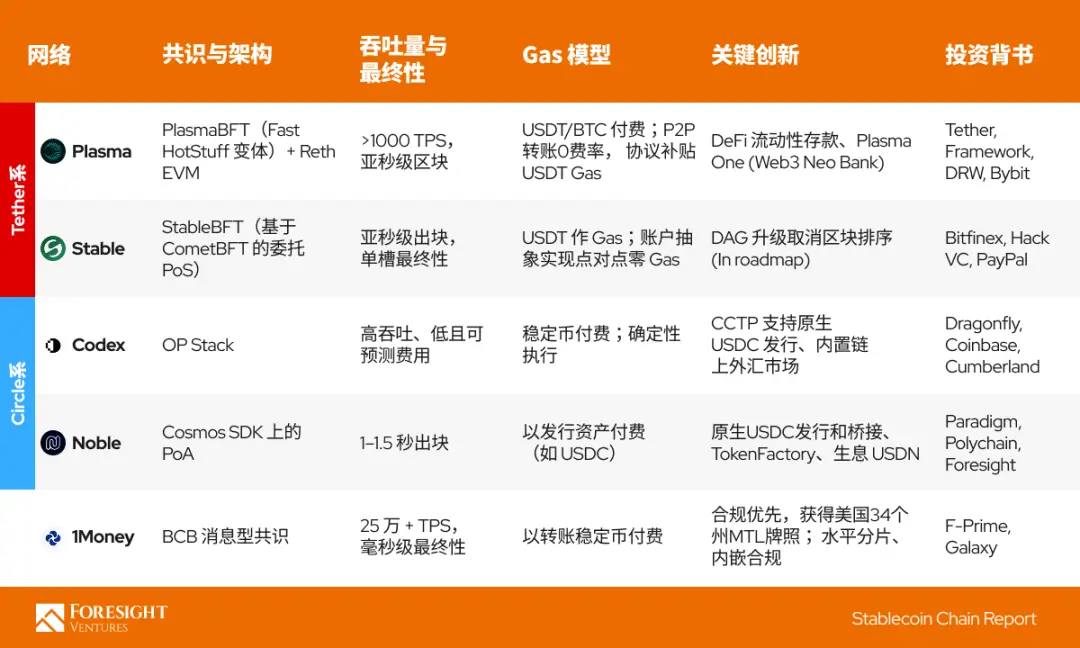
This report selects five representative stablecoin chains - Plasma, Stable, Codex, Noble and 1Money, and conducts in-depth analysis from five dimensions: positioning, market strategy, community popularity, development progress and core data. A horizontal comparison reveals their differentiated advantages and potential challenges.
Plasma
Basic Introduction
Plasma is a high-performance Layer 1 blockchain designed specifically for stablecoins, supported by well-known institutions such as Bitfinex, Founders Fund, and Framework.
GTM Strategy
Plasma launched a pre-TGE subscription window for XPL in mid-2025. Using a "deposit first, apply later" process, it attracted approximately $1 billion in stablecoins within 30 minutes, with a pro-rata refund for any oversubscription. The project is collaborating with Tether to introduce native USDT and is collaborating with liquidity partners such as Bitfinex, Flow Traders, and DRW.
Plasma's roadmap will start with a permissioned system (trusted validators), transition to a horizontal scaling phase, and ultimately move towards an open validator set;
The mainnet Beta is scheduled to go online on September 25, 2025.
Subsequently, Binance Earn launched the on-chain Plasma USDT Locked Product: the first batch of 250 million USDT was filled within an hour, and then expanded in batches to the upper limit of 1 billion USDT, distributing USDT income on a daily basis and distributing XPL rewards after TGE.
In September 2025, the team also launched Plasma One, a native neobank for stablecoins. Its bank card is issued by Signify Holdings under a Visa license, supporting zero-fee USDT transfers, a "spend and earn" account model, and up to 4% cashback.
Community and market popularity
Thanks to its strong investor base, Plasma has garnered significant market attention since its launch in 2024. It has over 130,000 followers on the X platform. Since the announcement of Plasma's public offering, it has sparked widespread community discussion, making it a hot topic in the stablecoin blockchain space.
Development and testing progress
The Plasma mainnet is currently in Beta, technically integrating with Bitcoin sidechains and Ethereum EVM compatibility, and integrating with node service tools such as QuickNode and Tenderly. Its core consensus mechanism is PlasmaBFT (based on the Fast HotStuff algorithm). The mainnet will be rolled out in three phases: trusted validator launch, scaling, and full openness. The zero-fee USDT transfer feature on the testnet is still under development and debugging. By mid-2025, the Plasma testnet had already processed approximately $1 billion in cross-chain stablecoin deposits (including USDC and USDT), which were mapped to the Plasma chain.
During its testing period, Plasma also connected with multiple wallets and exchanges, validating its zero-gas stablecoin transfer capabilities and network stability. In terms of active development, Plasma's official documentation and codebase are continuously updated to ensure developers can successfully deploy contracts on its EVM chain.
In terms of performance, Plasma's core metrics claim to support over 1,000 TPS throughput, block production per second, and transaction finality within seconds, with most standard transaction fees below $0.01. Specifically for USDT, a protocol-level paymaster mechanism has been designed to directly sponsor gas fees for simple transfers, enabling zero-cost transactions (subject to frequency and eligibility restrictions). This feature will significantly enhance the user experience for stablecoin payments. Based on official documentation and testnet data, its transaction speeds (standard transfers receive blocks within 1 second, finality is achieved within several seconds, and zero-fee USDT transfers, while slightly slower, still remain within seconds) primarily cover the needs of most mainstream scenarios—from daily transfers and payments by retail investors, to deposits, lending, and trading in mainstream DeFi, to compliant settlements for small and medium-sized merchants—meeting the core demands of low cost and stability. However, in scenarios with extremely high real-time requirements such as high-frequency quantitative trading, institutional-level sub-second real-time settlement, or extreme peak conditions with millions of concurrent transactions, the current second-level confirmation speed and channel design may appear insufficient. But overall, its performance accurately matches the popular and institutional basic scenario needs of the stablecoin payment chain, and can support the vast majority of daily and mainstream business scenarios.
Regarding USDC support: Plasma supports USDC at the bridge and contract level, but it's not native to Circle. The zero-fee policy explicitly covers USDT, but not USDC. This means USDC settlement on Plasma is possible, but the cost experience will be different from USDT.
Key data indicators
The figure below shows the main composition of stablecoin deposits in the Plasma network: the core is almost entirely composed of two types of assets, AETHUSDC and AETHUSDT, accounting for approximately 60% and 39% respectively.
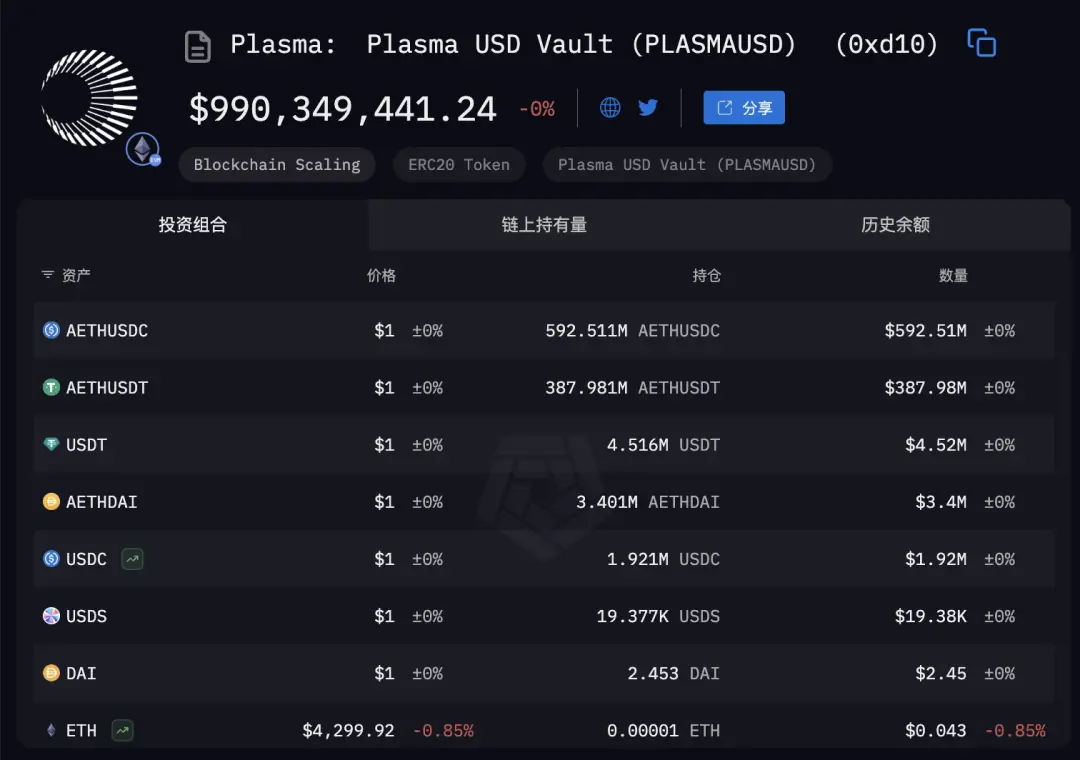
Plasma on-chain stablecoin deposit composition (data source: Arkham Intelligence)
Plasma has officially announced that it will integrate over 15 stablecoins by the time its mainnet launches and has partnered with over 50 projects. These partners include wallets, payment companies, and DeFi protocols, introducing application scenarios to the Plasma ecosystem. For example, it is expected that Tether will directly support USDT as a native asset on Plasma. Exchanges such as Bitfinex may also provide deposit and withdrawal interfaces, and market makers such as Flow Traders and DRW will also assist in providing liquidity.
Stable
Basic Introduction
Stable is a dedicated stablecoin public blockchain incubated by the Tether/Bitfinex team. Stable features a unique "USDT native gas" model, meaning transaction fees are paid directly in USDT, rather than holding a separate native token. This significantly lowers the barrier to entry for users and makes the payment experience more similar to fiat currency transfers.
GTM Strategy
In terms of marketing, Stable fully leverages the influence of Tether/Bitfinex: in July 2025, it officially announced the completion of a $28 million seed financing round, with investors including Bitfinex, Hack VC, Franklin Templeton (a well-known traditional asset management company), Bybit, KuCoin and many other institutions.
The Stable roadmap is divided into three phases for implementation: Phase 1 (currently) focuses on building network infrastructure and implementing the USDT Gas model; Phase 2 will introduce stablecoin transaction aggregators and enterprise-level reserved block space services to attract institutional users with large payment volumes; Phase 3 plans to further optimize speed and provide developer tools to enrich the application ecosystem.
Community and market popularity
Since its unveiling in mid-2025, Stable's popularity has skyrocketed. Its official account on the X platform quickly amassed over 160,000 followers (even slightly exceeding Plasma's). Mainstream optimism about Stable is expressed, believing it aligns with regulatory compliance trends and is poised to attract institutional investors. However, community discussions have also highlighted the need for Stable to demonstrate its performance and security advantages in competing for liquidity with competitors like Plasma, and users are eager to see actual data from the Stable testnet.
Development and testing progress
The Stable project officially exited stealth mode in late July 2025 and is still in its early stages of development. As mentioned above, Phase 1 has already begun, including achieving sub-second block times and finality, as well as USDT's native gas mechanism. Stable anticipates launching a public testnet by the end of 2025 and gradually moving to the mainnet. Currently, Stable's internal testnet is operational, and it is selectively inviting partners to trial it.
Key data indicators
Since the Stable mainnet has not yet been launched, data such as its on-chain TVL is not available yet.
Codex
Basic Introduction
Codex is a blockchain company dedicated to a "universal electronic cash system." Its core product is a Layer 2 network dedicated to stablecoins built on Ethereum.
GTM Strategy
Codex's market strategy focuses on B2B scenarios and enterprise-grade stablecoin settlement. Its chain selection is built on the Optimism technology stack, aiming to provide a platform with predictable low fees and stable performance for high-frequency stablecoin transactions.
In terms of market expansion, Codex prioritizes collaboration with stablecoin issuers and financial institutions. The project has received strategic investments from Coinbase, Circle, Foresight, and Cumberland (DRW). In addition to its investment, Circle is actively supporting the native integration of USDC into the Codex chain. In July 2025, Circle deployed USDC contracts on Codex, making it one of the youngest networks to natively support USDC. Codex has also launched a direct CCTP v2 cross-chain channel and integrated Circle Mint/API, allowing businesses to mint/redeem USDC, perform cross-chain settlements, and conduct on-chain FX/local fiat deposits and withdrawals directly on Codex, significantly reducing onboarding friction. This initiative has earned Codex authoritative recognition within the stablecoin issuance ecosystem and paved the way for attracting other fiat stablecoins (for example, the Turkish lira stablecoin BiLira has also been integrated into the Codex platform). Furthermore, Codex is collaborating with major exchanges and over-the-counter brokers to develop stablecoin off-ramps, allowing users to directly convert on-chain stablecoins into fiat.
The GTM strategy is mainly to: ① Anchor the custody layer, through cooperation with leading custodians such as Fireblocks, build a compliant asset custody infrastructure to ensure the safe custody of institutional funds on the chain; ② Connect the tool layer, integrate "Wallet as a Service" (WaaS) solutions such as Dfns, and provide institutional users with a convenient on-chain asset management portal; ③ Open up the application layer, focus on connecting payment service providers (PSPs) and cross-border payment institutions, and take the lead in entering high-frequency and urgent demand scenarios such as corporate settlement and cross-border B2B transactions to realize the implementation verification of institutional-level payment settlement.
In summary, Codex's GTM strategy focuses on compliance, institutions, and multi-asset: by collaborating with authoritative institutions such as Circle to gain credibility, it focuses on enterprise-level application scenarios such as cross-border payments and foreign exchange settlement, hoping to gain a firm foothold in this vertical field.
Community and market popularity
Compared to the mass-market marketing efforts of Plasma and Stable, Codex's community engagement is relatively modest. Its X platform has approximately 7,000 followers. Codex's official social media presence is relatively cautious, focusing on releasing product updates and industry perspectives. Following the announcement of its funding round in April of this year, mainstream media outlets such as Cointelegraph and Fortune covered the news, sparking industry discussion on the "stablecoin dedicated chain" model.
Development and testing progress
The Codex project, launched in 2024, accelerated network development after announcing funding in April of this year. The Codex network, utilizing the Optimism Rollup architecture, has essentially completed mainnet construction and achieved integration with the Ethereum mainnet and Circle's backend. Technically, the Codex mainnet launched mid-year. Circle's official website also indicates that the USDC contract address on the Codex chain has been deployed, and custodial/payment platforms such as Fireblocks and Dfns have begun supporting Codex. This means the Codex network has achieved USDC anchoring and circulation on the mainnet, as well as integration with leading institutional systems.
Codex's public testnet is now open, allowing developers to experiment with cross-chain asset transfers to Codex and call its API for high-speed stablecoin transfers. Codex also focuses on developing compliance features, such as on-chain atomic swaps and compliance checks. Through mechanisms like atomic withdrawal channels and on-chain foreign exchange trading, Codex ensures KYC/AML checks are completed during transactions, reducing the risk of stuck funds and regulatory violations. Furthermore, Codex is developing a cross-border FX instant settlement platform (Codex Avenue) to enable instant settlement of multi-currency stablecoins.
Codex's mainnet gas fees are typically as low as 0.1 cents, payable in ETH. Initially supporting native USDC minting, transfers do not require a cross-chain bridge. Focusing on payment chain features, the platform prioritizes asset liquidity over DeFi lock-up. Currently, Codex is focusing on applications such as instant USDC transfers, ensuring high throughput. A Codex co-founder mentioned in an interview that they plan to support major stablecoins such as USDT and EURC, but have not yet announced a specific timeline for USDT integration.
In terms of development activity, the Codex team comes from OP Labs and the Ethereum community, has strong technical capabilities, and continuously updates the network code and TokenFactory module on Github to meet the needs of various issuers.
Key data indicators
The Codex chain's native USDC has been launched and is supported by CCTP v2, with a current circulating supply of approximately $1.7 million USD. However, data aggregators like DefiLlama do not yet list Codex as a standalone chain, making comparable "DeFi TVL" statistics unavailable. This aligns with Codex's focus on B2B settlement and compliance channels, rather than broader DeFi liquidity.
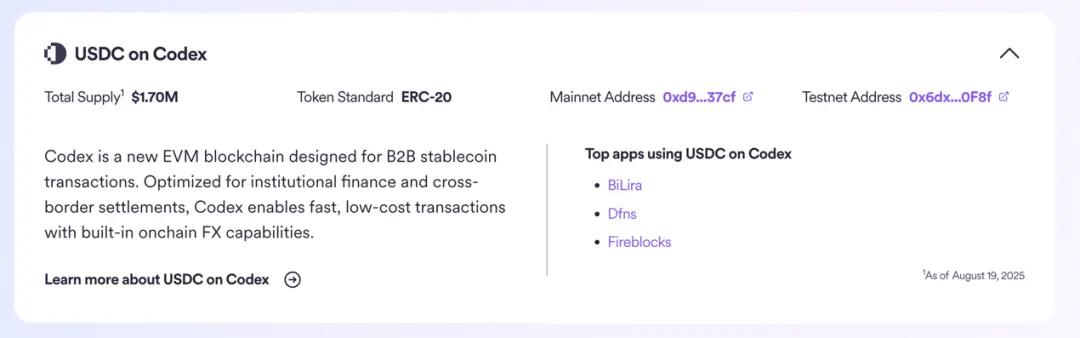
USDC issuance on the Codex chain (data source: Circle)
Noble
Basic Introduction
Noble is the first application chain in the Cosmos ecosystem that focuses on on-chain asset issuance.
GTM Strategy
Noble's market strategy is anchored in the Cosmos multi-chain ecosystem, aiming to deeply connect with the application needs of various public chains by becoming a "stablecoin issuance hub." This initiative was achieved through a partnership with Circle to natively issue USDC on Noble in April 2023, addressing Cosmos' previous lack of a mainstream stablecoin.
Noble positions itself as the "native issuance chain for stablecoins and RWAs": any stablecoin that wishes to serve Cosmos users can choose to issue on Noble, which will then seamlessly circulate across nearly 50 chains in the ecosystem via the IBC protocol. This "issuance in one place, circulation in many places" model greatly facilitates applications in accessing trusted stablecoin liquidity.
In addition, Noble also cooperated with decentralized stablecoin infrastructure provider M^0 to launch Noble's own yield-generating stablecoin USDN (Noble Dollar) in January 2025. Its design innovatively introduces U.S. Treasury bond returns. Through USDN, Noble hopes to enhance the attractiveness of the Cosmos stablecoin and differentiate it from traditional USDT/USDC.
Its GTM route is also clear: ① Directly connect to Circle Mint/API upstream to directly mint institutional/fiat funds into USDC@Noble, using the "official version" to eliminate multi-version conflicts and reduce reconciliation friction; ② The middle platform distributes USDC to the application chain of the Cosmos ecosystem with low latency, giving priority to scenarios with urgent needs such as trading and clearing; ③ Extend the asset layer to launch the USDN income-generating stablecoin, forming a link of "converting interest-free USDC to interest-bearing USDN", and implement it in the margin accounts, transaction settlement and DeFi scenarios of various application chains.
This series of initiatives demonstrates Noble's two-pronged GTM strategy: providing a bridge for existing mainstream stablecoins to enter Cosmos to meet the needs of DeFi and other sectors, while also launching innovative native stablecoin products to enhance user retention and value capture. At the same time, Noble places a strong emphasis on user experience and compliance: partnering with Circle to utilize its Cross-Chain Transfer Protocol (CCTP) to ensure smooth and secure swaps from Ethereum to Cosmos, and designing support for blacklisting and address freezing to meet issuer compliance requirements.
For Noble, users can swap between USDC and USDN. There are two vaults to choose from to maximize USDN returns:
- Points Vault: Give up income to earn points. Lock USDN. The longer the lock-up period, the faster points accumulate. After 30 days, there is a multiplier bonus.
- Enhanced Yield Vault: This allows users to earn the base yield of U.S. Treasury bonds (currently 4.07%), as well as the additional yield that users who choose the Points Vault give up.
- Mechanism formula: Boosted APR ≈ r_tbill × (1 + Points Pool Balance / Boosted Pool Balance). When the two pools are of similar size, the annualized rate is roughly double the base rate (~8%+). Initially, an APR of ~16% was observed (including the base return).
As of August 6th, the Enhanced Yield Vault has been deactivated, leaving only the Points Vault. As of August 2025, USDN's treasury yield is approximately 4.08% annualized.
The underlying interest is derived from short-term US Treasury bonds, which are distributed to participating parties. Meanwhile, the average transaction fee for intra-chain transfers is approximately $0.01, payable in USDC. Converting USDC to USDN (or vice versa) incurs a 0.1% transaction fee.
Community and market popularity
As a key infrastructure component of the Cosmos ecosystem, Noble enjoys considerable industry recognition. On the X platform, Noble's official account has approximately 30,000 followers. Compared to Tether-related projects, Noble's community is more modest in size, but its user base is highly engaged—most of its followers are Cosmos ecosystem participants and cross-chain developers.
Market sentiment has generally been positive for Noble. First, Noble's successful introduction of USDC was seen as a sign of Cosmos' maturity, a move widely recognized by the community. Second, Noble's USDN model has also received widespread positive feedback, with some arguing that it brings US Treasury yields on-chain in a compliant manner and represents a valuable exploration of stablecoin innovation. Of course, there are also some skeptics, such as the fact that USDN uses centralized custodial assets to generate returns, which may pose concerns about overly ties to traditional financial institutions. However, the Noble team (led by former Polychain executive Jelena and others) has actively engaged in community dialogue, explaining its security measures and decentralized approach, maintaining community confidence. Overall, Noble has established itself as an OG in the Cosmos and interchain space, earning it the nickname "the OG chain for stablecoin issuance on the interchain," and its market recognition and reputation are steadily increasing.
Development and testing progress
Noble launched its mainnet in Q2 2023, becoming a dedicated asset issuance chain built with the Cosmos SDK. Technically, Noble fully supports the IBC protocol, enabling assets issued on Noble to be instantly cross-chained and used on major chains such as Osmosis, Cosmos Hub, and Kujira. After completing the first cross-chain issuance of USDC in April 2023, Noble, in collaboration with Circle, has subsequently conducted multiple network upgrades to support new asset types: supporting the issuance of Ondo's OUSD (USDY) and Monerium's Euro (EURe) in 2024; and successfully launching the USDN stablecoin in January 2025.
The Noble Network utilizes the modular architecture of the Cosmos SDK, introducing the TokenFactory module to empower issuers to independently mint and burn tokens and implement operations such as blacklisting. Over the past two years, Noble has also significantly enhanced its interoperability with Ethereum: integrating the Circle Cross-Chain Transfer Protocol (CCTP) by the end of 2023, enabling the rapid exchange of USDC directly from Ethereum to the Noble Chain, and then distributing it through the Interchain Business Chain (IBC) process, significantly improving the user experience.
For developers, Noble provides data services like the Range API, enabling the ecosystem to query USDC circulation across various chains. Currently, Noble is testing support for the Frax decentralized stablecoin and the issuance of Japan's Progmat stablecoin. This demonstrates Noble's steady development progress and clear goals: continuously introducing new assets and maintaining chain stability. With the integration of more RWAs, such as Treasury bond yields, Noble is poised to continue leading innovation in Cosmos stablecoins.
Key data indicators
The issuance of stablecoins on the Noble Chain has grown rapidly over the past year, with USDC being the most prominent. As the primary USD stablecoin in the Cosmos ecosystem, USDC's circulation on Noble at one point exceeded $500 million. To date, according to DeFiLlama data, the total market capitalization of stablecoins on the Noble Chain is approximately $408 million, of which USDC accounts for 82% and USDN for 16%. The chart below shows the specific supply of stablecoins on Noble:
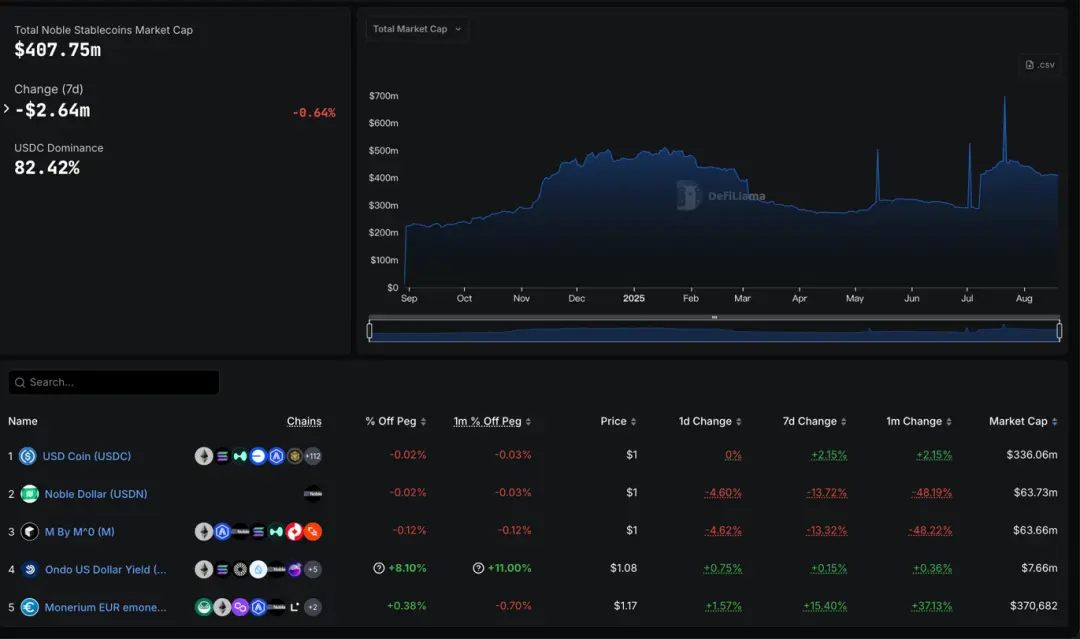
Noble's on-chain stablecoin composition (data source: DeFiLlama)
Notably, USDN's circulation has reached approximately 64 million in just six months, demonstrating rapid growth. In terms of ecosystem collaboration, Noble has established IBC connections with over 50 Cosmos chains, enabling its stablecoin to be freely used and traded across these chains. Several leading Cosmos DeFi protocols (such as the Osmosis decentralized exchange and the Kujira coin market) have included Noble's USDC in their main trading pairs and stablecoin pools, significantly increasing the liquidity depth of the Cosmos ecosystem.
Transaction Volume: The Noble mainnet processed over $5 billion in USDC transactions in its first year, demonstrating its high throughput capabilities. Fees are paid in USDC: Officially, Noble transaction fees are paid in USDC, with internal transfers averaging approximately $0.01. If you require USDT, you must first convert USDT to USDC at the source, then distribute it to Cosmos via Noble/IBC.
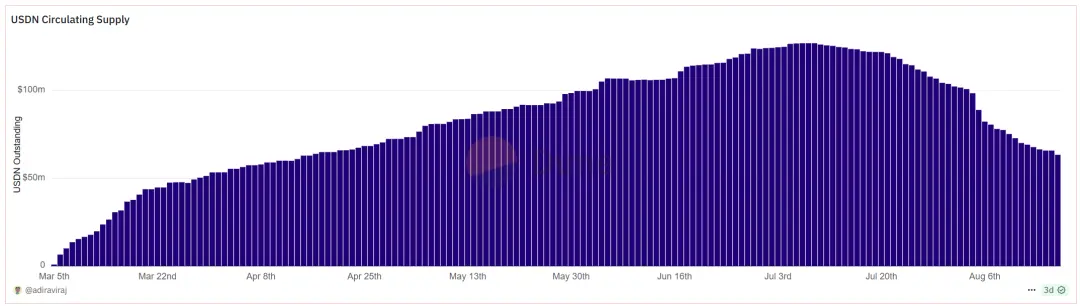
Noble's daily USDN circulation is approximately $50 million to $100 million (data source: Dune)
In general, Noble has significantly increased the dollar liquidity of the Cosmos ecosystem. Its growth curve is closely related to the development of Cosmos DeFi, and it has shown strong momentum in both strategy and data.
1Money
Basic Introduction
1Money is a new blockchain project founded by Brian Shroder, former CEO of Binance.US, that aims to build the world's first Layer 1 network optimized for stablecoin payments.
GTM Strategy
1Money's market strategy focuses on mainstream users in the payment sector, highlighting its selling points of "simple, compliant, and fast." Unlike traditional public blockchains, 1Money explicitly states that "a complex token economy is unnecessary." With no native gas token, no staking requirements, and no governance voting, users don't feel like they're using a blockchain. This design caters to the simplicity needs of businesses and individual users. For example, when users transfer USDC on the 1Money network, transaction fees are paid directly in USDC at a low, fixed amount, eliminating the need to hold any additional tokens.
The main approach is: ① Make gas-free stable payments the default experience, and plan to offer gas-free options through ecosystem partners. Transaction fees will be paid directly with transferred stablecoins, eliminating the need to hold a second gas token. ② The external narrative is "building a dedicated payment network for stablecoins," suitable for e-commerce acquiring, small-value cross-border transactions, and P2P transactions. Its website and media outlets repeatedly emphasize "no smart contracts, no congestion, and no skyrocketing fees," providing merchants with predictable service standards. ③ The team also operates the 1Money Global brand, providing stablecoin-powered debit cards and US dollar account infrastructure, with the potential to channel traffic from card schemes and banks into on-chain settlement.
In terms of marketing, 1Money emphasizes its compliance advantages: its board of directors recently joined former US FinCEN Director Ken Blanco, former Treasury Department OFAC Acting Director Michael Mosier and other senior political and regulatory figures to endorse the network's compliance structure.
In terms of financing, 1Money announced in January 2025 that it had secured over $20 million in seed funding from renowned institutions such as F-Prime (a subsidiary of Fidelity Investments), Galaxy, Kraken, KuCoin, and BitGo. These investors, spanning traditional finance and crypto, not only provided capital but also paved the way for future connections with banks, exchanges, and other resources. 1Money also emphasized its commitment to becoming a bridge between traditional finance and Web3, stating its vision that "stablecoins will form the foundation of the modern financial system."
Overall, 1Money's GTM strategy is to attract regular users to stablecoin payments through technological innovation (ultra-high TPS, minimalist UX), while also leveraging regulatory compliance and industry relationships to secure the integration of banks and payment companies into its network infrastructure. This dual-track approach aims to propel stablecoins from the cryptosphere into mainstream payments.
Community and market popularity
As a new project launched this year, 1Money currently has a relatively limited community. Its official account on the X platform has approximately 7,000 followers, primarily from crypto industry insiders and investors bullish on the payments sector. 1Money did not conduct large-scale airdrops or marketing campaigns targeting retail investors at its launch, resulting in a lower level of buzz among retail crypto investors than projects like Plasma.
Development and testing progress
1Money's key technical characteristics are "extreme speed + security + simplicity." Since its inception, the project has secretly developed an innovative consensus protocol, the BCB (Byzantine Consensus Broadcast). On August 6, 2025, 1Money officially launched its public testnet and developer portal. According to the official blog post, the testnet demonstrated "unprecedented speed" and verified the feasibility of operating the network without a native token.
Regarding development progress, 1Money is currently optimizing the stability of the BCB protocol based on testnet feedback to ensure consistent and efficient operation under various network conditions. The official plan is to launch the mainnet as early as Q4 2025 (originally scheduled for Q2, but slightly delayed). Prior to the mainnet launch, at least one round of security audits and stress testing will also be conducted.
1Money is also actively expanding its developer ecosystem. While the network doesn't support smart contracts, it will provide an easy-to-use API for wallets and payment apps to integrate with. Developer documentation and an SDK are now available on the portal, and some wallet providers have begun integration testing.
Key data indicators
Since 1Money has not yet been launched on the mainnet, its on-chain indicators are mainly based on performance test data.
During closed testing, the 1Money network achieved a processing capacity cap of 250,000 TPS, far exceeding the Ethereum mainnet and most existing public blockchains. Officials stated that this figure is linearly scalable, indicating the ability to handle global payment-level transaction volumes in the future. Transaction confirmation times remained below 1 second during testing, achieving a user experience similar to the immediacy of traditional electronic payments. Regarding fees, 1Money plans to maintain a very low fixed base fee and, through collaboration with partners such as merchant acquirers, achieve zero fees for end users.
Compliance is also a key feature of 1Money: a built-in network sanction address blocking mechanism ensures that non-compliant wallets cannot complete transactions. All validating nodes undergo KYC, meaning that network block production is performed by vetted institutions, approaching the level of trustworthiness of consortium blockchains.
1Money has already established a network of over 20 investment and partnership institutions, including exchanges (Kraken, KuCoin), payment companies (MoonPay, CoinFlip), custodial security (BitGo), and traditional VCs (F-Prime). This will provide support for its stablecoin launch—mainstream stablecoins such as USDC and USDT are expected to be integrated into the 1Money network immediately. Integration with new stablecoins (including those issued by multinational fiat currencies) issued by partner institutions is also not ruled out.
In summary, 1Money’s current hard indicators focus on performance and compliance, and its success will be more reflected in whether it can attract active users to conduct a sufficient number of transactions in the future.
Summarize
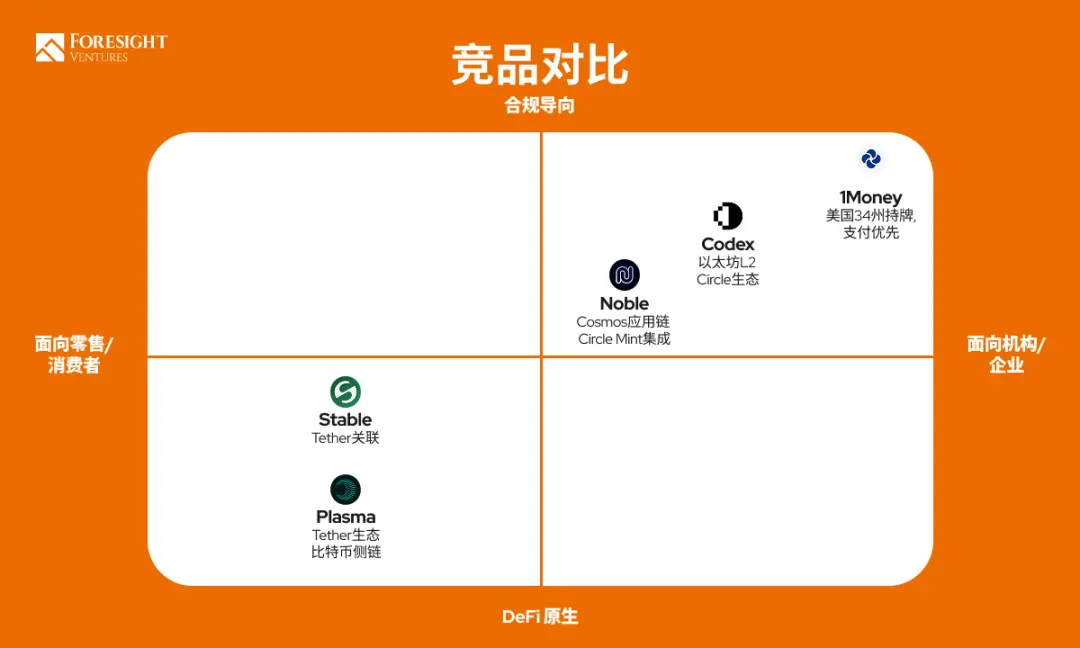
In summary, Plasma, Stable, Codex, Noble, and 1Money are all “stablecoin public chains,” each with its own strengths and weaknesses in strategy, progress, and market acceptance.
Market positioning and strategy
Both Plasma and Stable, with their roots in Tether and Bitfinex, tend to build payment networks centered around USDT. Plasma emphasizes technological breakthroughs (zero fees, ultra-fast speeds) and the security backing of Bitcoin; Stable, capitalizing on shifting US regulations, prioritizes compliance-friendliness and the ease of use of USDT (Gas). In contrast, Codex and 1Money take an enterprise-grade/compliant approach. Codex leverages Ethereum's Layer 2, offering institutions predictable fees and integration with existing infrastructure (Circle, Coinbase, etc.); 1Money designs its compliance architecture from the ground up, even forgoing smart contracts to eliminate complexity, directly targeting cross-border and retail payments. Noble's strategy differs from these. As part of the Cosmos ecosystem, Noble focuses on multi-chain issuance, acting as a partner to stablecoin issuers (helping stablecoins like USDC enter the Cosmos ecosystem) while also launching its own innovative stablecoin (USDN) to meet the needs of the ecosystem.
Therefore, from a strategic perspective: Plasma/Stable tends to compete for the existing USDT market, Codex/1Money focuses on expanding the incremental institutional payment market, and Noble is deeply engaged in the supply of stablecoins within the cross-chain ecosystem.
Development progress and technical implementation
In terms of mainnet progress, Noble is the most advanced—it has been operating stably for over a year, issuing multiple stablecoins and enabling hundreds of millions of dollars in cross-chain circulation. Plasma completed a record number of test deposits in mid-2025 and is currently preparing for its mainnet launch, with technical details largely finalized. Stable is in the internal development and testing phase, with a mainnet expected by the end of the year or later. Many of its design concepts (such as the USDT aggregator and dedicated enterprise block space) remain to be verified. Although Codex only raised funding in early 2025, leveraging the mature OP Stack solution, it successfully launched native USDC in a short period of time, presumably completing core functional development and entering the optimization phase. 1Money, developing an innovative consensus from scratch, has progressed more slowly, but it did launch a public testnet in Q3 2025.
Application Scenario
These five projects demonstrate the diverse explorations within the public stablecoin blockchain space: some embrace the largest stablecoin, USDT, to rapidly expand their scale; some focus on improving technology and compliance to gain recognition in traditional finance; and still others focus on resolving stablecoin liquidity issues within the public blockchain ecosystem. In the future, these projects may each serve different market segments and even complement each other. For example, Plasma and Stable may dominate consumer-side small-value payments, while Codex and 1Money may handle large-value clearing and cross-border remittances for businesses. And Noble will continue to delve into cross-chain asset issuance and interest rate products.
It's foreseeable that as the regulatory environment clarifies and market education deepens, the stablecoin chain will enter a period of rapid development. At that time, the competition will not only focus on technical performance, but also on ecosystem development and compliance trust. Among the aforementioned projects, whichever can first achieve key application implementation and win user trust will win the race for "on-chain stablecoin infrastructure," propelling stablecoins into mainstream payments.