
The price of gold once broke through $4,378 per ounce, and its year-to-date increase has exceeded 66%, marking its best annual performance since 1979.
The surge: The dollar's credit cracks are linked to multiple factors.
A century-long history of the game between gold and the US dollar
The relationship between gold and the US dollar is the key to understanding gold price fluctuations, and the history of this dynamic dates back to the 20th century. In 1944, the Bretton Woods system established a dual peg mechanism: the US dollar was pegged to gold, and other currencies were pegged to the US dollar. At that time, gold became the anchor of the US dollar's credit, and the gold price was fixed at $35 per ounce. In 1971, the Nixon administration announced the decoupling of the US dollar from gold, marking the official arrival of the era of credit-based currency. Gold shifted from a monetary attribute to an investment attribute, but the negative correlation between a falling US dollar and a rising gold price persists to this day.
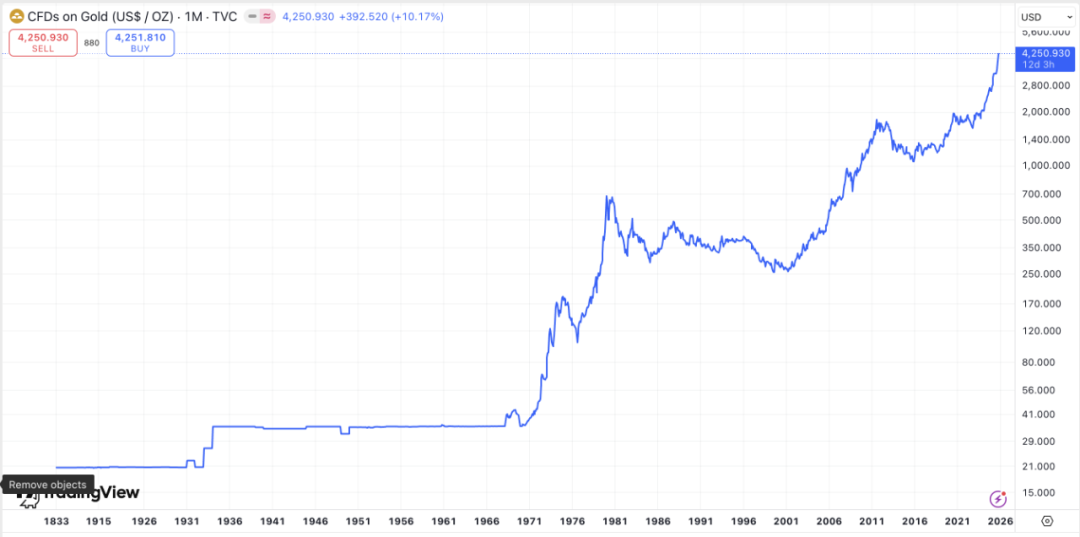
Data shows that over the past 50 years, the correlation between gold and the US dollar index has been -0.68. This negative correlation has been particularly pronounced during critical moments when the US dollar's credit system has been challenged. For example, after the collapse of the Bretton Woods system in 1971, the price of gold rose from $35 per ounce to $850 per ounce within a decade. During the 2008 financial crisis, a short-term plunge in the US dollar index caused the price of gold to double within two years. The surge in gold prices in 2025 is essentially a reiteration of this historical pattern.
US dollar credit crisis: the core engine of this round of rise
In 2025, the US dollar's credit system faced multiple shocks, becoming a key driver of gold's breakout. From a fundamental perspective, US debt has surpassed $37 trillion, the government shutdown has re-emerged, and regional bank credit crises continue to ferment. The introduction of US dollar stablecoins could also undermine the dollar's creditworthiness (this is because US government stablecoins allow them to bypass the Federal Reserve to obtain "curve coinage rights." By issuing and pledging US debt, issuing US dollar stablecoins, and then exchanging them for US dollars), the US government could effectively seize digital dollar coinage rights and interfere with the Fed's monetary policy independence. These issues are continuously undermining market confidence in the dollar. As a non-credit monetary asset, gold, without the backing of any national sovereignty, naturally becomes the preferred tool for hedging US dollar risks.
The Federal Reserve's monetary policy shift has further exacerbated the short-term weakness of the dollar. On September 17, 2025, the Fed initiated interest rate cuts, lowering the federal funds rate to 4.00%-4.25%. The dot plot signaled another 50 basis point cut this year, and the market is pricing in a 98% probability of a 25 basis point rate cut in October. The US dollar index has fallen over 8% from its year-to-date high, and the 10-year US Treasury bond's real interest rate has fallen from 4.5% to 3.2%. As real interest rates decline, the value of gold, a zero-interest asset, has significantly increased.
The superposition and resonance of geopolitical risks and inflation expectations
In 2025, the global geopolitical risk index rose to a 10-year high. The continued fermentation of the Russia-Ukraine conflict and the tense situation in the Middle East have continued to stimulate market risk aversion. In the past two months, the monthly increase in gold prices has exceeded 10%, highlighting the market's risk aversion.
Regarding inflation, although global core inflation has fallen to 3.2%, it remains above the 2% target of major central banks. Energy and food price fluctuations triggered by geopolitical conflicts could further push inflation higher. Historical data shows that since the collapse of the Bretton Woods system in 1971, gold prices have risen more than 50-fold, far exceeding the global average annual inflation rate of 3.5%. During the global hyperinflation cycle from 2020 to 2023, gold prices saw an annualized increase of 12.3%, significantly outperforming the global average annual inflation rate of 6.8% over the same period. This anti-inflationary property has continued to drive capital inflows into the gold market.
Capital Map: Dual Drive of Long-Term Allocation and Medium-Term Investment
Central Bank: A long-term buyer at the "ballast stone" level
The continued increase in gold holdings by global central banks is the most stable support for the gold market. This allocation is by no means a short-term speculative move, but rather a long-term strategy based on national strategy. Data shows that global central banks have increased their gold holdings by over 1,000 tons annually for three consecutive years, and 95% of the central banks surveyed expect official reserves to continue to increase over the next 12 months. my country's central bank has shown particularly strong performance, increasing its gold holdings for 11 consecutive months. At the end of September, its gold reserves reached 74.06 million ounces, an increase of nearly 10% from the beginning of the year.
Structurally, emerging market central banks have been the main contributors to gold reserves growth, with their share of gold reserves increasing from 10% to 18% over the past five years. The core rationale behind these central banks' gold increases is to hedge against US dollar credit risk, maintain financial stability, balance asset portfolios, and combat inflation. Essentially, increasing gold holdings aims to diversify foreign exchange reserves and reduce reliance on US dollar assets. The size of a country's gold reserves is also a crucial symbol of its creditworthiness and financial strength, bolstering international confidence in its currency. This "official reserve-level" demand provides a strong foundation for gold prices, ensuring a rapid recovery even from short-term corrections.
Financial institutions: strategy-driven core traders
Various financial institutions constitute the backbone of the gold market, and their behavior has both trend and strategic characteristics.
Taking public funds as an example, public funds passively respond to investor demand through gold ETFs. From September to October 2025, global gold ETFs saw a net inflow of US$17.3 billion in a single month. Among them, the world's largest gold ETF (SPDR Gold Shares) saw its holdings increase by 45% compared to the beginning of the year, and the scale of China's Hua Xia Gold ETF (518850) exceeded 30 billion yuan.
Retail investors: comprehensive entry from consumption to investment
The massive influx of retail investors is also a key driver of the market, showing a dual-driven trend of consumption and investment. On the consumer side, demand is strong in traditional gold-consuming countries such as China and India. The Chinese wedding market alone consumes over 300 tons of gold annually. Physical gold sales at gold shops are projected to increase by 28% year-on-year in 2025. Gold jewelry from brands like Chow Tai Fook remains stable at 1,247 yuan per gram, yet demand still outstrips supply.
The investment sector performed even more strongly, with retail investment purchases increasing by 45% year-on-year. Sales of gold bars and coins doubled, and products such as paper gold and gold accumulation became increasingly popular. ICBC's "accumulation gold" program is expected to exceed 50 billion yuan in size by 2025. The core motivations for retail investors to enter the market include hedging against inflation, stock market volatility, and trend following. Especially after gold prices broke through historical highs, the "buying-up effect" significantly inflated market trading volume.
Realistic considerations of gold's safe-haven function
Hedging effectiveness in normal inflation
Gold's ability to maintain its value in a normal inflationary environment has been repeatedly verified by history. During the global hyperinflation cycle of 2020-2023, the price of gold rose from $1,700 per ounce to $2,500 per ounce, an annualized increase of 12.3%, far exceeding the global average annual inflation rate of 6.8% during the same period, effectively safeguarding the purchasing power of assets.
For individual investors, allocating 5%-10% of their assets to gold can effectively hedge against the erosion of wealth caused by rising prices. Among investment tools, gold ETFs offer high liquidity and low transaction costs, making them suitable for average investors. Physical gold, such as gold bars and coins, is more popular among investors who value the perceived value of physical possession, but storage costs and liquidity constraints must be considered.
Safe-haven boundaries in extreme environments
In extreme scenarios such as war, gold's "crisis hedge" properties are highlighted, but there are also potential risks.
Gold is a cross-cyclical wealth carrier. It is the most reliable asset store during wartime and holds irreplaceable value during post-war recovery. For example, in Germany after World War I, war reparations triggered hyperinflation, causing the mark exchange rate to plummet. The mark to the dollar rose from 64 marks in 1921 to 4.2 trillion marks in 1923. This meant that the wealth of residents holding marks was wiped out, while those holding gold preserved the value of their wealth (in 1923, the mark convertible into one ounce of gold rose from 12,000 marks at the beginning of the year to 4.2 trillion marks by the end of the year, fully offsetting the hyperinflation). In such periods, holding gold across war cycles can quickly restore wealth after the war. Holders of gold can use it to rebuild their homes and invest in real estate, while those holding fiat currency may face the risk of currency becoming invalid.
However, individuals holding gold should be wary of policy risks. Historically, there have been numerous cases of governments forcibly requisitioning gold during extreme periods. During World War II, Nazi Germany enacted the Reich Gold Law, forcing citizens to surrender all their gold and imposing severe penalties on violators. During the Pacific War, Japan implemented the Gold Control Order, prohibiting private gold ownership. In 1933, during the Great Depression, the US Congress passed the Banking Act of 1933, abolishing the right to private gold ownership and forcibly expropriating private gold at $20.67 per ounce. The following year, however, the official price was raised to $35 per ounce, effectively buying low and selling high, directly depriving citizens of their wealth. When a country faces a crisis of survival, personal gold reserves may be subject to expropriation, marking the limits of gold's safe-haven function.
Extended thinking: Bitcoin and gold?
Essential differences in core attributes
Gold is a safe-haven asset during world wars, while Bitcoin is a safe-haven asset for avoiding localized conflict. Gold, proven over millennia, possesses characteristics such as lack of sovereign backing, no credit risk, and high scarcity, long earning it the title of "the ultimate non-credit asset." Bitcoin's safe-haven properties, however, have yet to be tested in extreme crises. In war-torn areas without computers, mobile phones, or even internet or electricity, Bitcoin cannot function as a direct exchange like physical gold. However, if the conflict is limited to a localized area and people can relocate to a safe location, Bitcoin is easier to take with them than gold.
Bitcoin's scarcity is more definitive. Global gold reserves are limited and mining is expensive, with annual production increasing by only around 3,000 tons, though there are occasional reports of large-scale gold mines. Bitcoin's total supply is fixed at 21 million, making its scarcity even more certain.
Significant differentiation in market structure
The two asset classes have significantly different owner structures and market characteristics, which determine their different price-driving logics. The gold market is dominated by long-term funds, with central banks and long-term institutional investors holding over 60%. This structure makes it resilient to short-term liquidity shocks.
Bitcoin, on the other hand, remains primarily short- and medium-term funded. While significant long-term allocations have been added this cycle (e.g., national strategic reserves, Bitcoin ETFs, Bitcoin DATs), the average daily turnover remains high, with leveraged trading accounting for over 60%. This high turnover and leverage make it more susceptible to sell-offs during periods of declining risk appetite. Furthermore, Bitcoin's correlation with the Nasdaq is stronger than with gold, further demonstrating its role as a "risk-on" asset rather than a "safe haven."
Future positioning is complementary rather than alternative
Judging from development trends, Bitcoin and gold are likely to form a complementary relationship. Gold, with its millennia-old credit foundation and physical properties, remains a core reserve asset for central banks and institutions worldwide, making it irreplaceable in scenarios like sovereign credit crises and extreme wars. Bitcoin, leveraging blockchain technology, demonstrates unique advantages in areas such as inflation mitigation, cross-border payments, global asset allocation, and the global flow of wealth.
For individual investors, gold can serve as a "safety cushion" in their asset portfolio, providing deterministic risk hedging and preservation of value; Bitcoin can be used as part of a high-risk allocation to gain excess returns from technological innovation, but it must withstand its sharp price fluctuations and the uncertainty of regulatory policies in a few regions.