By Wenser, Odaily Planet Daily
On September 5, the U.S. Securities and Exchange Commission (SEC) and the Commodity Futures Trading Commission (CFTC) jointly issued two major statements.
One document stated that the two sides would strengthen collaboration to support the development of crypto assets, DeFi, prediction markets, perpetual contracts, and portfolio margin. Subsequently, they would enhance the competitiveness of the US market through regulatory harmonization, closing regulatory gaps, extending trading hours, and utilizing innovative exemptions. The other document foreshadowed a joint roundtable meeting on September 29th, with planned discussions including "considering harmonizing product and venue definitions, streamlining reporting and data standards, adjusting capital and profit frameworks, and leveraging each agency's existing exemptions to establish a coordinated innovation exemption."
As two crucial regulatory agencies in the U.S. economic system, the actions of the U.S. SEC and CFTC may indicate that new actions are about to be taken in U.S. crypto regulation. Odaily Planet Daily will briefly analyze this incident and its related impact in this article.
The core goal of the joint US SEC and CFTC regulation is to make American Capital Great Again.
In two joint statements issued by the US SEC and CFTC, both mentioned "ensuring the United States' leading position in global capital markets." This demonstrates that the core objective of this joint regulation remains part of the Trump administration's "America First" policy. Specifically, the primary impact of this joint regulation is reflected in the following areas:
1. Opening the US market to crypto trading platforms
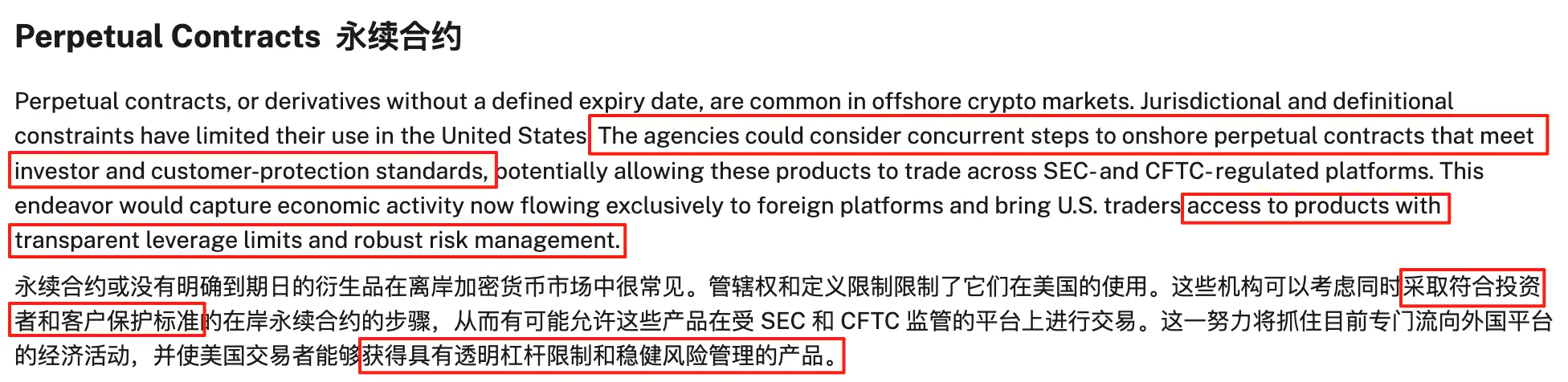
According to previous information and a joint statement from the two agencies, the US CFTC plans to issue guidance clarifying registration rules for foreign trading platforms. The prediction market Polymarket has received CFTC approval to re-enter the US market. The SEC and CFTC will also explore the introduction of perpetual swaps in the US market, enabling traders to participate in related products previously primarily available overseas on local platforms. Furthermore, the two agencies plan to explore areas such as 24/7 markets, prediction markets, portfolio margin optimization, and DeFi innovation exemptions.
There is no doubt that after Trump came to power, the US government reversed its previous "closed-door" attitude towards the cryptocurrency industry and planned to fully open the US market to attract a number of crypto trading platforms to participate in the construction of the US crypto economic system.
2. Further Attract Overseas Capital Liquidity
The U.S. CFTC plans to clarify the registration rules for foreign trading platforms (FBOTs). This will not only attract industry infrastructure such as trading platforms to the U.S. market, but will also allow large-scale inflows of funds, capital, and liquidity from U.S. and global crypto users. U.S. crypto market participants including Gemini, Kraken, and Coinbase will also be able to reach more users and liquidity worldwide.
As Caroline D. Pham, Acting Chair of the U.S. CFTC, previously stated: "This is a way to 'repatriate' crypto activity to the United States, which had previously been diverted abroad by Biden-era law enforcement, while reaffirming the regulatory framework that has existed since the 1990s. For U.S. traders, this means legal access to more global liquidity; for the crypto industry, it is another step towards regulatory clarity and an initiative of the Trump administration's 'Crypto Sprint Strategy.'"
3. Reduce regulatory costs and improve law enforcement efficiency
Under existing US law, the SEC and CFTC are both financial regulatory agencies, but their powers differ: the SEC was primarily established and enforced under the Securities Act of 1933 and the Securities Exchange Act of 1934, while the CFTC's existence and regulation are based on the Commodity Exchange Act (CEA). In other words, the SEC primarily regulates the securities market, emphasizing investor protection and disclosure requirements, with penalties including civil fines, injunctions, and criminal referrals; the CFTC, on the other hand, focuses on commodity futures and derivatives markets, emphasizing risk management and anti-manipulation, often involving leveraged trading and high-risk derivatives. Joint oversight will further clarify the boundaries of authority between the two parties, while reducing the compliance burden on crypto platforms (such as margin capital lockups), thereby reducing regulatory costs and improving enforcement efficiency—a true expression of the principle of "rendering to Caesar what is Caesar's and to God what is God's."
4. Encourage innovation while strengthening risk management
The introduction of several potential policies and favorable measures will further encourage innovative development within US crypto companies. In particular, 24/7 trading, portfolio margin, and innovative exemptions for DeFi are expected to inject new momentum into the development of DeFi within the US financial sector. Furthermore, the two departments emphasized "compliance with investor and customer protection standards," and subsequent policies may be introduced to further strengthen risk management and reduce market manipulation. In the long term, this move may effectively mitigate the disorderly price manipulation and speculation currently plaguing the crypto market.
After crypto IPOs, crypto derivatives may become a new highland in the United States
Following the completion of benchmark IPO events in the crypto industry such as "crypto asset management giant" Galaxy, "the first stablecoin stock" Circle, and crypto trading platform Bullish, with the joint regulatory statement issued by the US SEC and CFTC, crypto derivatives and DeFi may become the next US crypto innovation highland.
In the past, due to the high-pressure regulatory situation in the United States, many cryptocurrency exchanges and projects avoided the US user market. The joint statement of the US SEC and CFTC is equivalent to sending a signal of a new round of regulatory direction: encouraging rapid development and prospering the US crypto financial market, and launching more innovative products that meet exemption requirements based on risk control and investor protection.
On the one hand, “US-based crypto projects” such as WLFI, Uniswap, Solana, and Moonpay may usher in a new round of expansion and favorable regulatory policies;
On the other hand, cryptocurrency index funds and related targets such as Coinbase, Gemini, Kraken, Kalshi, Polymarket, Bitcoin Spot ETF, Ethereum Spot ETF, etc. will usher in more active traders and a new wave of liquidity.
It is worth mentioning that this joint supervision may open up imagination space for the U.S. financial market to activate the liquidity of traditional financial markets with the help of the crypto economic system. Traditional fund institutions including traditional index funds, state pension funds, university endowment funds, etc. are expected to use this to make more crypto asset allocations.
Considering Nasdaq's previous announcement that it would tighten regulatory measures on listed companies establishing cryptocurrency reserves, it is becoming increasingly difficult to achieve the effect of "double-flying of cryptocurrency and stock" by simply relying on a "coin hoarding strategy" through a backdoor listing. Instead, one can only hope for the innovation of more standardized and innovative crypto-financial products and the introduction of liquidity.
In addition, although Strategy, the "first BTC hoarding stock," met all the hard conditions for S&P 500 components but was not selected for the S&P 500, CFTC Acting Chairperson Caroline Pham previously described this as the "Uberization of Bitcoin," meaning that digital assets are integrated into the US economic system to the point where they are difficult to remove, which shows the importance the US CFTC attaches to crypto concept stocks.
Unlike the Internet economy that has penetrated into every aspect of people's lives, the cryptocurrency industry currently only stays in the field of financial investment. However, with the development of different tracks such as PayFi, DeFi, prediction markets, and US stock tokenization markets, the crypto economy will also further realize the mainstream process based on ETF funds.
Attached is the relevant time nodes of US CFTC regulatory measures
On August 21, Acting CFTC Chairwoman Caroline D. Pham announced the launch of the next phase of the CFTC's Crypto Sprint initiative to implement the recommendations of the President's Digital Asset Markets Task Force report. The initiative focuses on promoting spot trading of digital assets at the federal level and aligns with the SEC's "Crypto Project," echoing President Trump's call for U.S. leadership in the crypto space.
On September 5, the U.S. CFTC and SEC jointly issued a statement, intending to promote joint supervision of cryptocurrencies and derivatives.
On September 29th, a joint CFTC-SEC roundtable will be held at the SEC's headquarters at 100 NE F Street in Washington, D.C. The roundtable will be open to the public and will be webcast live on the SEC website. A recording of the roundtable will be posted on the SEC's website. Details of the agenda and participants can be found here.
According to previous remarks by Caroline D. Pham, Acting Chairperson of the U.S. CFTC, the CFTC will widely solicit opinions from stakeholders, covering topics such as leverage, margin, and retail financing transactions, and will open a channel for public submission of opinions before October 20.