
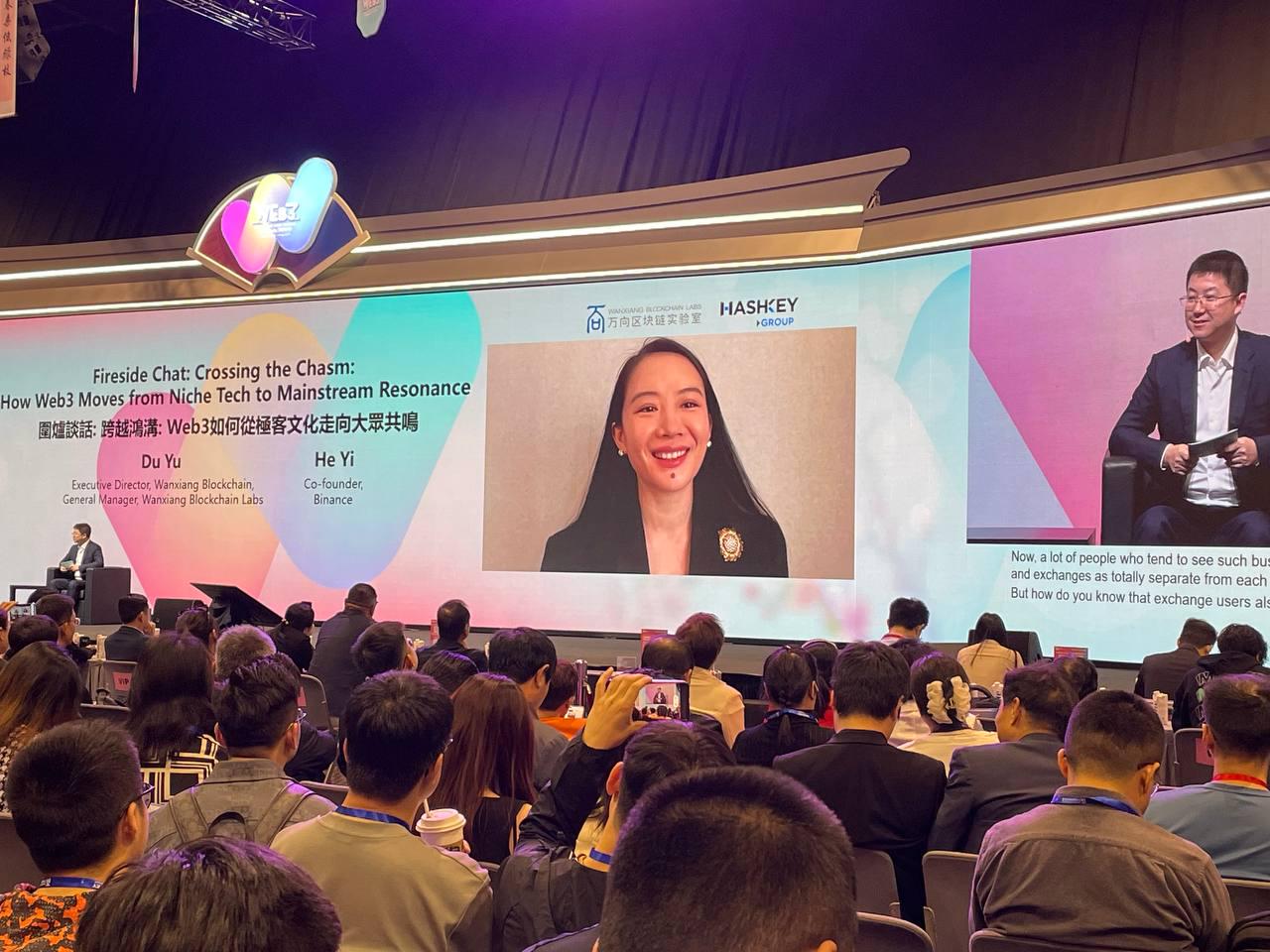
On April 7, at the just-concluded Hong Kong Web3 Festival, Binance co-founder He Yi participated in an online fireside chat with Wanxiang Blockchain Executive Director Du Yu on the theme of "Bridging the Chasm | How Web3 Can Go from Geek Culture to Mass Resonance" and had an in-depth exchange with Wanxiang Blockchain Executive Director Du Yu.
In the conversation, He Yi shared her long-term observations on the development of Web3, from the initial rise of the concept of blockchain to the current popularization of technology. She believes that the definition of technology should not be a constraint, and the key lies in whether it truly creates value for users. At the same time, she also pointed out that Web3’s real breakthrough does not rely on "educating users", but on winning the natural use of the public through products that solve real problems.
In addition to industry observations, He Yi also talked about the original intentions and responsibilities of entrepreneurs, emphasizing the importance of continuously creating real value and giving back to the community in the long term.
The following is a complete transcript of the conversation:
Opening
Du Yu :
Welcome to the roundtable discussion. We are honored to invite Binance co-founder He Yi, also known as "Yijie". Before we officially start, Yijie, please say hello to everyone.
He Yi :
Hello everyone, first of all, thank you Mr. Du for the invitation. I am the "Chief Customer Service of Binance" that everyone is familiar with. All along, Binance has been able to get to where it is today, and it is inseparable from the support of community users and industry partners, including Mr. Du, Mr. Xiao Feng, etc. I am also honored to have this opportunity to communicate with you in Chinese.
Although I was not able to be there in person today, I have already felt the warm atmosphere of Hong Kong. Thank you everyone!
About the evolution and understanding of Web3
Du Yu :
Our topic today is "Crossing the Chasm: How Web3 Goes from Geek Culture to Mass Resonance". You entered this industry in 2013, and so did I. In the past ten years, we have experienced the evolution of discourse from "blockchain" to "Web3". Some people may wonder if this is just a different term.
So my first question is: What do you think of the concept of "Web3"? In your more than ten years of industry experience, has your understanding of "blockchain" or "Web3" changed? You once said that "I hope Binance will become the Google of Web3", so what is the core service role of Binance in Web3, financial services or a broader application platform?
He Yi :
I personally don’t like being over-defined. Oftentimes, we define a new concept in order to find a position in a longer historical dimension.
From the perspective of human society, we have gone through the agricultural age, the industrial age, and now the information age. The core resources of each era are different: the agricultural age is land, the industrial age is machines and organizational management, and the information age is data and connections. But we are still looking for the core means of production in the "information age".
In this context, Web1.0 is information transmission, Web2.0 is the connection between people, and Web3 may be our attempt to use blockchain technology to establish a new trust mechanism and organizational method. However, these definitions are not absolute, and like hot words such as "metaverse" and "RWA", they are always evolving.
Binance's slogan has always been "Exchange the World". We have built a platform that allows people to trade, pay, chat, and even make friends in groups. For us, the most important thing is not what we do at which technical stage, but whether we provide users with truly valuable products.
Just like Steve Jobs said, the essence of technology is a tool to serve users. Technology that cannot solve user needs is meaningless. We hope to use blockchain technology not only for transactions, but also to build ecological infrastructure, such as BNB Chain, to help more entrepreneurs explore possibilities.
How Web3 can be democratized
Du Yu :
Yes, technology must ultimately serve users. Let's talk about the issue of public resonance. I saw a set of data: by the end of 2024, the number of people in the world who own crypto assets is about 659 million, of which only 200 million are users who actually own Web3 wallets. Compared with the entire Internet users, this proportion is actually very small.
Binance currently has about 270 million registered users, and you have mentioned many times the vision of "attracting the next billion users". So what do you think are the main obstacles in the process of Web3 going to the public? How does Binance and its ecosystem solve these problems?
He Yi :
First of all, I don’t agree with the idea of “educating users”. I majored in education and I hate being “educated”. Users truly accept a technology because it can truly improve their lives.
For example, on Pinduoduo, whether it is an 80-year-old lady “cutting a knife” or a 60-year-old fruit farmer selling apples on it, they are not educated, but because the product is useful to them. Similarly, blockchain products must also have “real value”.
For example, when we held a BBW in Dubai, a Kenyan guy shared that he would use Binance to send his salary home, which was low-cost and fast. This is the real experience of "being useful", and he doesn't need to understand what blockchain is.
Many people separate "exchange" and "wallet", but it is not necessary. For me, I don't trade cryptocurrencies, and my exchange account is my wallet. The boundary between centralization and decentralization is not clear-cut. The key lies in whether it solves a specific need of users.
Public perception and regulatory trends
Du Yu :
Indeed, technology is a means, and solving problems is the core. However, the public's perception of this industry is still negative, partly because the media focuses on price fluctuations and partly because of some industry chaos. At the same time, countries are gradually strengthening supervision. How do you think Binance, as an industry leader, should establish a positive industry image? How to "guide" the public to better understand this field?
He Yi :
The public’s misunderstanding is actually understandable. Human nature is to pursue order and security, so every new technology will be questioned at the beginning.
During the Industrial Revolution, people holding swords blocked the construction of railways; when the Internet first emerged, we had to be sneaky when surfing the Internet. Back to today, the same is true for Web3.
Satoshi Nakamoto's original vision was indeed "anti-traditional", so many early participants were idealists. But I think the key today is to find the "sweet spot" between ideals and reality. Web3 technology has indeed brought efficiency improvements, helping us build a more efficient and elegant financial system.
The gradual intervention of supervision is also a good thing, which means that the traditional system has begun to recognize the value of Web3. What we need to do is to continue to make positive voices and let the public see the real application and value of technology.
The fusion of AI and Web3
Du Yu :
Speaking of new technologies, I would like to add a topic - AI. In the past two years, from ChatGPT to DeepSeek, AI is affecting all walks of life. You also mentioned in an interview that you are optimistic about the AI track. So how do you view the impact of AI on Web3? The so-called "AI Native" plus "Crypto Native", what new opportunities do you think the combination of the two will bring?
He Yi :
I think AI is a "revolution in productivity" and blockchain is a "revolution in labor relations."
Binance is a good example: we only raised $15 million back then, but today we have given back to countless token holders. Technology brings new production relations, and once you can combine effective productivity with production relations, it will bring about huge changes.
The next question is: what problem do you want to solve with AI or blockchain technology? Who are your users? Are they willing to pay for it? These are the most critical things in entrepreneurship.
Many Web3 projects have good intentions, but they don’t make money. If you can’t make money, users will accuse you of “scamming”. I’m not a Web3 “fundamentalist”. I just follow a very traditional business logic: good products, business models, and sustainable community development.
If you really want to help users, you need to consider long-term and responsibility. Web3 entrepreneurship is not a model of "cutting a wave and leaving". The issuance of each token is actually a responsibility.
Advice for Chinese entrepreneurs
Du Yu :
We also congratulate Binance for receiving a $2 billion investment from the Abu Dhabi sovereign fund MGX, which is one of the largest investments received by Chinese entrepreneurs in recent years. Many people say that Web3 lacks applications, but Chinese people actually have a special advantage in application development. Can you briefly give some advice to Chinese entrepreneurs?
He Yi :
I am used to looking at problems within an organizational framework.
Our generation has benefited from China's strong basic education, and we are also extremely hardworking and resilient. These are our advantages.
But I want to remind everyone not to be frightened by the "division" of the world. You have to be an "optimistic pessimist" - in the most pessimistic soil, the most optimistic flowers will bloom.
Success does not depend on whether you have smooth sailing, but on whether you are willing to persevere and give back to the community. When you have success, you should "remember the grass and trees", and don't forget that it is the community that has supported you to where you are today.
Du Yu :
Thank you for your wonderful sharing! Today's time is limited, and I am still not satisfied. I also look forward to meeting offline next time for a more in-depth exchange. Thank you, Yijie, and thank you everyone!