
Yesterday, the Beijing Municipal Public Security Bureau’s Law Enforcement Corps published an article on its WeChat account: “ First! A “new channel” for handling virtual currencies involved in cases ”. This article has caused a lot of controversy. Many friends in the industry know that in the web3 field, Lawyer Liu has done some research on the judicial handling of virtual currencies. People have been sending me private messages asking me what this so-called “first” and “new channel” is all about. Some even said, “Doesn’t China prohibit virtual currency transactions? Isn’t this just selling the virtual currencies seized by judicial authorities for money? Now that China has liberalized the judicial handling business, will it completely liberalize private virtual currency transactions in the future?”
In fact, these understandings are somewhat biased. Even the article by the Beijing Municipal Public Security Bureau itself has some inaccurate expressions.
(Photo source: Faqingyuan, please delete if infringement)
1. What is the “first” and “new channel” of judicial disposal in Beijing?
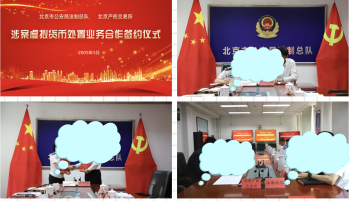
According to an article from the Beijing Municipal Public Security Bureau's Law Enforcement Brigade, the Beijing Municipal Public Security Bureau and the Beijing Equity Exchange (hereinafter referred to as "BEE") signed a "Framework Agreement on Cooperation in the Disposal of Virtual Currency Involved in the Case" regarding the disposal of the virtual currency involved in the case.
The article introduces the specific mode of disposal as follows:
(1) The Beijing public security organs entrusted the virtual currency involved in the case to the Beijing Stock Exchange for disposal;
(2) After accepting the commission from the public security department, the CBEX selected a third party to conduct the testing, receipt, and transfer of the virtual currencies involved in the case, and sold them publicly through a compliant licensed exchange in Hong Kong (disposal and conversion into legal tender);
(III) After the approval of the State Administration of Foreign Exchange, the realized funds will be converted into RMB and transferred to the special account of the public security organ.
According to the article, this model has helped the Shunyi Branch of the Beijing Municipal Public Security Bureau handle a case involving virtual currency.
However, as a web3 lawyer who is deeply involved in domestic judicial disposal business, from the practical experience of Lawyer Liu, the disposal model of cooperation between the Beijing Municipal Public Security Bureau and the Beijing Stock Exchange is not the first in China, nor does it use any new channels. This joint disposal model of domestic entrustment + overseas disposal has been implemented by disposal companies as early as 2023.
2. China’s virtual currency disposal model
The reason why I say this is because Lawyer Liu is too familiar with the judicial disposal model in mainland China. Generally speaking, judicial disposal in my country has gone through three periods:
During the period from 2018 to 2021 (roughly), domestic judicial authorities mostly cashed out the virtual currencies involved in the judicial seizure directly through OTC exchanges (U merchants), private individuals, etc. There is a possibility of money laundering by using the disposal and cashing out for judicial authorities, which poses a huge compliance risk;
From September 2021 to 2023, based on the "9.24 Notice" ("Notice on Further Preventing and Dealing with the Risks of Virtual Currency Trading Speculation"), which prohibits the exchange of virtual currencies and legal tender in mainland China, in principle, no more virtual currency disposal and liquidation activities will be carried out in China. Some third-party disposal companies will liquidate the virtual currency overseas, and then bring the liquidated funds into the country through foreign exchange settlement, and then pay them to the judicial authorities. The problem here is that many disposal companies' foreign exchange settlements are false settlements under the guise of foreign exchange quotas under trade/services/capital items, which essentially violates the relevant regulations of the State Administration of Foreign Exchange and the central bank, so it is still non-compliant;
3. Disposal 3.0
From the end of 2023 to the present, a small number of domestic third-party disposal companies have taken the lead in completing a disposal model similar to the cooperation between the Beijing Stock Exchange and the Beijing Municipal Public Security Bureau, that is, a joint domestic and overseas disposal model.
In short, domestic judicial authorities entrust a third-party disposal company in the mainland, which then entrusts an overseas entity to dispose of the assets on an overseas compliance platform and convert them into legal currency (generally US dollars, Hong Kong dollars, or offshore RMB). The converted legal currency is transferred to the foreign currency account of the domestic third-party disposal company, which then settles the foreign exchange upon entry and transfers it to the special account of the judicial authority or the non-tax account of the treasury, thus completing the disposal closed loop.
Therefore, the disposal model of the Beijing Stock Exchange and the Beijing Municipal Public Security Bureau may be the first time that Beijing has adopted this kind of joint disposal at home and abroad, but from a national perspective, many places have already operated in this way in practice.
3. Is there any problem with the disposal model of the Beijing Stock Exchange?
In fact, after carefully reading the article of Beijing Municipal Public Security Bureau, Lawyer Liu made a discovery:
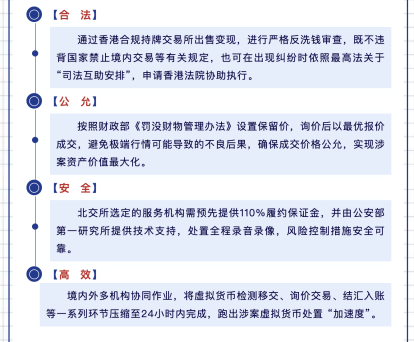
First, the Beijing Stock Exchange actually accepted the commission from the Beijing Municipal Public Security Bureau and then selected a "professional service agency" to carry out the actual disposal operation. Therefore, in essence, the Beijing Stock Exchange is not even a third-party disposal company, but only an intermediary and introduction party. It needs to entrust the case sources it has obtained to a third-party disposal company;
Second, "the service agency selected by the Beijing Stock Exchange needs to provide a 110% performance bond in advance", which is still relatively high in actual operations. Normally, for example, if you want to dispose of virtual currency worth 100 million yuan, then the third-party disposal company needs to provide a margin of 110 million yuan before it can be disposed of. In fact, in practice, it is not necessary to pay so much. Normally, virtual currency worth 100 million yuan will definitely suffer some losses after being disposed of and cashed out overseas (such as slippage losses, exchange fees, technical service fees of the disposal company, etc.), and the final amount returned to the country will definitely be less than 100 million yuan. Therefore, in principle, it is acceptable for the disposal company to submit a deposit that is not less than the amount remitted to the judicial authority for disposal;
(Photo source: Faqingyuan, please delete if infringement)
Third, regarding the service fee. The article mentioned that "the reserve price will be set in accordance with the Ministry of Finance's "Regulations on the Management of Confiscated Property", and the transaction will be completed at the best price after inquiry..." Lawyer Liu checked the regulations and found a provision regarding the reserve price:
" According to needs, the confiscated items may be auctioned by methods such as "one item, one auction". If an open auction is adopted, a reserve price shall generally be determined for the auction item. The reserve price is generally determined by reference to the appraisal price made by a price appraisal agency or an asset appraisal agency that meets the qualifications, or by reference to the market price or through Internet price inquiries.
If a public auction fails, the reserve price for the next auction shall not be lower than 80% of the reserve price of the previous auction . If a public auction fails three or more times, the law enforcement agency may, after consultation with the finance department at the same level, conduct an auction without a reserve price through the Internet platform or transfer to other disposal methods.
In other words, the reserve price here is only used when judicial disposal is carried out through public auction . However, if the judicial disposal of virtual currency is carried out in a compliant exchange in Hong Kong, it is not considered a public auction of the property involved (in essence, it is sold at the market price of the virtual currency).
In fact, the "Shandong Province Confiscated Items Disposal Procedures (Trial)" jointly issued by the Shandong Provincial Department of Finance and 17 other departments on August 25, 2023, more directly mentioned the issue of the disposal and realization price of virtual currency:
" Law enforcement agencies may negotiate with the merchants that issued the prepaid cards and virtual currencies that have been confiscated according to law, and the merchants will offer to buy them back. The recycling price is agreed upon by both parties and, in principle, shall not be less than 80% of the face value or balance of the virtual currency or prepaid card . Both parties shall sign a recycling agreement. "
In the defense of criminal cases involving virtual currency that Lawyer Liu has experienced, we have encountered some local judicial organs and disposal agreements where the highest disposal fee rate was as high as 35%! (That is, only 65 million yuan was received after the disposal of virtual currency worth 100 million yuan, and the remaining 35 million yuan was collected by the disposal company as a handling fee); currently, compliant disposal companies generally cannot charge a service fee higher than 20%, which is also consistent with the regulations of Shandong Province.
Some people may think that since the Beijing Municipal Public Security Bureau has published an article saying that judicial disposal can be carried out legally, does this mean that China will relax judicial disposal and even virtual currency transactions in the future?
Lawyer Liu's view is this: There is no question of whether the judicial disposal of virtual currencies involved in the case is relaxed or not, because the country has never banned it. Judicial organs across the country began to explore the judicial disposal of virtual currencies in 2017 and 2018, and now a joint disposal model has been formed at home and abroad. Domestic disposal has never stopped.
As for the claim that the country will open up virtual currency transactions, it is too early. I predict that in the next two to three years, my country will still focus on strong regulation and will not allow citizens to generally participate in virtual currency transactions.