Blockchain is popular for its decentralization, trust-free or low-cost trust, permission-free, and privacy protection. Users only need to hold a private key to enter the permissionless Web3 world without providing personal information such as mobile phone number, email address, name, ID number, etc.
However, as Web3 applications are increasingly integrated into real life, and in the early stages of Web3 development, Web3 applications are in line with their demand for regulation and commitment to security, especially in the DeFi field, making concepts such as no permission required and high privacy protection seem very idealistic.
On the one hand, this idealistic challenge comes from the promise of authenticity of user information: What if the user is under 18 years old? Who is eligible to vote in the DAO organization? Who is not a robot? On the other hand, as the market scale expands, applications must have the ability to verify off-chain data (such as compliance status, user uniqueness or jurisdiction) on a large scale and frictionlessly.
The authenticity of user information and the large-scale development of applications force Web3 applications to move towards a completely different situation from Web2.
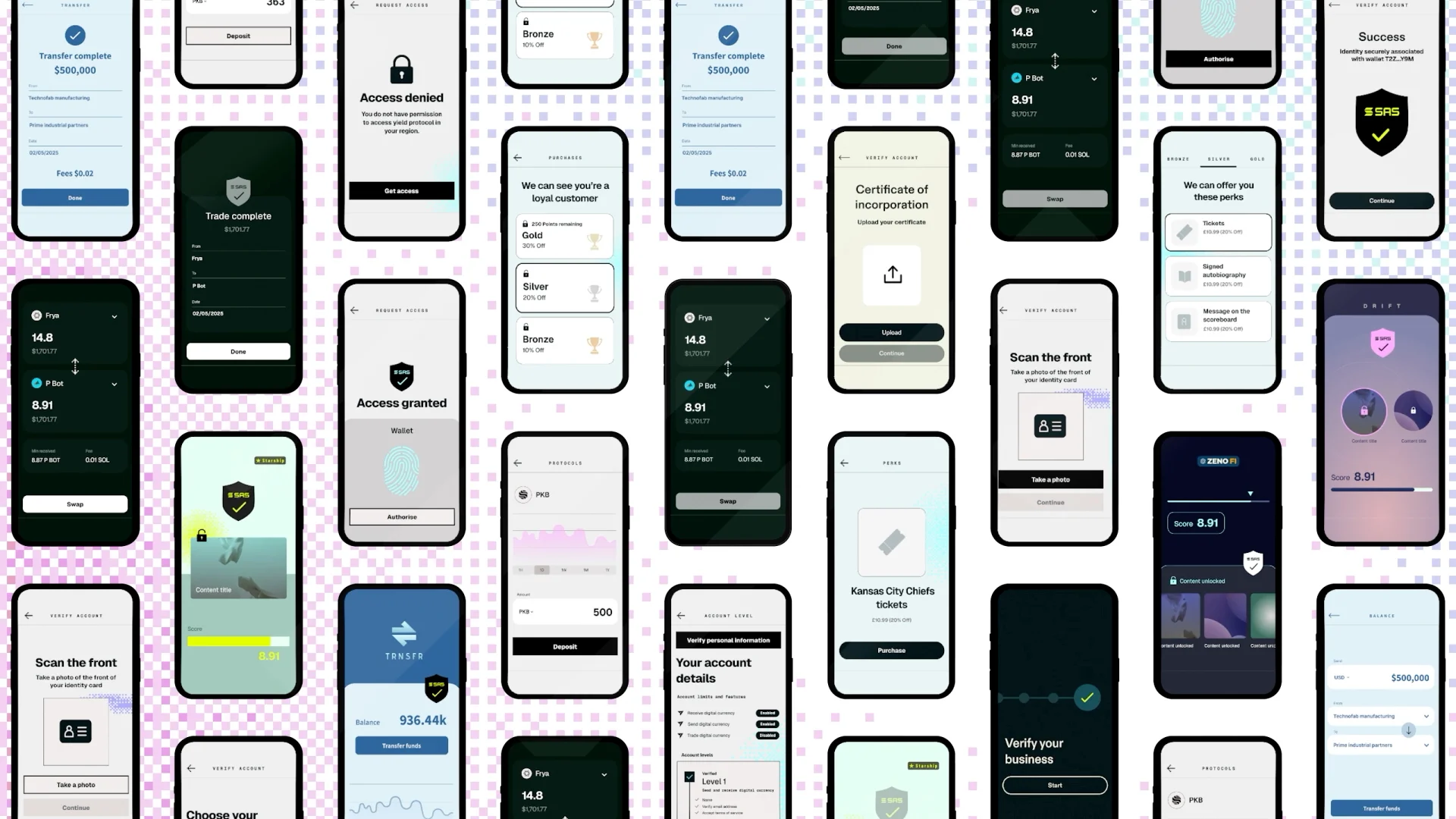
The ideal picture of moving towards Web3
For a long time, the answers to these questions could only be solved through closed KYC platforms or one-time user verification processes. Every decentralized application (dapp) that wanted to verify user qualifications had to repeatedly build a fragile backend system, and users were constantly forced to re-prove their qualifications at each entry point.
Most current applications often require building their own verification processes, managing sensitive user data, or relying on closed integration solutions, which not only increases the user operation threshold, but also brings higher compliance risks and operating costs.
There are many solutions to solve the identity system, and zero-knowledge proof privacy technology is one way - verifying identity without revealing specific information but only indicating whether the information is correct. Currently, some Layer 1 or Layer 2 public chains are developing zero-knowledge proof privacy technology.
In the Solana ecosystem, a solution that has recently attracted much attention is the Solana Attestation Service (SAS).
Solana introduced in its official blog on May 24: SAS is an open, permissionless, verifiable credential protocol. SAS allows trusted issuers to associate off-chain information (such as KYC checks, geolocation qualifications, Clip membership, or certification status) with users' wallets. These certifications are signed, verifiable, and reusable between applications without exposing sensitive data or repeating verification steps on the chain. By providing a neutral and permissionless proof layer, SAS enables compliance, access control, reputation systems, and programmable identities throughout the Solana ecosystem. This brings a better and more convenient experience to end users and builders.
SAS essentially provides a common infrastructure layer for issuing and verifying identity-based credentials. Institutions such as KYC providers, DAOs, employers, and even governments can write signed attestations to Solana wallet addresses, such as: "I am over 18 years old," "I live in the United States," or "I passed the verification process of this DAO." Dapps don't need to save or repeatedly verify this data - they can just verify the "stamp."
A typical attest contains: wallet address, claim content (such as "certified"), metadata (optional), and the publisher's signature. Solana stores this attestation information on the chain, which can be quickly queried and verified through a single SDK call.
No servers, no user data, no custom logic. Just trust, composability, and a fast path to compliance.
How does SAS certification service work?
Under the Solana Attestation Service (SAS) system, users can obtain some "stamps" (that is, certification credentials or reputation marks on the chain) by participating in DAOs (decentralized autonomous organizations), accumulating professional experience on the chain, or completing certain verified behaviors (such as identity authentication and skill assessment). These stamps are like "medals" or "credit records" of the user's identity on the chain.
These stamps can be used as "input conditions" for judgment and decision-making by other applications in the future, such as:
● Unsecured lending : Traditional finance requires collateral, but if you have a good credit stamp on the chain (such as timely repayment, true identity, and active participation), you may be able to obtain a loan without collateral.
● On-chain reputation system : Seals can build your “on-chain credit profile”. For example, if you are a senior member of a DAO, an active developer, etc., these can enhance your reputation.
● Dynamic governance weight : In DAO governance, your voting rights are no longer allocated based on the number of coins you hold. Instead, the governance weight is dynamically determined based on the stamps you obtain (such as participation, expertise, and historical contributions), so that “those who know more have a greater say.”
In the above case, Solana Attestation Service (SAS) provides the following core capabilities:
● Only one verification required: Users can save credentials in their wallets and reuse them across multiple applications.
● Neutral and open infrastructure : Issuers, developers, and users can rely on it to operate without relying on centralized gatekeepers.
● Programmable trust mechanism : Applications can access verification functions through a single SDK call without maintaining backend systems or identity databases.
DePIN further decentralizes
In areas such as DeFi, DePIN, and games, Solana authentication services will play a special role.
In DePIN (decentralized physical infrastructure network) application scenarios, it is often necessary to know whether a device actually exists and whether it is running in a specific location. However, this information is off-chain data and is not naturally recorded on the blockchain, so it is necessary to use "attestation" to introduce off-chain facts into the chain in a credible way.
Solana Attestation Service can complete the authenticity authentication of an IoT device; whether a user is in a specific geographic location; and whether a network node is operating as required.
In this way, the DePIN project can automatically distribute incentives, allocate network resources, and establish trust mechanisms based on these "verifiable off-chain proofs" without relying on centralized validators.
This type of authentication is the “bridge” between the physical world and blockchain logic and is crucial to DePIN.
Conclusion
SAS allows developers to respect these real-world constraints without sacrificing user experience, privacy, and decentralization. Solana has long been a testing ground for DePIN, DeFi, and blockchain games due to its performance advantages. But to expand to the next billion users, real-world constraints must be dealt with. How the role of authentication services will perform in the field of Web3 applications remains to be seen.
refer to: