
2. Mechanism collapse: Crowdfunding auction model drags down ecological vitality
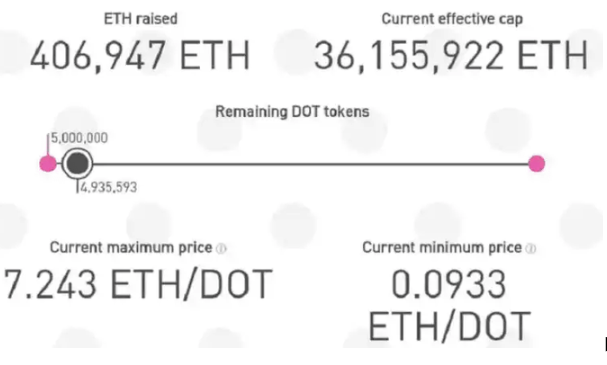
The parachain auction mechanism initially adopted by Polkadot was seen as a symbol of “fairness and decentralization”. However, in practice, it has become a “brake” for development:
Project owners must lock up a large amount of $DOT (up to 96 weeks) before they can go online
User mobility is severely constrained, causing the ecosystem to lose vitality
Leading to high development threshold, heavy capital cost and high interaction threshold
This not only slowed down the ecological expansion, but also seriously affected the community activity.
3. Polkadot 2.0: Upgrade is “paper talk”, no one pays attention
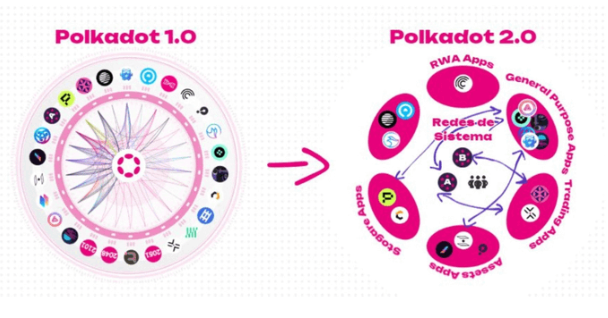
At the end of 2024, Polkadot will launch the 2.0 upgrade, including:
JAM Protocol (more flexible execution architecture)
Agile Coretime
Elastic Scaling
While these upgrades are technically sound, the problem is:
No matter how good the technology is, there must be people who care about it and use it, otherwise it is just "self-entertainment".
4. User loss and developer exodus: The ecosystem enters a “death spiral”
Mid-2024: Approximately 2,400 developers
End of 2024: Developers fall to 1,260
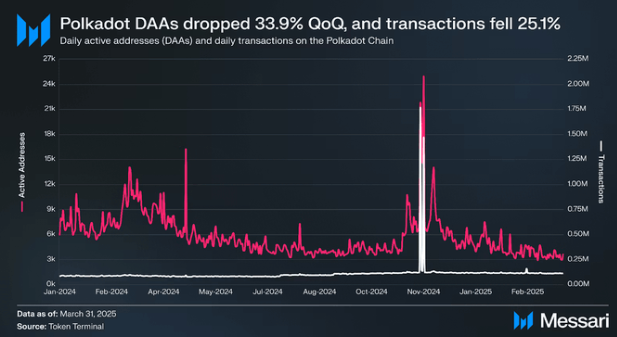
2025 Q1: Daily active wallets are only 4,280, down 13.1% from the previous quarter
Why is there such a dramatic loss?
The technical threshold of Rust + Substrate is too high. At the same time, new ecosystems such as Solana, Arbitrum, and Base provide a faster and more friendly development experience.
5. Chaotic structure and unclear incentives: Dual-chain dual-currency system becomes an obstacle
Polkadot and Kusama adopt a "dual-chain, dual-coin" design, which is theoretically used for testing in parallel with the main network. But in practice:
It is difficult for developers to determine which chain to deploy on
The user experience is confusing, and it is easy to confuse the purpose of KSM and DOT
Ambiguous incentive mechanism leads to inefficient growth
This directly violates the "availability first" principle emphasized by Web3.
6. Treasury management out of control and community trust collapsed
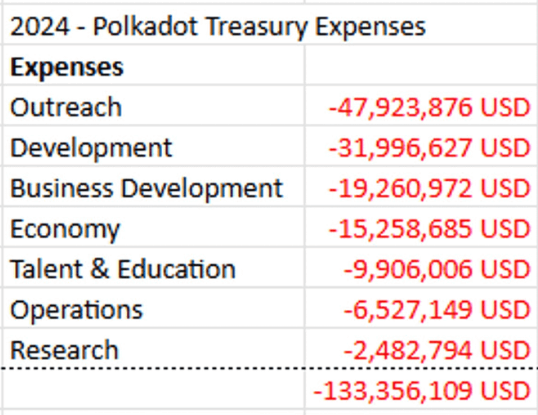
Polkadot’s treasury spent more than $133 million in 2024 for ecological incentives and project funding. But the result is:
A large amount of funds flow into projects with low ROI
Voting participation rate declines quarter by quarter, and community participation enthusiasm collapses
Governance power is concentrated in the hands of large users, and the OpenGov mechanism is just a formality
The vision of "democratic governance" has gradually been replaced by the reality of "whale dictatorship".
7. Lack of narrative and cultural penetration
Whether a project can survive for a long time depends not only on technology, but also on whether it can form a "cultural consensus".
Compared to:
Solana’s “High Speed + Meme + Blockchain Game”
Base's "Coinbase endorsement + community atmosphere + new narrative"
Polkadot has never reached a consensus on the narrative:
No strong memes, no popular DApps, no cultural symbols
✅ Summary: Polkadot’s failure was not a scam, but a failure due to “loss of attention”
Polkadot’s ecosystem still has:
World-class cross-chain protocol XCM
Native design combining multi-chain architecture and security
Hundreds of millions of dollars in unspent Treasury funds
But its problem is not lack of technology or funds, but:
Lack of "attention" mechanism to attract developers, users and capital.
✳️ So what should we think about Polkadot?
It is not a Ponzi scheme like FTX, but it is indeed a failed experiment of "high-profile and slow death". 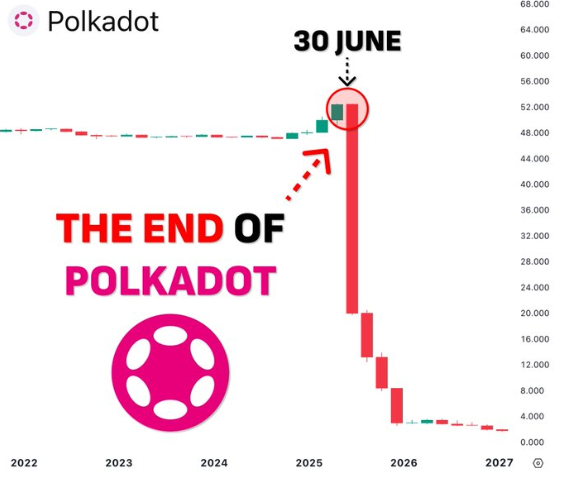
What failed was not the vision, but the execution path; what failed was not Gavin Wood, but the misjudgment of the market rhythm.

