
This week, global financial markets experienced a broad sell-off, with a significant cooling of risk appetite.

Bitcoin fell below the key psychological level of $100,000 on Tuesday, hitting a low of $98,962.06, a 21% drop from its October high. The total market capitalization of cryptocurrencies also fell to a four-month low of $3.44 trillion.
Technical breakdown continues
From a technical analysis perspective, the outlook for Bitcoin is not optimistic.
Analyst Micah Zimmerman stated that the $106,900 support level – aligned with the 0.146 Fibonacci retracement level – was repeatedly tested last week but ultimately failed to trigger effective buying. The market is now eyeing the $104,000 level, but this position has also been tested twice and its support is weakening.
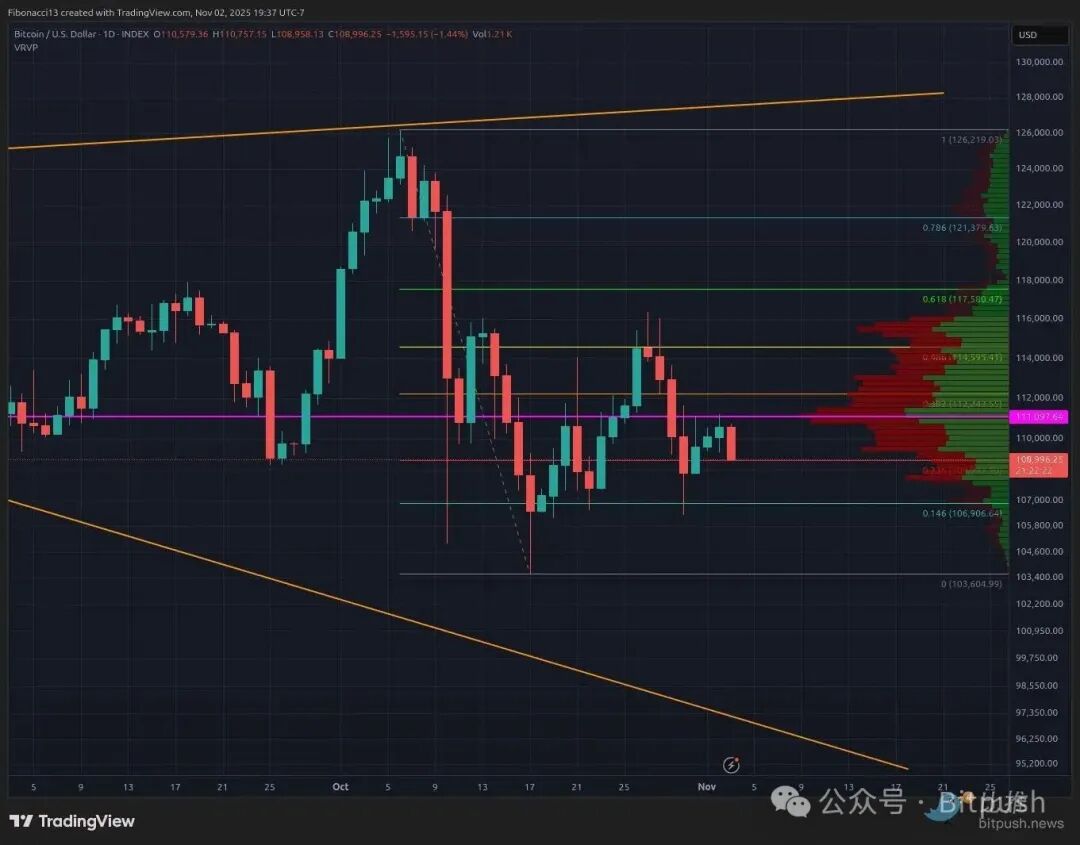
If the $104,000 level is confirmed to be breached, traders generally expect $96,000 to become the next important support area.
On the other hand, for the bulls to regain upward momentum, they need to first recover the 21-day exponential moving average and the price control point around $111,000. After that, they need to break through the two resistance levels of $114,600 and $122,000.
Tightening liquidity exacerbates market pressure
"Bonds were the only asset class to perform well this week, while risk assets such as Bitcoin, gold, and stocks were generally under pressure," said Tim Sun, a senior researcher at HashKey Group. Despite the continued downward pressure, he still believes that $85,000 will be a key support level for Bitcoin.
This assessment was echoed by several analysts. Schroders operations analyst Jiehan Chen stated directly: "A stronger dollar is likely the main driver of this round of market declines." A strong dollar exerts significant downward pressure on dollar-denominated risk assets.
"The cryptocurrency market is facing multiple headwinds," Caladan's research director, Derek Lim, added in an interview with Bloomberg. "The market's foundation has been damaged after the massive liquidations in October and a series of protocol vulnerability attacks." Against this backdrop, traders are opting to deleverage and avoid establishing aggressive long positions.
Panic sentiment is clearly diverging from fundamentals.
What is worth exploring further is that, despite the sharp deterioration in market sentiment, the on-chain data presents a completely different picture.
CryptoQuant certified analyst XWIN Research believes that "Bitcoin's drop below $100,000 is largely driven by sentiment." Data shows that the Fear & Greed Index has plummeted to 21, indicating extreme fear, reflecting that market sentiment has entered irrational territory.
However, the fundamentals of the Bitcoin network remain robust: the network hashrate remains near all-time highs, and $10.7 billion in stablecoins have flowed into the Binance exchange. These "reserve ammunition" may provide support for a subsequent rebound.
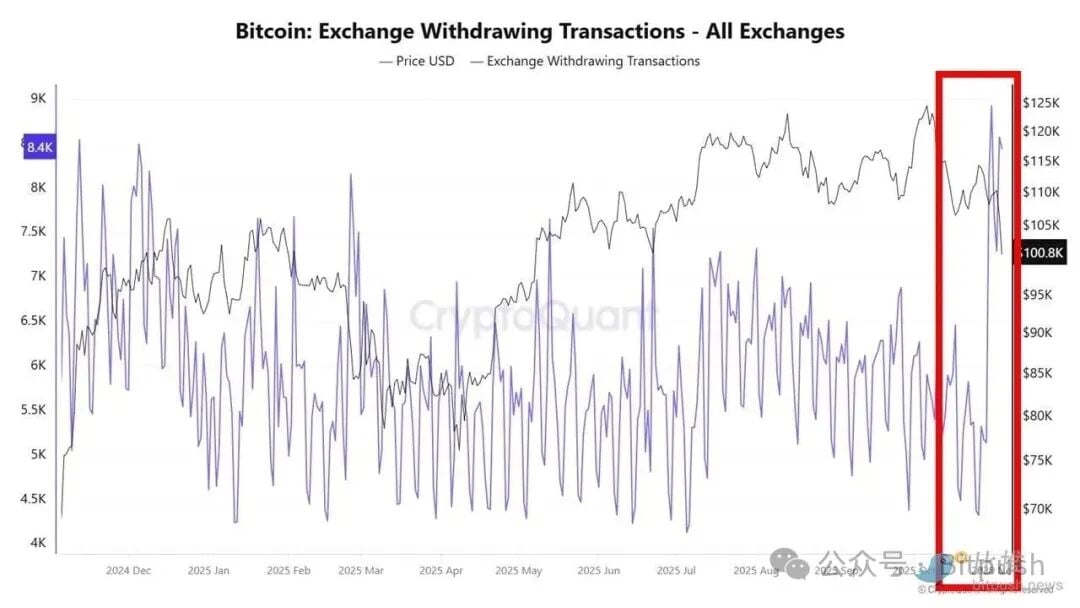
On-chain analytics platform Santiment also observed that during the market downturn, a large number of investors continued to buy on dips.
Bitwise Chief Investment Officer Matt Hougan described the current market as "two parallel worlds": "Crypto-native investors are in a state of extreme pessimism, with massive deleveraging... but when I talk to institutional investors, they remain enthusiastic about allocating to these assets."
This divergence is reflected in ETF fund flows. Although the pace of inflows slowed compared to the second quarter, Bitcoin ETFs still maintained stable net inflows.
Hougan specifically mentioned that Bitwise's Solana staking ETF attracted $400 million in its first week, indicating that institutional demand remains robust. However, the ETF has fallen sharply during the recent crypto downturn, dropping nearly 20% since its listing on October 28.
Bottom prediction?
Analysts are clearly divided on where Bitcoin has bottomed out.
Tiger Research senior analyst Ryan Yoon maintains his assessment of $98,000 as a support level, while keeping his long-term target at $200,000.
Tim Sun of HashKey believes that $85,000 is a stronger support level.
Strategy CEO Michael Saylor told CNBC last week that he believes Bitcoin could reach $150,000 by the end of the year, one of many bullish predictions recently, although the timing doesn't seem right now.
However, Bitwise's Hougan believes this prediction isn't far-fetched. He stated on CNBC, "I think Bitcoin could easily reach a new all-time high before the end of the year. That means around $125,000 to $130,000. Whether it reaches Saylor's predicted $150,000 remains to be seen."
The macro environment adds more variables
However, these forecasts all face severe challenges from the macroeconomic environment. Signals from the short-term money market are alarming: widening interest rate spreads, increased use of the Federal Reserve's standing repurchase facility, and the US Treasury's account exceeding $1 trillion are all continuously withdrawing liquidity from the market.
The month-long US government shutdown has exacerbated the situation, leading the market to place high hopes on the upcoming Consumer Price Index report to be released on November 13, expecting the data to act as a catalyst for a shift in market sentiment.
In these uncertain times, experienced traders understand one thing: the market bottom is never a precise point, but rather a range. Within this range, panickers see risk, while rational traders see rare opportunities.
As the market gradually digests short-term negative news, investors who remain calm amidst the panic may be accumulating positions for the next wave of market activity. As we have observed, institutional investors have a more rational understanding of the fundamentals of crypto assets, and they are likely to become the main driving force behind the next market rally.
However, investors need to remain patient until the market completes this necessary "emotional cleansing," as the road to the bottom is often more tortuous than expected.