
Author: Crypto Miao
With the rapid development of the global cryptocurrency market, more and more companies and individuals in Hong Kong use virtual currencies as income instead of traditional fiat currencies such as Hong Kong dollars and US dollars, providing a richer form of assets while also bringing a lot of tax challenges. As the government strengthens tax supervision of cryptocurrencies, understanding how to properly handle tax-related issues has become a compulsory course for related companies.
Regulatory situation
Hong Kong has not yet developed a separate regulatory framework specifically for crypto assets, but the Securities and Futures Commission (SFC) has begun regulating the ecosystem of "security" tokens since 2017. This includes licensing requirements for trading platforms, "virtual asset" portfolio managers and funds, aimed at ensuring compliance with the existing Securities and Futures Ordinance (SFO). In addition, existing laws cover money laundering, terrorist financing, fraud and cybercrime, whether or not "virtual commodities" are involved, reflecting the broad applicability of regulation.
Tax Policy
The tax behavior of virtual assets is regulated by the "Profits Tax - Digital Economy, E-commerce and Digital Assets" (hereinafter referred to as DIPN 39) guidelines issued by the Hong Kong Inland Revenue Department in 2020. Since 2022, blockchain-related businesses have grown by 250%, and Hong Kong is seen as one of the fastest growing regions for cryptocurrency business in the world in 2025.
Cryptocurrency income
1. For individuals:
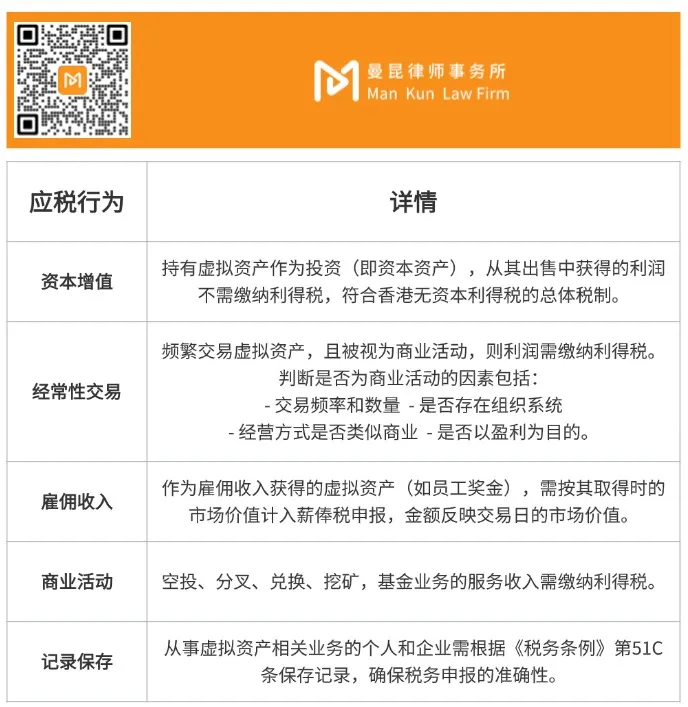
DIPN39 provides that employees, especially those working in digital asset-related industries, may receive remuneration (such as wages) in the form of cryptocurrency. Even if the remuneration is paid in cryptocurrency, the salary tax treatment applicable to labor income remains unchanged. The amount of labor income that employees need to report should be the market value of the cryptocurrency at the time of receipt.
Therefore, individuals are required to declare the market value of remuneration (such as wages) received in the form of cryptocurrency as taxable income for salaries tax. This applies to all employees and is particularly common in the digital asset industry. This provision ensures that the tax treatment of cryptocurrency remuneration is consistent with traditional wages, reflecting the flexibility of the Hong Kong Inland Revenue Department to adapt to the digital economy.
2. For companies:
DIPN 39 states: A person engaged in commercial activities may use cryptocurrencies for transactions for various purposes. For example, the person may accept payments in cryptocurrencies from customers, or use cryptocurrencies to purchase goods. The market value of the cryptocurrency on the transaction date should reflect the amount of sales and purchases.
Therefore, any cryptocurrency payments received by a company in Hong Kong for business activities, or any new cryptocurrency received in the course of its business activities, must be converted into Hong Kong dollars based on the market value on the transaction date and included in the company's taxable income.
Virtual Currency Fund Tax Policy
Firstly, determining whether a Hong Kong fund is subject to tax depends on whether it meets the Unified Fund Exemption (UFE) regime. The Unified Fund Exemption (UFE) regime was introduced on April 1, 2019 through the Inland Revenue (Profits Tax Exemption for Funds) (Amendment) Ordinance 2019, which aims to provide uniform profits tax exemption treatment for all eligible funds operating in Hong Kong, regardless of whether they are locally registered or not, and must meet the fund definition and transaction requirements stipulated in the Inland Revenue Ordinance.
The conditions for qualifying for UFE include:
1. The fund meets the definition of tax exemption;
2. The assessable profits are derived from qualifying transactions (incidental transactions less than 5%);
3. Qualifying transactions are executed or arranged in Hong Kong by designated persons, or the fund is a qualified investment fund.
Among them, the fund's taxable profits must come from "qualified transactions", including: securities trading, private company shares, futures contracts, foreign exchange contracts, deposits (excluding lending), exchange-traded commodities, foreign currencies, over-the-counter derivatives, etc.
During the trading process, virtual currency funds are likely to hold tokens other than security tokens, such as utility tokens (platform tokens) or payment tokens (stablecoins), which do not qualify for exemption under the Unified Fund Exemption (UFE) system.
If a fund does not qualify for the Unified Fund Exemption (UFE), it may still be able to obtain tax exemption through the Offshore Fund Exemption (OFE) regime, but it will need to meet the specific conditions of the OFE. If a fund does not qualify for either the UFE or the OFE, its operating profits may be subject to profits tax.
Determination of operating profit
Recognized as operating income
Profits are considered business income and are taxed at either the corporate profits tax (16.5% or two-tiered rates) or the personal profits tax (progressive rates of 2%-17% or a standard rate of 15%).
If a cryptocurrency fund has investment advisory and fund management services in Hong Kong and is entitled to execute transactions, then the consulting fees, handling fees and management fee income from this part will be deemed as income from business operations in Hong Kong and profits tax should be paid on its profits derived from Hong Kong.
DIPN39 also stipulates that certain events (such as airdrops and blockchain forks) may generate new cryptocurrencies. If these new cryptocurrencies are obtained in the course of cryptocurrency business, they are considered business income and are subject to tax. If airdrops are part of business activities (such as through cryptocurrency trading platforms or as business promotion), they must be included in business income at market value.
In addition, in Hong Kong, profits from operations (such as trading, exchange, and mining) are also subject to profit tax based on operating income.
Recognized as capital gains
Due to the particularity of Hong Kong's capital gains tax, profits obtained by individuals or companies from the disposal of capital assets (such as stocks, properties, bonds, etc.) in Hong Kong are generally exempt from tax.
According to the tax treatment of digital assets mentioned in DIPN 39 of the Hong Kong Inland Revenue Department, capital gains tax is exempted for long-term holding of cryptocurrencies as an investment behavior. This means that if a fund trades digital assets, it may be regarded as an asset disposal, and the capital gains generated are generally not subject to tax. Therefore, it is important to confirm the legal holding and beneficial holding status of digital assets (the attribution of profits); the nature of the transaction (for example, whether it is a transaction or lending of digital assets); and whether the intended transaction complies with the contractual arrangements with customers and counterparties (the purpose of the contract).
It is worth noting that the cryptocurrency trading activities of the fund's trading or investment department also need to distinguish the purpose of its transactions. If a company frequently trades virtual currencies or uses them as part of its business remuneration, its profits may be considered business income and may be subject to tax. 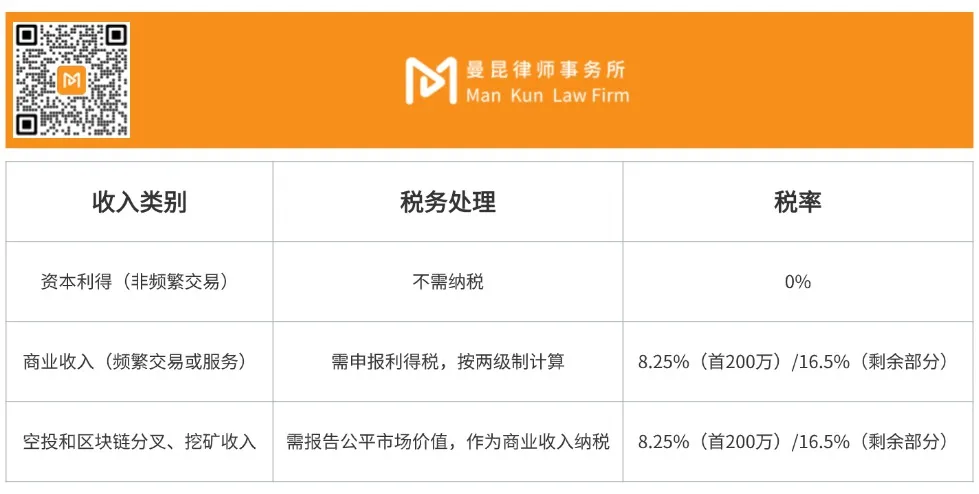
Things to note when calculating taxes on cryptocurrencies
Things to keep in mind when calculating cryptocurrency profits in Hong Kong:
1. Tax base
The purchase price or price of the cryptocurrency, plus any fees or commissions paid, constitutes the tax basis for calculating profit or loss.
2. Fair market value
Fair market value refers to the price at which a cryptocurrency would be sold on the open market at the time of trading. This price is usually determined by referring to a reputable cryptocurrency exchange or a blockchain oracle.
3. Holding time
The timing of buying and selling cryptocurrencies is crucial, determining the length of time the asset is held, which in turn affects the substance of the business and, in turn, the applicable tax rate. Factors to consider include transaction frequency, holding period, and holding ratio. For example, if a company frequently trades virtual currencies, it will be considered business income and will need to report capital gains tax; if it is held for a long time, it will generally be considered an investment, and capital gains will not be subject to tax.
4. Contractual arrangements
Cryptocurrency trading activities by a fund’s trading or investment arm need to be mindful of how the business activities are planned, whether the cryptocurrencies held are held for own funds or for others, and whether the intended transactions are consistent with the contractual arrangements with clients and counterparties (the purpose of the contract).
5. Cost deduction
Certain fees associated with cryptocurrency, such as transaction fees or wallet storage fees, can be deducted from the proceeds.
6. Record keeping
Keep detailed records of all cryptocurrency transactions. The Hong Kong tax authorities may require supporting documents. Complete records of cryptocurrency transactions should be kept in accordance with Section 51C of the Inland Revenue Ordinance.
As the cryptocurrency market in Hong Kong continues to develop and mature, the regulatory environment is expected to become more complete and strict in the future. For individuals and companies engaged in virtual currency income and crypto fund-related activities, compliant and forward-looking tax management is not only a necessary means to cope with regulatory challenges, but also a core competitiveness to seize opportunities in the digital economy.