
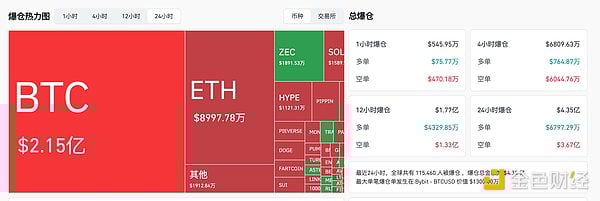
The cryptocurrency market rebounded rapidly last night, with Bitcoin returning to $93,000, briefly touching $93,660, erasing the losses from December 1st, and rising over 7% in 24 hours. Ethereum briefly broke through $3,000, touching $3,070, rising over 10% in 24 hours. Data shows that in the past 24 hours, total liquidations amounted to $435 million, with long positions totaling $67.9729 million and short positions totaling $367 million, with short positions being the primary focus of liquidations.
Bitcoin just fell to around $83,000 on December 1st, but rebounded quickly within 24 hours, recovering all its losses. What happened to cause such a large fluctuation in the crypto market in such a short period of time? Have the various positive factors expected in December begun to affect the trend of cryptocurrencies? Can the market regain confidence in the rebound?
I. The crypto market experienced a mixed bag of emotions in a single day, quickly rebounding to recover lost ground.
The cryptocurrency market rebounded rapidly last night, with Bitcoin returning to $93,000, briefly touching $93,660, erasing the losses from December 1st, and showing a 24-hour increase of over 7%. Ethereum followed suit, briefly breaking through $3,000, reaching $3,070 at one point, recovering to pre-December 1st levels, with a 24-hour increase of over 10%. Coinglass data shows that in the past 24 hours, $435 million in positions were liquidated across the network, with $67.9729 million in long positions and $367 million in short positions, primarily short positions. Of these, $215 million was liquidated in BTC and $89.9778 million in ETH. Over 115,000 people were liquidated, with the largest single liquidation occurring on Bybit-BTCUSD, worth $10 million.
Just a day earlier, the crypto market had experienced a sharp drop, with Bitcoin falling to the $83,000 level, quickly erasing previous losses. It's foreseeable that major positive factors anticipated in December, such as Vanguard Group's $10 trillion asset management allowing clients to trade crypto ETFs, rising expectations of a Federal Reserve rate cut, a potential dovish successor to the chairmanship, and the end of quantitative tightening, have already begun to influence the market, supporting a rapid rebound in cryptocurrencies and other risk assets.
II. Vanguard Group, a giant in asset management, launches Bitcoin ETFs, stimulating a market rebound.
Vanguard Group began allowing clients to trade cryptocurrency ETFs and mutual funds on its brokerage platform on Tuesday. This marks the first time the asset management giant, known for its conservative investment philosophy, has opened cryptocurrency investment access to its 8 million proprietary brokerage clients. The company is one of the world's largest distributors of index funds, managing approximately $10 trillion in assets and serving over 50 million clients, making it the world's second-largest asset management giant after BlackRock.
Vanguard Group stated that it will support most regulated cryptocurrency ETFs and mutual funds, similar to its support for gold and other niche asset classes. The company also stated that it currently has no plans to launch its own cryptocurrency products. Bloomberg analyst Eric Balchunas noted on social media that this is a classic "Vanguard effect," with Bitcoin surging at the opening of the US stock market on the first trading day after Vanguard's shift, and BlackRock's IBIT exceeding $1 billion in trading volume within 30 minutes of opening, demonstrating that even conservative investors are looking to "add some excitement" to their portfolios.
Vanguard previously refused to venture into the cryptocurrency space, believing that digital assets were too speculative and volatile, inconsistent with its core philosophy of a long-term balanced portfolio. This shift reflects continued pressure from retail and institutional demand, as well as concerns about missing out on opportunities in a rapidly growing market. At a time when BlackRock has achieved great success with its Bitcoin ETF, Vanguard's loosening of its stance on this emerging asset class will have a profound impact on future fund flows.
III. Trump strongly hints at the possibility of a "dovish" Hassett taking over the Federal Reserve.
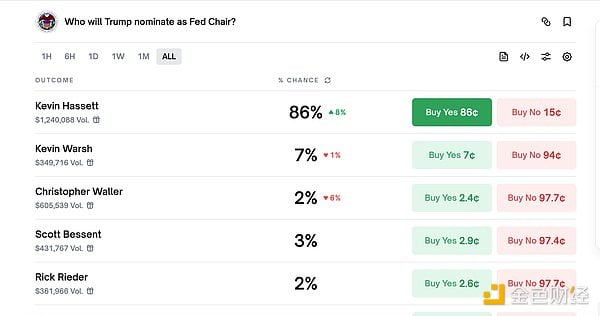
Recently, the possibility of Kevin Hassett, director of the White House National Economic Council, taking over as head of the Federal Reserve has been steadily increasing. The Wall Street Journal reported that sources revealed that although the selection process for Fed chair is still ongoing, Trump has almost locked in Hassett. Hassett is clearly leading among the final five candidates due to his strong loyalty to Trump and market approval. Trump stated at a cabinet meeting on Tuesday that he would announce his choice to succeed Powell as Fed chair "early next year." Trump also mentioned at the meeting that Treasury Secretary Bessett, who is leading the selection process, does not want to serve as Fed chair. Furthermore, at a White House event later Tuesday evening, Trump said, "I guess there's a potential Fed chair here too. Can I say? Potential. He's a respected person, I can tell you that. Thank you, Kevin." This statement was interpreted by the market as Trump personally implying that Hassett is the leading candidate to succeed him as Fed chair. Polymarket data shows that Hassett's probability of being selected as Fed chair has risen to 86%.
Trump has consistently favored candidates who support low interest rates, and Hassett, along with other candidates, is a public advocate for this approach. Despite a lack of explicit public statements, Hassett is widely considered a supporter of cryptocurrency. In June, he disclosed holding at least $1 million in Coinbase shares and receiving at least $50,001 in compensation for his role on the exchange's academic and regulatory advisory committee, highlighting his unusually close ties to the cryptocurrency industry—a rarity for a potential Federal Reserve chairman.
If the dovish candidate Hassett successfully takes over the Federal Reserve, it will have a significant impact on the Fed's future interest rate policy and may indirectly stimulate the rise of the crypto market.
IV. The Fed's December rate cut is gaining momentum; the outcome will be revealed next week.
With the emergence of potential "dovish" Federal Reserve chairs like Kevin Hassett, Trump reiterated his stance that the Fed should cut interest rates. He reiterated his criticism of Powell, stating that even JPMorgan CEO Jamie Dimon said Powell should lower rates. CME's FedWatch tool shows the probability of a 25 basis point rate cut in December has risen to 89.2%, while the probability of keeping rates unchanged is 10.8%. The probability of a cumulative 25 basis point rate cut by January is 66.6%, the probability of keeping rates unchanged is 7.7%, and the probability of a cumulative 50 basis point rate cut is 25.7%. Furthermore, Polymarket data shows the probability of a 25 basis point rate cut next week has risen to 93%, with total trading volume in the prediction pool exceeding $223 million.
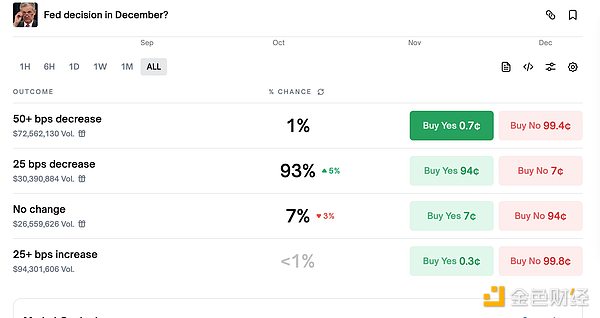
Expectations for a Federal Reserve rate cut in December continue to rise, with the market almost accepting a 25 basis point cut. The outcome will be revealed next week. This could further stimulate asset markets to strengthen before the final decision is announced.
V. The Federal Reserve ends quantitative tightening, injecting liquidity into the market.
The Federal Reserve officially ended its 3.5-year quantitative easing (QT) policy on December 1st, halting the process of reducing its balance sheet (referred to as "quantitative tightening"). Simultaneously, it injected $13.5 billion into the banking system through overnight repurchase operations. According to Fed economic data, this is the second-largest liquidity injection since the COVID-19 pandemic, even surpassing the peak during the dot-com bubble. Since 2022, the Fed has withdrawn over $2 trillion from the market, and its balance sheet has now shrunk to approximately $6.55 trillion. Some analysts point out that ending quantitative tightening marks a turning point in Fed policy: the aggressive tightening policies implemented after the COVID-19 pandemic have come to an end. This move is intended to address liquidity risks and boost the US economy.
With the Federal Reserve officially halting its balance sheet reduction this month, liquidity is beginning to ease, potentially providing a new liquidity shock for Bitcoin and risk assets.
6. Musk says debt crisis is good for Bitcoin, boosting market sentiment.
In a recent interview, Musk stated that the United States is rapidly heading towards a "debt crisis" that could trigger dramatic fluctuations in Bitcoin prices. Traders are bracing for potential major policy changes from the Federal Reserve in December, and against this backdrop, Musk predicts that in the future, "money as a concept will cease to exist," with energy becoming the only "real money." Musk stated, "That's why I say Bitcoin is based on energy; after all, you can't create energy through legislation." He also mentioned that "the United States is significantly increasing the money supply through a deficit of approximately $2 trillion."
Musk helped Trump return to the White House by warning of the ever-increasing U.S. debt (now exceeding $38 trillion), but their relationship deteriorated after Trump failed to control government spending. While Musk's support for Bitcoin and cryptocurrencies has fallen from its peak during the COVID-19 pandemic, he continues to support Bitcoin and Dogecoin. After leaving the White House, Musk stated that his "American Party" would prefer Bitcoin to the dollar, calling the dollar and other non-asset-backed currencies "hopeless."
Musk's support for cryptocurrencies is long-standing, and his pronouncements have consistently boosted the crypto market to some extent, and this time is no exception.
VII. Market Trend Analysis
Have these positive factors begun to influence the market trends of cryptocurrencies and other risky assets? Has the panic subsided somewhat? Can investors regain confidence during the rebound? Let's take a look at the main market interpretations.
1. Grayscale Research suggests Bitcoin could reach a new all-time high in 2026. In a report released Monday, Grayscale Capital points out that Bitcoin may not follow the so-called "four-year cycle"—the market consensus that Bitcoin's price peaks every four years (in sync with its halving cycle) followed by a significant pullback. Grayscale notes that historically, while long-term investors can profit from holding assets during volatility, they often need to "endure sometimes challenging drawdowns." The firm adds that pullbacks of 25% or more are common during bull markets, and such pullbacks do not necessarily signal the start of a long-term downtrend.
2. Coinbase Institutional states that with the end of quantitative tightening (QT) and the Federal Reserve's re-entry into the bond market, the pressure to withdraw funds from the market may have subsided. This is generally positive for risk assets such as cryptocurrencies. In the current environment, the institution believes that high-probability opportunities are more likely to lie in breakout trades rather than knife-catching.
3. Glassnode and Fasanara Digital jointly released their "Q4 Digital Asset Report," stating that Bitcoin saw $732 billion in new investment in Q4, with one-year volatility nearly halved. The market is currently experiencing more stable trading, continued growth in scale, and a significant increase in institutional participation.
4.4E Observer reports that Bitcoin has quickly recovered all the losses caused by previous macroeconomic shocks. This strong rebound was mainly driven by two factors: First, the auction of Japanese 10-year government bonds was key to stabilizing global risk assets. Second, the market widely bets that Hassett has been "internally confirmed" as the next Federal Reserve Chairman. Although the growth and inflation outlook for 2026 remains uncertain, the "dovish" short-term policy stance has boosted US stocks and interest rate cut expectations, providing momentum for BTC's rebound. Rapid reversals in macroeconomic policy expectations and volatility in the government bond market remain key variables dominating short-term market movements. The strength of BTC's recovery after this correction will depend on policy signals, the liquidity environment, and changes in the behavior of long-term holders. It is recommended to maintain a sense of timing and risk boundaries.
5. BitMine Chairman and CEO Tom Lee remains optimistic about cryptocurrencies and the stock market. In an interview with CNBC, he stated that the Federal Reserve will provide the biggest positive boost in the coming weeks. Lee said, "I think the biggest positive factor coming in the coming weeks will be the Fed. The Fed is expected to cut rates in December, and it has also ended quantitative tightening. This has been a fairly significant tailwind for market liquidity." As liquidity in the system is no longer being withdrawn, the flow of funds into risk assets may begin to accelerate. Lee is particularly confident in Bitcoin. He believes that historically, increased liquidity has often been associated with stronger performance in "risk-averse" assets.
6. Yi Lihua, founder of LiquidCapital (formerly LDCapital), posted on social media: Although BTC has returned to $93,000, BCH has hit a recent high, and WLFI has stabilized after a surge, ETH and the overall market are still lagging behind the stock market and the various positive factors . With the confirmation of another crypto-friendly new chairman (the Federal Reserve) after the SEC chairman, the 60-day bear market in crypto may be coming to an end. These 60 days were caused by the severe decline in liquidity across the industry due to 10/11, the four-year cycle resonance, the Japanese interest rate hike, and the government shutdown, but these negative factors have now been digested. With the dual benefits of interest rate cut expectations and crypto policies, I remain optimistic about the future market. Investing always requires not only wisdom but also patience.
7. AllianceDAO co-founder QwQiao stated that if L1 tokens have the potential to become a non-sovereign store of value, it indicates that their price is not yet severely overvalued and they can also serve as an effective hedging tool against Bitcoin. He still believes that Bitcoin is undoubtedly the best non-sovereign currency and the most likely asset to replace gold.