
For the past few years, the "initial public offering" (IPO) scenario in the cryptocurrency primary market has consistently operated in a regulatory gray area. Since 2018, US users have been almost completely excluded from token initial offerings. However, this situation is beginning to change.
Less than a month after acquiring on-chain fundraising platform Echo for $375 million, cryptocurrency exchange Coinbase has taken another key step. Overnight, its official token sale platform was officially announced, reopening the door for US retail investors to participate in compliant token launches.

Coinbase IPOs: A Structural Shift
1. From panic buying to algorithmic allocation: Improving fairness for retail investors
In the past, most mainstream platforms (such as BinanceLaunchpad and OKXJumpstart) adopted a "lottery" or "first-come, first-served" mechanism. Project teams tended to attract large investors, and whether ordinary users could win the lottery often depended on luck.
Coinbase's platform employs an algorithmic allocation mechanism, prioritizing small-amount subscriptions and gradually expanding to larger amounts. This design lowers the financial threshold, reduces opportunities for high-frequency arbitrageurs, and provides retail investors with more genuine opportunities to participate.
2. Lock-up and anti-arbitrage mechanisms: Encourage long-term participation and prevent immediate selling upon listing.
Coinbase imposes a mandatory lock-up period on project teams—within six months of the issuance, the project team and its affiliated entities are prohibited from engaging in over-the-counter trading or selling tokens. Simultaneously, the platform introduces incentive constraints on user behavior: if a user sells tokens acquired within 30 days of the token's listing, they will be automatically downgraded by the system in the future.
3. Standardized Information Disclosure: Informed Decision-Making, Rather Than Blindly Following the Crowd
On the Coinbase platform, project teams are required to disclose detailed information, including the token's economic model, the use of funds, team background, development roadmap, and potential risks. This disclosure standard is significantly higher than the information depth offered by most exchange launchpads.
While other platforms also require some disclosure, most focus on marketing materials and basic data, whereas Coinbase mandates standardization, aiming to emulate IPO prospectuses. This helps investors truly understand what kind of project they are investing in, rather than betting solely based on "community buzz" or "FOMO."
4. Eliminating platform token participation mechanisms: Decentralized arbitrage incentives, returning to value judgments
Currently, most exchanges require users to hold platform tokens (such as BNB and OKB) to participate in new token offerings. Users are often forced to purchase platform ecosystem assets in order to qualify for participation, which exacerbates the price volatility of platform tokens and amplifies the risks.
Coinbase breaks away from this "token economy model dependence": it doesn't require users to lock up any platform tokens; participation only requires USDC, and there are no transaction fees. The platform's revenue comes from a fixed percentage of service fees paid by the project teams. This mechanism returns "initial public offerings" to their essence—selecting projects, not speculating on platforms.
Monad's first IPO: Is it worth participating?
Coinbase's first token sale project is Monad ($MON), a high-performance public blockchain under development that emphasizes parallel computing, extremely high transaction throughput, and full compatibility with the Ethereum Virtual Machine (EVM). Monad is backed by several well-known institutions, including Jump Trading, Placeholder, Lattice, and Dragonfly.
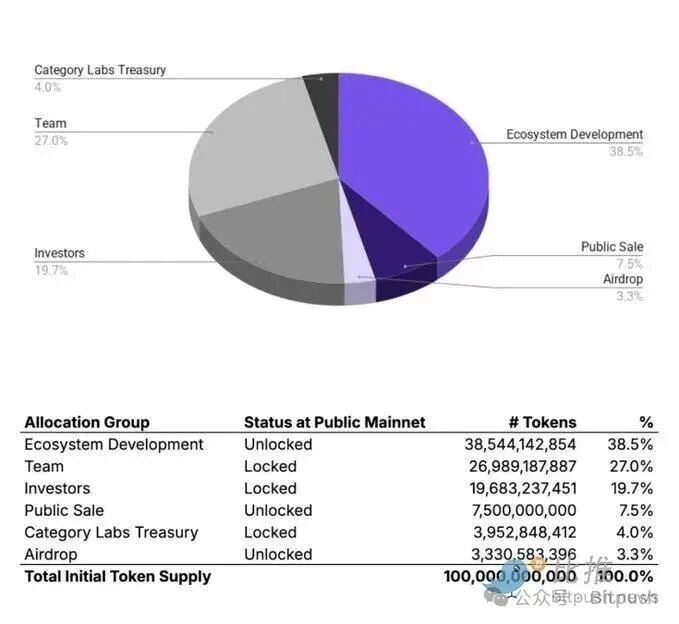
The public offering price was set at $0.025, a significant discount compared to the previous pre-market trading price of approximately $0.06. The market expects the price to have a short-term upside potential of 2–3 times, especially given the pre-IPO status on Coinbase.
However, it's worth noting that Monad is only releasing 7.5% of its total supply this time, with a valuation of approximately $2.5 billion, which is relatively high compared to other L1 projects that haven't yet launched their mainnets. Furthermore, the ecosystem is still in its early stages of development, and its future performance remains uncertain.
In addition, Coinbase's algorithmic allocation mechanism prioritizes smaller applications, so even if an individual user wins a lottery, their allocation is usually small, limiting their actual investment opportunities.
Therefore, for ordinary investors, Monad is a promising project, but it does not equate to "guaranteed profits." If you choose to participate, it is advisable to control your subscription amount, take a medium- to long-term view of the project's development, and pay attention to the ecosystem development after its mainnet launch.
The Era of Frenzied Involution in CEX
Coinbase's latest move is not an isolated case. In fact, in recent years, most mainstream exchanges have been continuously increasing their investment in the "token launch" track, gradually building a "launch closed loop" from project selection and financing design to trading listing and ecosystem support. Binance Launchpad, OKX Jumpstart, Bybit IDO, and others that we often hear about are all representative of this trend.
This evolution from a "trading matching platform" to a "full-chain service provider for the primary market" is both a result of the exchange's own business expansion and a reflection of the crypto industry gradually entering a more structured and standardized period.
Below is a comparison of several leading exchanges:
Exchange | IPO platforms | Features | Shortcomings |
Binance | Launchpad | Large traffic volume and strong explosive power | High valuation premium, insufficient information disclosure |
OKX | Jumpstart | Lottery mechanism + position allocation | Significant differences in user fairness |
Bybit | Web3 IDO | Strong sense of community participation | Most of the projects launched are startups, which are high-risk. |
Gate.io | Startup | High launch frequency, fast coin listing | The lack of mandatory lock-up periods has led to a strong speculative atmosphere. |
Coinbase | Token Sales | Compliant and transparent, retail investor friendly | In the initial stage, it still needs to be verified. |
It can be seen that the biggest difference between Coinbase and other platforms is that its design concept is closer to the "IPO + allocation + lock-up" process of the traditional financial market, attempting to guide the entire token issuance ecosystem from the previous "speculation logic" to "system construction".
Coinbase is not replicating Binance's success, but rather forging a new path, building a new token issuance route more suitable for compliant users and targeting long-term investors. The essence of this model lies in injecting stability and predictability into crypto assets through standardized processes and risk control systems.
For the entire crypto industry, Coinbase's issuance platform not only helps restore retail investor confidence, but may also become the "main gateway" for high-quality projects to enter the market in the future, reducing gray paths to circumvent regulations and establishing a new foundation of trust for the primary market.
Can an institutionalized primary market for crypto emerge from here?
The industry urgently needs blockbuster projects and a fair and legal issuance system that allows ordinary people to participate. Coinbase may be paving a new path for this.
Rather than calling this an "innovative new product launch," it's more accurate to say that Coinbase is posing a question: Can there be a more orderly, fairer, and more rational alternative to hype in early-stage Web3 financing than a lottery? By acquiring Echo, Coinbase is putting its vision of an integrated channel "from fundraising to listing" into practice. If Echo's issuance tools are smoothly integrated with Coinbase's distribution and compliance processes, it will form a standardized primary market infrastructure in the United States, improving the efficiency of fundraising and liquidity.
It may not succeed immediately, but at least it has opened a door. Whether this door can become an entry point to mainstream compliant users and high-quality projects remains to be seen.
However, before the feast begins, perhaps we should first pour some cold water on it: can this market, which is already saturated with new coins, really be saved by yet another launch platform? Coinbase has restructured the rules of issuance, but perhaps its biggest challenge is finding truly valuable new assets for a saturated market.