
By Eric, Forestight News
The reason for the collapse of xUSD issuer Stream Finance was finally revealed yesterday. The Delta-neutral strategy suffered losses on collateral assets due to ADL during extreme market conditions. The risks accumulated from entrusting funds to third parties for off-chain operations and using cyclical leverage strategies came to a head after the third parties suffered losses of nearly $100 million, ultimately leading to insolvency.
In an article I translated in 2023, written by Austin Campbell, a professor at Columbia Business School, I proposed that USDe issued by Ethena is not a stablecoin, but rather a share of Ethena's structured financial products.
The de-pegging of xUSD itself has also affected many DeFi strategies based on this "stablecoin" and some lending positions using xUSD as collateral. Strategies that maintain the value of collateral through Delta neutrality, or even slowly increase it, have been impacted by extreme market conditions and a lack of operational transparency.
What's even more worrying is that we've discovered the xUSD incident may not be the end of the story.
All available loans using USDX have been borrowed.
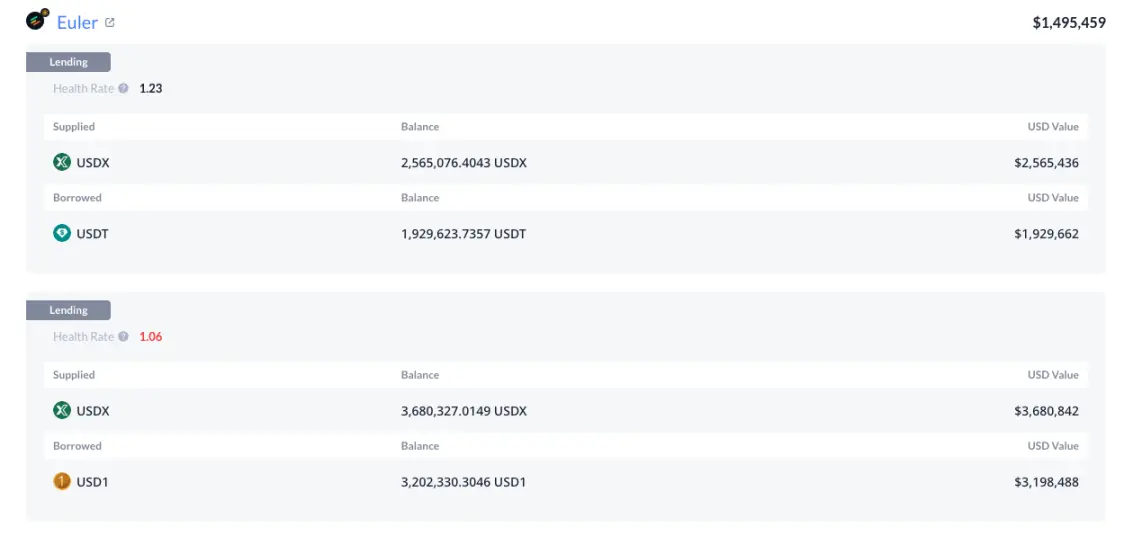
A user named 0xLoki tweeted last night that he only needed to wait one day to redeem the stablecoins used to mint sUSDX, but an address ignored the annualized interest rate of over 30% and drained all the pools on Euler that could use USDX and sUSDX as collateral to borrow other stablecoins.
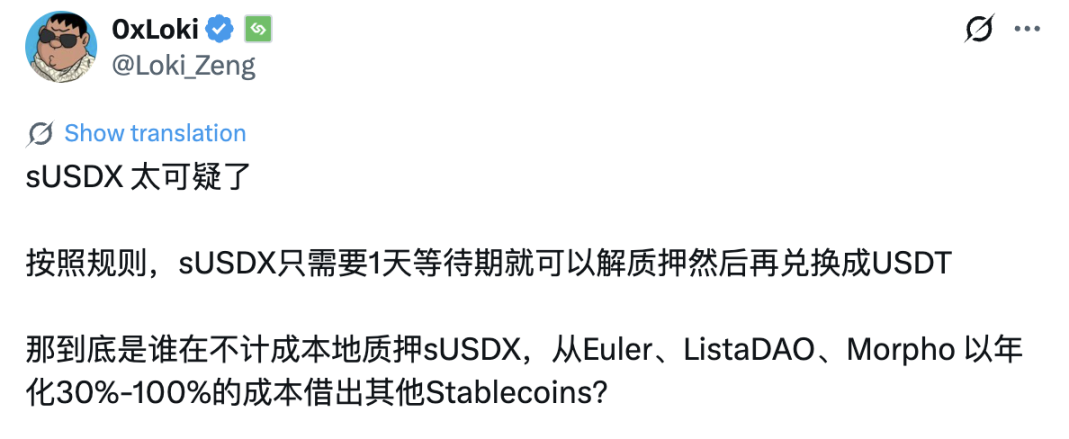
Here's a brief introduction for those unfamiliar with USDX. USDX is a stablecoin issued by usdx.money, a project that announced a $45 million funding round at a valuation of $275 million late last year. USDX's issuance model is almost identical to Ethena's, employing a Delta-neutral strategy. Users staking USDX can also earn short-selling funding rates. Unlike Ethena, usdx.money doesn't just trade Bitcoin and Ethereum; it allows the use of altcoins as the main instruments in its strategies. While this amplifies returns, it also increases risk.
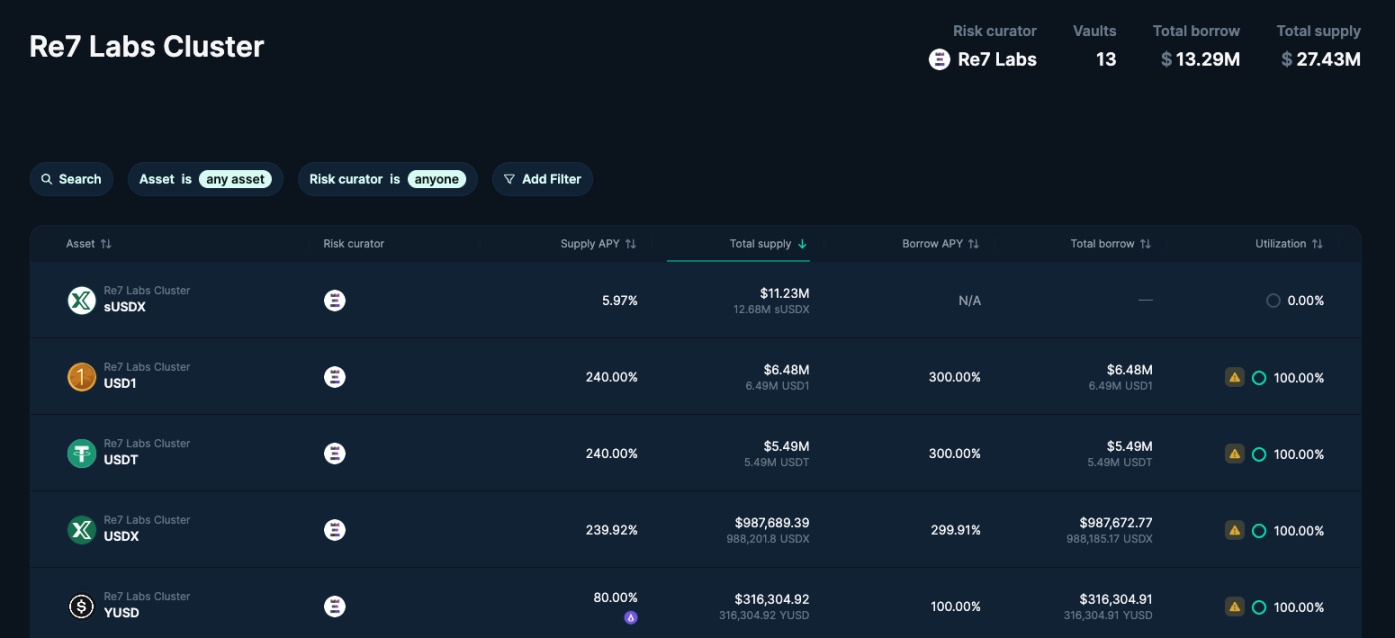
According to my investigation, data from Euler last night showed that Re7 Labs Cluster, the only platform that supports lending using USDX and sUSDX as collateral, had completely emptied its pool of USDT, YUSD, USD1, and even WBNB and BTCB.
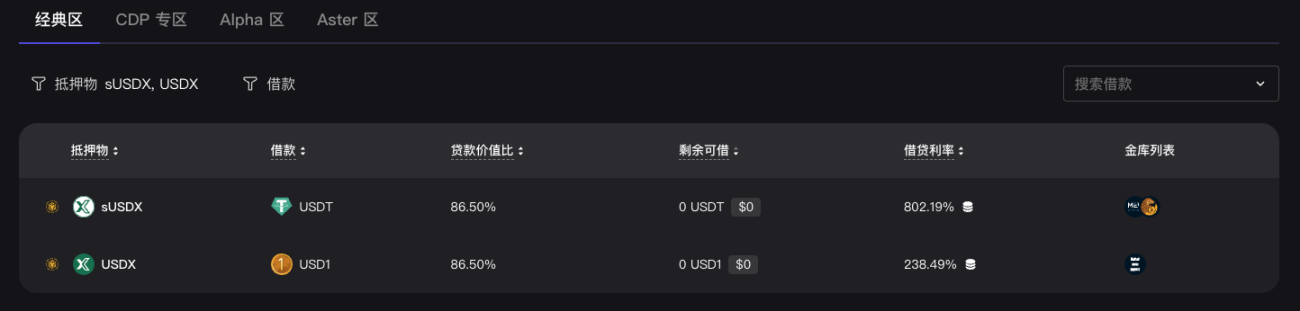
The pool on Lista DAO where you can borrow USDT and USD1 using USDX and sUSDX has also been emptied. At the time of writing, the interest rate for borrowing USDT using sUSDX as collateral exceeded 800%, and if borrowers still choose not to repay, the interest rate will continue to soar until forced liquidation.
Additionally, 0xLoki mentioned in a tweet that there were corresponding lending pools on Morpho and Slio, but as of the time of writing, the author could no longer find relevant information, possibly indicating that the platforms removed the corresponding pools from their front-end. However, the fact remains that almost all assets in the DeFi market that could be borrowed using USDX and sUSDX as collateral have been completely wiped out. Similar to xUSD, Re7 Capital and MEV Capital were the companies that established the market for USDX-based assets. A user on X revealed that Re7 Capital personnel stated on Euler Discord that they were discussing how to handle the situation with Stables Labs, but no definitive conclusion has been reached yet.
Who is frantically "borrowing money"?
A user named Arabe ₿luechip noticed something was wrong yesterday morning and listed four addresses that had run out of borrowable funds in various markets.
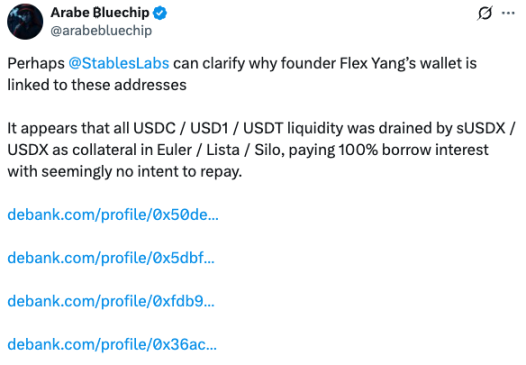
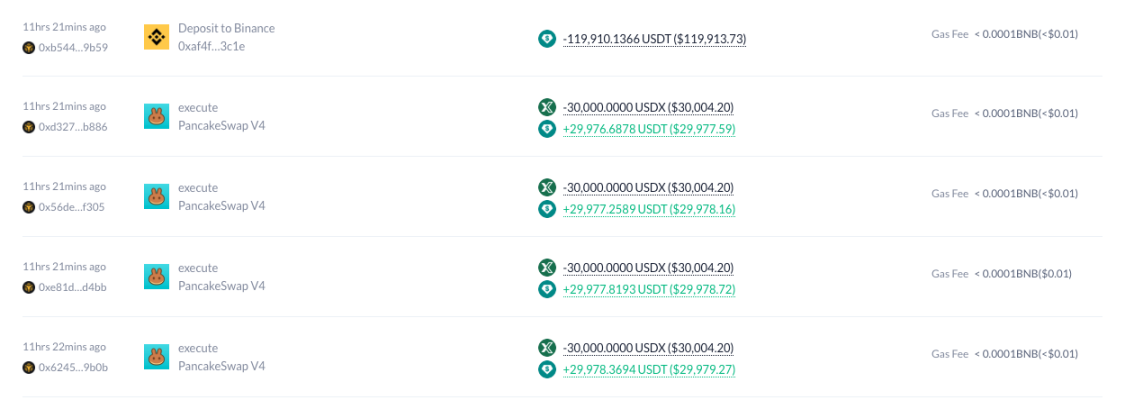
Addresses starting with 0x50de began receiving USDT from addresses starting with 0x246a in late July and transferring it to Binance. From late October, they began receiving large amounts of USDX from addresses starting with 0x5bdf, as well as a large amount of sUSDX obtained from other channels. They also lent out stablecoins such as USDT, USDC, and USD1 from Euler, Lista DAO, and Silo, and transferred them to Binance almost immediately after lending them out.
After finding no more loans available, the address directly exchanged USDX for USDT on PancakeSwap and transferred the funds to an exchange. This process only ended 11 hours ago.
Addresses starting with 0x5bdf also show a large number of transactions on Euler and Lista DAO involving collateralizing USDX to borrow USDT and USD1, but currently there are no borrowed stablecoins in the address.
As for the remaining two addresses, upon investigation, although they held a large amount of USDX or sUSDX and had engaged in some collateralized lending activities, they ceased activity in September and June respectively, and are not closely related to this incident.
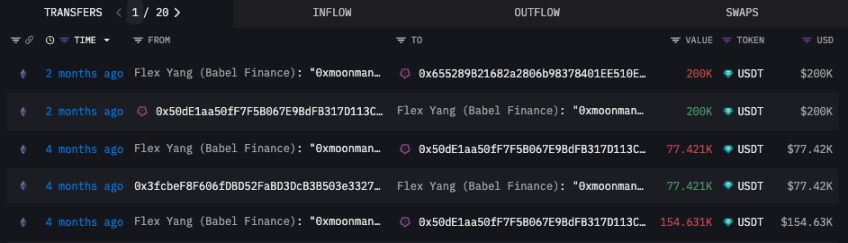
The most suspicious address, starting with 0x50de, was flagged by Arkham as potentially belonging to Flex Yang, the former founder of Babel Finance and HOPE. The most direct evidence is that the address directly flagged as Flex Yang, starting with 0x246a, transferred USDT to the address starting with 0x50de twice four months ago, which marked the beginning of his continuous borrowing of stablecoins and transferring them to exchanges.
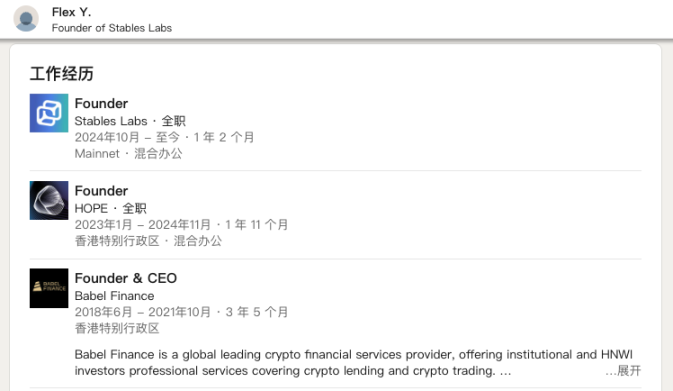
In addition, according to LinkedIn information, Flex Yang is the founder of Stables Labs, the company behind usdx.money.
Addresses directly linked to the founder were borrowing stablecoins regardless of interest rates, and frequently trading USDX for USDT on PancakeSwap before directly transferring the resulting stablecoins to exchanges. These unusual actions raised concerns among many users. Some users on X believed that USDX might have also experienced insufficient collateral during the "10.11 crash" due to ADL or other reasons.
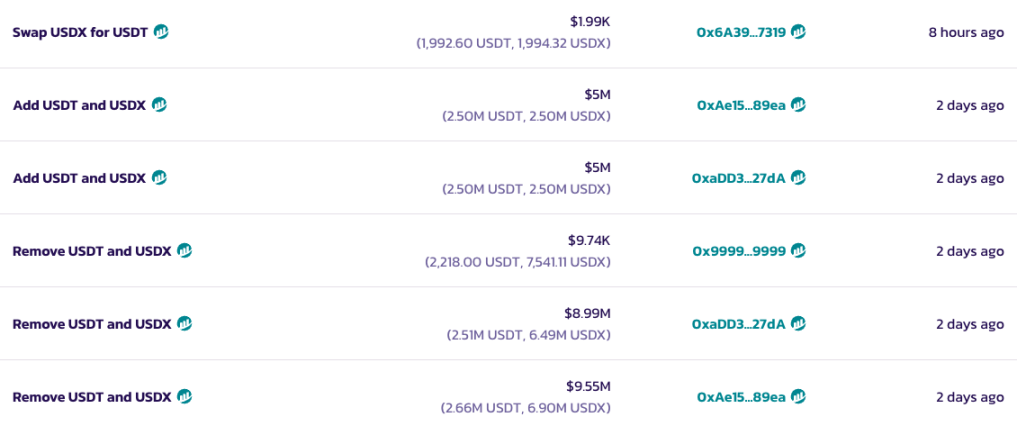
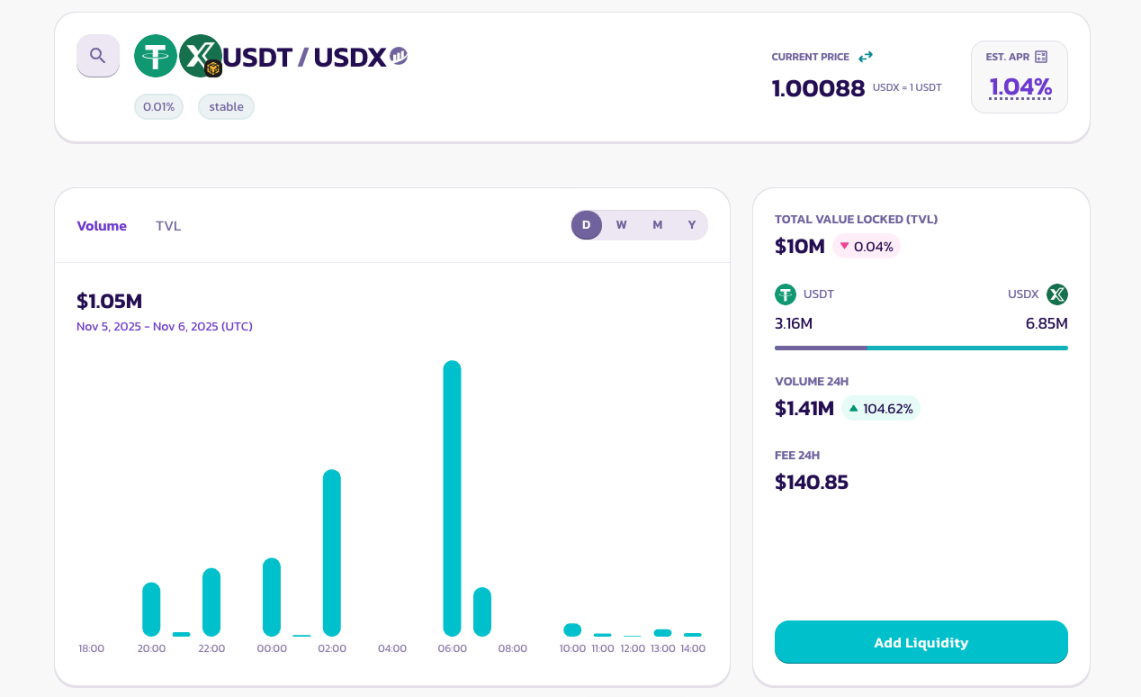
Although the Stables Labs project's multisignature address removed nearly $20 million in liquidity from PancakeSwap's stablecoin pool two days ago and then added a total of $10 million in liquidity, as of the time of writing, the pool has shown a significant liquidity shift, possibly related to multiple transactions made on PancakeSwap by an address starting at 13:44 yesterday afternoon.
Decentralized stablecoins urgently need transparency
According to USDX.Money's official website, as of 9:00 AM today, it still has over $680 million in reserve assets on exchanges, with the majority of those assets held on Binance.
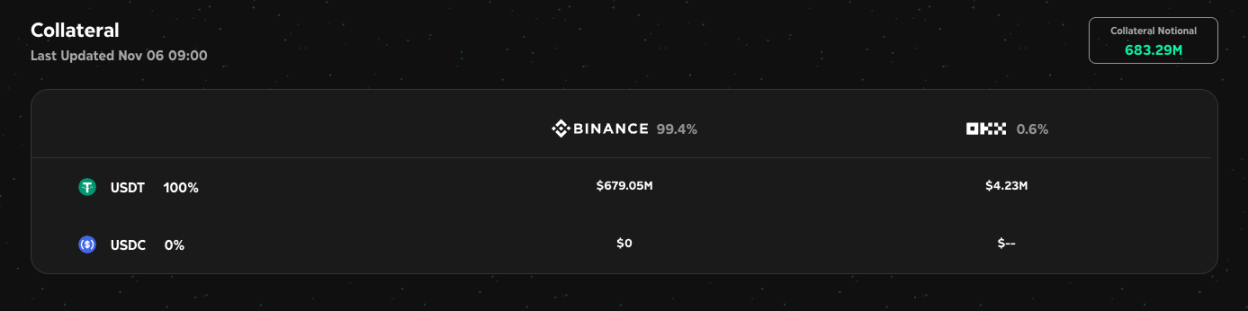
However, given the lack of transparency of centralized exchanges, users have questioned the authenticity of this asset report due to recent transactions. Currently, we still lack sufficient evidence to prove exactly what happened, but we do know that some problems have arisen, prompting an address directly linked to the founder to attempt to abscond by any means necessary. There is still no news regarding Stables Labs' planned USD0x, which is based on US Treasury bonds.
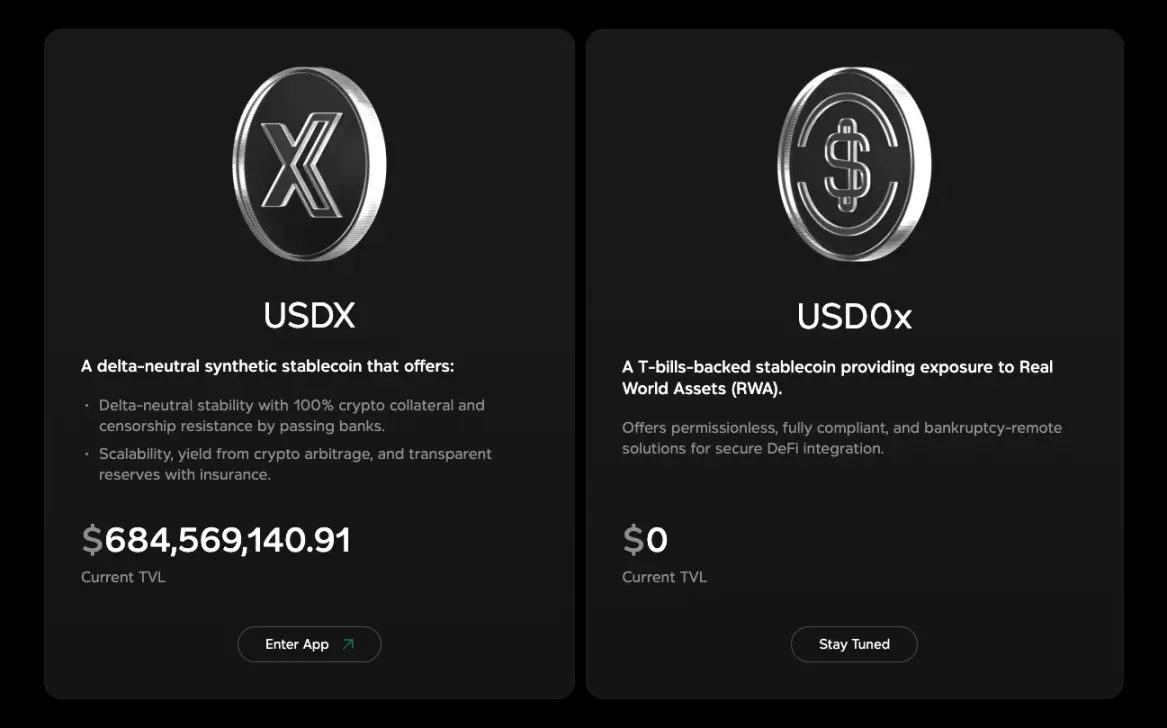
Stablecoins touting Delta neutrality have become highly sought after, starting with Ethena. However, due to the need for sufficient contract liquidity, many projects still opt for centralized exchanges. This makes the collateral assets behind these "stablecoins" a black box, with no one except the project team knowing the actual situation. Unless regular third-party audits are implemented, problems in large-scale projects could trigger a butterfly effect across the DeFi space.
Besides transparency, the current DeFi protocols are also quite complex, with many structured products becoming so complex that they may be impossible to unravel. For example, crvUSD can use a stablecoin issued with crvUSD as its underlying asset to issue crvUSD. Although this kind of nesting may essentially only be a matter of leverage, similar situations are constantly exposing the problems of DeFi risk control.
The 2022 bear market led to the bankruptcy of many highly leveraged centralized lending institutions, but at least we could look at the ledgers and figure out exactly how much they owed. Now, a serious problem with DeFi is that even if all information is publicly transparent on-chain, we seem unable to accurately calculate how many layers of leverage have been added to a most basic underlying asset.
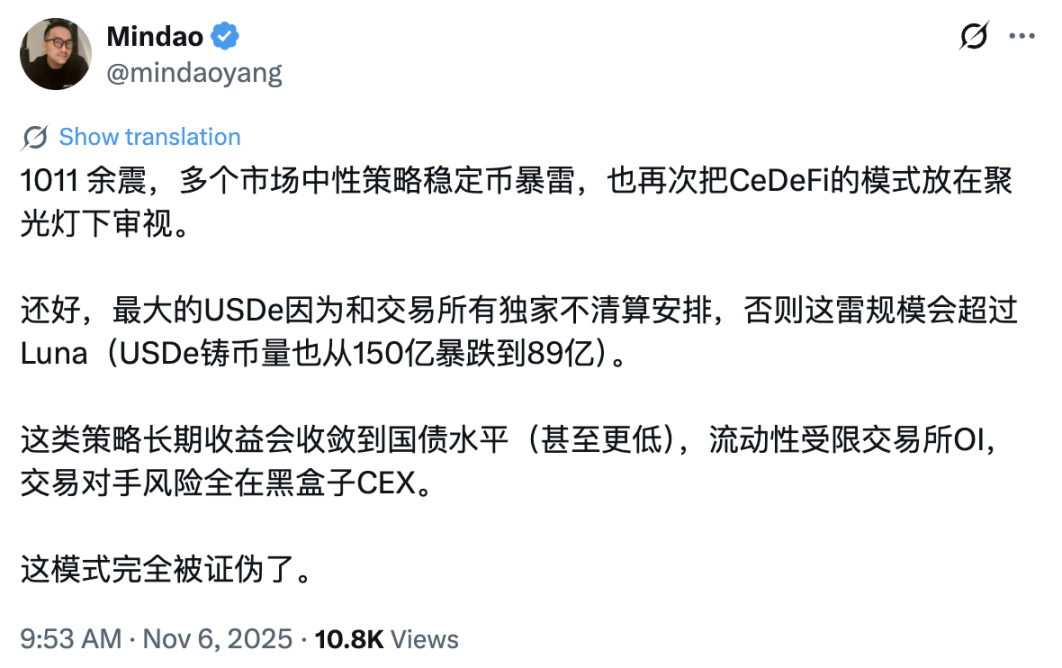
Returning to the issue of USDe-style stablecoins, X user Mingdao even frankly stated that this model may have already been proven false. After more than five years of development, we may need to re-examine, at a significant cost, how DeFi still needs to be improved.