
In criminal cases involving virtual currency, most cases require judicial authorities to determine the amount involved. However, according to the current domestic regulatory policy on virtual currency, no organization may engage in pricing services for virtual currency transactions. Although judicial authorities now entrust third-party companies to dispose of the virtual currency involved in the case in judicial practice, the disposal is mostly carried out after the court's judgment.
According to Lawyer Liu’s practical experience, it is difficult to determine the value of the virtual currency involved at the outset of a criminal case. So when the virtual currency involved appreciates or depreciates during the entire criminal procedure, how should the court ultimately determine the amount involved?

Lawyer Liu discussed this topic from three aspects: the high volatility of the value of virtual currency, the importance of determining the amount involved in criminal cases, and how to determine the amount involved in criminal cases involving virtual currency.
1. High market volatility of virtual currencies
As Lawyer Liu is typing, the price of Bitcoin has fallen to $93,000. Although analyzing the price trend of Bitcoin is essentially a financial analysis, and Lawyer Liu, as a legal worker, has only superficial financial knowledge; but from a metaphysical point of view, it seems to be convincing: during the Chinese Spring Festival, the price of the currency does not seem to be much higher.
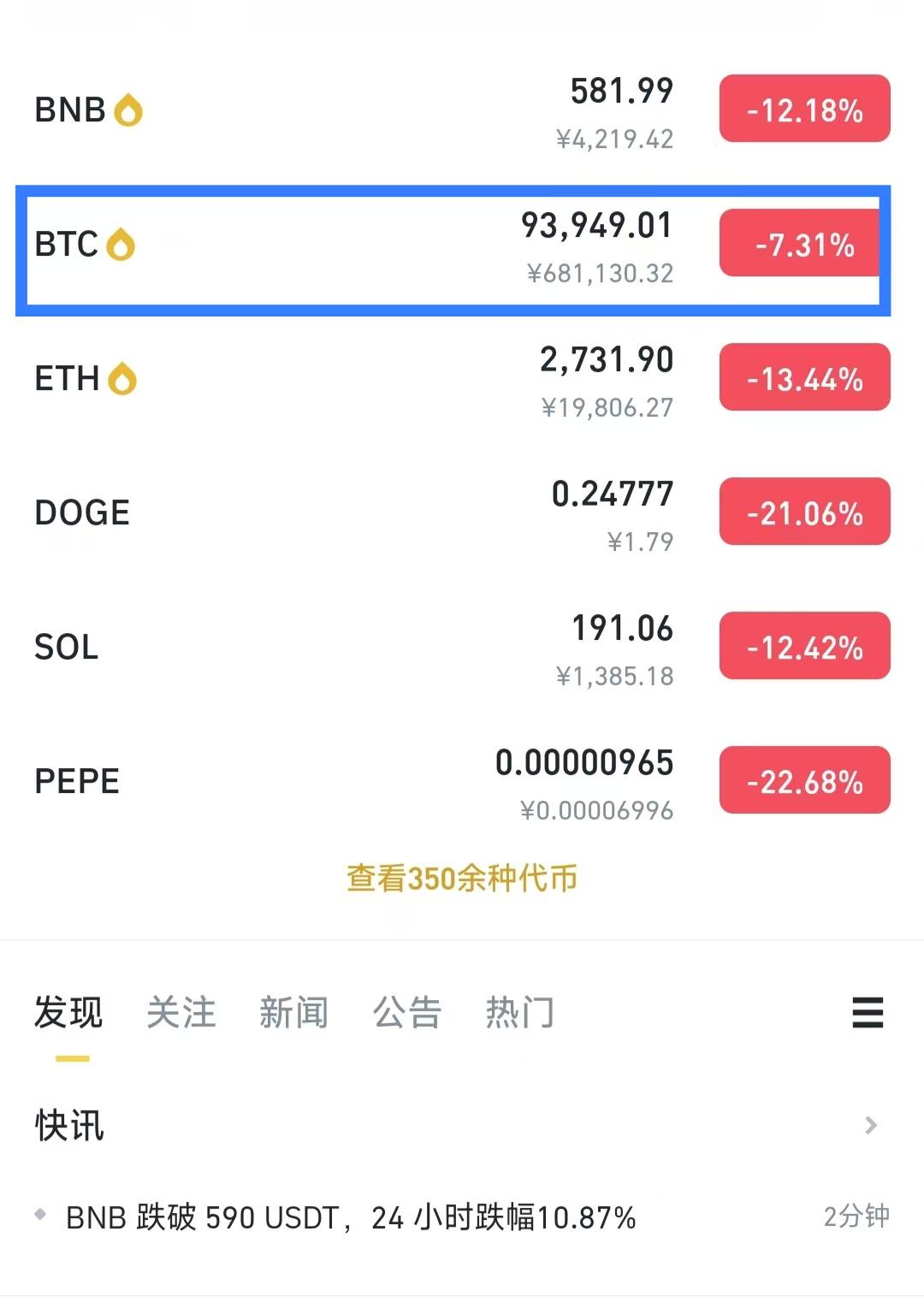
(The cryptocurrency world seemed to be all red on the sixth day of the Lunar New Year. Although it reflected some traditional festive colors, it was a scene of grief for friends in the cryptocurrency world.)
High price volatility is a basic feature of mainstream and even non-mainstream currencies (except stablecoins USDT, USDC, etc.), but friends with a little "legal sense" know that the most basic feature of the law is stability, and they hate "ADHD". The high volatility of virtual currency prices will inevitably bring considerable troubles to the implementation of the law. For example, when the public security organs file a criminal case, the seized virtual currency may be worth only 1 million yuan, but when the court makes a judgment, the price of these virtual currencies has risen to 10 million yuan; or when the criminal case is filed, the market value of the seized virtual currency is 10 million yuan, and the value of these currencies has returned to zero during the court trial (this is a common situation in the currency circle).
If it is the first situation mentioned above, except for the suspect/defendant, his defense lawyer and family members, everyone else will be happy - the victim will have guaranteed compensation, and the public security, procuratorate and courts will have more motivation to handle the case; but the second situation will be the opposite: the suspect/defendant, his defense lawyer and family members will be happy, but everyone else will be very uncomfortable, because virtual currency with zero value may mean that it no longer constitutes a criminal case.
2. Why is it important to determine the amount involved?
At present, most cases involving virtual currency are concentrated in the fields of economic crimes and crimes that disrupt social management order (such as aiding and abetting crimes). A very important factor in the constituent elements of these crimes is the amount involved. For example, under normal circumstances, if the amount involved is less than 3,000 yuan, it does not constitute a fraud crime, and if the amount involved in a pyramid scheme crime is less than 2.5 million yuan, a prison sentence of more than five years cannot be imposed (here Lawyer Liu uses the control variable method in science and engineering experiments and does not consider other circumstances).
In addition, for criminal cases, not only the criminal case filing stage of the public security department must be considered, but there are also two subsequent processes with the procuratorate and the court. The unpredictable amount involved in the case will make prosecutors and judges who pursue high-quality case handling nervous like Schrödinger's cat.
Therefore, a clear and explicit amount of money involved in the case is crucial for the filing of a criminal case, review and prosecution, trial, and even the subsequent execution.
3. What should be done if the virtual currency involved appreciates/depreciates?
Through the above analysis, we know that in judicial practice, one thing that must be done is to clarify the amount involved in virtual currency criminal cases. How to do it specifically?
At present, there are generally the following ways to determine the amount involved in criminal cases:
First, it is determined by the price determination center. According to the National Development and Reform Commission's "Price Determination Behavior Code", the price determination in criminal cases can be determined by the price determination agency (i.e. the price determination center in various places), and the specific methods include: market method, cost method, income method, expert consultation method, etc.; however, according to the "9.24 Notice" ("Notice on Further Preventing and Dealing with the Risks of Virtual Currency Transaction Speculation"), my country currently does not allow any institution to provide pricing services for virtual currency transactions, so whether the price determination center can determine the price of the virtual currency involved in the case is a big controversy. Lawyer Liu believes that the price determination center is not suitable to participate in the price determination of the virtual currency involved in the case;
The second is to refer to the market transaction price. At present, some judicial organs will refer to the virtual currency transaction price of mainstream virtual currency exchanges (with USDT as the pricing benchmark) to determine the price of the virtual currency involved, such as the theft case of Li in the criminal judgment (2020) Yue 0304 Xingchu No. 2 of the Futian District Court of Shenzhen. However, this approach has a flaw: my country currently does not allow virtual currency exchanges to provide services to mainland Chinese residents. So can judicial organs use the pricing services of foreign virtual currency exchanges as an exception? Lawyer Liu believes that of course it is not possible;
The third is to determine the price in the price appraisal opinions of third-party institutions and judicial appraisal opinions. Although third-party appraisal institutions are different from price appraisal centers with "official backgrounds", they are still essentially domestic third-party institutions that provide pricing services for virtual currencies. There is no essential difference from the pricing services provided by the price appraisal centers in the first model, and it is difficult to circumvent the prohibitive provisions of the "9.24 Notice". In particular, the price determination of the virtual currency involved in the case by the judicial appraisal institution has exceeded the scope of judicial appraisal. The judicial appraisal institution has no power and qualifications to determine the price of the virtual currency involved in the case;
Fourth, it is determined by the amount of stolen goods sold by the suspect/defendant or the amount of loss of the victim. Because my country does not prohibit virtual currency investment transactions, whether it is a criminal case that requires the return of property (such as fraud, theft), or a criminal case that requires the confiscation of property involved (such as organizing and leading pyramid selling activities, opening a casino, and illegal business operations), if the suspect/defendant has sold the virtual currency involved in the case for cash or has exchanged it for other property, then the amount of cash or the value of the exchanged property can be used as the amount involved; if it is difficult to calculate the amount of stolen goods sold by the suspect/defendant, but the amount of loss of the victim can be clearly determined, the amount of loss of the victim should be used as the basis for determining the amount involved. This is because in determining the amount involved in criminal cases, there is a basic principle, which is the principle of "the victim does not profit" (while also taking into account the principle of "when in doubt, it is beneficial to the suspect"). If the virtual currency purchased by the victim for 10,000 yuan is stolen, and the virtual currency has appreciated to 100,000 yuan when the court makes a judgment, then the court should use 10,000 yuan as the amount involved in the case; if the amount of the victim’s loss (purchase amount) cannot be ascertained, the market value of the virtual currency at the time of judgment can be considered as the amount involved in the case.

4. Final Thoughts
The large price fluctuations of virtual currencies mean that in criminal cases, all parties involved in the litigation must pay attention to the value of the virtual currencies involved. Even for stablecoins such as USDT and USDC, it cannot be taken for granted that their value can always be constant and equivalent to the US dollar. After all, no one can guarantee that Tether or other centralized institutions will not go bankrupt. Therefore, it is necessary to determine the value of the virtual currencies involved in the case in a timely, accurate, legal and compliant manner, and properly handle the appreciation or depreciation of the virtual currencies involved during the period of detention in the criminal case.
In current judicial practice, there are mature plans for the legal and compliant disposal and monetization of virtual currencies involved in criminal cases, which is crucial for protecting the legitimate rights and interests of victims, suspects/defendants in criminal cases.