1. Market background
The next wave of the blockchain world is not only about performance and throughput, but also about how to deeply integrate real-world assets with decentralized finance. Just as Ethereum laid the foundation for the era of smart contracts, the RWA track is leading the transformation from technology to assets, making the on-chain ecology and traditional wealth achieve an unprecedented intersection. Currently, according to DeFi Llama, RWA has jumped to the seventh largest category of DeFi, with a total locked value of more than 12 billion US dollars. 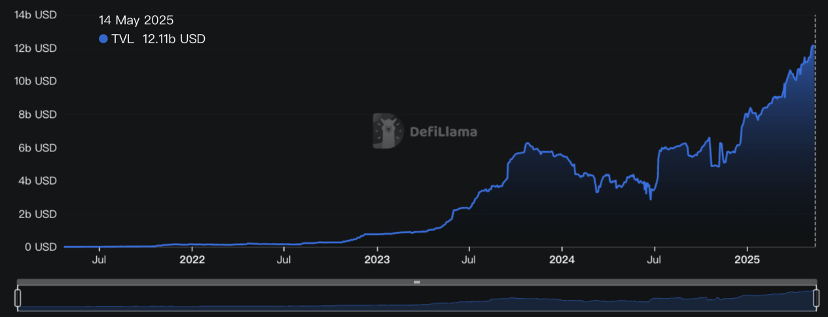
RWA track total TVL (source: defillama)
U.S. Treasury bonds are the most liquid financial assets in the world. The average daily trading volume is as high as trillions of dollars all year round. They can be bought and sold at any time with extremely low bid-ask spreads. They are backed by the U.S. government with "full faith and credit" and have never defaulted substantially, making them a model of zero default risk. Their yield is regarded as a risk-free rate by the industry, meaning that investors can obtain a benchmark rate of return without any credit risk, providing the most reliable anchor for pricing and risk management of various assets.
The RWA track has become the best paradigm for off-chain assets to move towards on-chain innovation by virtue of its unique value of connecting to the real economy and combining it with the U.S. Treasury bonds, which are the most liquid and secure in the world. Tokenized Treasury bonds not only inherit the core advantages of the "risk-free interest rate" and the highest credit endorsement of U.S. Treasury bonds, but also integrate the transparency, efficiency and composability of DeFi into sovereign bonds, creating an unprecedented investment tool. The Boston Consulting Group predicts that by 2030, the global illiquid asset tokenization market will exceed $16 trillion, accounting for 10% of global GDP, including both emerging on-chain asset tokenization and traditional ETFs, real estate investment trusts and other share models. As of May 13, 2025, the market value of tokenized Treasury bonds has soared from approximately $1.39 billion a year ago to $6.89 billion, confirming the explosive growth potential of this track.
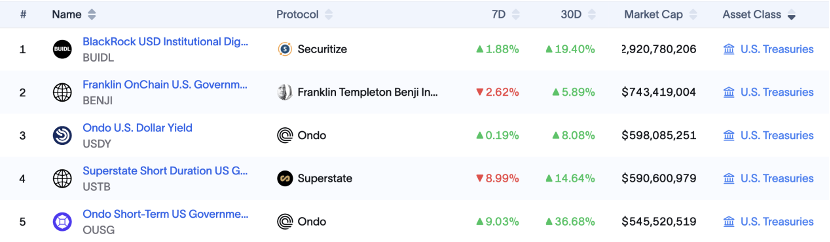 U.S. debt tokenization protocol market capitalization ranking (source: rwa.xyz)
Ondo Finance has firmly established itself at the forefront of the tokenized US Treasury market through its two flagship products, USDY and OUSG. USDY and OUSG account for two out of five of all tokenized US Treasury assets, and together contribute approximately 25% of the market share, significantly ahead of other similar products.
At the same time, Ondo Finance's overall TVL has also hit new highs. On March 3, 2025, the platform announced that its TVL exceeded US$1 billion for the first time, and now it is approaching US$1.2 billion in just two months.
Against the backdrop of falling global inflation and diverging interest rates, investors’ demand for stable and highly liquid assets continues to rise, and tokenized government bonds have emerged. What kind of innovations does Ondo Finance rely on to continue to lead? Where does its core moat come from? Looking forward to its development, how will Ondo use its unique tools and architecture to connect the last mile between the crypto world and Wall Street and achieve a truly “seamless asset channel”? Next, we will analyze in depth:
2. Overview
2.1 Project Introduction
Ondo Finance is a large, highly liquid ETF managed by asset management giants such as BlackRock and Pacific Investment Management Company (PIMCO). It has launched three tokenized U.S. Treasury and bond products, namely the U.S. Government Bond Fund (OUSG), the Short-Term Investment Grade Bond Fund (OSTB), and the High Yield Corporate Bond Fund (OHYG).
l Market share: about 20%
l Treasury bond product market value: $122,511,877
Management fee: 0.15%
2.2 Core Product Introduction
Ondo Finance's two core and best-performing products are USDY and OUSG, which are respectively aimed at stable income needs and U.S. Treasury bond investment scenarios, and constitute the basic pillars of its RWA product system.
2.2.1 USDY
USDY (US Dollar Yield Token) is an interest-bearing stablecoin issued by Ondo USDY LLC. Each USDY is backed by short-term U.S. Treasury bonds and bank demand deposits. Holders can automatically earn interest on the underlying assets without having to participate in additional contracts or pledges.
Mechanism Introduction:
l Issuance and minting: For institutions and qualified investors outside the United States, it can be minted and redeemed daily at the net value ($1 USDY≈$1 USD). There is a 40-50 day transfer lock -up period after the first minting.
l Interest rate and APY: As of April 2025, USDY’s target annualized rate of return is approximately 5.2%, which is determined by the actual income of the underlying assets (treasury bonds and deposits) and is set and announced monthly in the governance documents.
2.2.2 OUSG
OUSG (Ondo Short-Term US Government Treasuries Fund) is an on-chain transferable fund that provides short-term US Treasury exposure to holders through custody in BlackRock USD Institutional Digital Liquidity Fund (BUIDL) and direct bond purchases, and updates the net asset value (NAV) daily to reflect the latest asset performance and fee deductions.
-Mechanism composition
l Underlying assets: Mainly invests in short-term US Treasury bonds in BlackRock USD Institutional Digital Liquidity Fund (BUIDL), as well as high-grade Treasury bonds and GSE funds from institutions such as Franklin Templeton, WisdomTree, and Wellington Management.
l Fund structure: Ondo Capital Management is responsible for fund management, and holders obtain corresponding shares by minting/redeeming OUSG tokens; after the end of each business day, the on-chain price Oracle is updated according to the latest NAV.
l Price Release: On-chain Price Oracle is updated by Ondo, which calculates the daily price of each OUSG token by dividing NAV by the total token supply and publishes it on the chain, supporting 24/7 instant investment and redemption
- Cost allocation
l Management Fee: 0.15% per annum, charged by Ondo Capital Management to cover platform operation and management costs.
l Performance Fee: 0%, which means no additional share regardless of the profit.
l Other fees: There are no subscription fees, redemption fees or hidden fees; all fees are deducted from the daily NAV, and holders do not need to pay redemption fees separately.
l Third-party service fees: The management fee of the underlying BUIDL fund itself (≈0.10%–0.15%) is already included in the above management fee and NAV, and there is no additional charge.
-APY
Formula:

“End NAV” and “Start NAV” are the fund’s net value at the beginning and end of the 30-day period.
l Update rules: Updated once every working day (except holidays), based on the annualized change in net income and net worth over the past 30 days (and 7 days), reflecting historical earnings performance but not future performance
3. Key mechanism: building a bridge to the “last mile”
3.1.Flux Finance
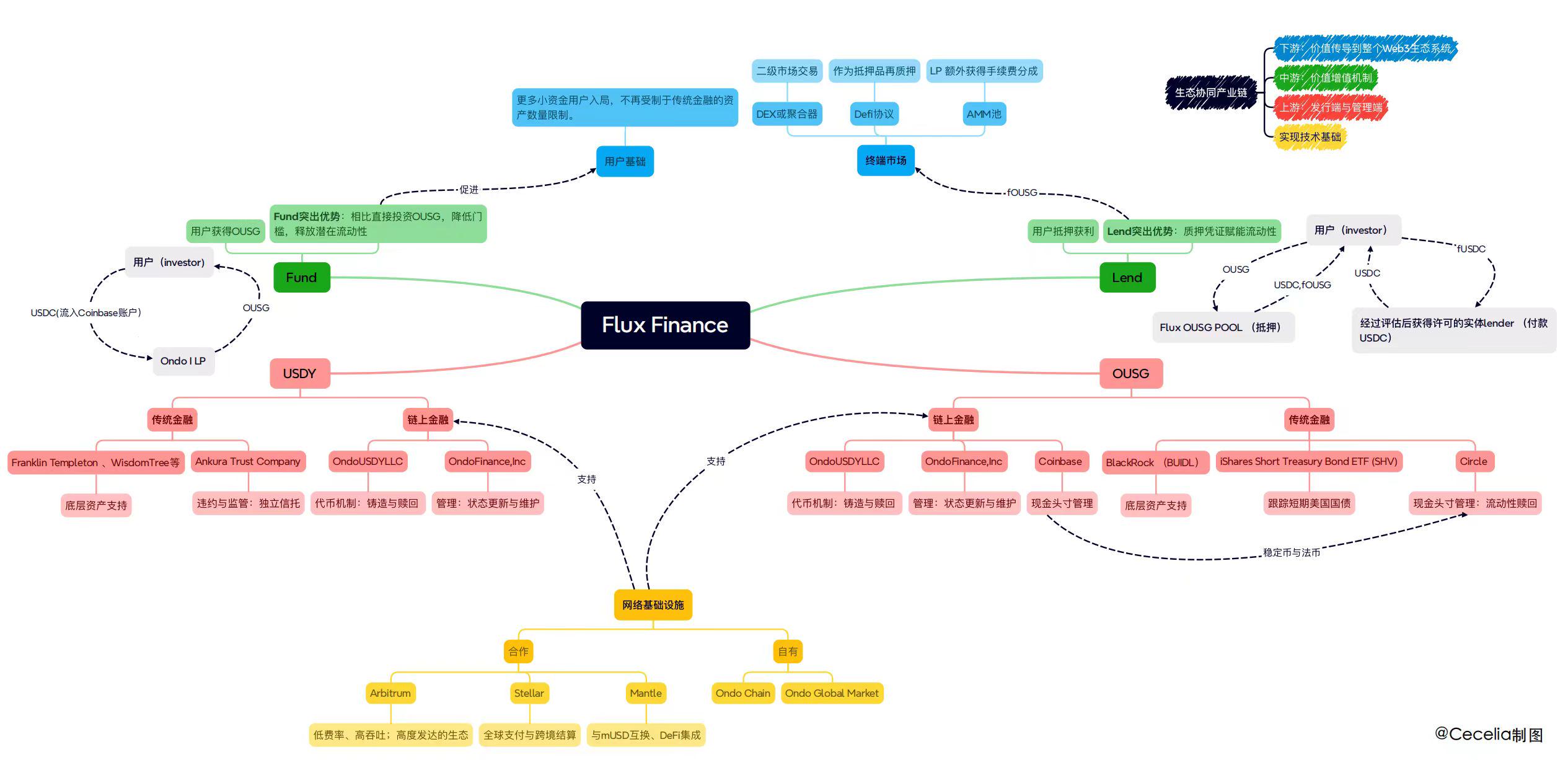 Flux Finance builds a collaborative transmission path for the industrial chain (source: Cecelia)
3.1.1 Technical foundation
With the help of high-throughput, low-cost Layer2 networks such as Arbitrum and Mantle, as well as the cross-border settlement capabilities of Stellar, Flux seamlessly introduces traditional asset liquidity into a multi-chain environment, promotes stablecoins (USDC, fUSDC) and RWA tokens (OUSG, fOUSG) to conduct secondary market transactions in DEX or aggregators or provide liquidity in AMM pools, and creates additional income for LPs from the sharing of transaction fees.
At the same time, Ondo Finance relies on its own Ondo Chain to provide a compliance verification network that natively supports RWA; Ondo Global Markets builds on-chain custody and cross-chain trading platforms based on it, together forming an end-to-end on-chain financial infrastructure.
3.1.2 Upstream: Issuing and Management
l Traditional finance: Its mechanism starts with the compliant custody of high-quality traditional assets such as U.S. short-term Treasury bonds. Institutions such as BlackRock, Franklin Templeton, and WisdomTree provide underlying income support through the iShares Short Treasury Bond ETF (SHV), and independent trust institutions such as Ankura Trust Company are responsible for defaults and supervision.
l On-chain finance: After traditional financial funds flow into the accounts of centralized institutions such as Coinbase in the form of USDC, they are transferred to Ondo USDY LLC, which brings the risk-free interest rate of real-world assets onto the chain by minting two tokenized income certificates, USDY and OUSG.
3.1.3 Midstream: Value-added Mechanism
l Fund: Users can deposit stablecoins on the Ondo Finance platform to obtain USDY (direct income type) or exchange OUSG with a lower threshold through Flux Fund. The latter releases a large amount of potential liquidity through the "Fund" link.
l Lend: In the "Lend" link of Flux, OUSG becomes the only high-quality collateral that can be pledged. Licensed on-chain lending agreements or institutional borrowers lend USDC to platform users, who then pledge OUSG to the Flux OUSG Pool, thereby achieving refinancing and leverage of income certificates. This process not only enables holders to obtain treasury bond returns without active management, but also lowers the participation threshold for small and medium-sized capital users, allowing more retail investors to participate in the RWA market with a low threshold.
Flux Finance ensures that the risk of collateral price fluctuations is controllable and maintains the security and efficiency of the entire ecosystem through continuous monitoring of the OUSG collateral pool and automatic liquidation mechanism.
3.1.4 Downstream: Value Transmission Mechanism
The RWA liquidity released by Flux transmits value to the entire Web3 ecosystem through on-chain lending, decentralized transactions and re-staking, and provides stable and low-cost capital for emerging tracks such as DeFi protocols, smart contract applications, AI+blockchain, and DePIN.
l At the same time, Flux is constantly optimizing its governance and compliance architecture, introducing multi-signature custody, off-chain audits, and on-chain contract upgrade mechanisms to adapt to the ever-changing regulatory environment and market demands.
Flux Finance closely combines the "hard currency" of U.S. Treasury bonds with the efficient on-chain market, which not only realizes the value exchange of on-chain and off-chain assets, but also injects unprecedented liquidity into the crypto world. In this closed ecological loop, the Flux mechanism fulfills the promise of "coexistence of stability and efficiency" of the RWA track, and opens up a new paradigm for the deep integration of traditional finance and Web3.
3.2 Ondo Chain
Ondo Chain is a blockchain network launched by Ondo Finance, designed for real-world assets and positioned as the underlying infrastructure serving the institutional financial market. It is between traditional permissioned chains and open public chains, with the compatibility and connectivity of open blockchains, while meeting the compliance and risk management needs of institutions.
Ondo Chain itself consists of several core components .
l Native support for real assets: Provides on-chain mapping services for assets such as government bonds and money market funds from the bottom up.
l “Permission model” on the verification mechanism: Unlike the public chain where anyone can participate, only audited nodes can verify transactions, thus preventing destructive behaviors such as MEV to a certain extent.
Ondo’s self-developed cross-chain bridge tool, Ondo Bridge: supports native communication with chains such as Ethereum, Arbitrum, and Solana, reducing barriers to asset mobility.
l Mandatory KYC process: ensure the identity compliance of participating users.
Ondo Chain realizes the mapping and interoperability between on-chain assets and traditional financial products by natively supporting RWA and integrating compliance mechanisms (license verification, KYC process, etc.), thus building a bridge between blockchain and traditional financial systems.
Potential defects:
l Although the permission verification mechanism improves security, it also increases the centralization of the network. The verification rights are in the hands of a limited number of large capital entities, and the freedom of mechanism innovation will be restricted.
l Security still needs to be strengthened. Although Ondo Chain adopts a variety of security mechanisms, such as licensed verifiers and cross-chain bridges, the security of the verification layer and the middle layer still needs to be further verified. Considering the huge amount of funds, the consequences of any security incident will be disastrous.
3.3 Ondo Global Markets
It is a tokenization platform launched by Ondo Finance, which aims to put traditional financial assets such as stocks, bonds and ETFs on the chain, providing global investors with round-the-clock on-chain trading channels. Its core innovation lies in the tokenization of traditional financial assets through blockchain technology, making them have liquidity and transferability similar to stablecoins, thereby breaking down the barriers between on-chain finance and traditional finance.
Ondo GM is implemented by several key parts :
Ondo Chain: As the underlying infrastructure, it provides an environment that combines the openness of public blockchains with the compliance of permissioned chains, supporting the issuance, trading and management of tokenized assets.
Ondo Bridge: The platform enables asset transfers with multiple blockchain networks through the integrated Ondo Bridge, enhancing cross-chain interoperability.
l Collaborate with the traditional financial institution ecosystem: ensure the secure custody and compliance of underlying assets.
Advantages:
l For user investors, Ondo GM provides unprecedented convenience.
Different from the asset custody method of traditional financial institutions, Ondo GM combines the scattered funds of retail investors into a unified mortgage pool across institutions and companies, releasing the potential liquidity of retail investors with small funds. This allows ordinary investors to participate in financial operations such as margin trading, derivatives, and perpetual options, which were originally only available to large institutions, through Ondo GM.
l For institutions, Ondo GM takes advantage of blockchain smart contracts to simplify traditional financial processes.
Subscription and redemption operations can be completed directly through interaction with the wallet address and mapped to real assets, reducing intermediate links and improving efficiency; in addition, the blockchain mechanism can also automatically handle default risks, simplify processes, improve efficiency, and enhance the security and reliability of the system.
Potential defects:
Ondo GM is still in its infancy and has not yet achieved full integration with traditional finance. As integration deepens, mechanisms in the cryptocurrency field, such as re-pledge and flash loans, may have a huge impact on traditional assets with insufficient liquidity depth. While promoting financial innovation, Ondo should also weigh risks and benefits to ensure the stability of the system.
4. Mechanism comparison
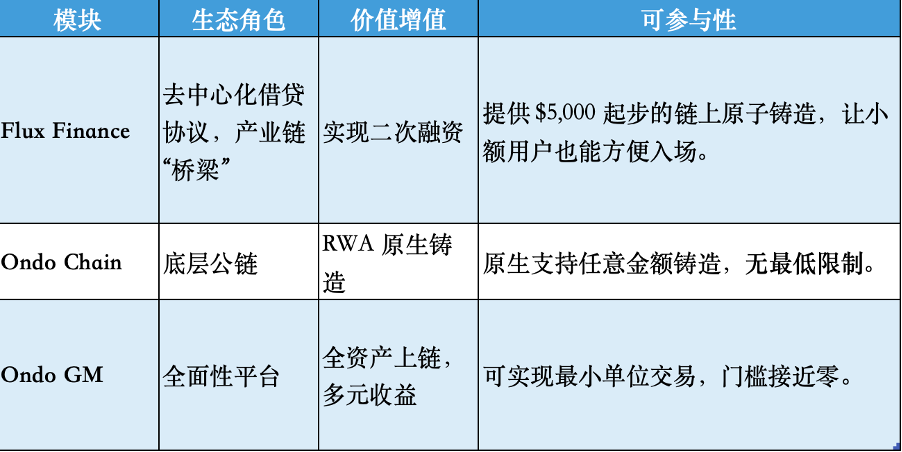
Mechanism comparison (source: Cecelia)
Ondo Finance links traditional finance and the crypto world through three key mechanisms, achieving the on-chainization and complete release of liquidity of real assets.
Ondo Chain provides native support and compliance verification for high-grade assets such as U.S. Treasury bonds and money funds. The licensed nodes and KYC process ensure that every on-chain transaction is backed by credible real assets.
Ondo Global Markets aggregates the scattered funds of retail investors into a unified collateral pool across institutions and companies. Smart contracts automatically complete subscription, redemption and derivative transactions, allowing small investors to participate in high-end strategies such as margin trading and perpetual options that are traditionally monopolized by large institutions.
l The OUSG/USDY fToken mechanism on Flux Finance allows users to not only redeem the underlying assets at any time after staking short-term treasury bond funds or stablecoins, but also use the fTokens representing shares for lending, market making or secondary trading. The interest paid by the borrower is fully returned to the supporters, realizing a closed loop of "depositing means earning interest, borrowing means lending".
5. Summary
The above mechanisms work together to make Ondo Finance the central hub for the on-chainization of real assets. Whether it is institutional docking, compliant custody, or retail participation and derivative innovation, they are all efficiently completed on the same platform, truly opening up the entrance to traditional finance and the exit to the crypto market. Ondo Finance is setting off an unprecedented liquidity innovation at the intersection of traditional finance and the on-chain world. It will deeply integrate the compliant RWA bottom layer, cross-institutional capital aggregation and the instant interest-bearing fToken ecosystem, quickly release market potential, and continue to attract a new round of hot money inflows.
In the future, with the continuous optimization of these mechanisms, Ondo Finance will open up not only a 16 trillion blue ocean, but also an incremental space beyond imagination in the process of digitalization of real assets. As tough and high-spirited as the horns raised by the copper bull on Wall Street, the rise and success of Ondo Finance is guiding the RWA market, which is ready to take off, to usher in the next wave of explosion.
6. Summary of highlights
In just a few years, Ondo Finance has successfully built a bridge between traditional finance and the on-chain world with its forward-looking design concept and multi-level product architecture. It not only opens up the mapping and circulation path of RWA on the blockchain, but also releases the on-chain potential of high-quality assets such as government bonds on a global scale, and promotes the evolution of on-chain finance towards mainstream and institutionalization. We have come to the following key points:
1. RWA empowers the on-chain ecosystem : Through products such as USDY and OUSG, Ondo Finance tokenizes the world's most liquid and secure U.S. Treasury bonds, introduces a "risk-free interest rate" benchmark for DeFi, and quickly promotes the RWA sector to become the seventh largest category of DeFi.
2. Three major mechanisms work together to release liquidity : Ondo Chain's native compliance bottom layer, Ondo Global Markets' cross-institutional funding pool, and Flux platform's fToken lending closed loop, working together to open up the "last mile" between traditional finance and the crypto world.
3. Small users and institutions in parallel : Breaking down high-threshold barriers, small funds can also participate in high-end strategies such as margin trading, perpetual options, etc. that were originally limited to large institutions through a unified mortgage pool, while meeting institutional-level compliance and security requirements.
4. Instant, all-weather trading and settlement : Combining licensed nodes, KYC processes and native cross-chain bridges, it supports 24/7 minting, redemption and cross-chain asset transfers to build an efficient and transparent on-chain financial infrastructure.
Pioneer of the 16 trillion blue ocean : With the deep integration of traditional financial assets and on-chain innovation, Ondo Finance is attracting a new round of hot money, not only seizing the tokenization market expected to reach 16 trillion US dollars by 2030, but also paving unlimited incremental space for the digitization of real assets.