
Author: Stella L ( stella@footprint.network )
Data source: Footprint Analytics public chain research page
In February 2025, the blockchain market experienced a significant market adjustment, posing challenges to both established networks and emerging public chains. Bitcoin performed robustly and its dominance further increased, while most chains, including Solana, Avalanche, and Ethereum, fell sharply. Despite this, development activities in the public chain field have not slowed down: the launch of the Berachain mainnet, the upgrade of the Base infrastructure, and the launch of Uniswap's Layer 2 have become highlights of the month.
Market Overview
In February, the market saw a significant correction: Bitcoin fell from $98,768 to $84,177, a drop of 14.8%, while Ethereum fell even more, from $3,065 to $2,216, a drop of 27.7%. In the last week of the month, as security panic spread, selling pressure intensified further.
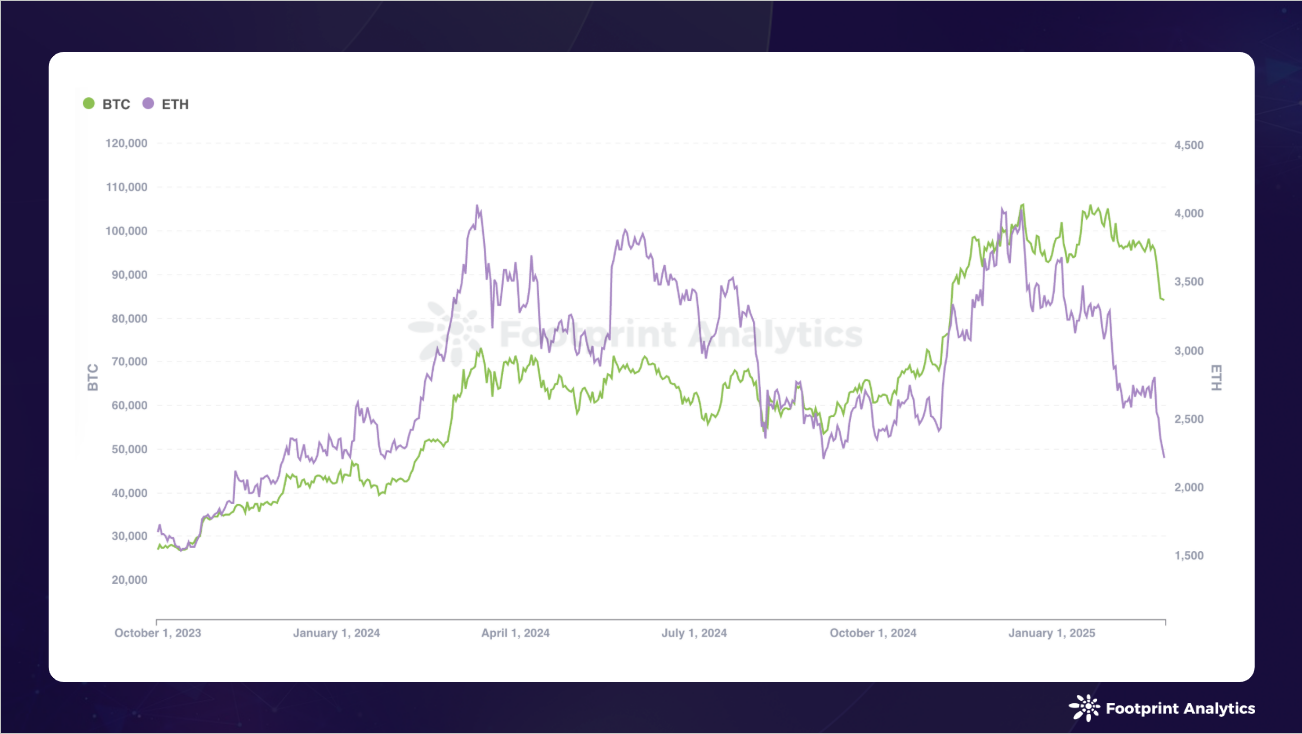
The pullback follows a bull run in January, but market signals are mixed as investors swing between optimism and concerns over security breaches. Market sentiment has deteriorated and risk appetite has declined, especially in speculative areas such as Memecoin. Globally, North American markets are cautiously optimistic due to policy changes, while Asia-Pacific markets are feeling the impact of hacker attacks more strongly.
Regulatory and policy changes
The Trump administration's cryptocurrency executive order focuses on self-custody and stablecoin development, providing the industry with rare policy clarity. However, the ByBit hack on February 21, which resulted in a loss of $1.5 billion, the largest loss in cryptocurrency history, triggered new security concerns and market sentiment shifted rapidly. At the same time, the SEC's attitude softened, suspending investigations into companies such as Coinbase, Binance, and Uniswap, and abandoning its appeal against the "dealer rule." The bipartisan-backed GENIUS Act (National Innovation Guidance and Establishment of Stablecoins in the United States Act) further strengthened the regulatory framework for stablecoins, showing a friendly trend in the U.S. regulatory environment.
Investor behavior reflects this turmoil. The Memecoin craze, which was driven by the token associated with Argentine President Milley, quickly cooled down due to the related negative news, and its valuation plummeted and trading volume shrank sharply. This shift suggests that the market is retreating from high-risk assets.
Layer 1
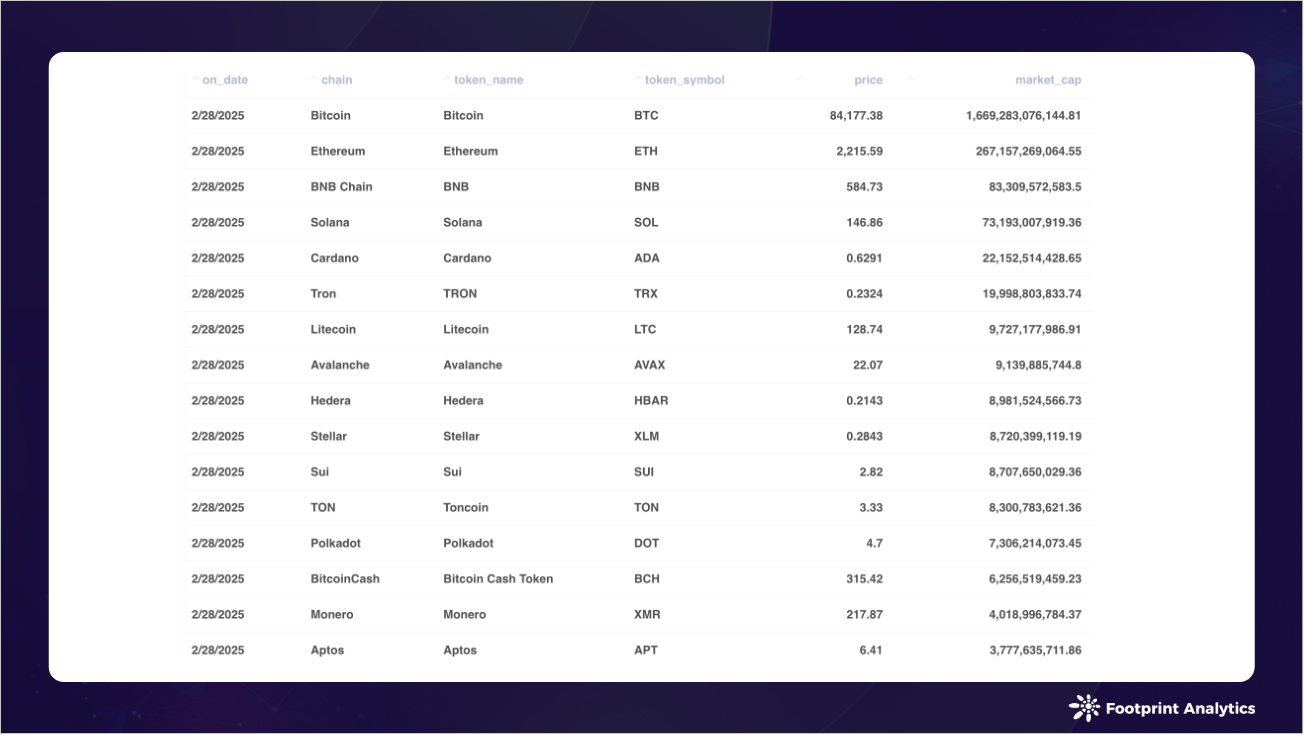
Layer 1 public chains were generally under pressure, with the total market value falling by 20.8% to $2.3 trillion. Bitcoin's dominance rose from 71.3% to 74.2%, while Ethereum's share shrank from 14.0% to 11.9%. BNB 's share rose slightly to 3.7%, but Solana's share fell from 4.0% to 3.3% after its price plunged 36.3%.
Litecoin bucked the trend, rising 1.0% to $128.7, while Solana (-36.3%), Avalanche (-35.7%) and others lagged behind.
DeFi TVL fell 20.0% to $82.9 billion, with Ethereum at $44.9 billion (down 21.7%) and Solana at $8.6 billion (down 34.1%).
Berachain has emerged as a dark horse, quickly jumping to sixth place with a TVL of $3.2 billion after the mainnet launch on February 6. The chain has issued 80 million BERA tokens and adopts a "liquidity proof" model - an innovative staking method that converts liquidity into network security. Following the $100 million financing in 2024, this month's airdrops and governance rights have stimulated market enthusiasm. Unlike traditional proof of stake, this approach may redefine how public chains balance growth and stability, making Berachain a project worth paying attention to.

Solana's Memecoin craze has clearly cooled. High-profile failures, such as the token associated with Argentinian President Milley, have hurt market confidence, causing a sharp drop in trading volume on DEX platforms such as Raydium. While Memecoin is not going away and can be thought of as a digital collectible card, its peak of enthusiasm may have passed, and traders are starting to pay more attention to fundamentals rather than hype.
Bitcoin Layer 2 & Sidechains
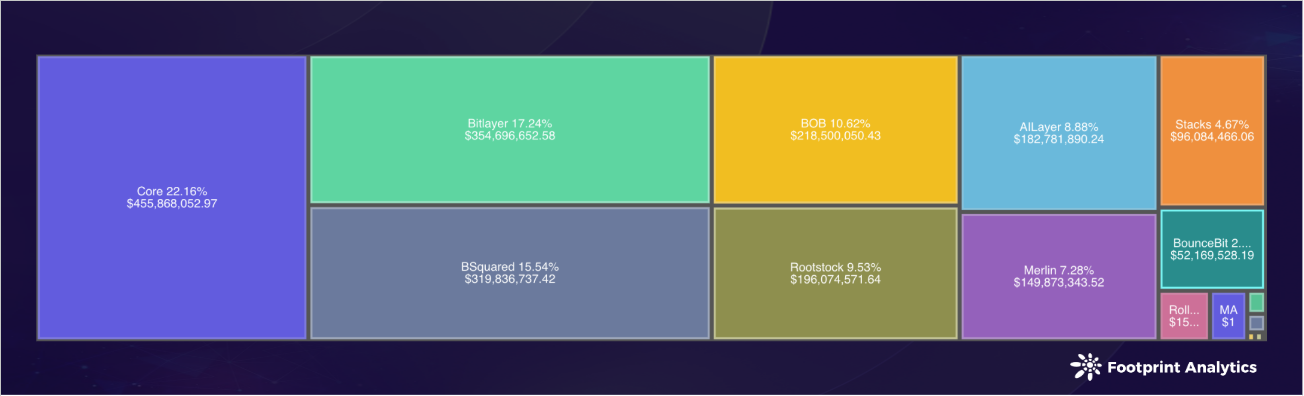
Bitcoin L2 and sidechains TVL shrank 24.5% from $2.7 billion to $2.1 billion. Core led with $460 million TVL (down 42.0%), followed by Bitlayer ($350 million) and BSquared ($320 million). BOB was the standout, down only 7.9% to $220 million.
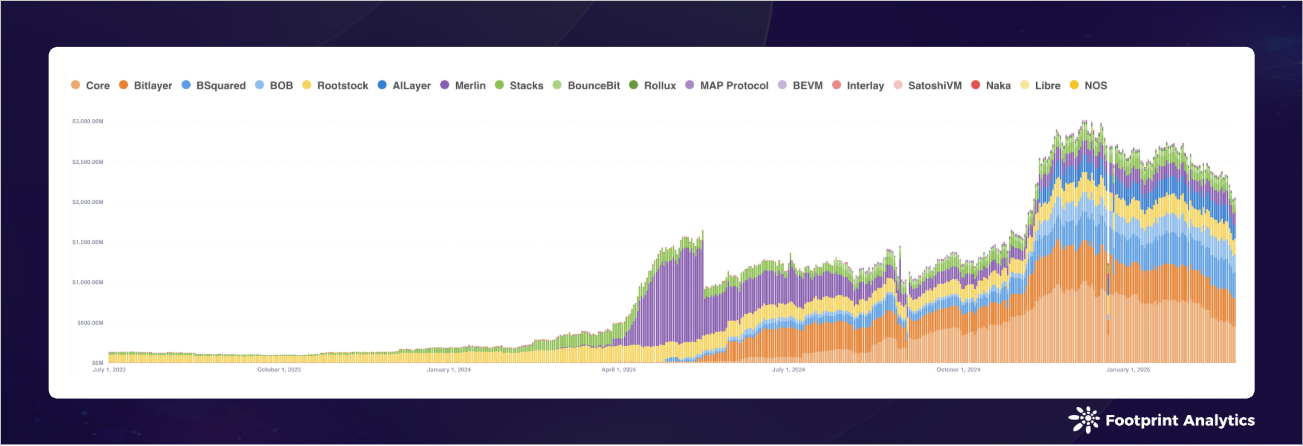
Among medium-sized platforms, Merlin performed better, with a slight decrease of 9.3% in TVL to $150 million. Small platforms faced greater pressure, with SatoshiVM falling 31.5%, MAP Protocol falling 29.6%, and Interlay falling 27.4%.
The downturn in the space is consistent with Stacks co-founder Muneeb Ali’s view at Consensus 2025: “More than two-thirds of existing Bitcoin Layer 2 projects will be gone within three years as initial enthusiasm fades.” He predicted that the market will face severe challenges, and the industry downturn in February suggests that consolidation may have already begun. Looking ahead, platforms that can prove actual utility may have more staying power than projects that are sustained by momentum alone.
Ethereum Layer 2
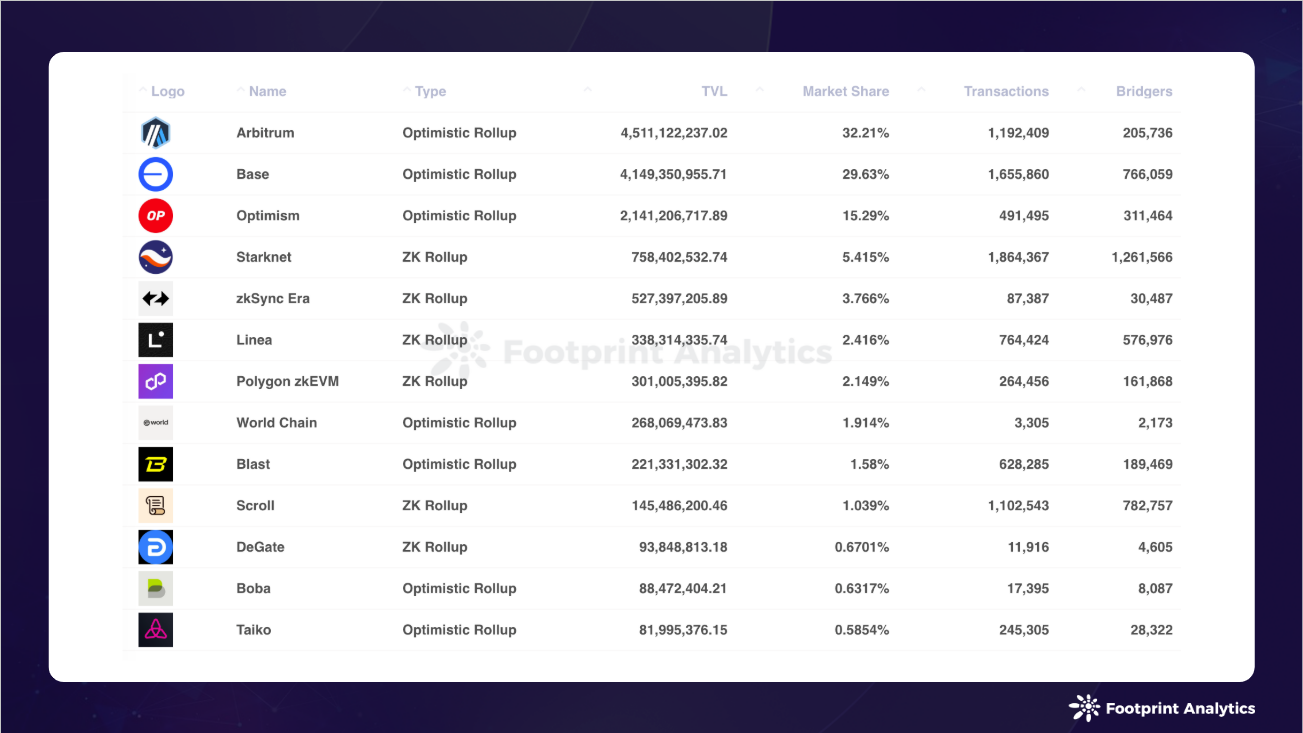
Ethereum L2 TVL fell 23.4% to $14 billion. Arbitrum maintained its lead with a TVL of $4.5 billion (down 33.4%), and Base climbed to second place with a TVL of $4.2 billion (down 10.6%), pushing Optimism ($2.1 billion) to third. Polygon zkEVM soared 104.1% to $300 million, becoming a rare highlight this month.
Base launched Flashblocks (faster transaction confirmation), Appchains (customized L3) and smart wallet subaccounts to maintain user stickiness. Unichain launched its mainnet on February 16, after its testnet had processed 95 million transactions in total, positioning itself as a game changer in scalability performance, with heavyweights such as Circle joining in. Starknet 's Nums application chain, as a Layer 3 gaming innovation, demonstrates the future of modular design.

Meanwhile, although Sonic EVM is not Ethereum Layer 2, its February 27 Mobius mainnet launch as Solana's first SVM chain extension has attracted a lot of attention, achieved 10,000 TPS, and brought $47.6 million in funding to Aave in a few days. These moves show that Layer 2 projects are doubling down on technology rather than just gimmicks.
Vitalik Buterin made comments on February 19, highlighting the need for Ethereum to clearly position itself in the growing competition. He pushed for Layer 2 to take the lead in scalability (such as 17x transaction improvement) and interoperability, noting that they have evolved from "advanced multi-signature" to a strong network. Although he did not comment directly on Sonic EVM, its EVM compatibility and speed echoed his vision of seamless connectivity for the "Ethereum universe." However, he also expressed dissatisfaction with the casino-like tendencies in the ecosystem, calling for a focus on real value rather than speculative bubbles.
Financing
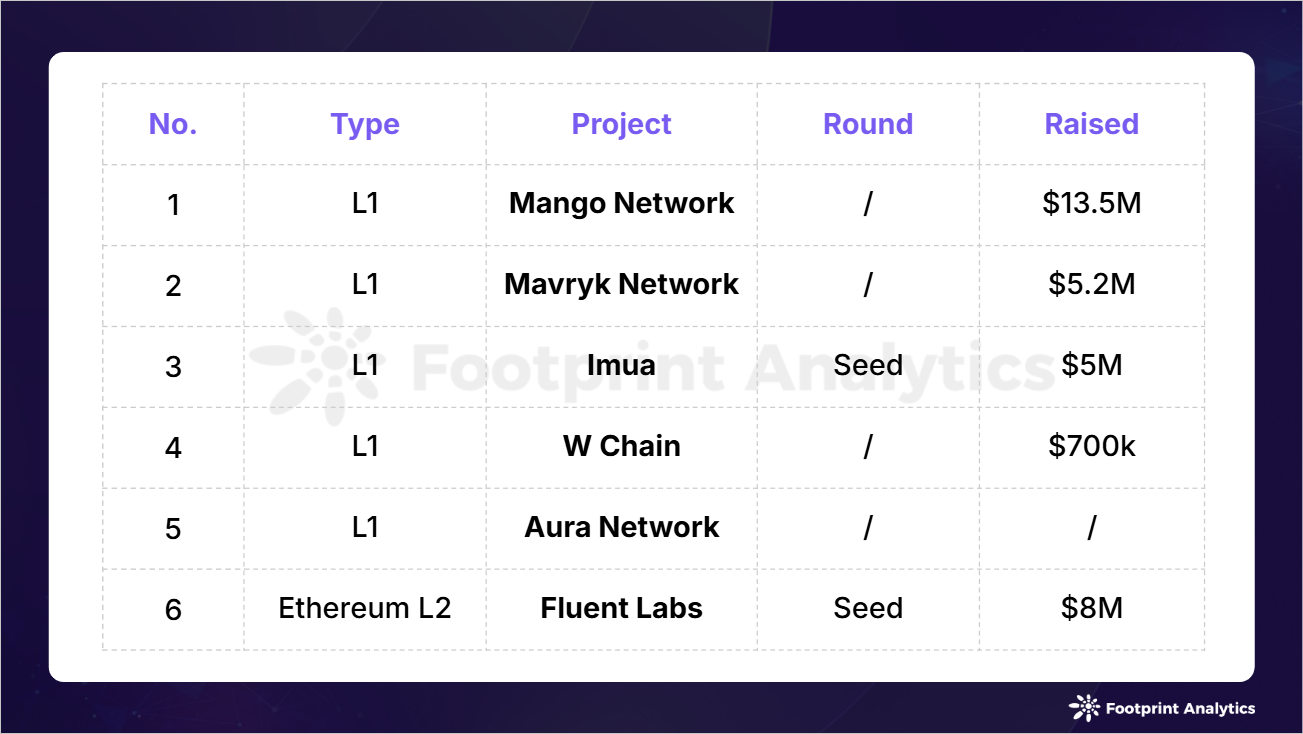
Fundraising activity slowed, with six deals totaling $32.4 million in February. Mango Network raised $13.5 million for its EVM-MoveVM hybrid chain, scheduled to launch in Q1 2025. Fluent Labs received $8 million in funding to develop a multi-virtual machine Layer 2 that connects Ethereum and Solana.
The data for this report comes from Footprint Analytics’ public chain research page , which provides an easy-to-use dashboard that contains the most critical statistics and indicators for understanding the public chain field and is updated in real time.
The content of this article is only for industry research and communication purposes and does not constitute any investment advice. The market is risky and investment should be cautious.
About Footprint Analytics
Footprint Analytics is a comprehensive blockchain data analytics platform that simplifies complex analytics for businesses and projects in the Web3 ecosystem. It provides customized solutions that eliminate the need for extensive expertise and infrastructure maintenance. The platform provides long-term growth tools designed to help gradually build and manage communities, emphasizing sustainable growth and user loyalty. By combining powerful analytical tools and community management tools, Footprint Analytics enables projects to effectively use blockchain data for decision-making and growth strategies, covering various fields such as GameFi, NFT and DeFi.