

Source: Talking about Li and other things
In the past two days, Bitcoin has continued to break new highs, reaching a maximum of $123,000. According to the previous plan, yesterday (July 14), another 10% of the position was sold. Regarding our own fixed investment plan in this cycle, previous articles have also shared details:
In 2022, we formulated a 20-month BTC fixed investment plan, insisting on buying BTC on a monthly basis, and finally ended (completed) this round of fixed investment plan in January 2024, with the average purchase cost of newly added Bitcoin holdings at around $25,000. At the same time, based on our expectations and goals for this round of bull market at the time (expected BTC to reach $100,000-120,000, and the goal was to achieve a 3-5 times return on the overall position), we also customized two sets of selling plans, namely Plan A and Plan B shared in the previous article (Plan A was later implemented).
So far, I have executed three selling operations as planned, on December 5, 2024 , May 22, 2025 , and yesterday (July 14, 2025). According to the original target plan, the established plan has been basically completed. But if BTC can continue to rise in the next six months, I will consider selling up to 20% of the position, and the remaining 50% of the biscuits will be kept in the cold wallet as long-term real estate.
Of course, the above is just a review of my personal holdings. Although it is just a summary of a few simple sentences, looking back, it seems to represent my stubbornness or persistence over the past few years.
1. The bull market is a great retreat
Some people say that the bull market is a great retreat, which actually makes a lot of sense.
As BTC continues to break new highs in this bull market, reaching more than $120,000, if the historical cycle rules are still valid, then it is not ruled out that Bitcoin may enter a "consolidation or periodic bear market" next. Of course, what I am talking about here is mainly the periodicity. In fact, I have always been a die-hard bull of Bitcoin in the long run.
Since US President Trump officially signed the One Big Beautiful Bill on July 3, Bitcoin has risen by more than $15,000, especially in recent days, setting new historical highs almost every day. This similar feeling seems to have been experienced last year (2024). If I remember correctly, it should be around March and November last year.
Some people may say: This time it feels different. Some people may say: The historical cycle of the crypto market has been broken.
But reason can still tell us that Bitcoin’s recent performance is still worthy of our vigilance, and we need to at least be seriously alert to the potential risks in the next few weeks (for example, possibly within 5-6 weeks).
Here we might as well expand our thinking through the DXY (US Dollar Index) indicator:
Normally, the trend of risky assets is inversely proportional to DXY. In most cases, if the US dollar is weak, the price of high-risk assets (such as gold and Bitcoin) will be strong, and vice versa. Although we have always been optimistic about Bitcoin, we must also admit that gold is still the first choice for safe-haven funds, not Bitcoin.
Let’s first look at the comparison between gold and DXY, as shown in the figure below.
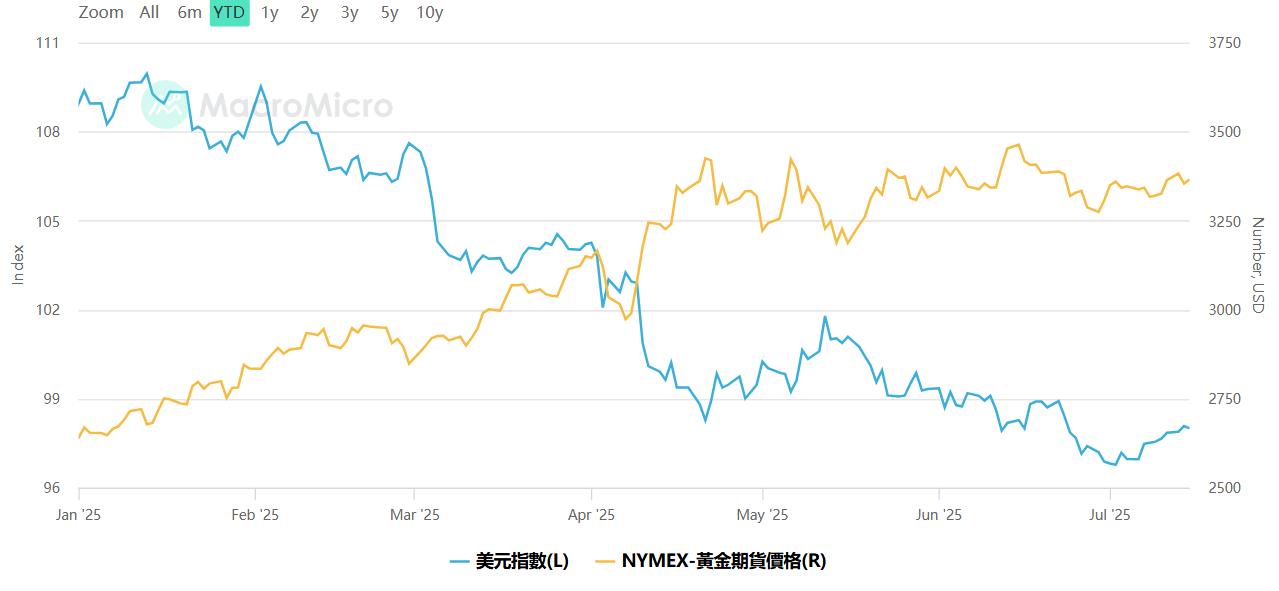
We only look at the macro-trend. As can be seen from the above chart, as DXY fell overall at the beginning of the year, the price of gold continued to rise, and continued to rise until around April, and then entered a macro-volatile market.
As gold consolidates at a high level, if DXY continues to fall or hover in a low range, then with the help of some macro policy changes, it is not ruled out that some funds may choose to enter Bitcoin for risk hedging.
We continue to compare the Bitcoin & DXY indicators and find some clues, as shown in the figure below.
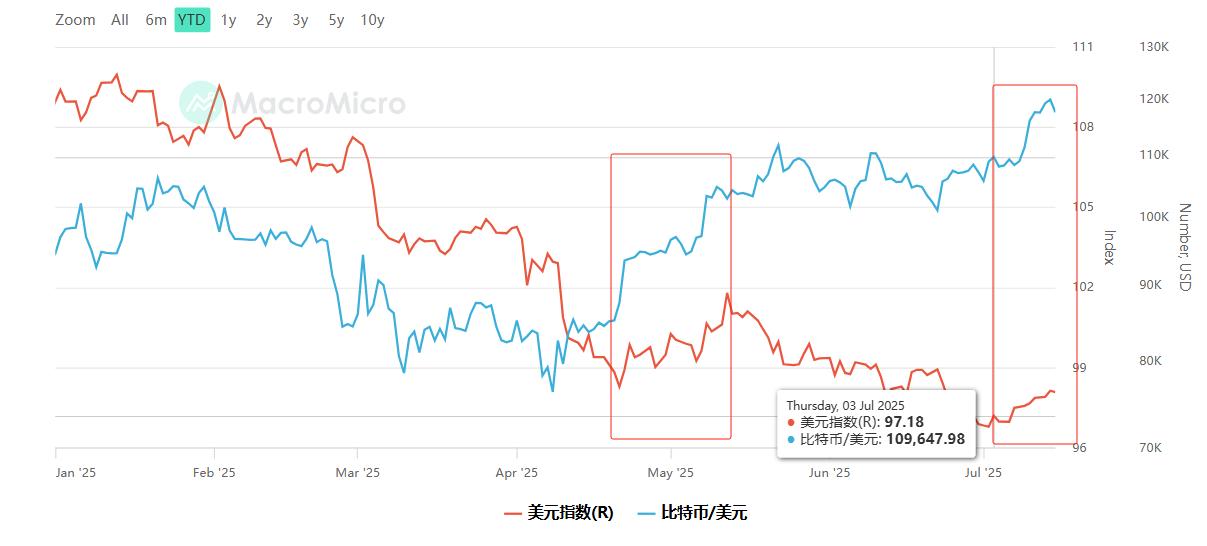
As can be seen from the above chart, there are two obvious divergences between BTC and DXY since the beginning of this year. The first one appeared in April, which was the period after Trump announced the 90-day tariff suspension. The second one was the period since the passage of the Big, American Act this month (July).
In other words, it is easier to understand that due to changes in macro factors, the trend of Bitcoin seems to be decoupled from the US dollar index at certain stages, and after each decoupling, Bitcoin will continue to create higher historical prices. For example, after the decoupling in early April, Bitcoin subsequently created a new historical high of $110,000; after the decoupling in early July, Bitcoin has now created a new historical high of $120,000 (it is not ruled out that it will continue to try to break new highs in the next two weeks).
So, is there a possible situation here, that is: if the existing market macro conditions remain largely unchanged, after Bitcoin continues to create new highs, it will re-enter a new round of correction, for example, in August (that is, within 5-6 weeks as we mentioned above), and fall back to around US$100,000.
August now seems to be a more interesting time point. Here is a new hypothesis: if Bitcoin really experiences a pullback next, and there happens to be a new policy event (such as the Fed’s interest rate change in September), BTC and DXY will decouple for the third time this year. In theory, it is not ruled out that Bitcoin will continue to rise and break the historical high again (around October).
But if the above new hypothesis can really happen, then in theory it may continue to mean that if we do not see more important macro-impact events this year, the new high in the fourth quarter may very likely be the last high point of this bull market, and then we may really usher in a relatively long period of periodic "bear market".
Of course, the above are just our speculations and guesses based on some data and theoretical level. As for how Bitcoin will go next, will it enter a new stage of "consolidation or periodic bear market"? Or will it completely break the historical cycle and enter a super "long bull cycle"? Let time tell.
2. Institutional capital and the craze for Bitcoin
In previous articles, we also talked about that the price of Bitcoin in this bull market seems to be mainly driven by institutions, and more and more institutional capital is directly or indirectly chasing this wave of Bitcoin's rise.
For example, after the BTC ETF was approved, IBIT (iShares Bitcoin Trust) launched by BlackRock took more than a year to reach a record asset management scale of US$83.5 billion, accumulating more than 200,000 BTC in assets, as shown in the figure below.
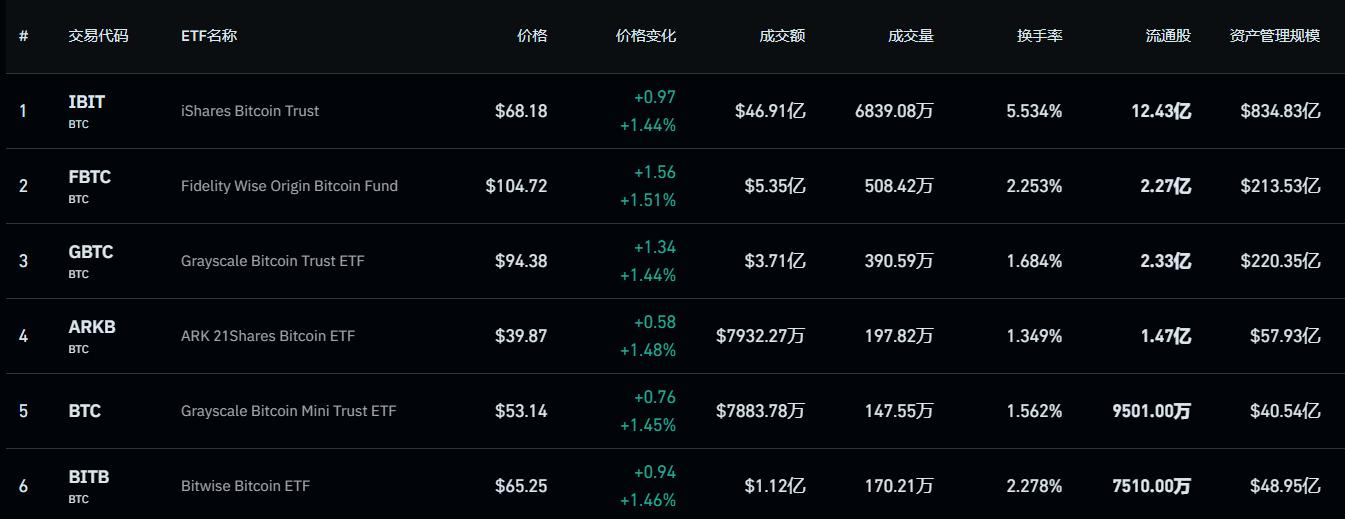
However, it took 20 years for the world's largest gold ETF GLD (SPDR Gold Shares) to reach the same milestone.
In the early days, the crypto market was dominated by retail investors. Since the last cycle, retail investors have begun to realize that more and more traditional institutions (such as Tesla) have entered the market. In this cycle, more institutional capital, hedge funds and family offices have begun to study or participate in the field of cryptocurrency. Even those "conservative" funds seem to be considering allocating 1% of their assets to Bitcoin.
According to a report by KobeissiLetter, the current asset management scale of US institutions is about 31 trillion US dollars. If 1% of US institutional capital flows into Bitcoin, it may also drive the asset to flow in by about 300 billion US dollars. Considering the global institutional AUM, we may see more than 1 trillion US dollars flowing into Bitcoin in the future. As shown in the figure below.
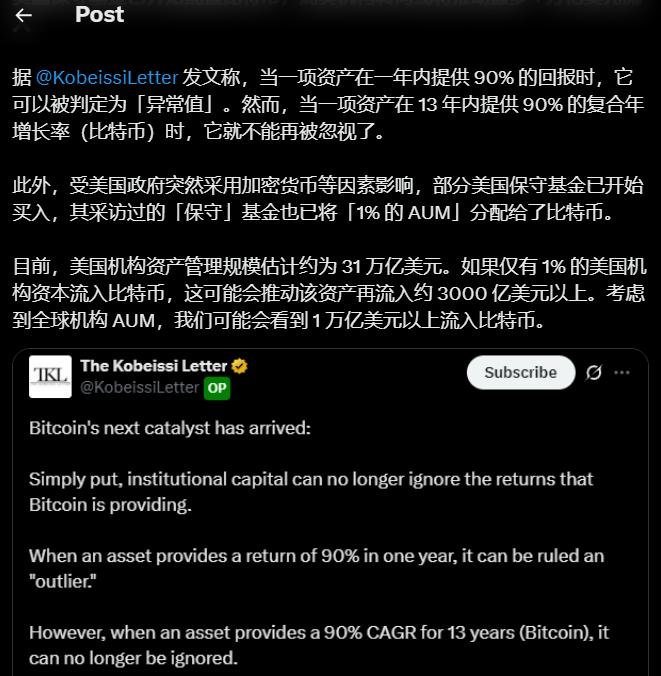
I asked ChatGPT to calculate that if $1 trillion continues to flow into Bitcoin, the price of Bitcoin may be pushed up from the current $120,000 to $250,000-340,000 in the future (this does not include the accelerated follow-up of speculative funds).

This number seems to be similar to the expectation (guess) in our previous article, that is, Bitcoin may reach 300,000 US dollars in 2029.
In short, here we still say the same old saying in the previous article: If your goal is long-term and you are firmly optimistic about the future of Bitcoin, then you can buy (reserve) Bitcoin at any time. If your goal is short-term or medium-term, then you need to be vigilant about market fluctuations and make choices that suit you according to your risk preferences.
In addition, as we mentioned above, Bitcoin may begin to enter a new "consolidation or periodic bear market", but this may not be a bad thing for altcoins, as we mentioned in our previous article (July 12) on the topic of altcoin season: As Bitcoin continues to hit new highs and enters consolidation, this may have the opportunity to bring about a new round of "mini altcoin season" opportunities.
That’s all for today. The sources of the images/data cited in the text have been added to Notion. The above content is only personal opinion and analysis, and is only for learning records and communication purposes, and does not constitute any investment advice.