
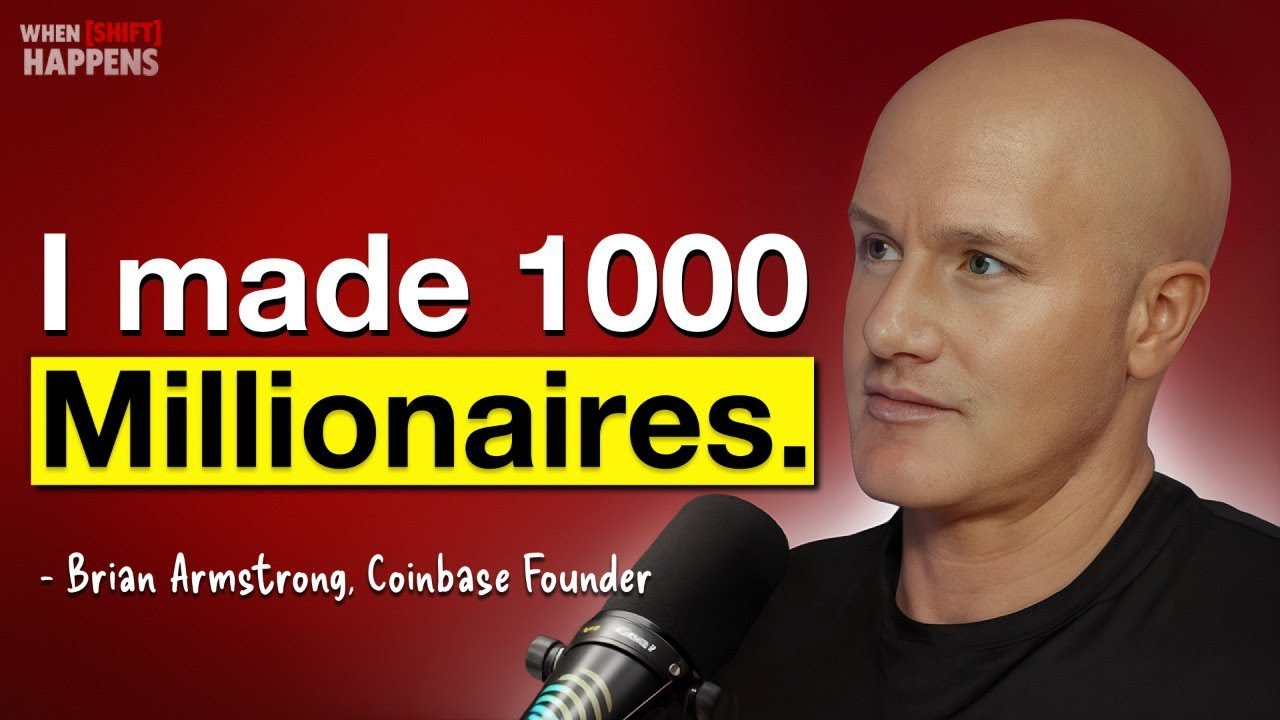
Original text: When Shift Happens
Compiled & edited by: Yuliya, PANews
"Chewing on glass while staring into the abyss." This is perhaps the most accurate description of Coinbase founder and CEO Brian Armstrong's entrepreneurial journey over the past thirteen years. Starting with nothing in 2012 when Bitcoin was worth only $6, to now leading a publicly traded company with a market value of hundreds of billions of dollars, his journey has not been smooth, but rather filled with chaos, burnout, lawsuits, and sharp political attacks.
In this episode of When Shift Happens , Brian Armstrong shares his transformation from an introverted engineer to a world-class business leader, his unique insights into the founder's psychology, practical strategies for handling challenging problems, and his profound thoughts on cryptocurrency, wealth, the meaning of life, and the future. PANews has selected excerpts from this podcast episode and provided a transcript.
The starting point and original intention of starting a business
Host: You once said that Coinbase's mission is to "enhance global economic freedom." What is the driving force behind this?
Brian: Coinbase's mission is to promote global economic freedom, while my personal mission is to accelerate the world's progress through science and technology. Although my upbringing wasn't particularly unique—for example, I didn't flee a country where wealth was being stripped away—I lived in Argentina for a year and witnessed firsthand the social turmoil caused by hyperinflation. These experiences gave me a deep understanding of the efficiency and fairness of the financial system and inspired my passion for continuous optimization, learning, and building. As a child, I loved playing strategy games like Civilization, managing resources and building infrastructure; this sense of accomplishment later extended to entrepreneurship and product development.
Host: How did you develop such a strong interest in the world of Bitcoin and blockchain?
Brian: I studied computer science and economics, and I like the concept of free market economics. I also personally experienced Argentina's hyperinflation. While working at Airbnb, I discovered that the global financial system was inefficient, and many people could not access basic financial services.
The Bitcoin white paper showed me that blockchain, like the internet, can grant everyone economic freedom. The idea that anyone with a smartphone can have secure wealth and the right to participate in a global economy excited me greatly, ultimately leading me to quit my job and start my own business.
Host: How long did it take you to build this confidence of "wholehearted dedication"?
Brian: From first reading the Bitcoin white paper in December 2010 to officially launching Coinbase in July 2012, it took about a year and a half. During this time, I experienced self-doubt due to the complexity of Bitcoin and the lack of understanding from friends. However, what truly spurred my decision was being accepted by the startup incubator Y Combinator. My first application to Y Combinator was unsuccessful, but my second application was supported, and I received $150,000 in seed funding. This funding gave me the confidence to quit my previous job, fully dedicate myself to the startup, and decide to try to achieve my goals over the next few years.
Host: How do you feel about people calling you the "bald founder"?
Brian: I noticed my hair thinning in my early twenties and eventually shaved my head. While it was uncomfortable at first, everyone has their insecurities; the key is to accept it and approach it with humor. Although the "bald founder" meme circulates in the crypto community, it doesn't hold any real meaning. I don't prejudice myself against others based on their appearance.
Coinbase's thorny path: Forging trust amid compliance, litigation, and chaos
Host: If you were to introduce Coinbase to an average person who doesn't understand technology, what would you say?
Brian: Coinbase is the simplest platform for buying, storing, and using cryptocurrencies. We are not only an exchange and custodian, but also provide services such as payments, loans, and credit cards. In the future, Coinbase will become like a bank, serving as a gateway for users to access higher-quality financial services. Even if users don't understand crypto technology, they can easily send money, take out loans, or raise funds with Coinbase, just like using a light bulb or the internet—no need to understand the underlying principles, just enjoy the convenience.
Coinbase's ultimate goal is for a billion or more people to access the Open Financial System every day through the Coinbase app. This will become an alternative to banks and brokerages for users, enabling all financial services through a single app, thereby increasing economic freedom globally and making it accessible to anyone with a smartphone.
Host: When you founded Coinbase in 2012, Bitcoin was only worth $6. Thirteen years later, Coinbase has a market capitalization of hundreds of billions of dollars and is listed on Nasdaq. You've taken a difficult path of compliance. What does it take to build the world's largest exchange by following the compliance route and not taking shortcuts?
Brian: This is definitely a longer-term endeavor. Communicating with regulators and legislators takes a lot of work ; they are often slow to act, but they eventually do. Even if the law doesn't require it, we do things we think might be required in the future , or at least things that at least a rational person would consider reasonable in the absence of clarity.
For example, setting up the company in the US instead of in some offshore tax haven. Early on, I would wear a suit to talk to these people. Sometimes they had no idea what we were doing and would ask me, "Isn't this just a video game?" Some banks would say, "We don't work with cryptocurrency companies."
I've found that if people only see us online, they're very skeptical. But once they meet us in person, they trust us much more. They can sense that although we're young and perhaps a little naive, we're not bad people, and we're trying to do some good for the world.
The development of cryptocurrencies has gone through a process of being ignored and then accepted. Initially, people either ridiculed or ignored cryptocurrencies, but as the industry grew, some began to see them as a threat to the financial system and lifestyles. We realized that there were two forces opposing us: Senator Elizabeth Warren and former SEC Chairman Gary Gensler.
We suddenly started receiving very strange behavior from the SEC. We met with them about 30 times, requesting clear rules that we would gladly comply with. But the response we received was: "We won't tell you. Go talk to your lawyer."
I realized they were simply trying to illegally destroy the entire industry. If we didn't fight back, the whole industry (at least in the US) could be strangled. I felt it was my responsibility to defend the rights of our customers. At the time, about 50 million Americans had used cryptocurrency, which was what the American people wanted, but a small group of activists within the government were trying to illegally stifle it.
I realized that we, as an industry, had to build political power . So we funded Stand with Crypto, which got about 2 million people to say they wanted to vote for a pro-crypto candidate; we created scorecards for every member of Congress; we donated to Fairshake (a super PAC); and we sued the SEC.
I'm very proud that we did this. When I talk to customers, this is what they thank me for most. They say, "Thank you for standing up against these people and defending our rights." This ultimately became a huge brand-building moment for Coinbase.
Host: Besides the departure of the co-founder, can you share one of the most difficult moments in Coinbase's history?
Brian: There are many such moments. Starting a company is like the old saying, "chewing glass while staring into an abyss." You have to constantly do things outside your comfort zone.
In a way, I even kind of enjoy doing difficult things because it helps me improve over time—that's the process of growth. But honestly, something like this happens almost every week. For example, I might have to have a tough conversation with someone and tell them they're going to be laid off, or that they need to do better in a certain area; or we might be unable to acquire a company, thus shattering their dreams.
Furthermore, you face countless challenges: being sued by the federal government, testifying before Congress, having negative articles about you appear in mainstream media read by millions, experiencing a cybersecurity incident that results in a $100 million loss, requiring you to pay compensation, publicly admit your mistakes, and reflect on your actions. Running a company involves numerous difficulties.
Survival Rules for Leadership, Collaboration, and Adversity
Host: You once mentioned that you were an introverted child, and even felt somewhat autistic. Many people believe that the most successful entrepreneurs often have autistic tendencies or childhood trauma. What's your opinion on this?
Brian: I agree with that. Many founders do have autistic or ADHD tendencies, which can lead to exceptional focus and creativity . Of course, this is just a simplified classification. More importantly, many entrepreneurs' early motivation stems from negative emotions such as fear, anger, or a desire for recognition. For example, when I was a child, I was afraid of not being recognized or not being good enough. This motivation needs to be transformed into more positive goals, such as learning, growth, and influence, after the company achieves a certain level of success; otherwise, it's easy to fall into burnout.
Host: How do you handle disagreements in a cooperative relationship?
Brian: My co-founder Fred Ehrsam and I agree about 90-95% of the time, but we disagree about the remaining 5%. To avoid dissatisfaction arising from power dynamics, we devised a simple method: we each assess how much importance we place on a particular issue, rating it from 1 to 5, and then reveal our scores simultaneously. Whoever scores higher gets the decision made.
This approach not only quickly resolves disagreements but also helps determine whether the other party truly cares about the issue or is simply enjoying the debate. We've never had a situation where both sides give a perfect score of 5. In the event of a tie, a coin toss might be used to decide. Furthermore, if following someone's method doesn't yield ideal results, that person is responsible for resolving the issue. This strategy helped us efficiently advance the company in its early stages, laying the foundation for Coinbase's success.
Host: Your co-founder Fred left the company in 2017. How did you feel at the time?
Brian: It was definitely a tough time at the time, I even felt abandoned, and I was worried that the employees would waver because of it. But Fred handled it very well. He communicated his thoughts to me and the senior management a year in advance, and chose to leave when the company and the market were both on the rise, helping the company smoothly transition to a more professional leadership team. This honesty and sense of responsibility have kept us good friends to this day.
His departure actually helped the company usher in its second "founding moment," transforming it from a company primarily decided by him and me to one where Brian became CEO and a true leadership team was built around him. This helped the company become more professional and laid the foundation for its later public listing. This experience also helped me grow in leadership skills and learn to face difficulties and challenges.
Host: How did you accept the departure of your co-founder without feeling like you were "working" for him (for the shares he held) while he went on to pursue the next exciting thing?
Brian: This is a very real issue. First, the vesting mechanism for shares is important. The standard in Silicon Valley is usually four years, but that's for employees. I think founders should have a longer vesting period, like ten years. Any worthwhile project is only just getting started after four years.
Secondly, if you, as the founder, already fully own your shares, I believe you have every right to approach the board and request new equity incentives . When you become a larger company, there are compensation committees and various due diligence and governance mechanisms to handle these matters. There are even lawyers who can represent you as the founder in negotiations with the board.
This is a tough job, so you need to feel like you can share in the profits from the company's growth. Some founders, even after all their shares have been vested, still feel that if the company's value doubles or triples, they still have huge upside potential. So ultimately, it's a personal choice for each individual.
Host: Do you think it's possible for a company to maintain outstanding performance in the long term without a founder or CEO?
Brian: Founder-CEOs have a unique advantage in driving innovation and creating value within a company, but without a strong operational team to complement them, the company can become chaotic. A combination of founder-CEO and a skilled operational team maximizes company value, as the former excels at innovation while the latter ensures efficient operation.
Succession planning is a complex and difficult task, much like the transfer of power in a nation or civilization. Take Apple, for example: after Jobs' death, the board chose the safer successor, Cook, and achieved tremendous success. However, most boards tend to be risk-averse, opting for more conservative leaders, which can limit the company's innovative potential.
Even if the founder leaves, the company can inject the "founder's DNA" into the organization by acquiring other companies led by the founder or cultivating internal talent, thus maintaining its innovative capabilities and competitiveness. This process, though difficult, is crucial for long-term development.
Host: What are your thoughts on independent founders?
Brian: Independent founders are viable, but the key is finding complementary partners. This complementarity can come from co-founders, leadership teams, or executive teams. It's crucial to find people you "awe"—those who excel in their respective fields and generate innovative ideas that motivate you to improve and keep up. This relationship is like a marriage, where both partners challenge and grow together. While disagreements are inevitable in this teamwork, when executed well, it significantly enhances individual and team performance.
Host : Building a business is already incredibly difficult, not to mention dealing with volatile markets, crazy bear markets, and now the added challenge of navigating the American political system and banks. You've persevered for 13 years, weathering multiple bull and bear market cycles, stock price crashes, the departure of co-founders, and another significant correction after the IPO… How do you maintain your long-term commitment under such immense pressure without collapsing?
Brian: I never give up. No matter how many times I fail, as long as my goal is clear, I will persevere. In entrepreneurship, determination is one of the most important qualities , even surpassing intelligence, creativity, or fundraising ability. Of course, not every day is filled with motivation; sometimes I wake up feeling frustrated, but I still try to adjust my mindset and keep going.
Host: What should you do when you experience extreme anxiety or burnout?
Brian: Work stress can affect physical and mental health in various ways, such as weight changes or severe back pain. The most important things are sleep, exercise, and nutrition. I occasionally listen to motivational videos by David Gogggins to adjust my mindset. When I'm stressed, I force myself to rest, exercise, and spend time with family and friends; I usually recover after 48 hours.
In the early stages of a startup, you can work incredibly hard for a short period, but to sustain it for decades, you must find a sustainable rhythm . Every few years, I experience burnout, which usually means I need to delegate some work or completely change the way I work.
Host: Many entrepreneurs dream of becoming like you. What do you think entrepreneurs are most likely to overlook?
Brian: I think many people don't actually do what they truly want to do; they're afraid to take that first step. Many entrepreneurs tell me, "I want to do something big in the future, but for now, I'll do something small." Actually, everyone should be bolder and pursue grander goals. I was like that myself. In the early days, I only wanted to run a small business, but later I kept setting bigger goals for myself, such as "founding a billion-dollar tech company." When you dare to set ambitious goals and think about how to achieve them every day, you attract more talented people and are more likely to achieve major breakthroughs. Any truly valuable and grand undertaking may take at least ten years. This is a lesson I've learned as I've gotten older.
Host: What is the one thing you've learned in the past 20 years that will benefit me for the rest of my life?
Brian: One of my favorite lessons is: "Action generates information." If you don't know what to do, just do it. Even if you're wrong, you'll get feedback and can adjust quickly. Many people get stuck in analytical paralysis, but continuous small steps forward are the key to breakthroughs.
The next chapter in the crypto world: A blueprint for privacy, on-chain, and open finance.
Host: What is your understanding of economic freedom?
Brian: Economic freedom is essentially self-sovereignty—you control your money. Inflation hurts the poorest people the most because the rich can invest in inflation-hedging assets (such as real estate, gold, and Bitcoin), while the poor are forced to hold cash, which is tantamount to a tax refund. Cryptocurrencies allow anyone to securely store wealth on their mobile phone and transfer it anywhere in the world at any time, protecting assets from government abuse or arbitrary seizure. This is not only financial innovation but also the foundation of global economic fairness and freedom.
Host: Many early cryptocurrency OGs have recently focused more on privacy. What role do projects like Zcash play in creating more economic freedom?
Brian: I think privacy is extremely important, especially in our financial lives. It's almost as sensitive as your health information. What surprises me is how much cryptocurrency has grown with default "pseudonyms," and all transactions, including amounts and timestamps, are on a single public ledger.
Early privacy-focused projects like Zcash or Monero, especially Monero because it's almost 100% private, have attracted some early adopters who were involved in illegal activities, creating the perception that "it's all being used by bad people."
My view is that privacy is extremely important, and we need to implement it in cryptocurrencies . I believe the way to achieve this is to start with the default public chains (like Ethereum, Base, and Solana) and offer an optional, private transaction type . This way, you can say, "Look, 99% of the activity on this chain is legitimate, and now legitimate people are using private transactions." This is very similar to the early internet transition from HTTP to HTTPS. We acquired a company called Iron Fish, which is working on providing a private transaction feature on the Base chain that anyone can use by paying a potentially slightly higher gas fee.
Host: You once tweeted that traditional financing processes are outdated and capital formation should take place on-chain. Why?
Brian: A lot of things are moving on-chain, for every asset class. That's what Coinbase is doing right now. We want to enable people to trade not only every crypto asset, but also stocks, prediction markets, commodities, energy, and more.
Traditional startup fundraising is extremely inefficient . Founders spend three months, attend hundreds of meetings, deal with countless rejections, and incur millions of dollars in legal fees. This can be done much more efficiently on-chain, at a lower cost, faster, and with a more global reach. We recently acquired Ecko and Liquify to help achieve this. In my ideal world, any entrepreneur can create a company, obtain a business account, and raise funds with a single click within our app.
Host: In a world where everything is moving on-chain, what role do centralized exchanges like Coinbase and Binance play?
Brian: We've long believed that more and more things will happen on-chain , so we've invested heavily in this area and integrated a decentralized exchange (DEX) into our main app, currently supporting over 40,000 assets, with plans to expand to millions in the future. In addition, Coinbase has launched the Base app, a fully on-chain, self-custodied wallet, fully embracing the on-chain migration trend.
The Ultimate Game: A Life Philosophy and Creator's Mindset Beyond Wealth
Host: How did you feel on the day of the IPO and the day after?
Brian: Because of the pandemic, I didn't go to Nasdaq to ring the bell; instead, I spent the moment at home. Although it was an important milestone in my life, I didn't feel much at the time because I was busy and tired.
What truly resonated with me emotionally were the thousands of messages I received afterward. Many employees and investors became millionaires that day , telling me how it changed their lives, enabled their families to buy houses, and so on. This had a tremendous emotional impact on me, and I will never forget it.
Host: What are your thoughts on becoming a billionaire?
Brian: I'm quite happy, or more accurately, I feel "very fulfilled." It's satisfying to be on a path I'm good at and that allows me to contribute value to the world. Although there are times when I feel stressed and burnt out, these are signs of growth.
To be honest, having wealth or becoming a billionaire can enable you to accomplish more. But it doesn't truly change your level of happiness.
Money is more like a KPI or benchmark, measuring whether I'm doing the right thing in terms of creating value for the world. It's a way of scoring in this game and giving you resources to do other things.
Host: When do you consider your career to be truly complete?
Brian: Even though I'm well past retirement age, I still hope to dedicate my life to entrepreneurship and creation. An entrepreneur's motivation isn't just personal wealth, but accumulating capital to support more meaningful causes.
Host: As a high-pressure entrepreneur, how do you balance your career and personal relationships? When did you realize you needed to take your love life seriously?
Brian: For both men and women, finding a supportive and complementary partner is important. The key is to invest time and energy in the relationship, just like running a company. Now that I'm married, my emotional life greatly benefits my career, making me more focused and motivated. For entrepreneurs, emotional bandwidth is indeed limited, but if it's constantly ignored, you might feel lonely after achieving success.