Text | RWA Knowledge Circle
Editor|RWA Knowledge Circle
1. The corporate compliance window period under the regulatory differentiation between the United States and Hong Kong
2. Stablecoins restructure the payment costs of retail enterprises
The current "stable currency dilemma" of retail enterprises stems from the differences between the U.S. Senate and the House of Representatives . After the bill was rejected in May, the Senate version added three key constraints:
- Restrictions on issuing entities: Non-financial enterprises are prohibited from issuing stablecoins
- Asset anchoring requirements: must be 100% supported by US dollars or equivalent liquid assets
- Audit High Voltage Line: Issuers with a market value of more than US$50 billion are required to undergo annual audits
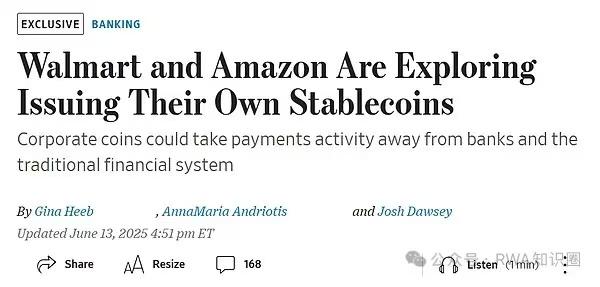
The stringent requirements have deterred many companies that intend to issue stablecoins in the United States, and the implementation of the bill has directly translated into quantifiable financial losses. Take retail giants Walmart and Amazon as examples: their credit card payment costs account for about 2% of their transaction volume. If they use stablecoins for payment (the cost can be reduced to less than 0.3%), based on the sales of $700 billion each in 2025, they will miss out on more than $28 billion in cost optimization space each year.
3. The Breakthrough Value of Hong Kong’s Window
As the United States raises the entry threshold, Hong Kong has established an innovation-friendly regulatory framework through the Stablecoin Ordinance, which provides new possibilities for small and medium-sized enterprises that are trapped by strict U.S. regulation. For the majority of small and medium-sized enterprises, the high cost and long cycle of cross-border payments have always been an unbearable pain point - the cost of traditional cross-border payments is generally as high as 6%, and the cycle is as long as 3-7 days. This is a heavy burden for small and medium-sized enterprises with limited profit margins, and may even swallow up most of the profits of cross-border trade.
Hong Kong's regulatory framework provides a compliant path to address these pain points. Large retailers like JD.com have already carried out relevant practices under Hong Kong's regulatory system. The stablecoins they launched are based on the public chain and are pegged 1:1 to fiat currencies such as the Hong Kong dollar or the US dollar. They have now entered the second phase of sandbox testing. Judging from their testing results, the payment cost has dropped from 6% to 0.0001%, and the cycle has been compressed from 3-7 days to seconds. If such solutions are implemented in cross-border payments, retail payments and other scenarios in the future, for companies with a trade scale of hundreds of billions of dollars, the annual loss reduction may exceed US$6 billion. The cost and efficiency optimization space demonstrated by this practice is also what many small and medium-sized enterprises are looking forward to.
The subtlety of Hong Kong's Stablecoin Ordinance lies in: focusing on the nature of payment tools , clarifying four categories of "regulated activities (issuing stablecoins in Hong Kong/issuing stablecoins anchored to Hong Kong dollars overseas/government announcement activities/related promotional activities) through Article 5, and at the same time, Part 2 of the Ordinance strictly prohibits the packaging of stablecoins as investment products for market promotion. This regulatory logic incorporates the entire chain of issuers, platform providers, and wallet service providers into the system, and reserves a compliance channel for non-financial enterprises. While this institutional design reserves channels for non-financial enterprises, it also places higher requirements on continuous compliance capabilities.IV. Ongoing Compliance Requirements for Hong Kong Licensing
Although Hong Kong is open to issuers, the ongoing compliance requirements set by the Stablecoin Ordinance constitute a substantial threshold. Companies interested in participating in stablecoin projects must be aware of the following:
- Fund reserve: Liquid assets of no less than HK$25 million
- Ongoing expenses: Fixed annual fee of HK$113,020 (first installment payable within 14 days)
- Liquidity guarantee: providing unconditional free redemption rights (Article 27 of the Regulations)
The financial barriers formed by these requirements have "dissuaded" most small and medium-sized enterprises from participating in stablecoin projects, but this does not mean that small and medium-sized enterprises are stuck in a dead end in the stablecoin race.
5. Path to Breakthrough under Global Competition
For the majority of companies that do not yet meet the licensing requirements, there are still three main ways to participate in the stablecoin ecosystem:
- Technology empowerment: Develop smart contract systems that meet regulatory requirements for licensed institutions;
- Resource docking: Linking stablecoin issuers, reserve asset custodians and application scenario parties through compliant intermediaries to form a collaborative network;
- Scenario integration: embed the stablecoin payment module into the e-commerce platform.
Faced with the complex environment brought about by the regulatory differentiation between the United States and Hong Kong, systematically improving compliance awareness and practical capabilities has become the key for enterprises to break through. To this end, a professional course focusing on the field of physical asset tokenization (RWA) will be launched soon. The course will cover three core modules: comparative analysis of the regulatory framework between the United States and Hong Kong, design of compliance participation paths for non-licensed enterprises (including practical application scenarios of stablecoins), and a full-process guide for cross-border business implementation, helping enterprises build a sustainable ecological participation strategy in the era of regulatory differentiation.
