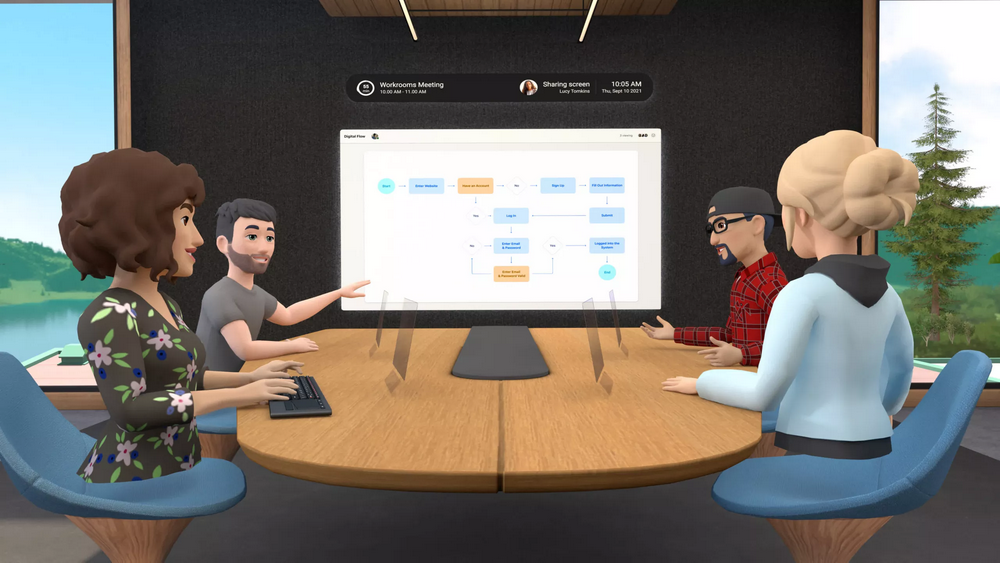
The concept of the Metaverse became popular around the world when Facebook changed its name to Meta in 2021. The Metaverse is defined as an immersive virtual space that can be entered through wearable devices or even brain-computer interfaces.
"The next platform will be even more immersive — an internet experience you're part of, not just looking at," Zuckerberg said in his 2021 Founders' Letter. "We call it the Metaverse, and it will touch every product we build."
Four years later, according to Meta insiders, by early 2025, Meta's Metaverse project had become a financial black hole, with cumulative losses of up to $45 billion. This figure is almost equal to the combined market value of social media competitors Snap and Pinterest, and is close to the amount Elon Musk paid for Twitter. Worse, Zuckerberg warned in last year's financial report that these losses would "significantly increase," but he did not specify what that meant.
Internal chaos, incompetent management and unclear strategies may be the main reasons for the huge losses. Yahoo Finance concluded after interviewing more than a dozen senior employees who had worked in Reality Labs (Meta's metaverse business unit). They (employees) described the department as "chaotic and disorganized." Frequent management changes and personnel adjustments have brought about continuous chaos. Many transferred managers come from other business units of Meta, but lack expertise in augmented reality (AR) and virtual reality (VR).
The specific losses of Meta's metaverse business, according to its financial data disclosure: losses exceeded $6 billion in 2020 , $10 billion in 2021, $13 billion in 2022 , and $16 billion in 2023. In the first quarter of 2024 alone, Reality Labs lost $3.8 billion , directly swallowing up the total revenue of the department in 2022 and 2023.
Such serious losses have caused the outside world to worry and question what value the Metaverse has and in what direction it will develop?
Looking at the development of the Metaverse, from its explosive popularity in 2021 to its current calm, the development of the Metaverse has shown a state of "shooting stars across the night sky". While it was shining brightly, the construction of the Metaverse in China alone and related policy support were written into the medium- and long-term development plans of the country and most provinces and cities.
For example, in 2023, the Ministry of Industry and Information Technology and five other departments jointly issued the "Three-Year Action Plan for the Innovation and Development of the Metaverse Industry (2023-2025)"; in 2022, Zhejiang Province issued the "Zhejiang Province Metaverse Industry Development Action Plan (2023-2025)"; in 2022, Chengdu issued the "Chengdu Action Plan for Cultivating the Metaverse Industry (2022-2025)"; in 2022, the Shanghai Municipal Economic and Information Commission revised and formulated the "Shanghai Action Plan for Cultivating a New Track of "Metaverse" (2022-2025)".
Although the Metaverse is facing losses and the industry as a whole has received much less attention than at its peak, "the Metaverse is an important platform for the interaction between the virtual world and the real society in the future," the Shanghai Science and Technology Commission defines the importance and long-term value of the Metaverse.
1. Metaverse reconstructs the “immersive entrance” of digital experience
The immersive technology that the Metaverse relies on includes key capabilities such as AIGC, spatial computing, new displays, and multi-modal perception and interaction. The goal is to lower the threshold for building virtual scenes and improve content flexibility and realism. This means that users will no longer be "people watching the screen" but "immersive participants"; the production and interaction of content will be highly intelligent and perceptual; and the construction of the digital world will tend to be real-time, personalized, low-cost, and high-fidelity.
After the 2D flat world represented by mobile phones, there may be a 3D metaverse that can be perceived and interacted with in real time. The metaverse may be the next generation of Internet platform, forming the infrastructure of "immersive digital experience".
2. Metaverse creates a “value trust layer” for a decentralized digital ecosystem
The Metaverse will certainly not be controlled by centralized giants. It may build decentralized/multi-centralized organizational rules and trusted value networks through the layout of Web3 and new blockchain systems, forming an automated collaboration mechanism based on smart contracts; personal ownership of data and assets; and an open, neutral, and verifiable network operation method.
In particular, by building the Web3 network operating system and a scalable, secure and controllable on-chain architecture, the foundation will be laid for large-scale virtual economy and digital asset transactions. By then, the metaverse will carry a new digital economic order and serve as the underlying institutional foundation for a "trusted digital society".
Among them, the decentralized cloud computing power (DeCloud) as the infrastructure of DePIN will provide computing power, storage and other driving forces for the immersive scene experience and value trust layer of the Metaverse, and integrate blockchain, smart contracts, privacy technology, AI technology, intelligent supercomputing, edge computing, etc. to form an active DeCloud ecosystem (such as decentralized cloud computing power PowerVerse), which is integrated into the development process of the Metaverse as infrastructure support.
Conclusion
Meta's loss in the Metaverse business is also related to its weak product sales and failure to gain mainstream market recognition. However, the development process of each generation of technology has not been smooth sailing. We have also seen that the Metaverse sub-sector, namely the wearable device AR/VR field, has regained attention in the past two years and has received a lot of investment and financing and market focus.
How to meet market demand and solve practical problems in the early stages of industry development will determine whether the first step of the Metaverse is solid.