
Author: Flashbots data analyst danning
Translated by: Azuma, Odaily Planet Daily

How much profit can MEV arbitrage robot make from CEX-DEX arbitrage?
No one has been able to answer this question before, but we are excited to announce that a new paper has finally been published that uses formal methods to measure it (paper link: https://arxiv.org/abs/2507.13023), and I will summarize all the core findings of the paper for you in a series of pictures and explanations below.
Super Condensed Version
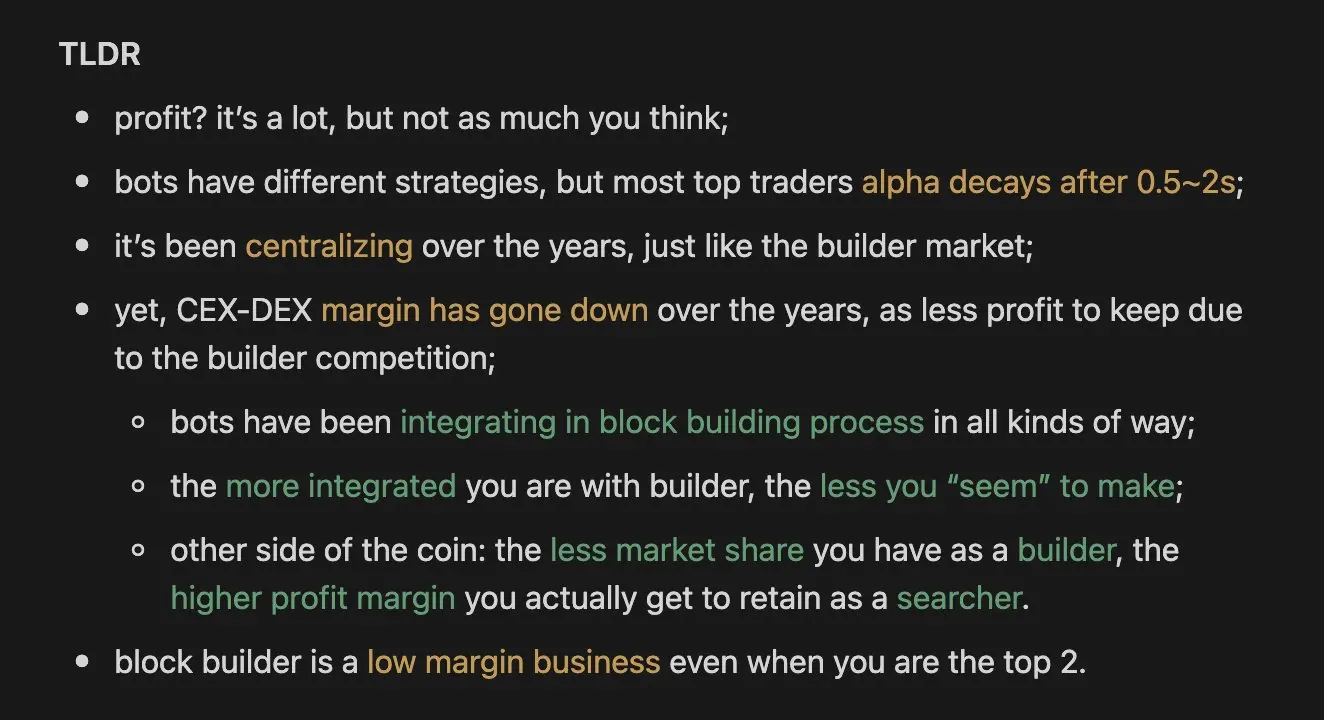
- Profit? Very impressive, but not as much as you think;
- Bot strategies vary, but the excess returns of top traders mostly decay within 0.5~2 seconds;
- Market concentration is intensifying, and the same is true for the block builder field;
- However, as competition among blockchain builders intensifies, the profit space of CEX-DEX arbitrage is shrinking year by year;
- Bots are deeply integrated into the block building process in various ways;
- The deeper the binding with the block builder, the thinner the "surface" profit (actually transferred to related parties);
- The smaller the market share of the block builder, the higher the actual profit margin retained by its related arbitrageurs;
- Even if it ranks among the top two in the industry, block building is still a hard business (profits are as thin as paper).
Relatively detailed version
In the 1 year and 7 months of data we collected, the data of 19 leading CEX-DEX arbitrage robots are as follows:
- The total transaction volume reached 241 billion US dollars;
- Withdrawing 233.8 million US dollars in profits;
- Only 90.1 million US dollars in net income was retained (143.7 million US dollars were paid to block builders);
Overall, the average profit rate of CEX-DEX arbitrage is 38.5%.
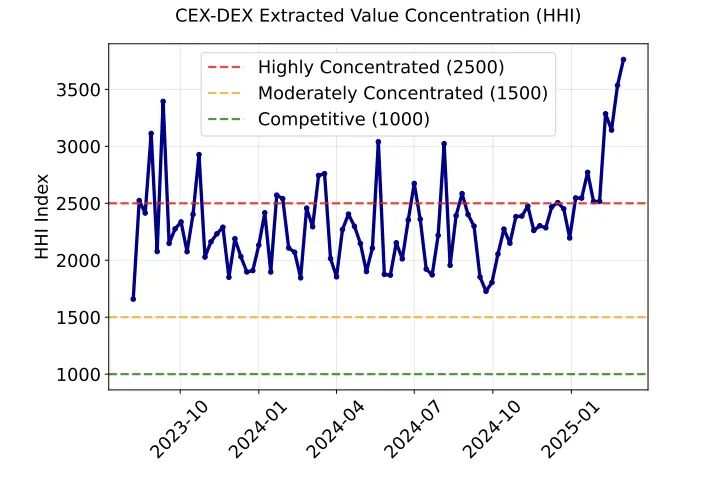
Based on the market share analysis of arbitrageurs, we confirm that the MEV market concentration trend of CEX-DEX has reached the "highly monopolistic" level.
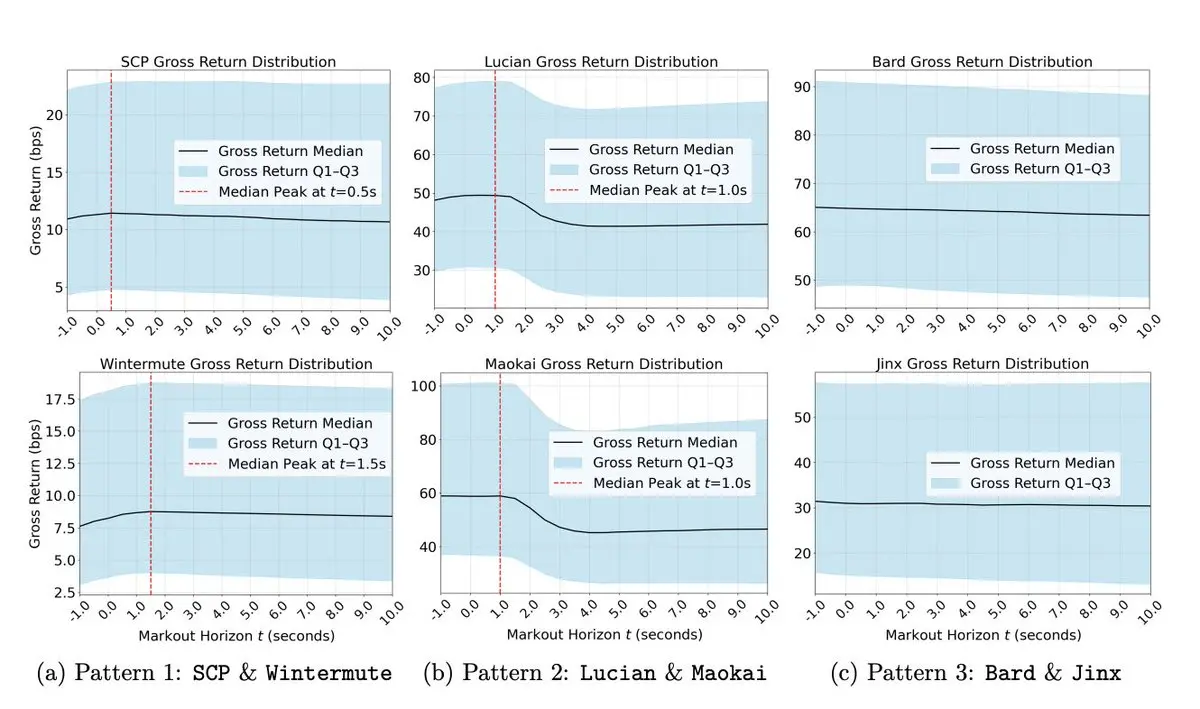
Following the "League of Legends" rank label system proposed by @0xRezin, we calculated the Binance markouts of the arbitrage bot and used the weighted average to define its "total income" before hedging.
The data shows that most CEX-DEX arbitrage signals disappear rapidly within seconds. The median distribution shows the peak of revenue, that is, the best hedging time occurs in the 0.5-1.5 second range.
After deducting the share paid to the block builders, we get the upper limit of the Bot profit.
So after combining the profit correction of arbitrageurs, what are the current earnings of the top three block builders?
Since rsync (currently ranked third) gave up the "order flow war" in the middle of last year, its market share has obviously plunged, but what no one noticed is that its profit margin has rebounded rapidly from 5% to 25%+, which makes its combined profit margin (arbitrage + block construction) reach about 27%.
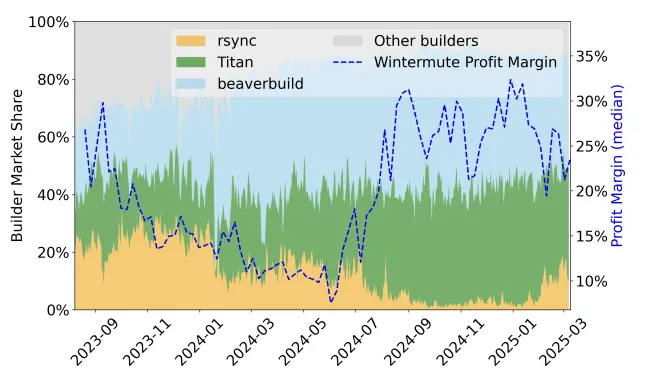
However, the top two block builders have limited profitability.
In the 18-month data period, beaverbuild (currently ranked first) had a comprehensive profit margin of only 7.92% (including arbitrage income), while Titan (currently ranked second) without self-operated arbitrage had a profit margin of only 5.85%.
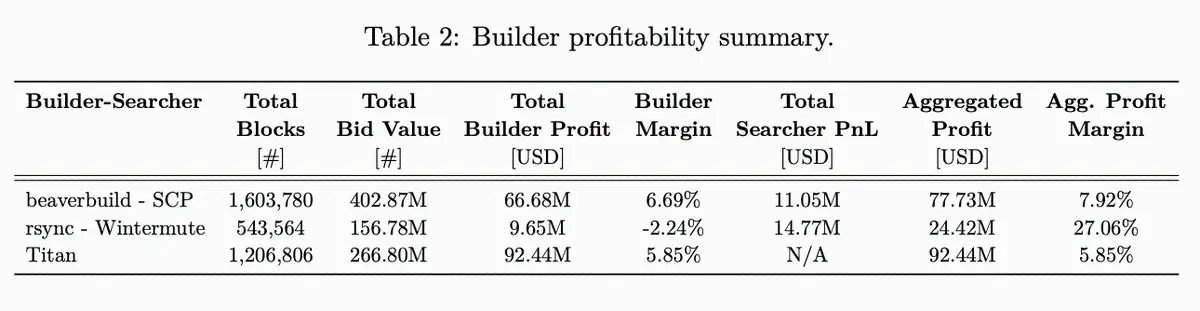
Obviously, the opaque "order flow" transactions make this situation more difficult to explain.
In addition to the known "block builder + arbitrageur" combinations such as beaverbuild + SCP, rsync + Wintermute, correlation analysis reveals another group of significant exclusive cooperation cases. Observe the 30-day rolling correlation between "Kayle's share of transaction volume in Titan-built blocks" and "Titan market share" in the figure below, and you can see the clues.
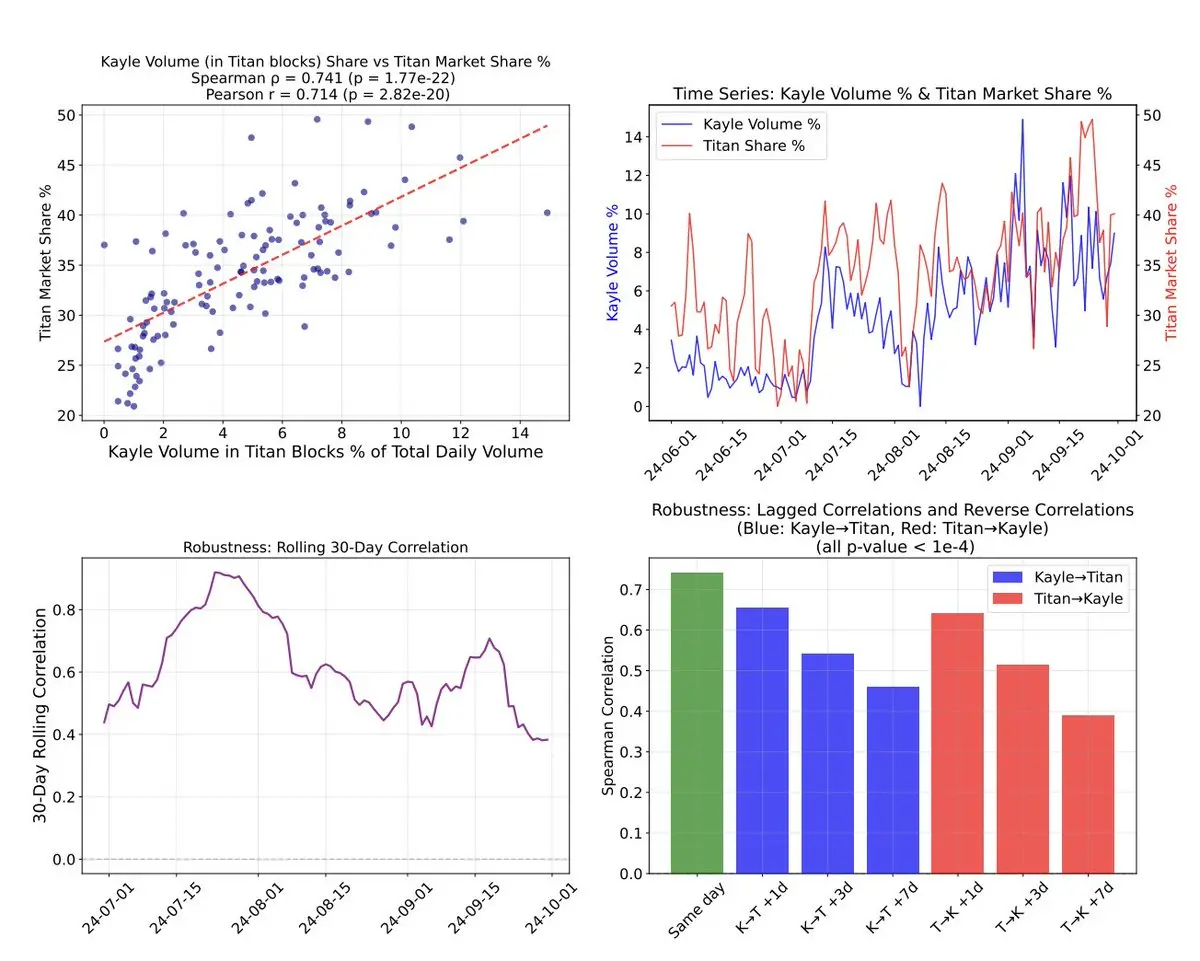
Our core conclusion is that block building is a low-profit business. If you do not hold an order flow with ultra-high MEV value, there is no opportunity to enter the market today.
In addition, the current block auction mechanism has serious inefficiencies. On the one hand, the subsidy mechanism will squeeze the profits of block builders; on the other hand, exclusive cooperation will split the order flow and prolong the waiting time for transactions to be on the chain.
But the status quo is not unchangeable. Flashbots' newly launched BuilderNet may be able to solve the problem and increase the profits of block builders.