
Author: Zhou Zhou, Foresight News

As the wave of tokenization of U.S. stocks sweeps the world, Hong Kong has chosen to remain silent.
"In the short term, no company will attempt to tokenize Hong Kong stocks," executives from three Hong Kong crypto companies revealed to the author.
Ten years ago, Hong Kong missed the best time to develop Hong Kong dollar and RMB stablecoins, and has fallen significantly behind the US dollar stablecoin (annual trading volume of 28 trillion US dollars) and the euro stablecoin (annual trading volume of 2 trillion US dollars). Today, the "stock tokenization" market is in the ascendant, but Hong Kong still chose to miss it.
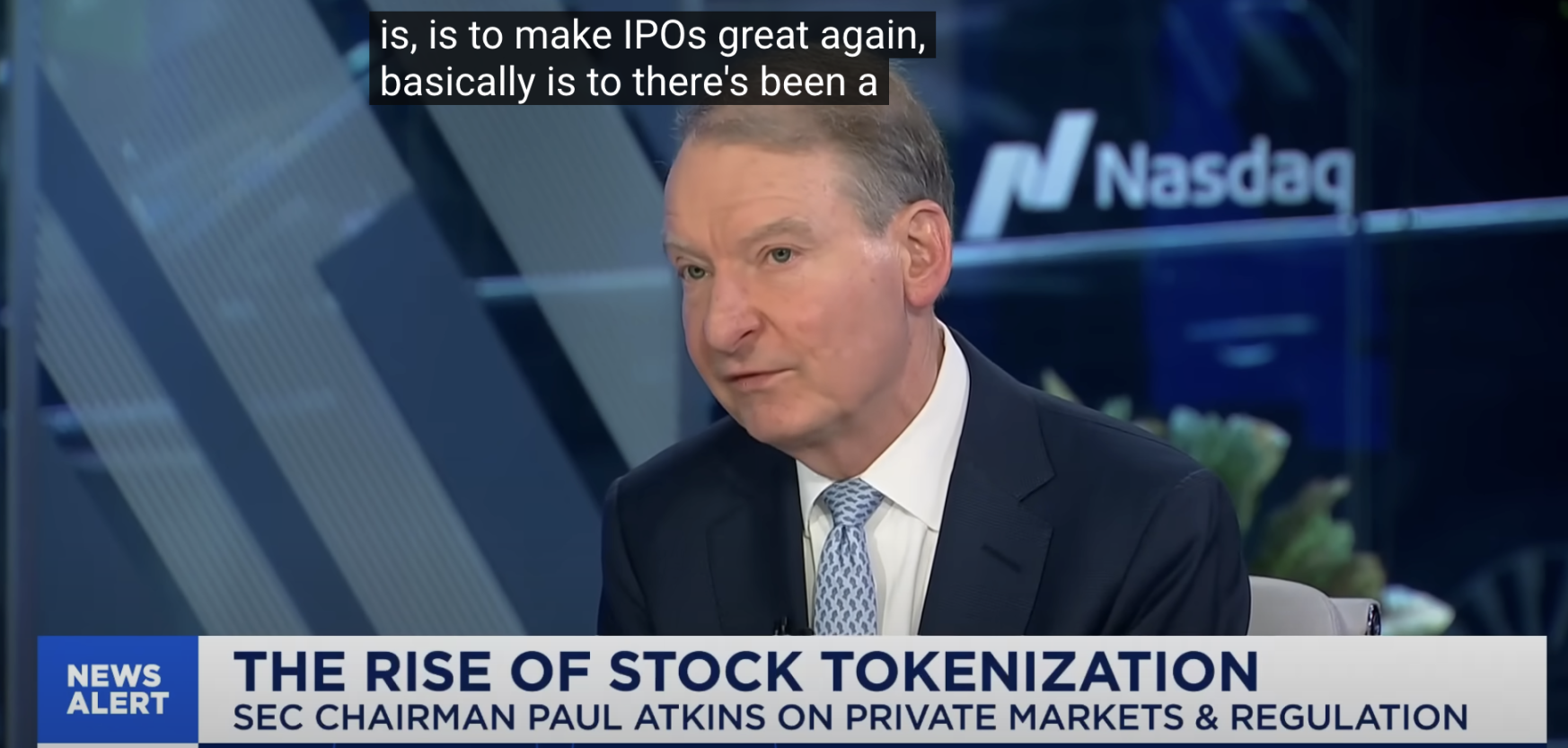
At the beginning of July 2025, US regulators and corporate giants set off an innovative wave of "US stock tokenization". Robinhood and Kraken officially announced the launch of their US stock tokenization products, allowing ordinary users to buy US stocks such as Tesla and Apple on the blockchain without permission. Robinhood has even launched tokenized stocks of private companies such as SpaceX and OpenAI, sparking heated discussions in the market. Paul Atkins, chairman of the US Securities and Exchange Commission (SEC), even expressed his support for stock tokenization technology in a recent guest appearance on CNBC TV.
However, on the other side of the ocean, Hong Kong crypto companies are quiet.
The author verified with practitioners from three Hong Kong-compliant encryption companies, including HashKey and OSL, and learned that although they are all actively paying attention to this matter, none of them have actually participated in the exploration of the actual business of stock tokenization.
Faced with this market, which is still in its early stages but has the potential to become the next trillion-dollar market after stablecoins, Hong Kong seems to have chosen to give up trying, even though attempts to tokenize U.S. stocks are in full swing, even though this could be a trillion-dollar market.
Some practitioners can't help but ask: Why did Hong Kong, which has been strongly supporting the development of cryptocurrencies in the past three years, choose to remain silent this time?
Hong Kong, why is it silent?
Having missed out on stablecoins ten years ago, Hong Kong will miss out on stock tokenization ten years later. Why is Hong Kong, which supports ETFs, RWAs, and stablecoins, hesitant only on stock tokenization?
An executive of a Hong Kong crypto company told the author that some forward-looking Hong Kong crypto industry practitioners actually actively promoted the tokenization of Hong Kong stocks very early on.
“Two years ago, Xiao Feng (founder of HashKey) actively promoted the Hong Kong government’s experiment (tokenization of Hong Kong stocks), and many industry executives were also actively promoting it, but it didn’t work.”
In Hong Kong, the law clearly stipulates that only exchanges approved by the Hong Kong Securities and Futures Commission can legally operate the stock trading market. This framework gives the Hong Kong Stock Exchange a "monopoly position" in Hong Kong stock trading. If the tokenization of Hong Kong stocks is tried, it will inevitably break the long-standing monopoly position of the Hong Kong Stock Exchange.
"The Hong Kong Stock Exchange has a monopoly on Hong Kong stocks. No one wants to take the first step to break the monopoly and become a sinner in the history of the Hong Kong Stock Exchange."
“If you were the Hong Kong Stock Exchange, would you revolutionize yourself?” the executive asked.
There is great resistance, and Hong Kong regulators and the Hong Kong Stock Exchange itself do not have sufficient power and motivation to promote the tokenization of Hong Kong stocks. This may be the reason for Hong Kong's silence this time.
The situation in the United States is different from that in Hong Kong. After Trump took office, the current US regulators are very supportive of cryptocurrency innovation. Whether it is the US dollar stablecoin or the tokenization of US stocks, they are all strengthening the status of the US dollar and US stocks, allowing global users to bypass regulation and buy US assets more conveniently.
The financial innovation ecosystem in the United States is also more dynamic and powerful. Whether it is Robinhood, the largest Internet brokerage in the United States, Coinbase, the largest cryptocurrency exchange in the United States, or Solana, the largest public chain in the United States, they all see themselves as challengers to the traditional financial world, and some even point their spearheads directly at Nasdaq. They have also successfully promoted the attempt to relax regulation on the tokenization of U.S. stocks.
This is also the difference between this round of stock tokenization and the previous round of stock tokenization.
An insider at Bybit pointed out: In the last market cycle, there were indeed some early attempts, such as the tokenized stock projects launched by Mirror Protocol and FTX. However, most of them faced unclear regulations, lack of continuous liquidity, and weak interoperability with other DeFi protocols. In addition, the failure of these projects was also exacerbated by the failure to establish a solid partnership with compliant custodians or infrastructure providers.
“Early setbacks should not hinder innovation in the field. As technology advances, regulation becomes clearer, and infrastructure is enhanced, tokenized stocks still have the potential to play a key role in the next round of financial change,” said a Bybit insider.
It is worth noting that the participants in this round of stock tokenization include not only powerful compliance institutions such as Robinhood, Coinbase, and Kraken, but also Bybit, Crypto.com, Gate and other experienced cryptocurrency exchanges that have been in the crypto market for many years.
Unfortunately, among the many participants, we may no longer see Hong Kong crypto companies. The excitement of stock tokenization is destined to have nothing to do with Hong Kong in the short term.
Stock tokenization has the potential to become a trillion-dollar market
Ten years ago, China missed the best opportunity to develop RMB stablecoins, and ten years later, Hong Kong will miss the opportunity to tokenize stocks. Perhaps ten years later, people will lament why tokenized Hong Kong stocks are not developed now, just as they lament why RMB stablecoins were not developed ten years ago.
Ten years ago, people gave up the exploration of RMB stablecoins, which led to a market value of US$100 billion and a market of US$1 trillion for US dollar stablecoins. In 2024, the annual transaction volume of US$28 trillion for US dollar stablecoins even exceeded the total of Visa and Mastercard.
The judgment that stock tokenization is the next important mass adoption track after stablecoins and the next potential trillion-dollar market is not groundless. Many industry insiders believe that the tokenized equity market "can reach a trillion-dollar level".
Data shows that by 2025, the market value of U.S. stocks will reach $5.2 billion, while the U.S. dollar in circulation will only be $20 trillion. From the perspective of the overall market size, the market for U.S. stock tokenization is larger than the market for U.S. dollar tokenization. Today, the market value of U.S. dollar stablecoins (U.S. dollar tokenization) has reached $100 billion, while the market value of U.S. stock tokenization is only $10 million, less than one ten-thousandth of the former.
In addition to the market size, global users have a strong demand for the tokenization of US stocks and the tokenization of US dollars. Currently, due to regulatory reasons, Europe, China and other regions restrict people from freely buying US stocks. The tokenization of US stocks, because it is issued on the public blockchain, naturally bypasses regulation and allows all users to buy freely.
In addition, the tokenization of U.S. stocks itself can do things that the U.S. stock market cannot do.
Andy from HashKey Tokenization believes that tokenized stocks have more advantages than traditional stocks.
“For example, users can realize 24/7 spot trading; users can conduct 24/7 on-chain derivatives trading; users can tokenize the stocks of private enterprises, and ordinary users can also purchase equity in OpenAI, SpaceX, ByteDance, Ant and other companies that have not yet gone public in advance; users in Europe, China and other global countries can bypass regulations to buy US stocks, just like bypassing regulations to buy US dollar stablecoins.” Andy said.
At present, not only compliant exchanges such as Kraken, Robinhood, and Coinbase are exploring the tokenization of U.S. stocks, but exchanges such as Bybit, Crypto.com, and Gate have also launched corresponding U.S. stock tokenization products. The trend of U.S. stock tokenization is gradually taking shape.
Last words
Although the current market size of U.S. stock tokenization is only tens of millions of dollars, which is only one ten-thousandth of the U.S. dollar stablecoin market, many industry insiders say that this market should not be underestimated.
Tether was founded in 2014. In the first three years, its annual trading volume was only tens of millions of dollars. However, in the bull market of 2017, Tether's trading volume increased 10,000 times in just one year to 100 billion dollars. This year's trading volume has reached 10 trillion dollars.
The development of U.S. stock token products may also be like this. It is waiting for its own ChatGPT moment, and the scenario where everyone buys U.S. stocks on the blockchain may be like the stablecoin track, and changes will come quietly overnight.
When this moment comes, I hope Hong Kong will not miss the opportunity again.