
Today, the People's Court Daily published an article: " Disposal of Virtual Currency Involved in Criminal Cases: Challenges, Innovations and Judicial Responsibilities ", the author of which is from the Shenzhen Intermediate People's Court. Perhaps the author is not a professional web3 practitioner, so the discussion of blockchain technology or virtual currency knowledge feels more like "artificial AI" - simply piling up technical content without further development.
Although the article is not very readable, as a legal practitioner and the fact that it was published in the People's Court Daily, it still represents a certain "official" or "judicial" cognition to a certain extent. Lawyer Liu briefly analyzes this article.
1. Main content of the article
Although the title of the Shenzhen Intermediate People's Court's article is about the disposal of virtual currency involved in criminal cases, there is not much content related to disposal in the entire article.
It first analyzed what virtual currency is, its characteristics, trading methods, etc. Then, based on the 2013 Central Bank's "Notice on Preventing Bitcoin Risks" and the 2017 "9.4 Announcement" on ICO issued by seven national ministries, it was explained that there is no legal trading platform for virtual currency in my country, and there are no legal rules for the evaluation and identification of virtual currency.
Then the author starts from the characteristics of virtual currency and demonstrates the difficulty of handling criminal cases related to virtual currency in judicial practice. For example, traditional investigation and freezing methods are difficult to carry out in cases involving virtual currency; there are no legal evaluation institutions and no legal disposal platforms, and it is difficult to determine the value of the virtual currency involved in the case and to dispose of it. Last year, the Supreme Court also made "the disposal of virtual currency involved in the case" an annual judicial research topic.
The Shenzhen Intermediate Court also affirmed the property attributes of virtual currency. However, in the field of civil trials involving virtual currency, the author believes that in judicial practice (judicial organs) generally recognize that virtual currency has property attributes , which Lawyer Liu strongly disagrees with. Nowadays, whether it is a virtual currency investment dispute or a loan dispute, the court will certainly not generally accept such cases in civil judicial practice, and will not even issue a ruling of non-acceptance (for fear that the parties will appeal). If the property attributes of virtual currency are recognized in civil judicial practice, then if Zhang San borrows a bitcoin from Li Si and does not return it after the due date and goes to court to sue, why doesn't the court accept it? In criminal judicial practice, the recognition of the value of virtual currency has basically reached a consensus as early as two or three years ago.

In addition, the article of Shenzhen Intermediate Court mentioned that the judicial operation in Futian District of Shenzhen City (mainly the custody of the virtual currency involved in the case) was not innovative, and most places in the country did the same; and for those who need to return compensation to the victims and fines to the state treasury, the author believes that it is possible to explore filing with the People's Bank of China, the State Administration of Foreign Exchange and other departments, and then entrust a qualified third-party institution to realize the cash through a compliant licensed exchange overseas (such as Hong Kong), and then directly deposit it into the foreign exchange account opened by the court . The original words of the author are: "After realizing the cash overseas, refer to the provisions of the State Administration of Foreign Exchange's "Letter on the People's Court Opening Foreign Exchange Accounts and Handling Foreign Exchange Receipts and Payments in Foreign-Related Judicial Activities"." How to understand this point, Lawyer Liu will analyze it below.
The author believes that virtual currencies that endanger national security and public interests should be put into black hole addresses and destroyed.
2. Effective information extraction from the Shenzhen Intermediate Court article
As a web3 lawyer, Lawyer Liu commented that this article of the Shenzhen Intermediate Court has no other effect except to allow us to peek into the views of some young judges in civil and criminal cases involving virtual currencies. For example, it is difficult for the author's views to have any substantial impact on judicial practice.
1. Summary of the Shenzhen Intermediate Court’s Views
1. The property value attributes of virtual currency are generally recognized in civil and criminal judicial practices;
2. The seizure of virtual currency adopts the so-called new model of "property remains static, information flows";
3. The virtual currency involved in the case can be disposed of and converted into cash, but this must be done overseas. After the disposal and conversion overseas is entrusted to a qualified third-party institution, the disposal proceeds will be collected in a foreign currency account opened by the court;
4. Privacy coins that endanger national security and social public interests must be destroyed and cannot be circulated.
First, the property value attribute of virtual currency is not reflected in the civil law practice of our country. Please see above for details.
Second, for current criminal cases involving currency, the investigative agency seizes virtual currency and only sends the seizure list (with a possible explanation of the seizure of the property involved) to the procuratorate and the court. This is not judicial innovation, but the judicial agency is helpless - because the people in the procuratorate and the court basically don't know how to use cold wallets (laughing to death), and only the public security knows a little about how to seize, keep, and transfer virtual currency (many still need the help of the investigation company). This is what I understand as "property is stationary, information flows". In fact, this has also led to many cases involving currency in which the court judgment has come into effect, and the court cannot directly dispose of the virtual currency involved, because the currency is still seized by the public security.
Third, the author's so-called (domestic) "under the record and supervision of the People's Bank of China, foreign exchange administration and other departments, entrusting a qualified third-party institution , abroad..." is purely a misunderstanding of the current judicial disposal practices and national regulatory policies. In China, according to the provisions of the "9.24 Notice": No mainland legal person, natural person, or non-legal person organization may conduct virtual currency and legal currency exchange business , and any "enterprise or individual business registration name and business scope shall not contain words or content such as 'virtual currency', 'virtual assets', 'cryptocurrency', or 'crypto assets' ".
So what exactly are the qualifications of domestic enterprises? Actually, there is no way to expand or discuss this in detail.
Fourth, it is even more impossible for the court to collect funds for the disposal of virtual currency abroad by opening a foreign currency account. See below for details.
Fifth, the destruction of the privacy coins involved in the case will increase the value of the privacy coins circulating in the market, which cannot completely solve the problem. Taking the privacy coin Monero (XMR) as an example, the current market circulation is more than 18.44 million coins, but its issuance has no fixed upper limit, unlike Bitcoin, which has 21 million coins. Therefore, it is difficult to completely solve its circulation problem by sending the confiscated Monero coins into a black hole (this is the characteristic of decentralized virtual currency: against all centralized institutions).
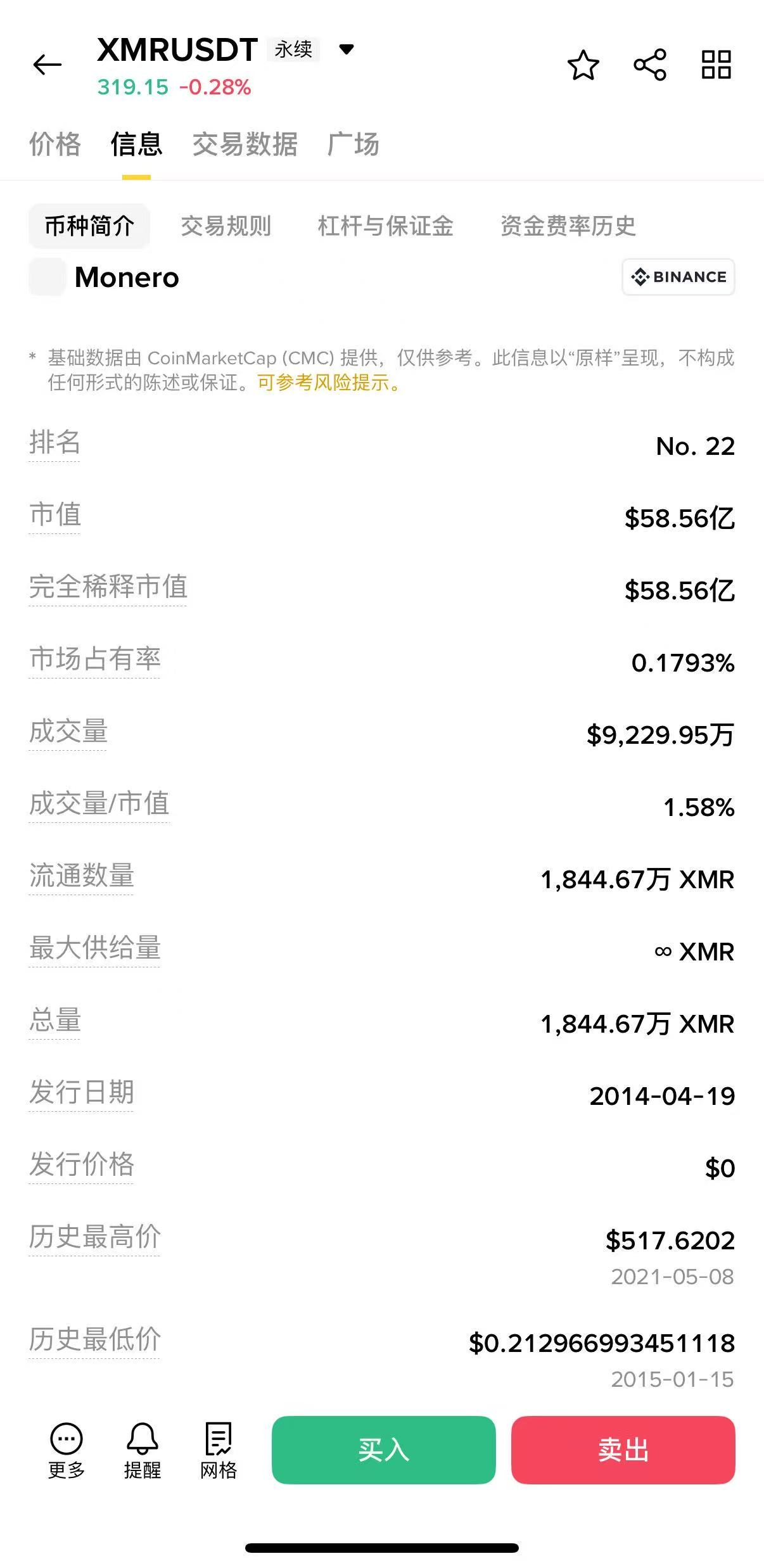
(Monero related information, source: Binance)
In Lawyer Liu’s opinion, it would be better to dispose of and liquidate the funds overseas (the simplest path: XMR-USDT-USD-RMB), which would also replenish the national treasury.
III. How the Court Participates in Judicial Disposal
There is one particularly novel point in the Shenzhen Intermediate People's Court's article, which is that the author suggests that the court can intervene in and handle business based on the provisions of the notice "Letter on Issues Concerning the Opening of Foreign Exchange Accounts and Handling of Foreign Exchange Receipts and Payments by People's Courts in Foreign-Related Judicial Activities".
As we all know, in the current judicial disposal business, the entrusting entity in the judicial organs is the public security, even in cases after the court judgment has come into effect. So how can the court take back the "right to speak on disposal"? There are two ways: one is that the court keeps the virtual currency involved in the case by itself, and then the subsequent disposal will be carried out by the court; the other is that when disposing, the court and the disposal agency sign a contract and entrust.
But is it feasible for the court to directly open a foreign currency account to collect the disposal proceeds of the virtual currency involved in the case? Is it necessary?
(I) Obstacles for courts to open foreign currency accounts in virtual currency disposals
According to the reply of the State Administration of Foreign Exchange to the Supreme People's Court, the income and expenditure of foreign exchange accounts under current items opened by intermediate and higher people's courts are limited to:
1. Foreign exchange received or paid for handling international judicial assistance matters;
2. Collect and refund foreign exchange litigation fees paid by overseas parties;
3. Collect foreign exchange fees required by domestic parties for applying for execution, preservation, seizure, detention, etc. abroad;
4. Pay foreign exchange fees required for overseas execution, preservation, seizure, detention, etc. to relevant overseas entities and individuals;
5. To enforce foreign exchange collected or paid for foreign currency objects in foreign-related cases in accordance with the law.
For judicial disposal, none of the above items meet the grounds for application. In the virtual currency disposal and liquidation business involved in the case, the cases involved are all domestic criminal cases, and the seized virtual currencies are all the property involved in the case of the defendants or victims. The disposal business itself is not international judicial assistance. The essence of judicial disposal is that the mainland of China does not allow the exchange of virtual currency and legal currency, and chooses to dispose of and liquidate overseas. As for how the liquidated money flows back to the country, it is not the reason for the court to apply for the opening of a foreign currency account.
(II) In fact, there is no need for the court to open a foreign currency account
In current disposal practices, the settlement of foreign exchange for disposal proceeds can be completed by disposal companies, which saves a lot of judicial resources. Even for cases involving virtual currency that have been concluded by the court, if the court is entrusted to handle the case, the disposal company can settle the settlement proceeds and transfer them to the court's special account or property account after the disposal is realized overseas.
The virtual currency involved in the case is actually no different from the traditional property involved in the case (such as real estate, stocks, and bonds). The reason why the disposal mode is very different is that the mainland does not allow any entity to conduct virtual currency and legal currency exchange business. If the "9.24 Notice" can be amended or abolished in the future, or even virtual currency licensed institutions can be allowed to operate appropriately in the mainland, then there will be no various disputes in the judicial disposal of virtual currency involved in the case.