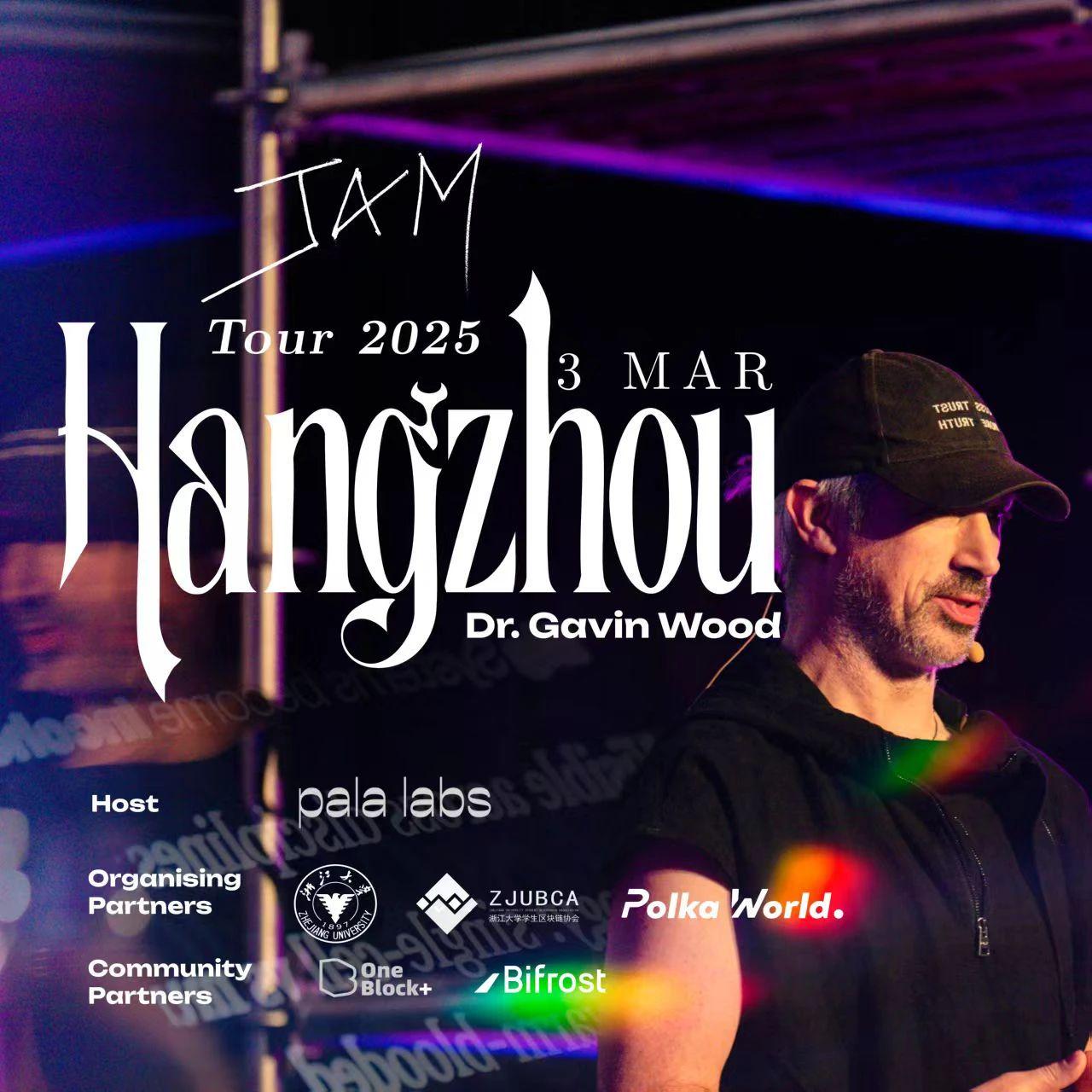
On March 3, 2025, the JAM Tour China Hangzhou Station was successfully concluded at the Zijingang Campus of Zhejiang University. The event attracted a large number of blockchain enthusiasts, developers and college students. The venue was packed with people, and many audience members even stood for hours just to catch a glimpse of Dr. Gavin Wood and learn more about the latest developments in Polkadot and JAM (Join-Accumulate Machine) technology.
This event was not only a technical feast, but also a cutting-edge discussion on the future development of Web3. In his speech, Dr. Gavin Wood introduced the core concept of JAM in detail, and had in-depth exchanges and interactions with the audience, discussing the future direction of blockchain computing power.

JAM Tour: Connecting Global Developers to Build the Future of Web3 Computing
What is JAM Tour?
The JAM Tour is a series of global lecture tours initiated by Polkadot and its founder Dr. Gavin Wood. It aims to promote JAM (Join-Accumulate Machine), a new blockchain computing architecture, to global developers, blockchain enthusiasts and researchers, and jointly explore the future development direction of Web3 computing.
Different from traditional blockchain technology exchanges, the JAM Tour is not just a concept presentation, but an in-depth technical exploration for the Web3 era. Each stop of the event revolves around the challenges and breakthroughs of decentralized computing. Dr. Gavin Wood not only shared JAM's technical vision, but also communicated with developers face to face, answered key technical questions, and encouraged global developers to actively participate in the construction of the Polkadot ecosystem.
The main goal of the JAM Tour
Introducing JAM technology: Explain in detail how JAM solves the current blockchain computing scalability bottleneck and provides a more efficient and economical decentralized computing platform.
Driving change in Web3 computing paradigm: Gavin Wood believes that blockchain is not just a ledger, but a scalable global computing network, and JAM attempts to become the core technology to realize this vision.
Interact with global developers: Through offline activities, communicate with developers, enterprises, and academia from all over the world to promote innovation and cooperation in the Web3 ecosystem.
Expand the influence of the Polkadot ecosystem: With the help of JAM Tour, the Polkadot ecosystem hopes to attract more developers to participate and jointly promote the development of Web3.
JAM Tour
The JAM Tour is planned to be held in many countries and cities around the world. It has been launched in Europe, Asia and other regions, and has attracted the attention of a large number of blockchain developers. As an important stop of the China tour, Hangzhou not only brings together domestic Web3 technology pioneers, but also lays the foundation for the further development of the Polkadot ecosystem in China.
In the future, JAM Tour will continue to travel to more cities to engage in deeper exchanges with global developers, promote the evolution of Web3 computing technology, and provide more possibilities for the future development of the blockchain industry.
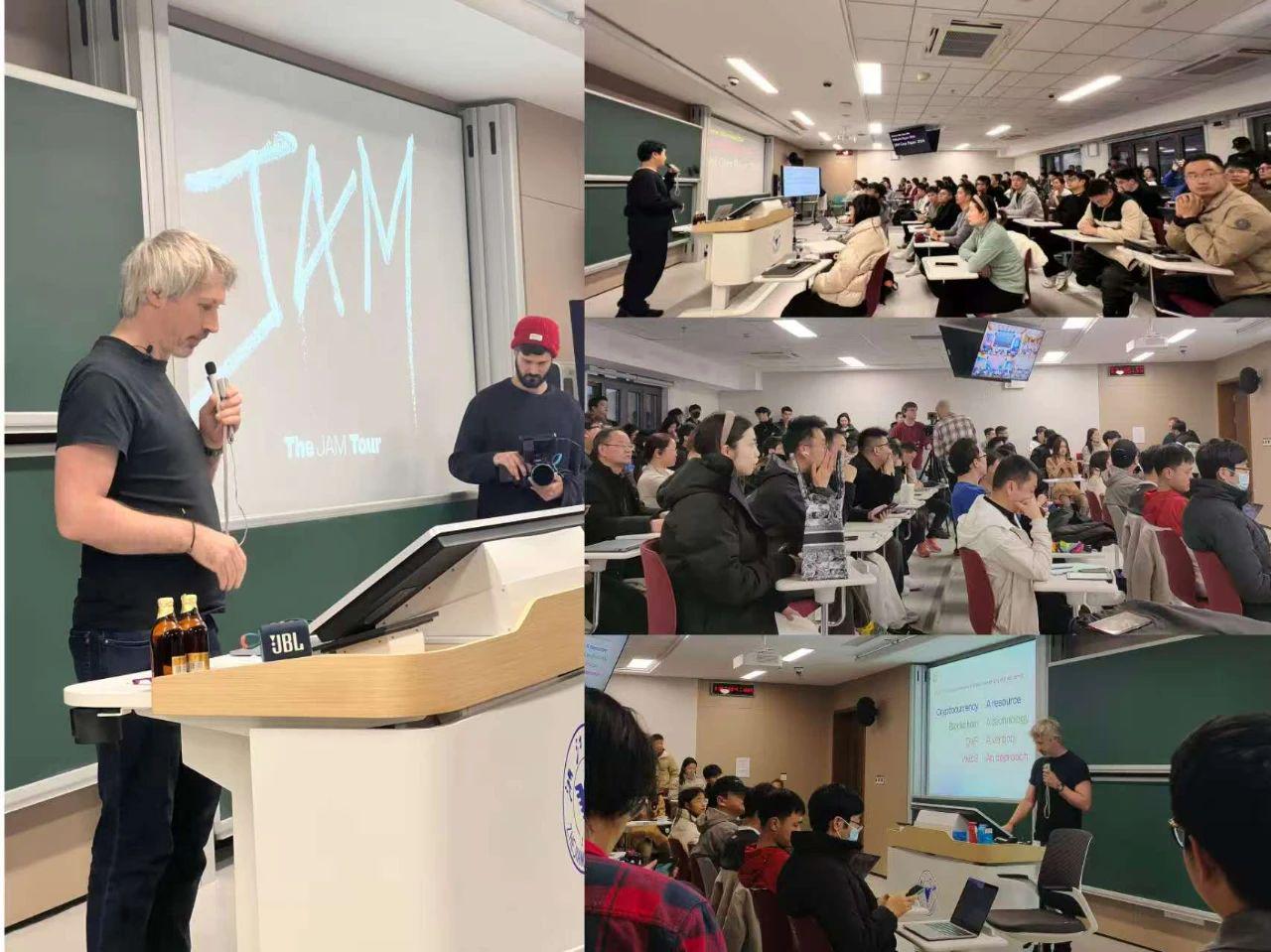
Photos of Zhejiang University event - Gavin Wood's speech
JAM Technical Analysis - Interpretation of Gavin Wood's Speech
Currently, blockchain technology is facing a bottleneck in computing power. Traditional smart contract platforms have many limitations in scalability, performance, and computing costs, making it difficult to support large-scale Web3 applications. In his speech in Hangzhou, Dr. Gavin Wood deeply analyzed JAM (Join-Accumulate Machine), a new blockchain computing architecture, and discussed with developers on site about the future computing paradigm of Web3.
JAM: Building a decentralized multi-core supercomputer
In this speech, Dr. Gavin Wood introduced in detail the core concept of JAM - building the world's first decentralized multi-core supercomputer. JAM introduces the design of a distributed data lake, where the status of all applications is stored, allowing different applications to collaborate seamlessly. This architecture allows workloads to be processed sequentially and distributed to different cores, achieving true multi-core distributed computing, greatly improving efficiency and scalability.
Gavin Wood further explained JAM's unique advantages in computing resource allocation. He said that compared with traditional smart contract platforms, JAM adopts a new computing paradigm, namely "reactor chain", which can manage state consistency more efficiently and support larger-scale computing needs.
JAM's core technology components include:
CoreVM: The foundation of the JAM computing architecture, providing an efficient decentralized computing environment and optimizing execution efficiency and parallel computing capabilities.
D (Deterministic Parallel Computing): Ensures the predictability of the computing process, allowing different computing tasks to be executed in parallel while ensuring the consistency of the final results.
Pipelining: Using modern CPU-level pipeline processing to improve computing throughput and break through the performance bottleneck of traditional blockchain.
PVM (Polkadot Virtual Machine): An upgraded version based on the WASM virtual machine, specially designed for the JAM ecosystem, supporting efficient smart contract execution and complex computing tasks.
JAM Grid: Breaking through computing limits and moving towards the future of Web3
The ultimate vision of JAM is to build a supercomputing network consisting of 341 high-performance cores, each with a computing power exceeding that of an ordinary computer, with an overall throughput of one billion transactions per second (TPS). This design makes JAM a truly decentralized computing network, providing powerful computing power and scalability.
Gavin Wood emphasized that the future competition in the blockchain industry will depend on who can provide the largest shared execution space and state space, and be economically affordable. JAM aims to be a leader in this competition, providing a sustainable, decentralized and efficient computing platform.
In addition, he also specifically mentioned JAM's potential in cross-chain interoperability. With the help of Polkadot's existing cross-chain communication protocol (XCMP), JAM is expected to seamlessly connect different blockchain ecosystems in the future and realize a truly global blockchain computing network.
CorePlay: Realizing the Vision of Blockchain Cloud Computing
Under the JAM framework, Gavin Wood also introduced the "CorePlay" mechanism, which can solve the fragmentation problem of the current blockchain ecosystem and make decentralized computing more flexible.
Unlike traditional parallel execution, CorePlay uses an on-demand operation mode. The application workload is sent to the sequencer and then allocated to the most suitable computing core for execution. In this way, developers do not need to worry about which core the application runs on when deploying it, and the system will automatically schedule resources. This design greatly improves the availability of JAM as a blockchain cloud computing platform and provides an efficient and economical infrastructure for decentralized applications.
Enthusiasm and opportunities for Chinese developers:
OneBlock+ Data Insights
The Hangzhou presentation not only showcased Polkadot’s continued efforts in technological innovation, but also provided Chinese blockchain developers and enthusiasts with an opportunity to gain an in-depth understanding of JAM technology.
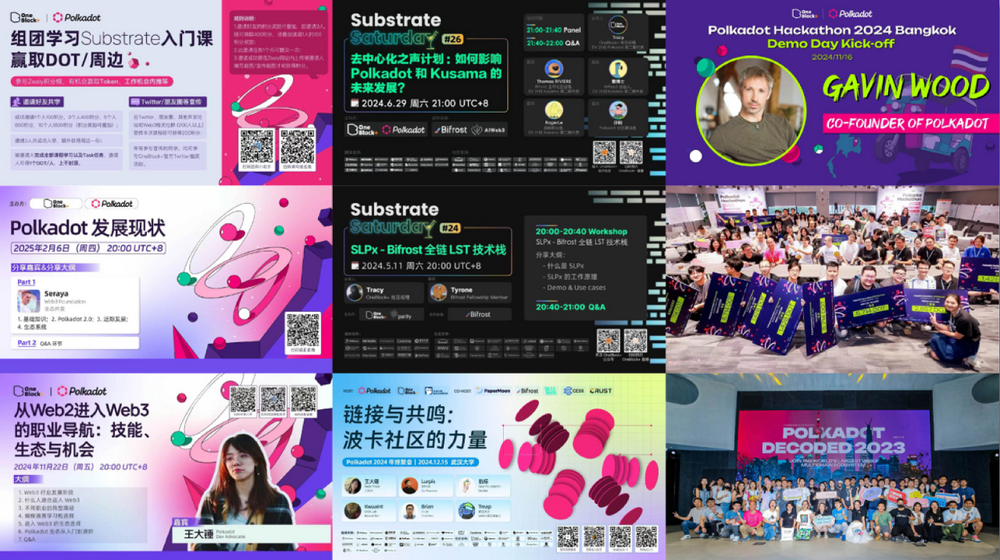
The OneBlock+ team also shared data on Chinese Polkadot ecosystem developers in 2024. Over the past year, the Polkadot ecosystem has shown a booming trend in the developer community in China. As an important driving force in the ecosystem, OneBlock+ has paved a clear growth path for developers through selected Substrate technical articles, high-quality Polkadot ecosystem content sharing, in-depth project interviews, active technical seminars, systematic developer courses, and the iconic Polkadot hackathon competition and colorful online and offline activities, and continues to provide them with the power to explore and innovate in the Polkadot and Substrate ecosystems.
Data shows that Oneblock+ published 296 high-quality articles and 269 video contents throughout the year, organized 41 rich and diverse online and offline activities, and attracted a large number of developers to participate. In the Polkadot hackathon, developers showed a strong enthusiasm for innovation and submitted a total of 191 projects. The Substrate development course was also widely welcomed, with 566 applicants throughout the year. Through the continuous operation of various social media platforms, a total exposure of 2.593 million was obtained throughout the year. These data not only show the influence of the Polkadot ecosystem in China, but also reflect the high attention paid by the Web3 field to technological innovation and talent training.

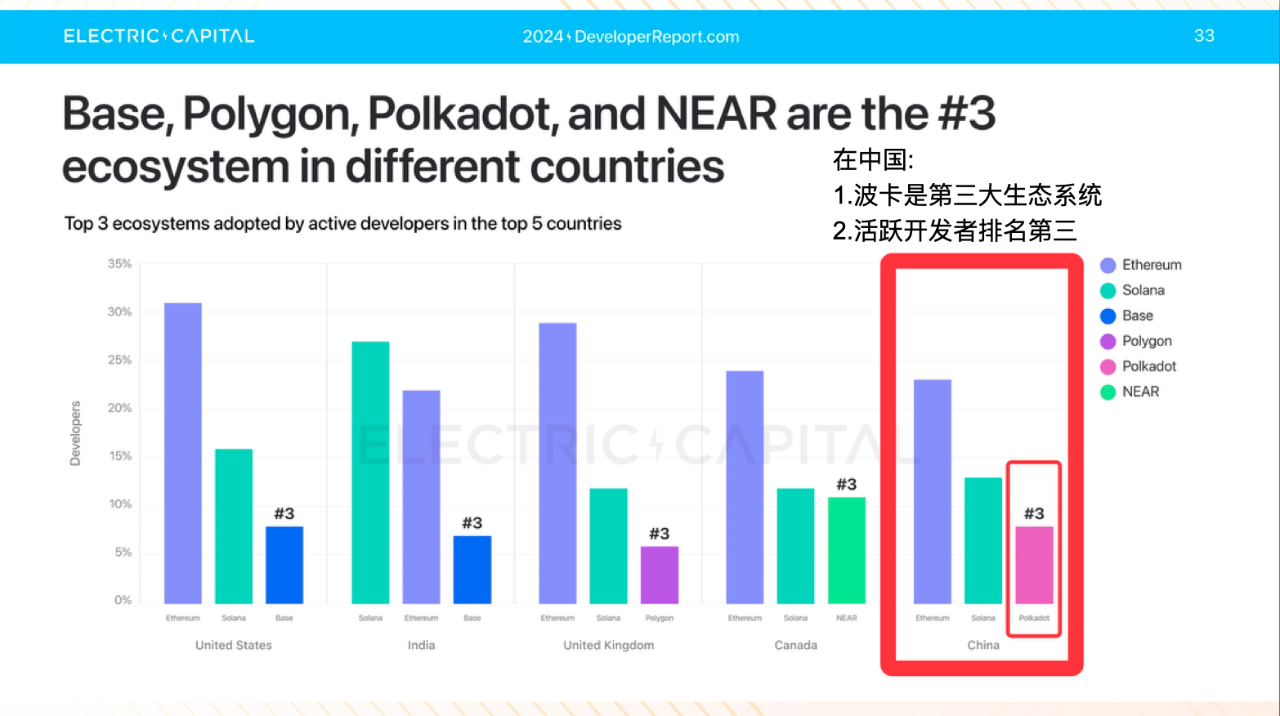
At the same time, the focus of global blockchain developers is changing. According to a report by Electric Capital, Polkadot is now one of the top three blockchain ecosystems in China, and the number of active developers also ranks third.
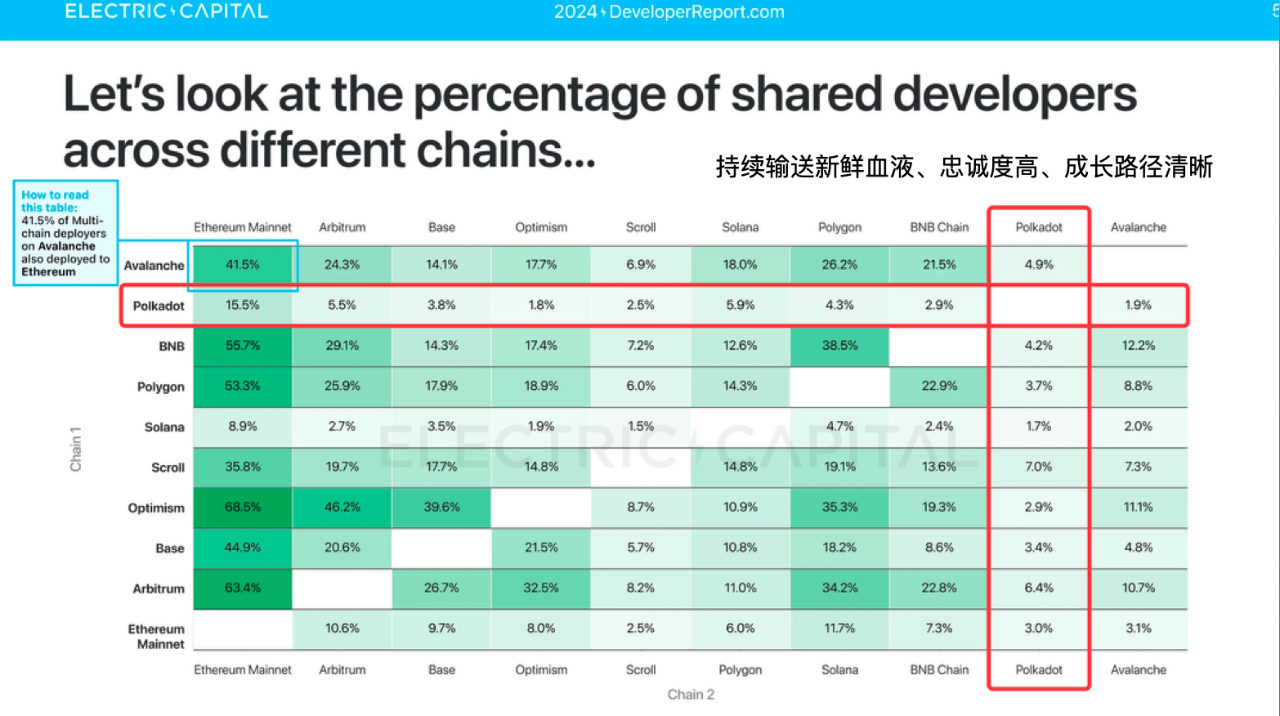
In addition, we also see the comparison of the homogeneity ratio of developers between major public chains, revealing the overlap of developers between different public chains. It is obvious from the data that the developers of many public chains overlap with the developer group of Ethereum to a large extent, which shows that these public chains rely heavily on attracting developer resources from the Ethereum ecosystem, forming a competitive situation of "mutual wool pulling".
However, Polkadot has shown unique advantages in this competitive landscape. Whether from the horizontal or vertical axis, Polkadot has the lowest developer homogeneity ratio. Behind this phenomenon, it reflects Polkadot's excellent strategy in developer ecosystem construction. Polkadot provides developers with a clear growth path, covering multiple levels from educational courses, hackathon activities to OpenGov funding applications and community governance. This transparent and systematic support system enables Polkadot to attract and cultivate a group of independent and loyal developers, rather than simply relying on "sucking blood" from other public chains.
Polkadot's ecological construction strategy not only helps it stand out in the fierce competition among public chains, but also lays a solid foundation for its future sustainable development. In contrast, although other public chains have achieved certain growth in the short term by attracting Ethereum developers, they lack a systematic developer support system like Polkadot, and may face the risk of insufficient ecological development in the long run. And with the continuous advancement of JAM technology and the implementation of more innovative applications, the Polkadot ecosystem is ushering in new growth opportunities, attracting more and more developers to join in and explore the infinite possibilities of Web3.
After the event, many developers shared their gains on social media and expressed their strong interest in JAM's future application scenarios. The successful Hangzhou event not only deepened Chinese developers' understanding of JAM, but also laid a more solid foundation for the localized development of the Polkadot ecosystem.
If you are interested in JAM, you can participate in:
Participate in JAM development and win 10 million DOT rewards: https://graypaper.com/
Polkadot introductory course: https://wj.qq.com/s2/17653871/18t2/
JAM Hackathon: https://lu.ma/yct0hfpx
Polkadot Ecosystem Job Recommendations:
https://www.notion.so/f10f5340ad05424b816d640f904114cb?v=d2c0c811e65148fc874f6af4fe75671a
Looking to the future: Global layout of JAM ecosystem
The successful holding of JAM Tour Hangzhou further proves the strong interest of the Chinese developer community in the future of Web3, and also lays a good foundation for the global promotion of the JAM ecosystem. Next, JAM Tour will continue to travel to more countries and cities to attract developers and researchers from around the world to explore the future of Web3 computing.
Dr. Gavin Wood emphasized: “What we are building is not just a new blockchain architecture, but a transformation of the entire Web3 computing paradigm.”
In the future, whether JAM can truly subvert the existing blockchain computing model is worthy of our continued attention.